
BAR-253 · Lesson 12 of 12 · 20 min
Capstone: Northern Mariana Islands practice questions and an exam-day plan
▶ Video coming soon A video version of this lesson is on the way.
Kiana's last one-on-one session with Hollis before the holidays was the capstone. Hollis had prepared three things: a set of short questions to check that the admission rules had stuck, an original problem on Commonwealth law written in the style of a Local Content Essay, and a plan for exam week. 'This is a dress rehearsal,' Hollis said. 'If anything here surprises you, better now than in February.'
Use this lesson the same way. Work the short questions without looking back, write the problem under time, then compare your work with the analysis. Finish by building your own exam-day plan.
Part 1: ten short questions
Answer each question in a sentence or two. The answers follow the set.
Question 1. Which body adopts the Rules of Admission, and which body runs the exam?
Question 2. What are the filing deadlines for the February 2027 exam?
Question 3. What MPRE score does the Commonwealth require?
Question 4. What is the NextGen passing score, and how was it chosen?
Question 5. How many Local Content Essays are there, how long is each, and what is the passing score?
Question 6. Within what period must both parts of the exam be passed?
Question 7. An applicant passed the NextGen exam in another jurisdiction in July 2026 with a 622. What must she do to be admitted in the Commonwealth?
Question 8. What is the maximum lease term, including renewals, that a person not of Northern Marianas descent may hold?
Question 9. What did Maratita v. CHCC decide?
Question 10. Within what time must a new lawyer take the oath?
Answers to Part 1
| Question | Answer | Source |
|---|---|---|
| 1 | The Supreme Court of the Commonwealth adopts the rules; the Board of Law Examiners runs applications and the exam | Lesson 1; Rules of Admission |
| 2 | December 22, 2026, with a late deadline of January 5, 2027 | Lesson 2; NCBE summary |
| 3 | 80 | Lesson 3 |
| 4 | 615, the midpoint of NCBE's recommended range of 610 to 620, set by order of April 2, 2026 | Lesson 4 |
| 5 | Two essays of 30 minutes each, scored out of 40 with 26 to pass | Lesson 6; Rule 72-1(b), (d) |
| 6 | The same 18-month period | Rule 72-1(d) |
| 7 | Transfer the score under Rule 72-1(e), pass the Local Content Essays, and complete character and fitness and the MPRE | Lesson 11 |
| 8 | 55 years, counting all renewal rights | Lesson 8; Article XII section 3 |
| 9 | It struck the Government Liability Act's 100,000 dollar cap and the Injury Compensation Act's 300,000 dollar non-economic limit under Commonwealth equal protection | Lesson 10; 2024 MP 10 |
| 10 | Within six months after notice of passing | Rule 75-2 |
Hollis's scoring rule: nine or ten correct means the admission rules are secure; seven or eight means review the lessons for the questions missed; fewer than seven means rereading lessons 1 through 6 before February.
Part 2: the problem
Allow 30 minutes. Read the call first, then the facts. Outline for about seven minutes, write for about twenty, and review for three.
The facts. Wenceslao Benavente, a person of Northern Marianas descent, owned two parcels on Saipan. In 1998, at a family gathering, he told his three children that Parcel 1, a house lot near the beach, would go to his daughter Ignacia, and that Parcel 2, an inland farm lot, would be shared by his two sons. Ignacia moved onto Parcel 1 in 1999, built a house and has lived there since. Wenceslao continued to farm Parcel 2 until his death in 2025. His 2010 will leaves 'all my real property' to his three children in equal shares.
In 2020, while Wenceslao was alive, Ignacia leased the beach portion of Parcel 1 to Brinley Vossen, who is not of Northern Marianas descent, for 45 years, with an option to renew for 15 years. Vossen built a small cafe.
In 2026, one of the sons, who has had a falling-out with Ignacia, argues that Parcel 1 is part of the estate and should be divided equally, and that in any event the Vossen lease is void. Separately, in October 2025, Ignacia's car was struck by a Commonwealth government vehicle driven by an employee on official business, and she suffered serious injuries. A government lawyer has told her that her recovery is capped at 100,000 dollars.
The call. (1) Is Parcel 1 part of Wenceslao's estate? (2) Is the Vossen lease valid? (3) Is Ignacia's recovery against the government capped at 100,000 dollars?
Analysis
Issue 1: whether Parcel 1 is part of the estate. Under 7 CMC section 3401, where written law does not decide a question, the court applies local customary law. Commonwealth courts recognize the Chamorro custom of partida, under which a parent divides family land among his children during his lifetime, often orally; land given by a valid partida belongs to the designated child and is not part of the parent's estate. Whether a partida occurred is a question of fact.
Here, Wenceslao announced the division at a family gathering in 1998, Ignacia took possession of Parcel 1 in 1999, built a house and lived there for more than 25 years, apparently without objection during her father's life. That conduct is strongly consistent with a completed partida. The son will argue that the 2010 will, leaving 'all my real property' equally, shows that Wenceslao did not consider Parcel 1 given away. The answer is that a will speaks at death and reaches only property the testator then owned; if Parcel 1 passed by partida in 1998 or 1999, the will does not reach it. The son's argument is stronger as to Parcel 2, which Wenceslao kept farming until his death, suggesting that the sons' shares had not yet vested in possession; the court will have to decide whether a partida of Parcel 2 was completed or whether that parcel passes under the will.
Conclusion on Issue 1: if the court finds, as the facts strongly suggest, that a valid partida gave Parcel 1 to Ignacia, Parcel 1 is hers and is not part of the estate.
Issue 2: whether the Vossen lease is valid. Article XII section 1 restricts the acquisition of permanent and long-term interests in real property to persons of Northern Marianas descent. Section 2 defines acquisition to include a lease. Section 3 defines long-term interests to include leaseholds of more than 55 years, including renewal rights. Section 6 makes a transaction that violates section 1 void ab initio.
Here, the lease runs 45 years with a 15-year renewal option, for a total of 60 years counting the renewal right. Vossen is not of Northern Marianas descent. The lease is therefore a long-term interest acquired by an ineligible person and is void ab initio. Two further points are worth making. First, the son's attack on the lease does not depend on Issue 1; if Parcel 1 were part of the estate, Ignacia would still have lacked power to grant a 60-year lease to Vossen, and if Parcel 1 is hers, her lease is still void because of its length. Second, the parties' rights after the lease falls, including Vossen's claim for the value of the cafe or the return of rent, turn on Commonwealth case law on the consequences of void Article XII transactions and should be researched. A new lease capped at 55 years in total, including any option, would be valid.
Conclusion on Issue 2: the Vossen lease is void ab initio because, counting the renewal option, it exceeds 55 years.
Issue 3: whether Ignacia's recovery is capped. The Government Liability Act waives the Commonwealth's immunity for damages caused by the negligent acts of employees within the scope of employment, and an employee driving on official business is within its scope. The Act formerly capped such claims at 100,000 dollars. In Maratita v. CHCC, 2024 MP 10, decided on December 30, 2024, the Supreme Court of the Commonwealth held that cap, and the Injury Compensation Act's 300,000 dollar limit on non-economic damages, unconstitutional under the Commonwealth Constitution's equal protection clause.
Ignacia's injury occurred in October 2025, after Maratita. The government lawyer's statement is therefore wrong unless the Legislature enacted a new cap that applies to her claim. House Bill 24-57 proposed new caps, but its enactment and terms must be checked. Even if a new cap was enacted, Ignacia's lawyer should examine whether it applies to an injury that occurred before its effective date and whether it can survive the equal protection reasoning in Maratita. Ignacia must also confirm that no exclusion in the Act, such as the intentional tort exclusion, applies; ordinary negligent driving is within the waiver.
Conclusion on Issue 3: under Maratita, the 100,000 dollar cap is unenforceable; unless a valid new cap applies to her October 2025 injury, Ignacia's recovery is not limited to 100,000 dollars.
How to grade your answer
Award yourself points as a grader would. For Issue 1: identifying section 3401 and customary law, stating the partida rule, applying the 1998 gathering and Ignacia's possession, answering the will argument, and concluding. For Issue 2: stating Article XII sections 1, 2, 3 and 6, counting the renewal option to reach 60 years, concluding that the lease is void, and noting restitution issues. For Issue 3: stating the Act's waiver, citing Maratita and its holding, dealing with H.B. 24-57 and timing, and concluding. An answer that covers every listed point in clear, headed paragraphs would score in the high 30s out of 40; an answer that misses one issue entirely would struggle to reach 26.
| Issue | Points a grader would look for |
|---|---|
| Partida | Section 3401 and custom; partida rule; facts of 1998 and possession; will reaches only property owned at death; conclusion |
| Lease | Article XII sections 1, 2, 3, 6; 45 plus 15 equals 60; void ab initio; restitution and a compliant new lease |
| Government claim | Act's waiver and scope; Maratita (2024 MP 10) and its equal protection basis; H.B. 24-57 and timing; exclusions; conclusion |
Part 3: an exam-day plan
The February 2027 exam falls on NCBE's national test dates, February 23 and 24, 2027, with the Local Content Essays scheduled by the Board alongside the NCBE exam. A candidate should confirm the exact schedule, the location on Saipan and the arrival time in the Board's notice.
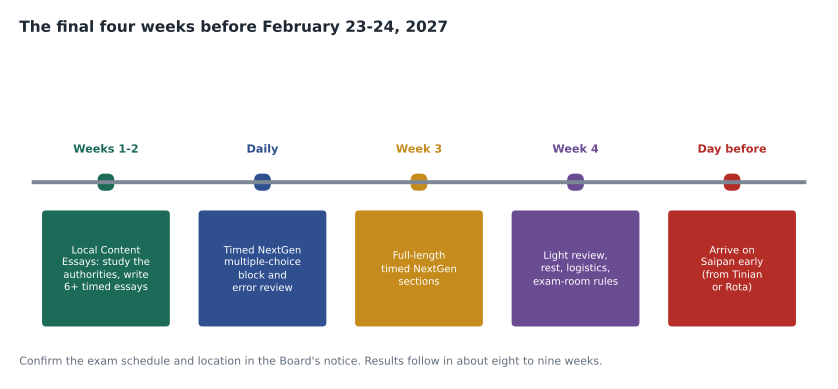
In the last four weeks, Hollis's plan for Kiana had a simple shape. The first two weeks after the subject announcement were for the Local Content Essays: study the Board's authorities, build outlines, and write timed essays, while keeping a daily NextGen practice block. The third week was for full-length NextGen practice under timed conditions, with review of errors. The final week was for light review, sleep and logistics.
Logistics matter more than candidates expect. A candidate traveling from Tinian or Rota should arrange to arrive on Saipan at least a day early, allowing for weather and flight changes. A candidate using her own laptop should complete NCBE's software requirements and registration well before the deadline. Every candidate should read the Board's rules on admission to the exam room, prohibited items and identification, and pack the night before.
On each exam day, the plan is the same: arrive early, keep to the time plan within each section, move on from a hard question rather than letting it consume a block, and use breaks to eat and reset rather than to discuss questions. For the Local Content Essays, follow the thirty-minute plan from lesson 6: read the call first, outline, write with a heading for each issue, and leave a few minutes to check that every call is answered.
After the exam
Results take about eight to nine weeks. If both parts are passed, the Board issues a letter of licensure, the candidate pays the Certificate of Admission fee to the Bar Association, and she must take the oath within six months of notice. If one part is passed and the other is not, the passed part counts for 18 months, and the candidate should register at once for the next administration of the failed part, or for a separate administration of the Local Content Essays if the Board offers one.
Kiana ended the session with a short list on a sticky note: 'Deadlines done. MPRE done. NextGen daily. Local essays: read the authorities the day they come out. Fly to Saipan early. Oath within six months.' Hollis told her to keep it on her desk until February.
Worked problem
Answering the call precisely
A candidate answering the capstone spends twenty minutes on whether Wenceslao's will was validly executed, and runs out of time before reaching the government claim. What went wrong, and how should she fix it?
Show solution
- The call asks three questions; the validity of the will's execution is not one of them and is not raised by the facts.
- The will matters only to Issue 1, and only for the point that a will reaches property owned at death.
- Running out of time on Issue 3 loses all of its points, which a brief, structured answer would have earned.
- The fix is to outline all issues first and allot time to each before writing.
Answer: She answered a question that was not asked. Outlining every issue first and budgeting time per issue would have secured the points for all three.
Common mistakes
MistakeTreating the will as controlling all of the decedent's land.
InsteadLand given by a valid partida during life is outside the estate.
MistakeMeasuring a lease only by its initial term.
InsteadCount renewal rights toward the 55-year limit.
MistakeApplying the 100,000 dollar cap after Maratita.
InsteadThe cap was struck in 2024 MP 10; check for any valid new cap and its timing.
MistakeLeaving travel to Saipan until the day before.
InsteadArrive at least a day early, allowing for weather and flight changes.
MistakeSpending time on issues the call does not ask.
InsteadOutline every issue the call raises and budget time for each.
Summary and key terms
- Admission essentials: Rules of Admission from the Supreme Court, the Board runs the exam, MPRE 80, NextGen 615, two Local Content Essays scored out of 40 with 26 to pass.
- Both parts must be passed within 18 months; score transfer under Rule 72-1(e) requires a pass within three years and the Local Content Essays.
- A partida problem turns on section 3401, customary law and proof of the division; a will reaches only property owned at death.
- Article XII counts renewal rights; a lease over 55 years to an ineligible person is void ab initio.
- Maratita v. CHCC (2024 MP 10) struck the government liability and non-economic damages caps; check for any new cap.
- Plan the final four weeks around the essay announcement, timed NextGen practice and early travel to Saipan.
- 0
- capstone
- 1
- issue spotting
- 2
- partida
- 3
- Article XII
- 4
- void ab initio
- 5
- Government Liability Act
- 6
- Maratita v. CHCC
- 7
- exam-day plan
- 8
- letter of licensure
Practice problems
Work each problem on paper first, then reveal the answer to check.
What is the first step in the thirty-minute essay plan?
Show answer
Read the call first, then the facts, and outline every issue.
Why does Wenceslao's will not reach Parcel 1 if a partida occurred?
Show answer
A will reaches only property the testator owned at death, and a partida transfers land during life.
Why is the Vossen lease void?
Show answer
Counting the 15-year option, it runs 60 years, more than the 55-year limit, to a person not of Northern Marianas descent.
When are results expected after the February exam?
Show answer
About eight to nine weeks later.
Lesson quiz · 5 questions
Score 60% or more to complete this lesson.
Create a free account to save your progress, take quizzes and earn a certificate.