
BAR-253 · Lesson 10 of 12 · 19 min
Torts, the Government Liability Act, family law, probate and customary law
▶ Video coming soon A video version of this lesson is on the way.
Quiles and Tudela's caseload is typical of a small Commonwealth practice. In a single week in November, Kiana worked on a car accident claim against a government agency, a divorce in which the main asset was family land on Rota, and a probate case in which three siblings disagreed about whether their late father had divided his land among them before he died. 'Three files, three bodies of law,' Dorotea Quiles said. 'And all three come back to the same thing: in the Commonwealth, the written law is only part of the story.'
This lesson covers the areas of Commonwealth substantive law that new lawyers meet most often: tort claims, including claims against the government under the Government Liability Act and the 2024 decision in Maratita v. CHCC; family law; probate; and the customary law that runs through family and land matters.
Tort law in the Commonwealth
Most Commonwealth tort law is common law. Where no Commonwealth statute governs a question, the rules-of-decision statute, 7 CMC section 3401, sends the court to local customary law and then to the common law, with the American Law Institute restatements as an influential source. In practice, ordinary negligence, premises liability, intentional torts and products claims are analyzed much as they would be in an American state, using restatement principles and persuasive decisions from other jurisdictions alongside Commonwealth precedent.
A lawyer should still check for Commonwealth statutes before applying a general rule. The Commonwealth Code addresses limitations periods, claims against the government, workers' compensation and other matters, and the Legislature has enacted statutes on specific kinds of claims. Where a statute speaks, it controls.
The Government Liability Act
The Commonwealth, like every American jurisdiction, began from sovereign immunity: it could not be sued without its consent. The Government Liability Act, codified at 7 CMC section 2201 and following sections, waives that immunity for certain claims. Under the Act, the Commonwealth is liable for damages caused by the negligent or wrongful acts or omissions of its employees acting within the scope of their employment, in the circumstances the Act describes.
The waiver is limited. The Act excludes several categories of claims, including claims based on intentional torts and claims based on the detention of goods or merchandise by law enforcement, excise or customs officers. Other exclusions follow the familiar pattern of government tort claims statutes. A lawyer must check each exclusion before filing, because a claim within an exclusion is barred no matter how strong the facts are.
The Act also addresses claims against government employees, generally channeling claims arising from an employee's conduct within the scope of employment into a claim against the Commonwealth and applying the same limits. A plaintiff who sues an employee individually for conduct within the scope of employment should expect the Commonwealth to step in.
For decades, the Act also capped damages. The cap most often cited was 100,000 dollars for claims against the government. Separately, the Injury Compensation Act limited non-economic damages, such as pain and suffering, to 300,000 dollars in certain cases.
Maratita v. CHCC (2024)
In Maratita v. Commonwealth Healthcare Corporation, 2024 MP 10, announced on December 30, 2024, the Supreme Court of the Commonwealth struck down both caps. The Court held that the Government Liability Act's 100,000 dollar cap on claims against the government and the Injury Compensation Act's 300,000 dollar limit on non-economic damages violated the equal protection clause of the Commonwealth Constitution.
The Court applied what it described as a heightened form of rational basis review under the Commonwealth Constitution. It found that the caps lacked a clear factual connection between their purposes and their effects, that they had become arbitrary and were no longer justified by the conditions of decades earlier when they were enacted, and that the Legislature had offered no factual findings or updated data to support them. The decision is a good example of the Commonwealth courts interpreting the Commonwealth Constitution independently of federal equal protection doctrine.
The decision prompted a legislative response. House Bill 24-57 proposed re-establishing a government liability cap. The House passed a version that would have capped wrongful death claims at 50,000 dollars and other claims at 100,000 dollars per person or 200,000 dollars per occurrence; a Senate version proposed 100,000 dollars for wrongful death and the same per-person and per-occurrence figures. The Commonwealth Healthcare Corporation urged passage, citing its exposure to unlimited liability. Whether a new cap has been enacted, and in what form, should be checked in the current Commonwealth Code and the list of public laws before advising a client. Any new cap would also have to survive the equal protection reasoning in Maratita.
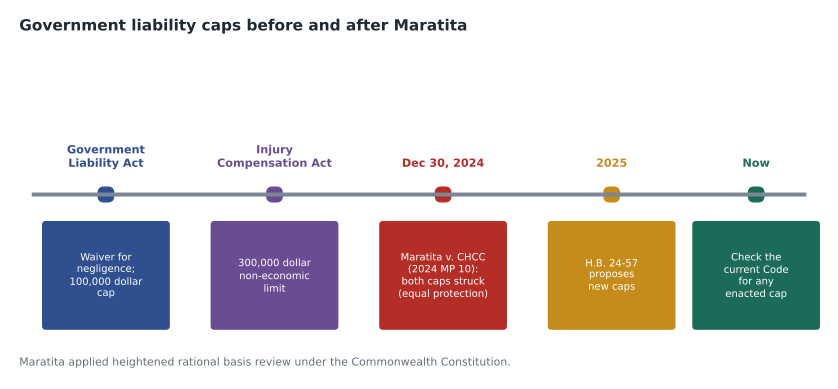
| Point | Before Maratita | After Maratita (2024 MP 10) |
|---|---|---|
| Immunity waiver for negligence | Government Liability Act | Unchanged |
| Exclusions (such as intentional torts, customs detentions) | Apply | Unchanged |
| 100,000 dollar cap on claims against the government | Applied | Struck down under Commonwealth equal protection |
| 300,000 dollar non-economic damages limit | Applied | Struck down under Commonwealth equal protection |
| New legislative cap | Not applicable | Proposed in H.B. 24-57; check current law |
Family law
Commonwealth family law is set out mainly in the family relations title of the Commonwealth Code, supplemented by court decisions and, in some matters, by customary law. Family cases are heard in the Superior Court.
Divorce requires that the court have jurisdiction, which depends on residence, and that a ground for divorce be established under the Code. Once a divorce is granted, the court divides the parties' property, decides on support, and makes orders about the care and custody of children. Custody decisions turn on the best interests of the child. Child support follows the Commonwealth's guidelines, and the Commonwealth participates in interstate enforcement arrangements, which matter in a jurisdiction where many families have members in Guam, Hawaii and the mainland.
Two features make Commonwealth family cases distinctive. First, land. The most valuable asset in many Commonwealth marriages is land, and Article XII may limit who can receive it. A court dividing property must consider whether a spouse who is not of Northern Marianas descent can hold a particular interest, and whether the land is family land that came to one spouse through a customary distribution rather than as marital property. Second, custom. Adoption, family obligations and the division of family land may involve customary practices, and Article XII itself recognizes adoption by a person of Northern Marianas descent of a child under 18. A lawyer in a family case should ask early whether any asset or relationship is governed by custom.
Probate
Estates are administered in the Superior Court under the Commonwealth's probate law. As elsewhere, a person may make a will, and a valid will controls the distribution of the estate, subject to the protections the law gives to surviving spouses and children. If there is no will, the intestacy provisions decide who inherits.
Probate in the Commonwealth often turns on land and custom. Two questions arise again and again. The first is whether property was still part of the decedent's estate at death, or whether the decedent had already distributed it to children during life under a customary distribution. The second is whether an heir is eligible under Article XII to take a permanent interest in the land. Section 2 of Article XII includes inheritance within acquisition, subject to its limited spousal exception, so an heir who is not of Northern Marianas descent may not be able to take a freehold interest. A lawyer administering an estate that includes land should check each heir's eligibility and the exact terms of section 2 before proposing a distribution.
Customary law: the partida
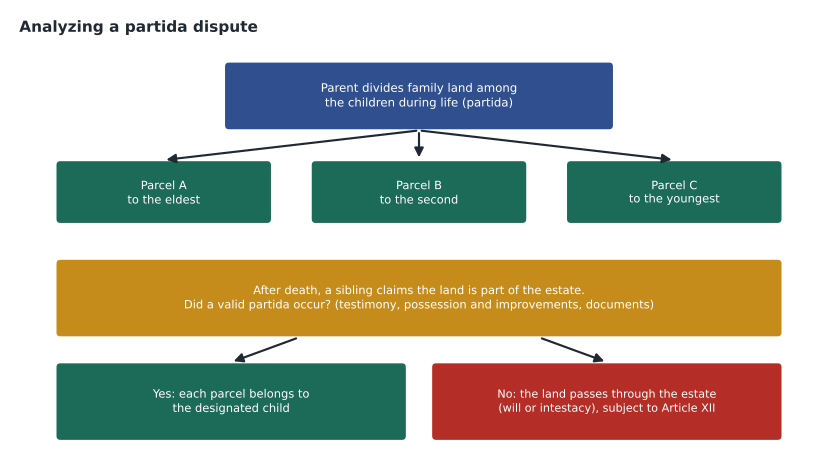
The best known Chamorro customary practice in land law is the partida. Under the custom, a parent, traditionally the father in Chamorro families, divides family land among the children during the parent's lifetime. The division may be made orally, often at a family gathering, and each child is told which parcel will be his or hers. The child may take possession at once or when a later event occurs, such as marriage or the parent's death. Once a valid partida has been made, the land designated for a child is treated as that child's, not as part of the parent's estate to be divided under a will or intestacy.
Partida disputes are common because the division is often unwritten. Years later, siblings may disagree about whether a partida happened, what it covered, or whether a later deed or will changed it. Commonwealth courts have recognized partida as customary law and decide such disputes on evidence: testimony from family members and others present, conduct consistent or inconsistent with the division, such as who lived on and improved the land, and any documents. Because customary law is often a question of fact, the lawyer's job is to prove the custom and the facts that bring the case within it.
Carolinian customs differ. Carolinian land traditions have been described as lineage-based, with land associated with a family line and with important roles for women in its control and transmission. A lawyer whose client is from a Carolinian family should not assume that Chamorro practices such as partida apply, and should find people who know the relevant customs to explain them.
Bringing the pieces together
These areas overlap constantly. A divorce may require deciding whether a parcel came to one spouse by partida. A probate case may require applying Article XII to an heir. A claim against a government agency may raise the Government Liability Act, the Maratita decision and the question of whether a new cap applies to an injury that occurred before it was enacted. The rules of decision tie the pieces together: written law first, then custom, then the common law.
Worked problem
A disputed family parcel
Pascuala and Norberto, siblings of Northern Marianas descent, dispute a parcel on Rota that belonged to their late father. Pascuala says their father gave her the parcel by partida at a family gathering in 2001, and she has lived on it and built a house since 2003. Norberto says no partida happened and that the parcel is part of the estate, to be shared under their father's 2015 will, which leaves "all my land" equally to his children. Their half-sister Teofila, who is not of Northern Marianas descent, also claims a share. How should the court approach the dispute?
Show solution
- Rules of decision: no statute decides whether a partida occurred, so the court looks to customary law, which Commonwealth courts recognize, and treats the custom's application as a question of fact.
- Evidence: testimony from family members present in 2001, Pascuala's possession and the house she built, and the father's conduct after 2001 all bear on whether a valid partida occurred.
- Effect of the will: if a valid partida transferred the parcel in 2001, it was not part of the estate in 2015, and the will's "all my land" clause does not reach it.
- Article XII: if the parcel is part of the estate, Teofila's inheritance of a permanent interest is an acquisition restricted to persons of Northern Marianas descent, unless the spousal exception applies, which it does not.
Answer: If the court finds a valid partida, the parcel is Pascuala's. If not, it passes under the will to the children who are eligible under Article XII, and Teofila cannot take a permanent interest, though other remedies, such as a share of value, may need to be considered under Commonwealth law.
Common mistakes
MistakeThe Government Liability Act still caps claims at 100,000 dollars.
InsteadMaratita v. CHCC (2024 MP 10) struck the cap; check whether a new cap has since been enacted.
MistakeMaratita was decided under the federal Equal Protection Clause.
InsteadIt was decided under the Commonwealth Constitution's equal protection clause.
MistakeA will always controls all of a decedent's land.
InsteadLand given by a valid partida during life is not part of the estate.
MistakePartida applies to every family in the Commonwealth.
InsteadCarolinian customs differ; prove the relevant custom.
MistakeAn heir can always inherit land regardless of descent.
InsteadArticle XII includes inheritance within acquisition, subject to a limited spousal exception.
Proving custom
Proving a custom in court takes planning. The lawyer should identify witnesses who know the custom from experience, such as older family members and respected community members, and witnesses who saw the events that bring the case within it, such as the people present at a family gathering where land was divided. Documents can help: old letters, family notes, tax records showing who paid taxes on a parcel, and photographs of improvements. The lawyer should also research prior Commonwealth decisions that describe the custom, because a court may treat a custom it has already recognized as established, leaving only the facts to prove.
Summary and key terms
- Most Commonwealth tort law is common law applied through 7 CMC section 3401, subject to Commonwealth statutes.
- The Government Liability Act waives immunity for negligent acts of employees within the scope of employment, with exclusions such as intentional torts.
- Maratita v. CHCC, 2024 MP 10 (December 30, 2024), struck the 100,000 dollar government liability cap and the 300,000 dollar non-economic damages limit under Commonwealth equal protection.
- H.B. 24-57 proposed new caps; check the current Code for any enacted cap.
- Family and probate cases often turn on land, Article XII and customary law.
- The Chamorro partida divides family land among children during life; Carolinian customs differ; custom is often proved as fact.
- 0
- Government Liability Act
- 1
- sovereign immunity
- 2
- Maratita v. CHCC
- 3
- equal protection
- 4
- Injury Compensation Act
- 5
- best interests of the child
- 6
- probate
- 7
- intestacy
- 8
- customary law
- 9
- partida
- 10
- family land
Practice problems
Work each problem on paper first, then reveal the answer to check.
What did Maratita v. CHCC hold?
Show answer
That the Government Liability Act's 100,000 dollar cap and the Injury Compensation Act's 300,000 dollar non-economic limit violated the Commonwealth Constitution's equal protection clause.
What standard of review did the Court apply in Maratita?
Show answer
A heightened form of rational basis review under the Commonwealth Constitution.
What is a partida?
Show answer
A Chamorro customary division of family land by a parent among the children during the parent's lifetime.
How do courts usually decide whether a partida occurred?
Show answer
As a question of fact, on testimony, possession and improvements, and any documents.
Lesson quiz · 5 questions
Score 60% or more to complete this lesson.
Create a free account to save your progress, take quizzes and earn a certificate.