
BAR-253 · Lesson 4 of 12 · 19 min
The Northern Mariana Islands bar exam: NextGen format, scoring and the 615 passing score
▶ Video coming soon A video version of this lesson is on the way.
Hollis opened their third session by sharing her screen. On it was a single line from an order of the Supreme Court of the Commonwealth, dated April 2, 2026: the minimum passing score for the NextGen Uniform Bar Examination would be 615. 'That number is your target,' she told Kiana. 'Everything else in this lesson explains what it is a score on and how you get there.'
The Commonwealth bar exam has two parts. The first is the NCBE exam, which since July 2026 has been the NextGen bar exam. The second is the Local Content Essays, two short essays on Commonwealth law. This lesson covers the first part: how the NextGen exam is built, how it is scored, how the Commonwealth set its passing score, and how the two parts fit together. Lesson 5 covers the transition from the legacy Uniform Bar Examination, and lesson 6 covers the Local Content Essays.
The structure of the Commonwealth exam
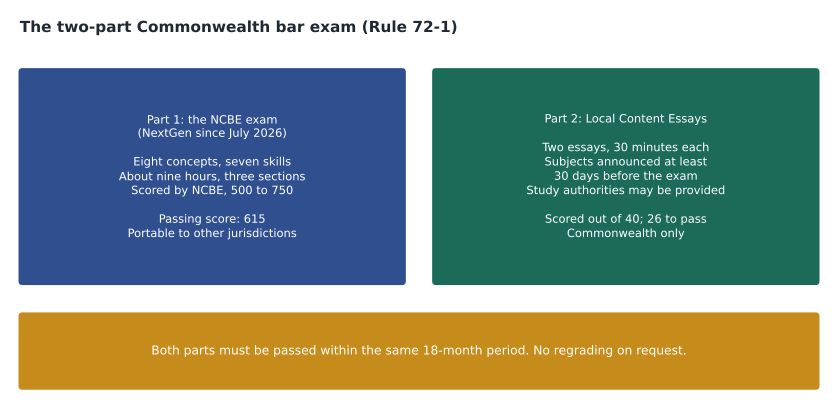
Rule 72-1(b) of the Rules of Admission describes the exam as two parts: the NCBE Bar, whose content NCBE sets, and two 30-minute Local Content Essays on subjects the Board prescribes. Rule 72-1(c) requires the Board to hold at least two exams a year over two consecutive days, scheduled with the NCBE exam, and allows it to offer the Local Content Essays separately as well. The Board publishes dates and locations online or by email.
Rule 72-1(d) sets the grading framework. NCBE's grading standards apply to the NCBE part, and NCBE certifies the scores, which makes them portable to other jurisdictions that accept them. Applicants must reach the minimum scaled score set by the Supreme Court. The Local Content Essays are scored out of 40 points, and 26 is passing. Both parts must be passed within the same 18-month period. The Board does not regrade exams on request.
How the NextGen exam is built
The NextGen exam is NCBE's redesigned bar exam, first given in July 2026 in the Commonwealth and a group of other early jurisdictions. It replaces the separate MBE, MEE and MPT with a single integrated exam that tests both legal knowledge and lawyering skills.
NCBE describes the content in two halves. The first is eight foundational concepts and principles: civil procedure, contract law, evidence, torts, business associations, constitutional law, criminal law and constitutional protections of the accused, and real property. Family law is added to the concepts from July 2028. The second is seven foundational skills: legal research, legal writing, issue spotting and analysis, investigation and evaluation, client counseling and advising, negotiation and dispute resolution, and client relationship and management. Professional responsibility principles appear within the skills.
The exam is given over a day and a half, about nine hours in all: six hours on the first day and three on the second. It is divided into three sections of about three hours each. Each section contains standalone multiple-choice questions, integrated question sets built around a common fact pattern, and a performance task in which the examinee works from a file and a library of legal sources. Within a section, the examinee may work in any order.
| Component | What it involves | Share of the total score |
|---|---|---|
| Standalone multiple-choice questions | Single-best-answer and select-two questions on the concepts and skills | 49 percent |
| Integrated question sets | A shared fact pattern with multiple-choice and short written questions | 21 percent |
| Performance tasks | Lawyering work from a file and library, including research tasks | 30 percent |
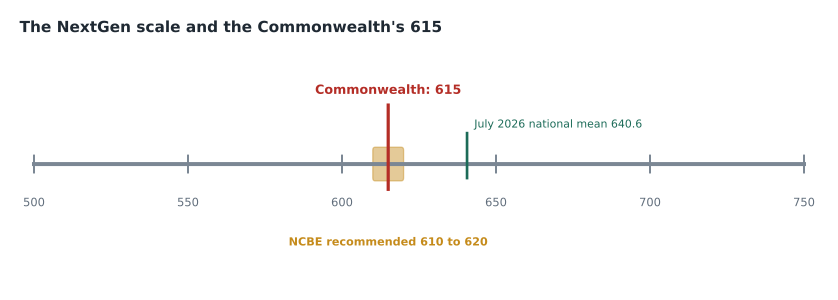
Because the exam is integrated, there are no separate subtest scores to pass. The examinee receives a single scaled score on NCBE's NextGen scale, which runs from 500 to 750.
How NextGen is scored
NCBE scores the whole exam, including the written answers. That differs from the legacy UBE, where jurisdictions graded the MEE and MPT essays themselves using NCBE's materials. Under NextGen, the scoring of short written responses and performance tasks follows NCBE's rubrics and process, and the results are scaled and equated so that a given score means the same level of performance from one administration to the next.
Equating matters for a candidate's planning. A 615 in February 2027 represents the same performance as a 615 in July 2026, even if one exam form is a little harder. That is why the Commonwealth can set a single passing score and keep it.
How the Commonwealth set its passing score
The April 2, 2026 order, entered in the Court's administrative docket on the admission to practice law and signed by Chief Justice Alexandro C. Castro, Associate Justice John A. Manglona and Justice Pro Tempore Roberto C. Naraja, explains the score. The Court had adopted the NextGen exam through the Rules of Admission on August 4, 2025. NCBE's standard-setting work recommended that jurisdictions set a passing score between 610 and 620 on the 500 to 750 scale. The Court chose 615, the midpoint of that range. The order also confirmed that the passing score for the Local Content Essays remained 26.
Rule 72-1(d)(1) is the source of the Court's authority to set the score, and the order cites the rules on exam composition, the adoption of NextGen and the Local Content Essay score. The order is short, but it is the controlling statement of the number.
Hollis pointed out a quirk of the published sources. NCBE's online summary of Commonwealth requirements lists 615 for NextGen, but it also shows a passing score of 260 against a jurisdiction-drafted exam and, in its scoring table, the old MBE, written and MPT weights. Those entries appear to be carried over from the legacy UBE, where the Commonwealth's passing score was 260 on the 400-point scale, and the earlier weighting of 50 percent MBE, 30 percent essays and 20 percent MPT. 'When a chart and a court order say different things,' Hollis said, 'the order wins. The NextGen target is 615.'
| Score | What it means |
|---|---|
| 615 on the NextGen scale | Minimum passing score for the NCBE part (order of April 2, 2026) |
| 26 of 40 | Minimum passing score for the Local Content Essays (Rule 72-1(d)) |
| 260 on the 400 scale | Figure still shown in NCBE's chart; it appears to be the legacy UBE standard |
| 80 on the MPRE | Minimum MPRE score |
Passing both parts
A candidate must pass both parts. A strong NextGen score does not make up for a weak Local Content Essay result, and a perfect essay score does not rescue a NextGen score below 615. The two parts are graded separately against separate standards.
Rule 72-1(d) also requires both parts to be passed within the same 18-month period. In practice, that means a candidate who passes one part and fails the other can retake the failed part without losing the passed one, provided the second passing result comes within 18 months of the first. A candidate who passes the NextGen exam in February 2027 but scores 24 on the Local Content Essays could retake the essays at a later administration, or at a separate local administration if the Board offers one under Rule 72-1(c), and still be admitted if she passes them in time. Lesson 6 covers the essays in detail.
Results
NCBE's summary states that grading and reporting take about eight to nine weeks after the February and July exams. Under Rule 72-1(h), the Board emails pass or fail results to applicants as soon as practicable and may publish the names of those who passed. Exams are not regraded on request.
What the score requires in practice
A passing NextGen score requires steady competence across the concepts and skills rather than brilliance in a few subjects. Because the score is a single combined number, a candidate can offset a weak area with a strong one, but the integrated format means weak areas show up in several places: a candidate who struggles with civil procedure will lose points on standalone questions, in integrated sets and in any performance task with a procedural issue.
Hollis's study plan for Kiana reflected that. About three quarters of her study time would go to the NextGen exam, divided among the concepts by weight and her own weaknesses, with regular timed practice on integrated sets and performance tasks. The remaining quarter would go to Commonwealth law for the Local Content Essays, rising in the last month once the subjects were announced.
Worked problem
Reading a score report
Wenceslao sits the July 2027 Commonwealth exam. His NextGen scaled score is 611 and his Local Content Essay score is 31 of 40. His friend says that his strong essay score should push him over. Is the friend right, and what should Wenceslao do?
Show solution
- Separate standards: the NCBE part and the Local Content Essays are scored separately; a strong essay score does not raise the NextGen score.
- Result: 611 is below the Commonwealth's 615, so he has not passed the NCBE part, even though 31 exceeds the essay passing score of 26.
- Keeping the essay pass: under Rule 72-1(d), both parts must be passed within the same 18-month period, so his essay pass can count if he passes the NCBE part within that window.
- No regrade: the Board does not regrade on request, so his path is a retake of the NextGen exam.
Answer: The friend is wrong. Wenceslao must retake the NextGen exam and reach 615 within 18 months of his essay pass to keep that pass.
Common mistakes
MistakeA strong Local Content Essay score offsets a low NextGen score.
InsteadThe two parts are graded separately; each must be passed.
MistakeThe Commonwealth still uses a 260 passing score.
InsteadSince July 2026 the NextGen passing score is 615; 260 is the legacy UBE score.
MistakeNextGen has separate MBE, MEE and MPT scores.
InsteadNextGen produces a single scaled score on a 500 to 750 scale.
MistakeThe Board will regrade an exam on request.
InsteadRule 72-1(d) says exams are not regraded on request.
MistakeEach part must be passed at the same sitting.
InsteadBoth must be passed within the same 18-month period.
Types of NextGen questions
NextGen uses several question formats, and a candidate should practice each. Standalone multiple-choice questions include single-best-answer questions and questions that ask the examinee to select two correct answers from a list, with partial credit possible on the select-two format. Integrated question sets present a common fact pattern, sometimes with documents such as a contract excerpt or a client email, followed by several questions that may mix multiple choice with short written responses. Performance tasks give the examinee a file of facts and a library of legal authorities and ask for a piece of written work, such as a memo, a letter or a short brief; some performance tasks also test legal research by asking the examinee to choose which sources to consult.
Each format rewards a different habit. Standalone questions reward precise knowledge of the rules within the content scope. Integrated sets reward careful reading of the shared facts, because later questions often depend on details introduced early. Performance tasks reward organization: reading the task memo first, identifying exactly what product is requested, extracting the governing rules from the library, and writing a document a supervising lawyer could use.
The role of professional responsibility
On the legacy UBE, professional responsibility appeared mainly in the separate MPRE. On NextGen, professional responsibility principles also appear within the foundational skills, especially client counseling and advising and client relationship and management. A performance task might, for example, ask the examinee to advise a client while recognizing a conflict of interest or a confidentiality issue. The MPRE remains a separate requirement, but its subject matter is no longer confined to it.
Building a practice schedule
Hollis's weekly schedule for Kiana's NextGen preparation from December through mid-February had three fixed elements. Each weekday began with a timed block of standalone multiple-choice questions on one or two concepts, followed by careful review of every miss. Twice a week, she completed an integrated question set under time. Once a week, she completed a full performance task. Every second weekend, she sat a full three-hour section. The rest of her study time went to concept review targeted at the errors the practice revealed. In the final month, the schedule shifted to make room for the Local Content Essays, but the daily multiple-choice block never stopped.
Using the score report after the exam
NCBE's score report gives the candidate her scaled score. A candidate who passes needs nothing more. A candidate who does not pass should use whatever diagnostic information NCBE provides, together with her own records of practice performance, to identify where points were lost. Because the score is a single combined number, the most useful diagnosis comes from the candidate's own error logs: which concepts and which formats consistently cost her points in practice.
Summary and key terms
- The Commonwealth exam has two parts: the NCBE exam (NextGen since July 2026) and two 30-minute Local Content Essays.
- NextGen tests eight concepts and seven skills over about nine hours in three sections; weights are 49 percent multiple choice, 21 percent integrated sets and 30 percent performance tasks.
- NCBE scores the whole NextGen exam on a 500 to 750 scale; scores are equated across administrations.
- The Court set the NextGen passing score at 615, the midpoint of NCBE's 610 to 620 recommendation, by order of April 2, 2026.
- The Local Content Essays are scored out of 40 with 26 to pass, and both parts must be passed within the same 18-month period.
- Results take about eight to nine weeks; there is no regrading on request.
- 0
- NextGen bar exam
- 1
- foundational concepts
- 2
- foundational skills
- 3
- integrated question set
- 4
- performance task
- 5
- scaled score
- 6
- equating
- 7
- passing score
- 8
- 18-month window
Practice problems
Work each problem on paper first, then reveal the answer to check.
What is the Commonwealth's NextGen passing score?
Show answer
615, set by the Supreme Court's order of April 2, 2026.
What range did NCBE recommend for NextGen passing scores?
Show answer
610 to 620 on the 500 to 750 scale.
How are the Local Content Essays scored?
Show answer
Out of 40 points, with 26 passing.
Within what period must both parts be passed?
Show answer
The same 18-month period.
Lesson quiz · 5 questions
Score 60% or more to complete this lesson.
Create a free account to save your progress, take quizzes and earn a certificate.