
BAR-253 · Lesson 8 of 12 · 19 min
Article XII: land alienation restrictions and Commonwealth property
▶ Video coming soon A video version of this lesson is on the way.
Fermin Tudela, the younger partner at Kiana's firm, keeps a framed copy of one page on his office wall. It is Article XII of the Commonwealth Constitution. 'More of our clients' problems start with this page than with any other,' he told Kiana. 'Leases that are too long. Corporations with the wrong shareholders. A spouse who inherits land and wants to sell it. People from the mainland who do not believe a constitution can tell them they cannot buy a house lot.'
Article XII restricts who may acquire permanent and long-term interests in land in the Commonwealth. It is the most distinctive rule of Commonwealth property law, and it reaches into leasing, conveyancing, inheritance, lending, corporate law and litigation. This lesson explains how it works, why it has survived constitutional challenge, and how a lawyer handles it in practice.
Why Article XII exists
Land in the Northern Mariana Islands is scarce, and it is central to family life and identity. During the negotiations that produced the Covenant, the people of the Northern Marianas sought protection against the loss of their land to outside buyers with far greater resources. The Covenant authorized the Commonwealth to restrict the alienation of permanent and long-term interests in real property to protect against exploitation and to promote the economic advancement and self-sufficiency of the people. The Commonwealth Constitution's Article XII implements that authorization.
The rule
Section 1 states the rule: the acquisition of permanent and long-term interests in real property within the Commonwealth is restricted to persons of Northern Marianas descent.
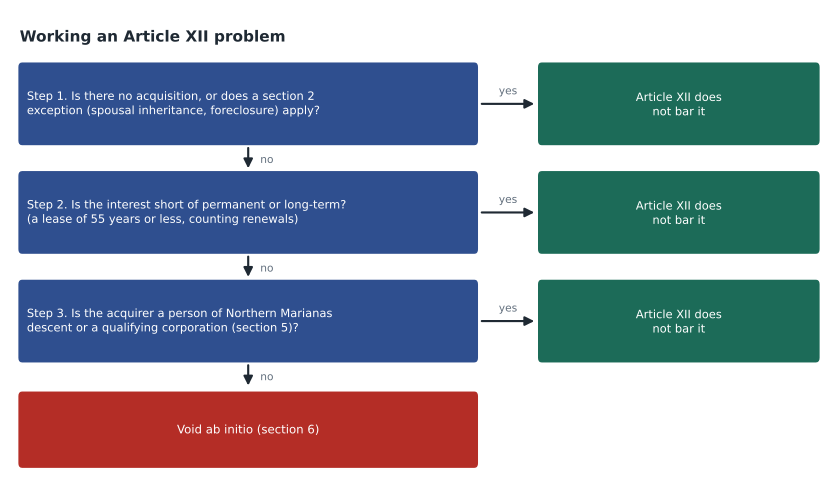
Each part of that sentence has a definition elsewhere in the article, and an Article XII problem is usually solved by working through the definitions in order. Is there an acquisition? Is the interest a permanent or long-term interest? Is the acquirer a person of Northern Marianas descent, or a qualifying corporation? If the answer to the first two questions is yes and the third is no, section 6 supplies the consequence.
Acquisition
Section 2 defines acquisition broadly to include sale, lease, gift, inheritance or other means. The breadth matters. A gift of land from a parent to a child who is not of Northern Marianas descent is an acquisition. So is an inheritance, subject to the exceptions.
Section 2 contains two important exceptions. The first concerns certain transfers to a spouse by inheritance: a surviving spouse who is not of Northern Marianas descent can inherit in the circumstances the section describes. The second concerns mortgage foreclosures. A bank, a federal agency or a Commonwealth government entity that acquires land through foreclosure on a mortgage it holds may take the interest, provided it does not hold it for more than a set period, which the article ties to ten years beyond the mortgage term. That exception makes mortgage lending possible, because a lender that could not foreclose would not lend. A lawyer handling a spousal inheritance or a foreclosure should read section 2's exact text, because the exceptions are carefully limited.
Permanent and long-term interests
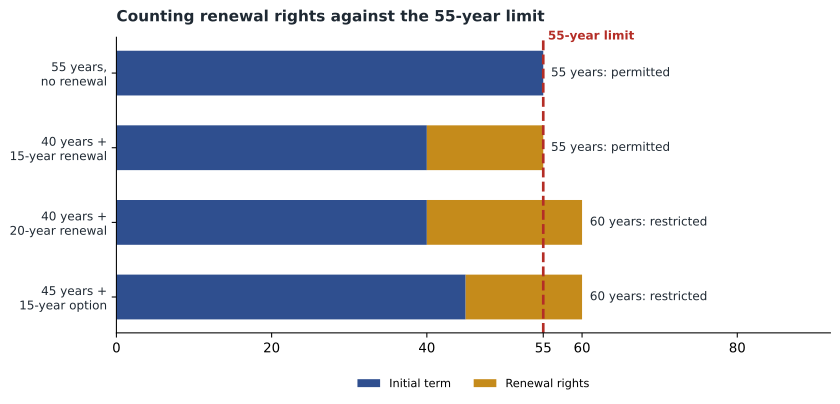
Section 3 defines permanent and long-term interests to include freehold interests and leasehold interests of more than 55 years, including renewal rights. In other words, a person who is not of Northern Marianas descent may hold a lease of up to 55 years, counting every renewal or extension right, but not longer, and may not hold the land in fee.
The renewal language is where many problems arise. A 40-year lease with an option to renew for 20 years is a 60-year interest for Article XII purposes, because the renewal right counts. So is a 50-year lease with a clause promising good-faith negotiation of an extension that, read fairly, amounts to a renewal right. Drafters who try to stay under the limit by splitting a long arrangement into a short lease and a separate side agreement run the risk that a court will read the documents together.
Section 3 also provides that transactions that would violate it are void, that existing leasehold agreements made before the relevant amendment are not affected, and that interests above the first floor of a condominium building are treated under a special rule that applies to private lands. A lawyer handling a condominium unit should read that provision's exact text before advising.
The 55-year limit is itself the product of amendment; the original limit was shorter. That history matters when a lawyer reviews an old lease, because the rule in force when the lease was signed may govern it.
| Interest | Restricted under Article XII? |
|---|---|
| Fee simple (freehold) | Yes |
| Lease of 55 years or less, including all renewal rights | No |
| Lease of more than 55 years, counting renewal rights | Yes |
| Lease of 40 years plus a 20-year renewal option | Yes (60 years in total) |
| Foreclosure by a bank on its mortgage, held within the permitted period | No (section 2 exception) |
| Inheritance by a qualifying surviving spouse | No (section 2 exception, as limited) |
Persons of Northern Marianas descent
Section 4 defines a person of Northern Marianas descent as a citizen or national of the United States who has at least one-quarter Northern Marianas Chamorro or Northern Marianas Carolinian blood, or a combination of the two. A person adopted under the age of 18 by a person of Northern Marianas descent qualifies. The section also provides that a person who was born or domiciled in the Northern Mariana Islands by 1950 and was a citizen of the Trust Territory before the termination of the trusteeship is considered to be full-blooded for this purpose.
The definition has been the subject of political debate and proposed amendments over the years, and voting on Article XII amendments was opened to all qualified voters after Davis v. Commonwealth Election Commission in 2016. A lawyer should always check the current text of section 4 rather than rely on memory, because the threshold and the treatment of particular groups could change by amendment.
In practice, a lawyer proves descent with documents: birth certificates, family records and, where needed, a determination or certificate from the agency that maintains such records. A buyer who claims to be of Northern Marianas descent should be asked for proof before closing, because the seller, the lender and the title insurer all depend on it.
Corporations
Section 5 treats a corporation as a person of Northern Marianas descent only if it is incorporated in the Commonwealth, has its principal place of business in the Commonwealth, and has all of its directors and all of its voting shareholders who are persons of Northern Marianas descent. Minors cannot be directors for this purpose. The section prohibits arrangements that would let persons who are not of Northern Marianas descent control the corporation through trusts, proxy voting or the separation of beneficial and legal title.
Those anti-evasion rules respond to schemes that have been tried. An outside investor might fund a corporation whose nominal shareholders are of Northern Marianas descent but who hold their shares for the investor. Section 5 makes such a corporation non-qualifying. Under section 6, a corporation that ceases to qualify forfeits to the Commonwealth government, without right of redemption, land interests it acquired after the amendment took effect. The Registrar of Corporations issues regulations to ensure compliance.
The consequence: void ab initio
Section 6 provides that any transaction made in violation of section 1 is void ab initio, meaning void from the beginning. A void transaction is not merely voidable. It never transferred the restricted interest, and in principle no party can ratify it.
The Commonwealth courts have heard many suits by sellers or their heirs seeking to set aside transfers as void under Article XII, sometimes decades after the transfer. Those cases raise hard questions about the effect of a void transaction on the parties' other rights: whether the buyer can recover the purchase price, whether improvements are compensated, and whether limitations periods or equitable defenses apply. Commonwealth decisions have addressed those questions case by case, and a lawyer facing one should research the current case law in detail.
Constitutional challenges
Article XII has survived federal constitutional challenge. In Wabol v. Villacrusis, decided in 1990, the Ninth Circuit held that the restriction did not violate equal protection. Applying the Insular Cases framework, the court reasoned that the right to acquire long-term interests in land was not a fundamental right that applied of its own force in the Commonwealth, and that the restriction was an essential part of the political arrangement the Covenant reflected. Wabol remains the leading authority.
Davis v. Commonwealth Election Commission, decided in 2016, addressed a different question: who may vote on changing Article XII. The Ninth Circuit held that limiting such votes to persons of Northern Marianas descent violated the Fifteenth Amendment. The ownership restriction itself was not before the court and remains in force.
Public lands and land records
Article XI of the Constitution governs public lands, which belong collectively to the people of the Commonwealth who are of Northern Marianas descent and are managed by a public lands agency. The agency leases public land for commercial and other uses and has administered homestead programs that grant land to eligible residents. Public land leases have their own statutory and regulatory limits, and a lawyer whose client wants to lease public land should start with the agency's rules.
Private land records are kept by the Commonwealth Recorder. Much of the private land in the Commonwealth was the subject of title determinations after World War II, and older parcels may have complex chains of title involving family transfers, customary distributions and court decisions. A title search in the Commonwealth often requires more than checking the recorded deeds; it can require understanding how a family's land was divided among children, a topic lesson 10 covers.
Practical drafting
A lawyer representing a lessee who is not of Northern Marianas descent should cap the total term, including every renewal, extension and option, at 55 years, and should avoid any side agreement that could be read as a disguised extension. A lawyer representing a buyer should confirm the buyer's eligibility with documents before closing. A lawyer representing a corporation that plans to acquire land should audit its directors and voting shareholders against section 5 and build controls to keep it qualified. A lawyer representing a lender should confirm that the foreclosure exception covers the lender and plan for disposition within the permitted period.
Worked problem
A long lease and a family claim
In 2004, Gualberto Remigio, a person of Northern Marianas descent, leased beachfront land on Tinian to Brinley Vossen, who is not of Northern Marianas descent, for 50 years with an option to extend for 10 more. Vossen built a small resort. In 2026, Gualberto's heirs sue to declare the lease void. What should Vossen's lawyer analyze?
Show solution
- Acquisition and interest: a lease is an acquisition; with the 10-year option, the interest is 60 years, which exceeds 55 years counting renewal rights.
- Rule in force: the lawyer must check which version of section 3 applied in 2004, since the limit has been amended, and whether any grandfather provision protects the lease.
- Eligibility: Vossen is not of Northern Marianas descent and no section 2 exception applies.
- Consequence: if the lease violated the rule in force, section 6 makes it void ab initio.
- Collateral issues: research Commonwealth case law on restitution of rent and compensation for improvements, and any equitable or limitations defenses.
Answer: If the 60-year interest violated the rule in force in 2004, the lease is void from the beginning, and the real dispute becomes the parties' restitution and improvement claims, which turn on Commonwealth case law.
Common mistakes
MistakeA 55-year lease plus a renewal option is permitted.
InsteadRenewal rights count toward the 55-year limit.
MistakeA void Article XII transaction can be ratified later.
InsteadSection 6 makes it void ab initio.
MistakeA corporation with local nominee shareholders qualifies.
InsteadSection 5 requires all directors and voting shareholders to be of Northern Marianas descent and bars trusts and proxies.
MistakeDavis struck down the land restriction.
InsteadDavis concerned who may vote on amendments; the restriction remains.
MistakeArticle XII forbids all mortgages to outside lenders.
InsteadSection 2 lets banks and certain agencies acquire by foreclosure within a limited holding period.
Article XII in due diligence
Every real estate transaction involving Commonwealth land should include an Article XII check. For a purchase, the buyer's eligibility must be documented before closing. For a lease, the total term, counting every renewal and extension right, must be calculated and compared with the 55-year limit. For a loan secured by land, the lender's status under the section 2 foreclosure exception and its plan for disposition must be confirmed. For a corporate acquirer, the corporation's directors and voting shareholders must be confirmed against section 5, and the corporation should have internal rules that keep it qualified when shares change hands. Title insurers in the Commonwealth commonly require this diligence, and a lawyer who skips it exposes the client to a transaction that is void from the beginning.
Summary and key terms
- Article XII restricts acquisition of permanent and long-term interests in land to persons of Northern Marianas descent, under authority from the Covenant.
- Acquisition includes sale, lease, gift and inheritance, with limited exceptions for certain surviving spouses and mortgage foreclosures.
- Restricted interests are freeholds and leaseholds of more than 55 years, counting renewal rights.
- Persons of Northern Marianas descent are U.S. citizens or nationals with at least one-quarter Chamorro or Carolinian blood, plus adoptees and certain pre-1950 residents; check the current text.
- Qualifying corporations must have all directors and voting shareholders of Northern Marianas descent; violating transactions are void ab initio.
- Wabol v. Villacrusis (9th Cir. 1990) upheld Article XII against an equal protection challenge.
- 0
- Article XII
- 1
- permanent and long-term interest
- 2
- acquisition
- 3
- person of Northern Marianas descent
- 4
- leasehold
- 5
- renewal right
- 6
- void ab initio
- 7
- qualifying corporation
- 8
- public lands
- 9
- Commonwealth Recorder
Practice problems
Work each problem on paper first, then reveal the answer to check.
What is the maximum lease term a person not of Northern Marianas descent may hold?
Show answer
55 years, including all renewal rights.
What is the effect of a transaction that violates Article XII section 1?
Show answer
It is void ab initio under section 6.
What blood quantum does section 4 require?
Show answer
At least one-quarter Northern Marianas Chamorro or Carolinian blood, or a combination, for a U.S. citizen or national.
Which case upheld Article XII against an equal protection challenge?
Show answer
Wabol v. Villacrusis (9th Cir. 1990).
Lesson quiz · 5 questions
Score 60% or more to complete this lesson.
Create a free account to save your progress, take quizzes and earn a certificate.