
BAR-253 · Lesson 1 of 12 · 20 min
Becoming a lawyer in the Northern Mariana Islands
▶ Video coming soon A video version of this lesson is on the way.
Kiana Atalig joined Hollis Marchetti's study group from the farthest time zone the group had ever seen. Saipan is fifteen hours ahead of Ohio, so Hollis's Friday evening is Kiana's Saturday morning, and their first one-on-one call began with Kiana holding a mug of coffee up to the camera while the sun came up over the lagoon behind her. 'Everyone in the group is studying for one exam,' she said. 'I am studying for one exam and two essays about a legal system most bar review companies have never heard of.'
Hollis had expected that. She had looked up the Commonwealth of the Northern Mariana Islands before the call and found a jurisdiction with about fifty thousand people, its own Supreme Court, its own constitution, a federal district court that is not quite like any other, and a bar exam that, since July 2026, has been the NextGen bar exam plus a pair of locally written essays. 'Then we start where every jurisdiction course starts,' Hollis said. 'Who admits you, what they require, and in what order you need to do things.'
This lesson is the map for the course. It explains who controls admission to the bar of the Northern Mariana Islands, the routes into practice, the main documents a candidate deals with, and how the rest of the course is organized. Later lessons go into each step in detail.
The Commonwealth in brief
The Northern Mariana Islands are a chain of fourteen islands in the western Pacific, north of Guam. Most people live on Saipan, the seat of government, with smaller communities on Tinian and Rota. The islands were administered by the United States after World War II as part of the Trust Territory of the Pacific Islands. In the 1970s their people negotiated a political union with the United States, set out in a document called the Covenant to Establish a Commonwealth of the Northern Mariana Islands in Political Union with the United States of America. The Covenant, the Commonwealth Constitution and the end of the trusteeship gave the islands their present status as a United States commonwealth with its own local government. Lesson 7 covers that history and why it matters to a lawyer.
For a bar candidate, three features of the Commonwealth matter from day one. First, it has its own court system, headed by the Supreme Court of the Commonwealth of the Northern Mariana Islands, which regulates the bar. Second, it has its own body of written law, the Commonwealth Code, along with its own constitution and a tradition of customary law. Third, it shares a federal court, the United States District Court for the Northern Mariana Islands, which has its own admission process. A new Commonwealth lawyer is often admitted to both.
Who admits lawyers
The power to admit lawyers belongs to the Supreme Court of the Commonwealth. The Court adopts the Rules of Admission, which set the requirements for every route into practice, and it decides who is admitted. Those rules were most recently amended on August 4, 2025, when the Court also adopted the NextGen bar exam.
The Court acts through the Board of Law Examiners, which runs the application process and the exam. The Board reviews applications, decides whether an applicant is approved to sit, prescribes the subjects for the Local Content Essays, administers the exam with NCBE, and reports results. Under Rule 72-1, the Board tells applicants by email whether they are approved to sit once it has all their materials and fees. It can let an applicant sit while its character, fitness or eligibility review is still open, but that permission is not an approval.
The National Conference of Bar Examiners, or NCBE, plays two roles. It writes and scores the national parts of the exam: the NextGen bar exam since July 2026 and, before that, the Uniform Bar Examination. NCBE also conducts character and fitness investigations for some types of applications, though the Commonwealth makes every final decision on who is eligible. NCBE says plainly that it makes no determinations about who should practice law.
Finally, there is the Bar Association of the Commonwealth. Under the oath rule, a new admittee pays the Certificate of Admission fee to the Bar Association before being sworn in, and continuing legal education is reported through the Bar Association's processes. Lesson 11 covers life after admission.
The routes into practice
There are several ways to become a lawyer in the Commonwealth. Each is governed by its own rule, and a candidate should identify the right route before filing anything.
The main route is admission by examination. An applicant with a J.D. from an ABA-approved law school files with the Board, passes character and fitness review, achieves a passing MPRE score, and passes both parts of the bar exam: the NCBE exam and the Local Content Essays. Most new lawyers, including Kiana, take this route.
An applicant who has already passed the NCBE exam elsewhere may be able to transfer that score. Under Rule 72-1(e), an applicant who passed the NCBE Bar in another jurisdiction within the previous three years, with a score that meets the Commonwealth's standard, can transfer it and take only the Local Content Essays. The applicant must arrange for NCBE to send the score in time. Lesson 11 covers the details and the conflicting information in published charts.
Lawyers who are already admitted elsewhere have a second route: the Attorney's Exam under Rule 72-2. NCBE's chart lists the Attorney's Exam as available to graduates of ABA-approved law schools, with a fee of 1,000 dollars. The rule's full text could not be checked for this course, so lesson 11 describes it in general terms.
There are also limited admissions. Rule 73-2 provides a limited admission for attorneys employed by the Commonwealth government. Rule 73-3 allows law students and recent graduates to appear as legal interns under supervision, preserves certain admissions made before the 1989 judicial reorganization, and lets the Board admit an attorney for a specific limited purpose, such as serving as a special ethics prosecutor. NCBE's chart describes admission on motion as available only on a limited basis.
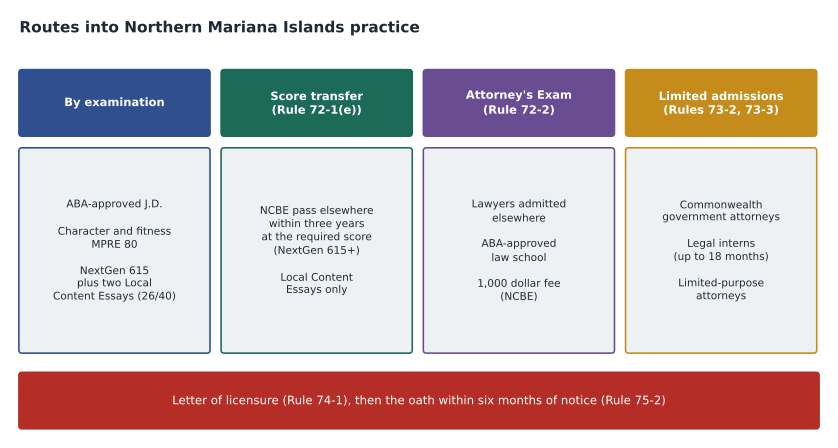
| Route | Rule | Who uses it | What is required |
|---|---|---|---|
| Admission by examination | Rules 70 to 72 | New graduates | ABA-approved J.D., character and fitness, MPRE 80, NCBE exam and Local Content Essays |
| Score transfer | Rule 72-1(e) | Candidates who passed the NCBE exam elsewhere in the past three years | Qualifying NCBE score, character and fitness, MPRE, Local Content Essays |
| Attorney's Exam | Rule 72-2 | Lawyers admitted elsewhere | ABA-approved J.D. and the requirements of the rule |
| Government attorney | Rule 73-2 | Lawyers employed by the Commonwealth government | Limited admission tied to government employment |
| Legal intern | Rule 73-3(a) | Law students and graduates of up to nine months | Dean approval or recent graduation, supervising attorney, Form E |
Why the Commonwealth is different
Kiana's classmates in the group were preparing for exams in Texas, New York, California and Louisiana. Each of those jurisdictions has a large bar, a large body of case law and a market of commercial courses. The Commonwealth has none of those things. It has a small bar, a Supreme Court that decides a modest number of cases each year, and a legal system that blends American law with its own constitution and customs.
That shapes the way a candidate studies. The NextGen exam is the same exam that candidates take in other NextGen jurisdictions, and all of the general materials for it apply. The Local Content Essays are different. They test Commonwealth law on subjects the Board announces at least 30 days before the exam, and the Board may supply local authorities for study. A candidate cannot buy a commercial outline for them; she has to read the Commonwealth sources herself.
It also shapes early practice. Commonwealth lawyers often handle a wide range of matters, because there are relatively few lawyers and many kinds of legal need. A new lawyer at a small Saipan firm might draft a land lease one morning, argue a custody motion in the afternoon and review a claim against a government agency the next day. Several of the most important local rules have no close parallel elsewhere, including the constitutional restriction on who may own land, the role of customary law in family property, and the Commonwealth's relationship to the federal government.
Hollis's view was practical. 'Most of your score will come from the NextGen exam,' she told Kiana. 'You study for that the way everyone in the group does. Then you build a second, smaller study track for the local essays, and you start it early, because nobody else is going to build it for you.'
The documents a candidate deals with
A candidate for admission works with a handful of key sources. The Rules of Admission govern every step, from the application to the oath. They are published by the Commonwealth Judiciary and in the Commonwealth's official law collection. Third-party copies exist online, but the official text controls, and the rules were amended in 2025.
Orders of the Supreme Court fill in details that the rules leave open. The most important recent one is the order of April 2, 2026, which set the minimum passing score for the NextGen exam at 615. The Board publishes notices about exam dates, the location, the Local Content Essay subjects and any study authorities.
NCBE's materials cover the national exam: the NextGen content scope, sample questions, the examinee guide and the MPRE. NCBE's jurisdiction charts summarize each jurisdiction's rules, but they are summaries. Where a chart and the Commonwealth's rules disagree, the rules and the Court's orders control. This course flags several places where published summaries conflict.
Finally, the Commonwealth's substantive law lives in the Covenant, the Commonwealth Constitution, the Commonwealth Code, the court rules, the Commonwealth Register for regulations, and the decisions of the Commonwealth Supreme Court. Lessons 7 through 10 cover the parts of that law that a new lawyer most needs.
A timeline for a February 2027 candidate
Kiana graduated in May 2026, began clerking at Quiles and Tudela in June, took the MPRE in August, and filed her application on November 18, 2026. The filing deadline for the February 2027 exam is December 22, 2026, with a late deadline of January 5, 2027. Her plan from there looks like this: wait for approval to sit, follow the Board's notice of the Local Content Essay subjects, finish her NextGen preparation, sit the exam in late February, and wait about eight to nine weeks for results. If she passes both parts, she must take the oath within six months of being notified.
How this course is organized
Lessons 2 through 6 cover the admission process: eligibility and deadlines, character and fitness and the MPRE, the NextGen exam and its passing score, the transition from the legacy UBE, and the Local Content Essays. Lessons 7 through 10 cover the Commonwealth law a new lawyer most needs: the Covenant and the Commonwealth Constitution, Article XII and land, the courts and the Commonwealth Code, and torts, government liability, family law, probate and customary law. Lesson 11 covers score transfer, limited admissions, professional conduct and life after admission. Lesson 12 brings it together in a capstone problem and an exam-day plan.
Throughout, the course focuses on what is distinctive about the Commonwealth. It does not reteach the general law tested on the NextGen exam, which BAR-101 and the other NCBE exam courses cover. Instead, it shows where Commonwealth law departs from the general rules, so that a candidate can write a strong local essay and avoid importing local rules into national answers.
Worked problem
Choosing the right route
Three people ask Kiana for advice. Ana graduated from an ABA-approved law school in 2026 and has never taken a bar exam. Ben passed the NextGen exam in another jurisdiction in July 2026 with a 630 and wants to practice on Saipan. Carla has practiced in California for twelve years and has just accepted a job as an attorney in a Commonwealth government office. Which route should each consider?
Show solution
- Ana: she has no prior score and no admission, so she takes the full exam: the NCBE exam and the Local Content Essays, plus character and fitness and the MPRE.
- Ben: his NextGen score is recent and above 615, so Rule 72-1(e) lets him transfer it and take only the Local Content Essays, if NCBE sends the score in time and he meets the other requirements.
- Carla: as a government employee, she should look first at the limited admission for Commonwealth government attorneys under Rule 73-2. If she wants a full license, she can consider the Attorney's Exam under Rule 72-2.
Answer: Ana takes the full exam, Ben transfers his score and sits only the Local Content Essays, and Carla considers the government attorney admission or the Attorney's Exam.
Common mistakes
MistakeThe Bar Association admits lawyers in the Commonwealth.
InsteadThe Supreme Court of the Commonwealth admits lawyers, acting through the Board of Law Examiners; the Bar Association receives the admission fee and handles CLE reporting.
MistakeNCBE decides who is fit to practice.
InsteadNCBE investigates some applications, but the Commonwealth makes every final decision.
MistakeA transferred score means no local exam at all.
InsteadScore-transfer applicants must still pass the Local Content Essays.
MistakeAdmission to the Commonwealth bar includes the federal District Court.
InsteadThe District Court for the Northern Mariana Islands has its own admission process.
MistakePublished bar charts are the final word.
InsteadThe Rules of Admission and the Court's orders control where a summary conflicts with them.
Summary and key terms
- The Supreme Court of the Commonwealth adopts the Rules of Admission and admits lawyers; the Board of Law Examiners runs applications and the exam.
- NCBE writes the NextGen exam and the MPRE and investigates some applications, but the Commonwealth decides eligibility.
- The main route is the NCBE exam plus two Local Content Essays; score transfer under Rule 72-1(e) requires only the essays.
- The Attorney's Exam (Rule 72-2) and limited admissions (Rules 73-2 and 73-3) serve experienced lawyers, government attorneys and interns.
- The Rules of Admission were amended on August 4, 2025, and the Court set the NextGen passing score at 615 on April 2, 2026.
- Commonwealth law blends American law with the Covenant, the Commonwealth Constitution and customary law.
- 0
- Commonwealth of the Northern Mariana Islands
- 1
- Covenant
- 2
- Supreme Court of the Commonwealth
- 3
- Board of Law Examiners
- 4
- Rules of Admission
- 5
- Local Content Essays
- 6
- NextGen bar exam
- 7
- Attorney's Exam
- 8
- limited admission
- 9
- District Court for the Northern Mariana Islands
Practice problems
Work each problem on paper first, then reveal the answer to check.
Which body adopts the Rules of Admission?
Show answer
The Supreme Court of the Commonwealth of the Northern Mariana Islands.
What two parts make up the Commonwealth bar exam?
Show answer
The NCBE exam (the NextGen bar exam since July 2026) and two Local Content Essays.
What does a score-transfer applicant still have to pass?
Show answer
The Local Content Essays, along with character and fitness and the MPRE.
When were the Rules of Admission most recently amended?
Show answer
On August 4, 2025, when the Court adopted the NextGen exam.
Lesson quiz · 5 questions
Score 60% or more to complete this lesson.
Create a free account to save your progress, take quizzes and earn a certificate.