
BAR-253 · Lesson 3 of 12 · 19 min
Character and fitness and the MPRE
▶ Video coming soon A video version of this lesson is on the way.
Kiana's paid traffic citation from college had worried her for weeks. She had heard stories, mostly secondhand, of candidates whose admission was delayed for small things. Hollis asked her one question: 'Did you put it on the application?' Kiana had. 'Then you have already done the part that matters most,' Hollis said. 'The item itself is minor. What gets candidates in trouble is leaving something off, or describing it in a way that does not match the records.'
Every jurisdiction requires two things beyond the bar exam before it will admit a lawyer: proof of good moral character and fitness to practice, and a passing score on the Multistate Professional Responsibility Examination. This lesson covers both as they work in the Commonwealth.
What character and fitness review is for
Character and fitness review asks whether an applicant can be trusted with the responsibilities of a lawyer: handling client money, keeping confidences, telling the truth to courts, meeting deadlines and following the rules of the profession. It is not a test of whether the applicant has lived a perfect life. It looks at conduct that bears on those responsibilities and asks, overall, whether the applicant is likely to practice honestly and competently.
The burden of showing good character rests on the applicant. In practice, that means the applicant must give the Board complete and accurate information and, where there is something in the record that raises a question, explain it and show what she has learned or changed since.
How review works in the Commonwealth
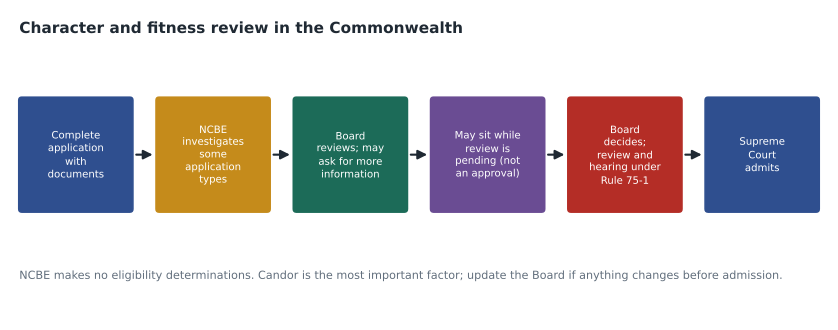
Character and fitness review in the Commonwealth starts with the application. The applicant answers questions about her education, employment, residences, finances, legal proceedings, discipline and other matters, and provides supporting documents. For some types of applications, NCBE conducts an investigation on the Commonwealth's behalf. NCBE may contact law schools, employers and courts the applicant lists, and it expects prompt responses to its requests.
NCBE's role is investigative only. Its guidance states that it makes no determinations or recommendations about who is eligible to practice. NCBE gathers and reports information; the Board and, ultimately, the Supreme Court of the Commonwealth decide. An applicant whose file raises concerns may be asked for more information or an interview. If the Board decides against an applicant, Rule 75-1 provides for review of decisions and hearings.
Timing matters because the Commonwealth's filing deadlines fall close to the exam. Rule 72-1(a) allows the Board to let an applicant sit for the exam while the character, fitness or eligibility review is still open, and states that the permission is not an approval. An applicant who sits under that permission and passes is not admitted until review is complete.
The conduct that draws attention
Across American jurisdictions, the same kinds of conduct tend to draw a closer look. They include criminal convictions and arrests, academic misconduct such as plagiarism or cheating, dishonesty in employment, unpaid debts and defaulted student loans handled irresponsibly, neglect of financial obligations such as child support, prior discipline in another profession, false statements on applications, and conduct showing disregard for the rights of others. Mental health conditions and treatment alone are not grounds for denial; the modern focus is on conduct, not diagnosis.
What usually decides a case is not the conduct itself but what surrounds it. Reviewers commonly consider how old the applicant was, how long ago the conduct occurred, how serious it was, whether it was isolated or part of a pattern, whether the applicant has made restitution or repaired harm, what the applicant has done since, and, above all, whether the applicant has been candid about it.
| Factor | Weighs in the applicant's favor | Weighs against |
|---|---|---|
| Recency | Conduct long in the past | Recent conduct |
| Seriousness | Minor infraction | Fraud, violence, dishonesty |
| Pattern | Isolated incident | Repeated conduct |
| Response | Restitution, treatment, changed behavior | No repair or continuing conduct |
| Candor | Full and consistent disclosure | Omissions or misleading answers |
Candor above all
An omission on a bar application is often treated as more serious than the underlying conduct. The reasoning is straightforward. A lawyer who hides an unfavorable fact from the body deciding her admission may hide unfavorable facts from courts and clients. The application asks questions precisely so that the Board can evaluate the answers; an applicant who decides for herself that something is too minor to mention takes that decision away from the Board.
The practical rule is to disclose anything that might reasonably fall within a question, explain it briefly and accurately, and attach the records. The answers should match every other document: law school applications, any amended disclosure filed with the law school, the MPRE registration, and bar applications in other jurisdictions. Inconsistencies across those documents can cause as much delay as the conduct itself.
Kiana's disclosure of the traffic citation met that standard. She listed the date, the court, the offense and the disposition, attached the receipt, and explained in one sentence that it was a single incident. Dorotea Quiles, who had served on bar committees years before, told her that a reviewer would spend about thirty seconds on it.
Disclosure obligations continue
The duty to be candid does not end when the application is filed. If anything changes before admission, such as a new citation, a new address, a change of employment, or a new legal proceeding, the applicant should update the Board promptly. An applicant who passes the exam and is later found to have concealed a change may have her admission delayed or revoked.
The MPRE
The Multistate Professional Responsibility Examination is a separate NCBE exam on the rules governing lawyers' conduct. It is based mainly on the ABA Model Rules of Professional Conduct and the Model Code of Judicial Conduct, along with controlling constitutional decisions and generally accepted principles from federal and state law. It is given several times a year on computer at testing centers and, in some cases, by remote proctoring.
The MPRE has 60 multiple-choice questions, of which 50 are scored and 10 are unscored pretest questions. Scaled scores range from 50 to 150. Each jurisdiction sets its own passing score.
The Commonwealth's minimum passing MPRE score is 80. That places it among the jurisdictions with a lower passing requirement; many states require 85 and some require 86. Kiana's 88 cleared the Commonwealth's standard comfortably and would also satisfy most other jurisdictions, which matters if she later seeks admission elsewhere.
When the MPRE must be taken
NCBE's summary indicates that the Commonwealth applies time parameters to MPRE scores for admission by examination, but the summary does not state them, and the Rules of Admission text on the MPRE could not be checked for this course. Many jurisdictions require the passing MPRE score to have been earned within a set number of years before or after the bar exam, and a candidate should not assume that an old score will count. A candidate should confirm the Commonwealth's window with the Board before relying on a score more than a couple of years old. For limited admission on motion, NCBE's summary indicates that no MPRE time parameters apply.
For a recent graduate, the simplest plan is the one Kiana followed: take the MPRE during or shortly after law school, while professional responsibility is fresh, and keep the score report with the bar file.
Studying for the MPRE
The MPRE rewards a specific kind of preparation. Its questions are short fact patterns that ask what a lawyer may, must or must not do. The heavily tested areas include conflicts of interest, client confidentiality, the client-lawyer relationship, the regulation of the profession, litigation and other forms of advocacy, and communications about legal services. Judicial conduct questions appear in smaller numbers.
Two habits help most. First, read the actual Model Rules and comments, not only summaries, because questions often turn on precise words such as 'reasonably believes' or 'informed consent, confirmed in writing'. Second, practice with released NCBE questions, because they show how the exam distinguishes between conduct that is proper, conduct that is subject to discipline, and conduct that may expose the lawyer to civil liability. BAR-140 covers the MPRE in detail.
The professional conduct rules that apply after admission
The MPRE tests the Model Rules, and the Commonwealth's own professional conduct framework is closely tied to them. The Rules of Admission require a legal intern to swear that she has read, understands and will follow the ABA Model Rules of Professional Conduct, and lesson 11 explains how the Model Rules apply to Commonwealth lawyers. That close fit means MPRE preparation doubles as preparation for practice on Saipan.
Worked problem
Two disclosure decisions
Ignacia, an applicant for the July 2027 Commonwealth exam, had two incidents in college: a dismissed charge for underage drinking at age 19 and an academic warning for submitting a paper with an incomplete citation. Her law school application mentioned the academic warning but not the dismissed charge. The bar application asks about all arrests and charges, whatever the outcome, and all academic discipline. What should she do?
Show solution
- Disclose both: the bar application asks about charges regardless of outcome and about academic discipline, so both fall within the questions.
- Explain briefly and attach records: the dismissal paperwork and the school's letter about the warning.
- Correct the inconsistency: because her law school application omitted the charge, she should ask her law school how to amend that application, so that the records match.
- Show what has changed: one or two sentences on what she learned and her conduct since.
Answer: Ignacia should disclose both incidents, attach the records, fix the inconsistency with her law school application, and explain briefly. Neither incident is serious; an omission would be the larger risk.
Common mistakes
MistakeMinor incidents can be left off the application.
InsteadDisclose anything that may fall within a question; the Board decides what matters.
MistakeNCBE decides whether an applicant is fit.
InsteadNCBE investigates some files; the Board and the Supreme Court decide.
MistakePermission to sit means the review is complete.
InsteadRule 72-1(a) says permission to sit is not approval.
MistakeThe Commonwealth requires an MPRE score of 85.
InsteadThe Commonwealth's minimum is 80.
MistakeAny old MPRE score will count.
InsteadConfirm the time window with the Board before relying on an older score.
Financial responsibility
Financial matters are among the most common subjects of character and fitness follow-up questions in every jurisdiction. Reviewers are not looking for applicants with no debt; most law graduates have substantial student loans. They look at how an applicant has handled obligations. A loan in deferment or on an income-based repayment plan is normal. A loan in default that the applicant has ignored, a pattern of unpaid bills sent to collections, or unpaid court-ordered obligations such as child support draw attention, because a lawyer who cannot manage her own obligations may mishandle a client's money.
An applicant with financial problems should do three things before filing. First, get current records: a credit report, loan statements and any payment plans. Second, take reasonable steps to address problems, such as entering a repayment plan or resolving a disputed account. Third, explain the situation briefly and accurately in the application, attaching the records. A short explanation showing that the applicant understands the problem and is dealing with it is far better than silence.
Prior legal matters and expungements
Applications typically ask about arrests, charges and convictions, including matters that were dismissed or sealed. An applicant should read each question carefully. Some jurisdictions' questions expressly require disclosure of expunged or sealed matters; others do not. If the Commonwealth's question asks about all charges regardless of outcome, a dismissed charge must be disclosed. When in doubt, disclosure with an explanation is the safer course, and the applicant can ask the Board how a particular question should be read.
Conduct in law school
Law school records matter because they are recent. Academic discipline, a pattern of late or missed obligations, and conflicts with the law school's honor code all bear on how an applicant is likely to behave in practice. Law schools also send a dean's certification as part of many bar applications, and that certification may mention discipline. An applicant who was disciplined should make sure her own description matches the school's records.
Practicing the MPRE habits in daily work
For a law clerk like Kiana, the professional conduct rules are not abstract. A clerk handles confidential client files, sees conflicts arise when a new client turns out to be related to an opposing party, and watches lawyers make judgment calls about candor to the court. Hollis encouraged Kiana to notice those moments at work and to ask Dorotea how she would analyze them under the Model Rules. It turned MPRE review into practice and practice into MPRE review.
Summary and key terms
- Character and fitness review asks whether an applicant can be trusted with a lawyer's responsibilities; the burden is on the applicant.
- NCBE investigates some Commonwealth applications but makes no eligibility decisions; the Board and the Supreme Court decide, with review under Rule 75-1.
- Reviewers weigh recency, seriousness, pattern, the applicant's response and, above all, candor.
- Disclosure duties continue until admission.
- The Commonwealth requires an MPRE score of 80 on the 50 to 150 scale; check the time window with the Board.
- The MPRE is based mainly on the ABA Model Rules, which closely track Commonwealth practice rules.
- 0
- character and fitness
- 1
- candor
- 2
- NCBE investigation
- 3
- Rule 75-1
- 4
- MPRE
- 5
- scaled score
- 6
- Model Rules of Professional Conduct
- 7
- continuing duty to disclose
Practice problems
Work each problem on paper first, then reveal the answer to check.
Who decides whether a Commonwealth applicant has the required character and fitness?
Show answer
The Board of Law Examiners and, ultimately, the Supreme Court of the Commonwealth.
What MPRE score does the Commonwealth require?
Show answer
80.
Why is an omission often treated as worse than the conduct omitted?
Show answer
It suggests the applicant may hide unfavorable facts from courts and clients.
Which rule provides for review of the Board's decisions and hearings?
Show answer
Rule 75-1.
Lesson quiz · 5 questions
Score 60% or more to complete this lesson.
Create a free account to save your progress, take quizzes and earn a certificate.