
BAR-253 · Lesson 6 of 12 · 19 min
The Local Content Essays
▶ Video coming soon A video version of this lesson is on the way.
'Two essays, thirty minutes each,' Kiana said. 'It sounds small until you realize there is no book for it.' Hollis had coached candidates for jurisdictions with state-specific components before, but most of those components came with published outlines, released questions or a commercial course. The Commonwealth's Local Content Essays came with a rule, a subject announcement and, sometimes, a packet of local authorities. 'Then we build the book ourselves,' Hollis said. 'It will be short, because you only need what the essays can reach.'
This lesson explains how the Local Content Essays work, how they are scored, how to prepare for them before and after the subjects are announced, and how to write a strong thirty-minute answer on Commonwealth law.
What the rules say
Rule 72-1(b) of the Rules of Admission makes the Local Content Essays the second part of the Commonwealth bar exam. There are two essays, each 30 minutes long, on subjects the Board prescribes. The Board announces the subjects at least 30 days before the exam. The Board may provide local authorities for applicants to study, but applicants may not consult them during the exam.
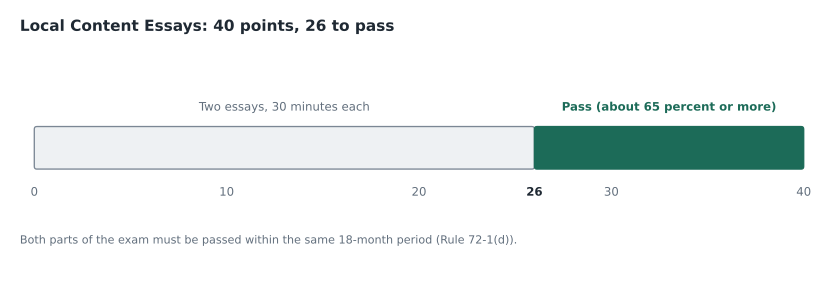
Rule 72-1(c) requires at least two exams a year over two consecutive days, scheduled with the NCBE exam, and lets the Board offer the Local Content Essays separately as well. Rule 72-1(d) provides that the essays are scored out of 40 points, with 26 passing, and that both parts of the exam must be passed within the same 18-month period. Exams are graded anonymously under Rule 72-1(f) and are not regraded on request.
Applicants who transfer an NCBE score under Rule 72-1(e) still sit the Local Content Essays. For many lawyers moving to the Commonwealth, the essays are the only exam they take there.
| Feature | Rule | What it means for the candidate |
|---|---|---|
| Two essays, 30 minutes each | 72-1(b) | About an hour of writing on Commonwealth law |
| Subjects announced at least 30 days ahead | 72-1(b) | A defined, short study window for the final push |
| Local authorities may be provided | 72-1(b) | Study them closely; they cannot be used in the exam |
| Scored out of 40; 26 to pass | 72-1(d) | About 65 percent of available points |
| Both parts within 18 months | 72-1(d) | A passed part can carry over while the other is retaken |
| May be offered separately | 72-1(c) | Score-transfer applicants and retakers may sit the essays alone |
| Graded anonymously; no regrade | 72-1(d), (f) | Write so that the grader can award points quickly |
What the essays are for
The NextGen exam tests general American law and lawyering skills. It does not test the Covenant, the Commonwealth Constitution, Article XII, the Commonwealth Code or customary law. The Local Content Essays fill that gap. They confirm that a new Commonwealth lawyer knows the local rules that most often decide outcomes in Commonwealth practice, and that she can find and apply them under time pressure.
Because the Board chooses the subjects for each administration, there is no fixed list. A candidate should think of the possible subjects as a universe of Commonwealth law that a new practitioner must know, and of each announcement as a selection from it. Lessons 7 through 10 of this course cover that universe: the Covenant and commonwealth status, the Commonwealth Constitution, Article XII and land, the courts and rules of decision, civil procedure, torts and government liability, family law, probate and customary law, and, through lesson 11, professional conduct.
Preparing before the announcement
The thirty-day notice gives a candidate a focused final month, but a candidate who waits for the announcement to begin will spend that month learning the basics. The better approach, which Kiana followed, is to build a short foundation first.
The foundation has four parts. First, read the Covenant's main articles and the structure of the Commonwealth Constitution, with special attention to Article XII. Second, learn the court structure and the Commonwealth's rules of decision, including the role of customary law. Third, read a handful of recent Commonwealth Supreme Court opinions, which show how the Court reasons and which issues are live. Fourth, skim the titles of the Commonwealth Code most used in practice: civil procedure, domestic relations, probate and property, and the government liability statute.
For each area, the candidate should prepare a one-page sheet with the governing provision, the key elements or tests, one or two leading Commonwealth cases if she can verify them, and a short note on how the Commonwealth rule differs from the general American rule tested on NextGen. Twelve or fifteen such pages make a complete foundation.
Preparing after the announcement
Once the subjects are announced, the work narrows. The candidate collects the authorities the Board provides, reads them in full, and turns them into a working outline for each subject. A good outline has three layers: the rule as written in the source, the elements or factors a grader will look for, and the common fact patterns in which the rule is applied.
The candidate then writes practice essays under timed conditions. Thirty minutes is short. A useful split is about seven minutes to read the facts, spot the issues and outline, about twenty minutes to write, and about three minutes to review. Hollis asked Kiana to write at least six timed essays in the final month, three on each announced subject, and to grade each one against her outline.
Writing a thirty-minute answer
A thirty-minute essay rewards structure. The grader is looking for the issues, the correct Commonwealth rule for each, a clear application to the facts, and a conclusion. A short answer that hits every issue usually beats a long answer that explores one issue at length.
The standard approach works well: state the issue, state the rule, apply it to the facts, and conclude. For Commonwealth essays, three refinements help. First, name the source of the rule: the Covenant section, the constitutional article, the Code title and section, or the case, as precisely as the candidate can recall it. Second, where the Commonwealth rule differs from the general American rule, say so briefly; graders tend to reward an answer that shows the candidate knows why the local rule matters. Third, where customary law may apply, identify it and explain how the Commonwealth's rules of decision tell the court when to use it.
Headings help a grader find points. A candidate should use one heading per issue, keep paragraphs short and put the conclusion for each issue at its end. If time runs short, a brief outline of the remaining issues is better than nothing, because a grader may award partial credit for an identified issue and the correct rule.
| Minutes | Task |
|---|---|
| 0 to 7 | Read the call first, then the facts; list issues; jot rules and key facts |
| 7 to 27 | Write: one heading per issue; rule, application, conclusion |
| 27 to 30 | Review: check that every issue has a conclusion and the call is answered |
Using the provided authorities well
When the Board provides local authorities, a candidate should treat them as the core of the exam. They signal what the essays will draw on. The candidate should read each authority in full, note the precise language of the key provisions, and practice stating the rules in her own words, because she will not have the text in the exam room.
A useful technique is to rewrite each provision as a checklist of elements. A statute that allows a remedy if four conditions are met becomes a four-item list, and each item becomes a sentence in the essay. That technique turns a passage the candidate has read into points a grader can award.
Common errors
The most common error on any jurisdiction-specific essay is answering with the general rule. A candidate who has just spent months on NextGen will reach for the national rule instinctively. On the Local Content Essays, that is often wrong, and it is wrong in a way the grader will notice. The second most common error is failing to answer the question asked. A call that asks whether a lease is valid under Article XII is not answered by a discussion of whether the rent is fair. The third is running out of time on the first essay and rushing the second.
Kiana's practice essay
Hollis wrote an original practice question for Kiana in late November, before the subjects were announced, to test her foundation. The facts were simple. A Tinian landowner of Northern Marianas descent, Gualberto Remigio, signed a 60-year lease of beachfront land to Brinley Vossen, an investor who is not of Northern Marianas descent, with an option to renew for 25 years. The call asked whether the lease was valid and what remedies were available.
Kiana outlined in six minutes. Issue one: whether the lease is a permanent or long-term interest restricted by Article XII. Rule: Article XII restricts permanent and long-term interests to persons of Northern Marianas descent, and section 3 defines long-term interests to include leaseholds of more than 55 years, including renewal rights. Application: 60 years exceeds 55 on its own, and the 25-year renewal right makes the total 85. Conclusion: the lease is a restricted interest acquired by a person who is not of Northern Marianas descent. Issue two: the consequence. Rule: section 6 makes a transaction that violates section 1 void ab initio. Application and conclusion: the lease is void from the beginning; the parties are left to restitution-type remedies outside the lease. She also noted that a lease of 55 years or less, including renewals, would not have been restricted.
Hollis scored it against her own rubric and gave it 30 of 40. 'You got both issues and both rules,' she said. 'You lost points for not explaining what void ab initio means in practice and for not saying what Vossen could do instead, such as taking a lease within the limit.' Lesson 8 covers Article XII in depth.
Worked problem
Turning an authority into points
Suppose the Board provides, as a study authority, a statute that allows a court to award a remedy if (1) the claimant is a member of a defined class, (2) the claimant filed notice within a set period, (3) the claim arises from a listed kind of event, and (4) no exclusion applies. How should a candidate prepare to write about it?
Show solution
- Make a checklist: four elements, each with its key words.
- Prepare a sentence for each: "The first requirement is that the claimant be a member of the class. Here..."
- Learn the exclusions as a separate short list, because a fact pattern may plant one.
- Practice one timed essay that uses the checklist, then compare the answer against the statute.
Answer: Converting the authority into an element checklist with ready-made sentences lets the candidate write a complete, gradeable answer in thirty minutes without the text in front of her.
Common mistakes
MistakeAnswering with the general American rule.
InsteadUse the Commonwealth rule, and say briefly how it differs from the general rule when it does.
MistakeWaiting for the announcement to start studying.
InsteadBuild a short foundation first, then narrow after the subjects are announced.
MistakeBringing the Board's authorities into the exam.
InsteadStudy them closely; Rule 72-1(b) bars consulting them during the exam.
MistakeWriting a long answer on one issue.
InsteadAddress every issue briefly, with a heading and a conclusion for each.
MistakeAssuming a transferred score excuses the essays.
InsteadScore-transfer applicants still sit the Local Content Essays.
Building a local-law library
A candidate preparing for the Local Content Essays needs a small, reliable library. The Commonwealth's official law website publishes the Commonwealth Code, the Constitution, public laws, court rules and Supreme Court opinions. The Judiciary publishes notices and orders. The Covenant is available in official form. A candidate should download the core texts early, organize them by subject, and keep notes of where each rule is found, so that the one-page sheets can cite sources precisely.
Secondary sources are thinner than in a large state, but they exist: law review articles on Commonwealth constitutional history, Article XII and customary law, and summaries prepared by local practitioners and the Bar Association. A candidate should treat secondary sources as maps, not authorities, and confirm every rule against the primary source.
Practicing with original problems
Because there are no commercial banks of Local Content Essay questions, a candidate must write or obtain practice problems. A study partner, a supervising lawyer or a coach can write short fact patterns that test a single rule or the interaction of two. Kiana's practice problems came from Hollis, from Dorotea, who drew on old files with the names changed, and from Kiana herself, who wrote problems for a study partner and graded the partner's answers in return. Writing a problem is itself good preparation, because it forces the writer to identify exactly what a rule requires and how a fact pattern can test it.
Summary and key terms
- The Local Content Essays are two 30-minute essays on subjects the Board announces at least 30 days before the exam.
- The Board may provide local authorities for study, but they cannot be consulted during the exam.
- The essays are scored out of 40, with 26 passing; both exam parts must be passed within 18 months.
- Prepare in two phases: a foundation of one-page sheets, then focused outlines and timed essays after the announcement.
- Write in issue, rule, application, conclusion form, naming Commonwealth sources and noting differences from the general rule.
- Score-transfer applicants still take the essays, and the Board may offer them separately.
- 0
- Local Content Essays
- 1
- subject announcement
- 2
- local authorities
- 3
- Rule 72-1(b)
- 4
- IRAC
- 5
- element checklist
- 6
- rubric
- 7
- anonymous grading
Practice problems
Work each problem on paper first, then reveal the answer to check.
How long is each Local Content Essay?
Show answer
30 minutes.
How far in advance are the subjects announced?
Show answer
At least 30 days before the exam.
May an applicant consult the Board's study authorities during the exam?
Show answer
No; Rule 72-1(b) bars it.
What score passes the Local Content Essays?
Show answer
26 of 40.
Lesson quiz · 5 questions
Score 60% or more to complete this lesson.
Create a free account to save your progress, take quizzes and earn a certificate.