
BAR-253 · Lesson 7 of 12 · 19 min
The Covenant, commonwealth status and the Commonwealth Constitution
▶ Video coming soon A video version of this lesson is on the way.
On her first day at Quiles and Tudela, Dorotea Quiles handed Kiana a slim, worn booklet. It was a copy of the Covenant, and the margins were full of notes from three decades of practice. 'Every big case on these islands comes back to this document sooner or later,' Dorotea said. 'Land, immigration, taxes, who can vote on what. If you do not know the Covenant, you will miss the issue that decides the case.'
The Covenant is the foundation of Commonwealth law. It defines the Commonwealth's relationship with the United States, decides which parts of the federal Constitution and federal law apply, and authorizes some of the most distinctive features of local law, including the land alienation restrictions in Article XII. This lesson explains the Covenant, the Commonwealth's status and the structure of the Commonwealth Constitution.
From trusteeship to commonwealth
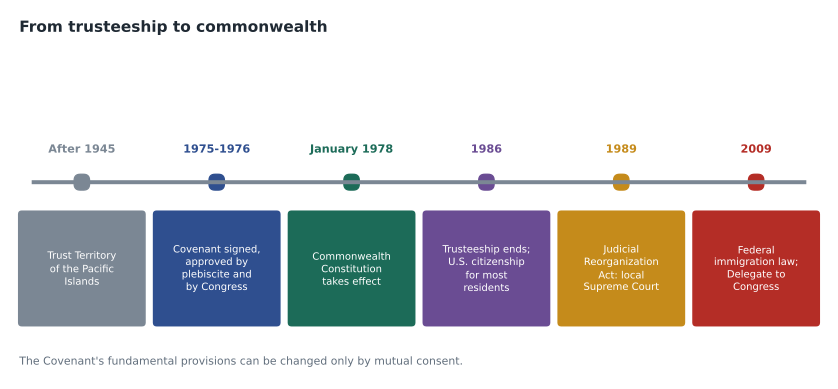
After World War II, the Northern Mariana Islands became part of the Trust Territory of the Pacific Islands, administered by the United States under a United Nations trusteeship agreement. In the late 1960s and early 1970s, the people of the Northern Marianas chose to pursue a closer and permanent relationship with the United States rather than the looser arrangements other parts of the Trust Territory later adopted.
Negotiations produced the Covenant to Establish a Commonwealth of the Northern Mariana Islands in Political Union with the United States of America. It was signed in 1975, approved by the voters of the Northern Marianas in a plebiscite that year, and approved by Congress in 1976. The Commonwealth Constitution, drafted by a local constitutional convention, took effect in January 1978, when the Commonwealth government began operating. The trusteeship ended as to the Northern Marianas in 1986, when the remaining provisions of the Covenant took full effect and most residents became United States citizens.
What the Covenant does
The Covenant has several articles, but four ideas matter most to a new lawyer.
First, political union and sovereignty. The Covenant establishes the Commonwealth in political union with, and under the sovereignty of, the United States. The United States controls foreign affairs and defense.
Second, local self-government. The Covenant guarantees the people of the Northern Mariana Islands the right of local self-government and to adopt their own constitution. The Commonwealth governs internal affairs through its own legislature, executive and courts. Courts have described the relationship as one in which federal authority is real but limited by the Covenant's protections for local self-government.
Third, which federal law applies. The Covenant specifies which provisions of the United States Constitution apply in the Commonwealth as if it were a state, and it addresses the application of federal statutes. Some federal laws applied fully from the start; others, such as federal immigration law and the federal minimum wage, were initially excluded and later extended by Congress. Federal immigration law, for example, was extended to the Commonwealth in 2009 under the Consolidated Natural Resources Act of 2008. The Commonwealth also gained a nonvoting Delegate to the House of Representatives in 2009.
Fourth, mutual consent and the protected provisions. The Covenant provides that certain fundamental provisions, including those on political relationship, citizenship, the application of the Constitution and the authorization of land alienation restrictions, may be changed only with the mutual consent of the United States and the Commonwealth. This mutual consent protection is one reason the Covenant is treated as more than an ordinary statute.
| Covenant theme | What it provides | Why a lawyer cares |
|---|---|---|
| Political union | The Commonwealth is under United States sovereignty | Federal authority over foreign affairs and defense |
| Self-government | Right to local self-government and a local constitution | Limits on federal interference with internal affairs |
| Applicable federal law | Specified constitutional provisions and statutes apply | Whether a federal rule governs a local dispute |
| Land alienation | Authorizes restrictions on land ownership to protect local people | The basis for Article XII |
| Mutual consent | Fundamental provisions change only by mutual consent | Stability of the core terms |
| District Court | Creates a federal district court for the Commonwealth | Federal forum and its jurisdiction |
Constitutional rights in a territory
The Commonwealth's status raises a question every American territory faces: which constitutional rights apply? The answer comes partly from the Covenant, which lists the constitutional provisions that apply, and partly from the so-called Insular Cases, a line of early twentieth-century Supreme Court decisions holding that only fundamental constitutional rights apply of their own force in unincorporated territories.
The Ninth Circuit has applied that framework to the Commonwealth. The leading example is Wabol v. Villacrusis, decided by the Ninth Circuit in 1990, which rejected an equal protection challenge to the land alienation restriction in Article XII. The court reasoned that the right to acquire long-term interests in Commonwealth land was not a fundamental right that applied of its own force in the Commonwealth, and that the restriction was part of the bargain the Covenant reflected. Lesson 8 discusses Wabol in context.
There are limits. In Davis v. Commonwealth Election Commission, decided in December 2016, the Ninth Circuit held that limiting voting on proposed amendments to Article XII to persons of Northern Marianas descent violated the Fifteenth Amendment's ban on race-based voting restrictions. The restriction on land ownership itself remained in place; the decision concerned who could vote on changing it.
A new lawyer does not need to master the Insular Cases. She does need to recognize when a case raises a question about whether a federal constitutional protection applies in the Commonwealth, and to know that the Covenant and the Ninth Circuit's decisions frame the answer.
The Commonwealth Constitution
The Commonwealth Constitution sets up the local government and protects individual rights. Its structure is familiar from state constitutions, with several distinctive provisions.
Article I contains a declaration of personal rights. Many of its protections parallel the federal Bill of Rights, and some go further; Commonwealth courts interpret them independently and are not bound to read them the same way as their federal counterparts.
Articles II, III and IV establish the three branches. The legislature is bicameral, with a Senate in which each of the three senatorial districts (Saipan and the Northern Islands, Tinian and Aguiguan, and Rota) has equal representation, and a House of Representatives apportioned by population. The executive branch is headed by an elected Governor and Lieutenant Governor. The judicial branch is headed by the Supreme Court of the Commonwealth, with the Superior Court as the trial court; lesson 9 covers the courts.
Other articles deal with local government, elections, initiative and recall, taxation and public finance, public lands, natural resources and education. Article XI governs public lands, which are managed for the benefit of persons of Northern Marianas descent, and Article XII restricts the alienation of land. Amendments may be proposed by a constitutional convention, by the legislature or by popular initiative, and are ratified by the voters.
The Senate's equal representation
The equal representation of the three senatorial districts reflects a political compromise at the Commonwealth's founding, protecting the interests of the smaller islands. Because Saipan has the great majority of the population, the arrangement departs from one-person-one-vote principles. Challenges have been brought under the federal Constitution, and the federal courts have upheld the arrangement, relying on the Covenant and the Insular Cases framework. It is a useful example of how Commonwealth law can depart from rules that would apply in a state.
Why this matters in practice
Covenant and constitutional questions arise more often in Commonwealth practice than a new lawyer might expect. A dispute over a lease raises Article XII. A challenge to a local tax or labor regulation may raise questions about which federal laws apply. A claim against the government may raise both Commonwealth constitutional issues, such as the equal protection clause that decided Maratita v. CHCC in 2024, and federal questions. A criminal case may raise questions about which federal constitutional protections apply of their own force.
For the Local Content Essays, the Covenant and the Constitution are natural subjects because they are the framework for everything else. A good essay on almost any Commonwealth topic will place the issue within that framework in a sentence or two before applying the specific rule.
Worked problem
Spotting the framework question
A Commonwealth statute limits a certain kind of business license to persons of Northern Marianas descent. A business owner who is not of Northern Marianas descent challenges it. A lawyer at Quiles and Tudela is asked for a first view. What framework questions should she identify?
Show solution
- Source of authority: the Covenant authorizes restrictions on land alienation; it does not obviously authorize a descent-based restriction on business licenses.
- Federal constitutional rights: whether equal protection applies of its own force or through the Covenant, and how the Insular Cases framework treats the claim, drawing on Wabol and later Ninth Circuit decisions.
- Commonwealth constitutional rights: the Commonwealth Constitution has its own equal protection guarantee, which the Commonwealth Supreme Court interprets independently.
- Remedy and forum: whether to sue in the Superior Court on Commonwealth grounds or in the District Court on federal grounds.
Answer: The lawyer should identify the Covenant, federal equal protection under the Insular Cases framework, the Commonwealth equal protection clause, and the choice of forum, and should note that Wabol upheld a land restriction specifically authorized by the Covenant, which this statute may not share.
Common mistakes
MistakeThe Covenant is an ordinary federal statute that Congress can change at will.
InsteadFundamental provisions can be changed only by mutual consent.
MistakeThe whole federal Constitution applies in the Commonwealth as in a state.
InsteadThe Covenant specifies applicable provisions, and the Insular Cases framework governs others.
MistakeDavis struck down Article XII.
InsteadDavis struck down limiting votes on Article XII amendments to persons of Northern Marianas descent; the land restriction remains.
MistakeThe Commonwealth Senate is apportioned by population.
InsteadEach of the three senatorial districts has equal representation.
MistakeCommonwealth constitutional rights mirror federal rights exactly.
InsteadCommonwealth courts interpret the Commonwealth Constitution independently.
Federal law in daily practice
For a new lawyer, the most concrete question the Covenant raises is whether a particular federal statute applies. The answer is often yes; most federal law applies in the Commonwealth as it does elsewhere. But the exceptions and transitions have been significant. Federal immigration law did not apply until 2009, and the Commonwealth had its own immigration and guest worker system before then. Federal minimum wage law was extended to the Commonwealth in stages. Federal tax law applies through a mirror system in which the Commonwealth's income tax is linked to the federal code, with local rebates and modifications. A lawyer advising a business on labor, immigration or taxation must check whether and how federal law applies, and whether a transition period or a special Commonwealth rule governs.
The Covenant also creates a mechanism for consultation between the United States and the Commonwealth on matters affecting their relationship. Formal consultations have been held on issues such as federal laws that affect the Commonwealth's economy and immigration. A lawyer working on a policy matter, such as a proposed federal law with special effects on the islands, should know that the consultation process exists.
The Commonwealth Constitution in litigation
Commonwealth constitutional claims are a regular part of litigation in the Superior Court. Article I's personal rights are invoked in criminal cases, in challenges to government action and, as Maratita v. CHCC shows, in challenges to statutes that limit remedies. Because the Commonwealth Supreme Court interprets the Commonwealth Constitution independently, a claim that would fail under federal doctrine may succeed under Commonwealth doctrine. A litigator challenging government action should consider both sources and plead them separately.
Constitutional amendments are also more frequent than in most states. The Commonwealth has held several constitutional conventions and approved amendments by legislative initiative and popular vote. A lawyer citing a constitutional provision should confirm that she is using the current text and should check the history of the provision if the case involves events that occurred before an amendment.
Why the framework matters on the essays
On a Local Content Essay, a sentence or two placing an issue within the Covenant and constitutional framework shows the grader that the candidate understands why the local rule exists. For an Article XII essay, that means noting the Covenant's authorization and Wabol. For a government liability essay, it means noting that the Commonwealth Constitution's equal protection clause, interpreted independently, decided Maratita. For a question on whether a federal law applies, it means starting with the Covenant. The framework sentence should be brief; the points come from applying the specific rule to the facts.
Summary and key terms
- The Covenant, approved by plebiscite in 1975 and by Congress in 1976, established the Commonwealth in political union with the United States.
- The Commonwealth Constitution took effect in January 1978; the trusteeship ended in 1986.
- The Covenant guarantees local self-government, specifies applicable federal law and protects fundamental provisions by mutual consent.
- Wabol v. Villacrusis (9th Cir. 1990) upheld Article XII against an equal protection challenge under the Insular Cases framework.
- Davis v. Commonwealth Election Commission (9th Cir. 2016) struck down descent-limited voting on Article XII amendments.
- The Constitution creates three branches, with equal Senate representation for the three senatorial districts, and includes Articles XI and XII on land.
- 0
- Covenant
- 1
- political union
- 2
- local self-government
- 3
- mutual consent
- 4
- Trust Territory of the Pacific Islands
- 5
- Insular Cases
- 6
- Commonwealth Constitution
- 7
- senatorial district
- 8
- Delegate to Congress
Practice problems
Work each problem on paper first, then reveal the answer to check.
What document established the Commonwealth's relationship with the United States?
Show answer
The Covenant to Establish a Commonwealth of the Northern Mariana Islands in Political Union with the United States of America.
When did the Commonwealth Constitution take effect?
Show answer
In January 1978.
What did Davis v. Commonwealth Election Commission decide?
Show answer
That limiting voting on Article XII amendments to persons of Northern Marianas descent violated the Fifteenth Amendment.
Why does the Senate depart from one-person-one-vote?
Show answer
Each of the three senatorial districts has equal representation, a founding compromise the federal courts have upheld.
Lesson quiz · 5 questions
Score 60% or more to complete this lesson.
Create a free account to save your progress, take quizzes and earn a certificate.