
BAR-253 · Lesson 11 of 12 · 20 min
Score transfer, limited admissions, professional conduct and practice after admission
▶ Video coming soon A video version of this lesson is on the way.
Kiana's classmate from law school called her in November with a question. He had passed the NextGen exam in another jurisdiction in July 2026 with a 628, had a job offer on Saipan, and wanted to know whether he had to take the whole Commonwealth exam. Kiana knew the short answer, because she had just read the rule: he could transfer his score and sit only the Local Content Essays. Hollis used the call as a starting point for this lesson, which covers every route into Commonwealth practice other than the full exam, the rules of professional conduct, and what a new lawyer must do after admission.
Score transfer under Rule 72-1(e)
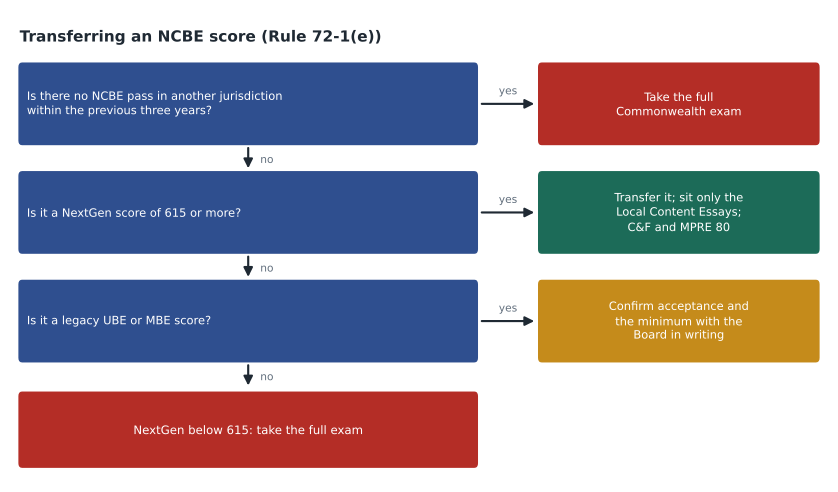
Rule 72-1(e) of the Rules of Admission lets an applicant who passed the NCBE Bar in another jurisdiction within the previous three years, with a score that meets the Commonwealth's standard, transfer that score instead of retaking the NCBE part of the exam. The applicant must still sit and pass the Local Content Essays, and must arrange for NCBE to send the score to the Commonwealth in time. The applicant also completes character and fitness review and meets the MPRE requirement.
For NextGen scores, the standard is clear. NCBE's current summary states that the Commonwealth accepts NextGen scores earned from July 2026 onward with a minimum of 615. Kiana's classmate, with a 628 earned in July 2026, meets both the minimum and the three-year window.
For older scores, the picture is less clear, and the published sources conflict. One NCBE page lists legacy UBE scores as accepted; another lists them as not accepted. NCBE's summaries also differ on whether transferred MBE scores are accepted. Because the Rules of Admission refer to a score that meets the Commonwealth's minimum, and because the legacy and NextGen scales differ, an applicant with a legacy UBE or MBE score should write to the Board and get a written answer before relying on it. If the answer is favorable, the three-year window in Rule 72-1(e) still applies.
Portability of a Commonwealth score
Score transfer works in the other direction too. Rule 72-1(d) notes that NCBE certifies Commonwealth scores and that they are portable. A lawyer who passes the NextGen exam in the Commonwealth can transfer the score to other jurisdictions that accept NextGen scores, subject to their minimums, time limits and local requirements. Not every jurisdiction accepts NextGen transfers yet. Some will not accept them until they adopt NextGen themselves, and a few do not accept transferred scores at all. A Commonwealth lawyer who may want to practice in Guam, Hawaii or a mainland state should check that jurisdiction's current rules, because the answer differs widely across the Pacific.
The Attorney's Exam
Rule 72-2 provides an Attorney's Exam for lawyers who are already admitted elsewhere. NCBE's summary lists it as available to graduates of ABA-approved law schools, with a fee of 1,000 dollars. The text of Rule 72-2 could not be checked for this course, so a lawyer considering the Attorney's Exam should read the current rule for its eligibility conditions, its content and how it relates to the Local Content Essays.
Admission on motion
NCBE's summary describes admission on motion in the Commonwealth as available only on a limited basis. It lists graduation from an ABA-approved law school as the education requirement, states that qualifying practice can include practice for a government agency, and lists a fee of 500 dollars plus the character and fitness fee. It does not list a number of years of practice or a reciprocity requirement. Another NCBE page shows admission on motion as not provided. A lawyer who hopes to be admitted without examination should not rely on either summary and should read the current Rules of Admission and ask the Board.
Limited admission for government attorneys
Rule 73-2 provides a limited admission for attorneys employed by the Commonwealth government. Government offices, including the Office of the Attorney General and the Office of the Public Defender, need lawyers, and the pool of locally admitted lawyers is small. A limited admission allows a lawyer admitted elsewhere to serve in a government position without first passing the Commonwealth exam, subject to the conditions in the rule. A limited admission is tied to the government role; a lawyer who leaves government service for private practice should expect to need full admission.
Legal interns and other limited admissions
Rule 73-3 covers three other kinds of limited admission.
Legal interns. Under Rule 73-3(a), a law student or a graduate of an ABA-accredited law school may be approved to appear in the Superior Court as a legal intern, representing the Commonwealth or private individuals. A student must be enrolled and in good academic standing, with the dean's written approval; a graduate must have graduated no more than nine months earlier. The applicant swears that she has read, understands and will follow the ABA Model Rules of Professional Conduct, and files Form E with the Board, signed by the supervising attorney, with no filing fee.
The supervising attorney must be in good standing and either admitted in the Commonwealth with a local office or representing the Commonwealth government or Micronesia Legal Services. A supervisor may oversee only one intern at a time, must direct and review the intern's work, must review and co-sign filings, and takes professional responsibility for the intern's work. The intern may not appear in court without the supervisor present, must identify herself as a legal intern on the record and to clients, and may not accept payment from clients, though an employer may pay her. If a client objects to the intern, the supervisor takes over. The Board sets the intern's term, up to 18 months, and the privilege ends if the dean withdraws approval, the student leaves school, or the Board revokes it.
Pre-1989 admissions. Under Rule 73-3(b), lawyers admitted before the Commonwealth Judicial Reorganization Act of 1989, or under the former statutory provisions as of 2000, may continue practicing under the terms of their original admission until those terms expire or they are suspended or terminated.
Limited-purpose attorneys. Under Rule 73-3(c), the Board may admit an attorney for a specific limited purpose, such as prosecuting ethics matters as a special ethics prosecutor, on the written request of the Bar or the Judiciary. In a small bar, conflicts can make it hard to find a local lawyer to prosecute a disciplinary case, and this rule solves that problem.
| Admission | Rule | Key conditions |
|---|---|---|
| Score transfer | 72-1(e) | NCBE pass within three years at the required score; Local Content Essays; character and fitness; MPRE |
| Attorney's Exam | 72-2 | Admitted elsewhere; ABA-approved law school; 1,000 dollar fee (NCBE) |
| Admission on motion (limited) | Rules of Admission | ABA-approved law school; government practice can qualify; 500 dollars plus C&F fee (NCBE) |
| Government attorney | 73-2 | Employment by the Commonwealth government |
| Legal intern | 73-3(a) | Student with dean approval or graduate within nine months; supervision; up to 18 months |
| Limited-purpose attorney | 73-3(c) | Written request from the Bar or Judiciary; limited to the purpose |
Admission, the letter of licensure and the oath
After an applicant passes both parts of the exam and completes character and fitness review, the Board approves the application and issues a letter of licensure under Rule 74-1. Rule 75-2 then governs the oath. The applicant must take the oath within six months after being notified of passing; if she does not, her scores may expire and her letter of licensure may be revoked. Before taking the oath, she pays the Certificate of Admission fee to the Bar Association.
The oath itself reflects the Commonwealth's legal order. A new lawyer swears to support and defend the Constitution and laws of the Commonwealth, the Covenant establishing the Commonwealth in political union with the United States, and the applicable provisions of the United States Constitution, laws and treaties. She promises to discharge her duties faithfully and honestly and to act with dignity and civility toward judges, court staff, clients and others.
Professional conduct
Commonwealth lawyers are governed by rules of professional conduct based on the ABA Model Rules of Professional Conduct, with discipline administered under the Supreme Court's disciplinary rules. The close link to the Model Rules shows in Rule 73-3(a), which requires legal interns to swear to follow the Model Rules. For a new lawyer, that means the rules studied for the MPRE are, in substance, the rules of practice.
Some professional conduct issues come up more often in a small jurisdiction. Conflicts of interest are common, because families are interconnected and lawyers often know both sides of a dispute. Confidentiality requires care in a community where clients and opposing parties meet daily. Competence matters when a lawyer takes a matter outside her usual practice because no specialist is available. And candor to the court matters when the body of local precedent is small and the court relies on counsel to bring the relevant authorities, including customary law, to its attention.
The District Court bar
Admission to the Commonwealth bar does not admit a lawyer to the United States District Court for the Northern Mariana Islands. The District Court admits lawyers under its own local rules, and a new Commonwealth lawyer who expects to handle federal matters should apply after admission.
Continuing legal education
The Commonwealth has mandatory continuing legal education under its CLE rules, which create a Committee on Continuing Legal Education and set requirements for reporting, approved activities, review, compliance and sanctions. Every active attorney must complete 20 hours every two years, prorated by the months the attorney holds active status, and current and former full-time Commonwealth judges and justices are exempt.
A commercial CLE summary adds details that a lawyer should confirm against the rules: that the compliance period ends on December 31 of odd-numbered years, that credits are reported by February 15 of even-numbered years using the Commonwealth's certification form, that up to 10 credits may be carried over, that no separate ethics hours are required, and that new admittees must complete a professionalism course. Because those details come from a secondary source, a new lawyer should read the CLE rules and the Bar Association's current guidance.
Worked problem
Choosing a route for an experienced lawyer
Inocencio has practiced in Hawaii for eight years. He passed the Hawaii exam in 2018. He has been offered a job at the Office of the Attorney General on Saipan, and he may later move to private practice there. What should he consider?
Show solution
- Score transfer: his 2018 exam is outside Rule 72-1(e)'s three-year window, so he cannot transfer that score.
- Government attorney admission: Rule 73-2 lets him practice in his government role under a limited admission, subject to its conditions.
- Full admission for later private practice: he should look at the Attorney's Exam under Rule 72-2 and at the limited admission on motion, confirming the current requirements with the Board, since published summaries conflict.
- Federal practice: he would apply separately to the District Court.
Answer: Inocencio should start under Rule 73-2 for his government job and, before leaving government service, obtain full admission through the Attorney's Exam or any available admission on motion, after confirming the requirements with the Board.
Common mistakes
MistakeAny NCBE score from any year can be transferred.
InsteadRule 72-1(e) requires a pass within the previous three years at the required score.
MistakeScore-transfer applicants skip the Local Content Essays.
InsteadThey must still pass the essays.
MistakeA legal intern may appear in court alone.
InsteadThe supervisor must be present, and the intern must identify herself as a legal intern.
MistakeThe oath can be taken at any time after passing.
InsteadRule 75-2 requires the oath within six months of notice, or scores may expire.
MistakeCommonwealth admission covers the District Court.
InsteadThe District Court has its own admission.
The first year of practice
A new Commonwealth lawyer's first year is often broad. In a small bar, new lawyers frequently handle matters across many areas: land transactions, family cases, criminal defense appointments, government claims and business formation. Three habits help. First, build a small set of trusted sources for each area and keep them current. Second, ask experienced lawyers for guidance; in a small bar, most are willing to help a new colleague, and the professional conduct rules allow consultation about ethics questions. Third, keep careful records of deadlines, conflicts checks and client communications, because the most common sources of disciplinary complaints everywhere are neglect and poor communication rather than dramatic misconduct.
Pro bono and appointed work are also part of practice in a small jurisdiction. Courts may appoint private lawyers to represent indigent parties when public defenders have conflicts, and legal aid organizations rely on volunteer lawyers. A new lawyer should expect to take some of that work and should treat it with the same care as any paid matter.
Summary and key terms
- Rule 72-1(e) allows transfer of an NCBE score earned within three years at the required level; NextGen scores of 615 or more are accepted, and the Local Content Essays are still required.
- Published summaries conflict on legacy UBE and MBE transfers and on admission on motion; confirm with the Board in writing.
- Rule 72-2 provides an Attorney's Exam; Rule 73-2 a limited admission for Commonwealth government attorneys.
- Rule 73-3 governs legal interns (up to 18 months, supervised), pre-1989 admissions and limited-purpose attorneys such as special ethics prosecutors.
- After passing, the Board issues a letter of licensure; the oath, which includes the Covenant, must be taken within six months.
- Professional conduct rules follow the ABA Model Rules; CLE is 20 hours every two years, prorated.
- 0
- score transfer
- 1
- portability
- 2
- Attorney's Exam
- 3
- admission on motion
- 4
- government attorney admission
- 5
- legal intern
- 6
- letter of licensure
- 7
- oath of admission
- 8
- Model Rules of Professional Conduct
- 9
- continuing legal education
Practice problems
Work each problem on paper first, then reveal the answer to check.
Within what period must a transferred NCBE score have been earned?
Show answer
Within the previous three years, under Rule 72-1(e).
How long may a legal intern's approval last?
Show answer
Up to 18 months, as set by the Board.
When must a new lawyer take the oath?
Show answer
Within six months after being notified of passing, under Rule 75-2.
How many CLE hours must a Commonwealth lawyer complete?
Show answer
20 hours every two years, prorated for partial periods.
Lesson quiz · 5 questions
Score 60% or more to complete this lesson.
Create a free account to save your progress, take quizzes and earn a certificate.