
BAR-253 · Lesson 2 of 12 · 20 min
Eligibility, education, application deadlines and fees
▶ Video coming soon A video version of this lesson is on the way.
Kiana's first question for Hollis was not about the exam at all. 'Dorotea says half the stress of this process is paperwork,' she said, referring to Dorotea Quiles, the senior partner at her firm. 'She has watched three clerks miss something small and lose a whole exam cycle.' Hollis agreed. Most candidates who fail to sit for an exam do not fail anything. They miss a deadline, leave out a document, or discover too late that they were not eligible in the first place.
This lesson covers who is eligible to sit for the Commonwealth bar exam, what education is required, when and how to file, the fees, and the practical steps that keep an application moving. Character and fitness and the MPRE are covered in lesson 3.
The education requirement
The Commonwealth requires a J.D. from a law school approved by the American Bar Association. NCBE's summary of the Commonwealth's rules lists an ABA-approved J.D. as required for admission by examination, and it lists graduation from an ABA-approved law school as the education requirement for the Attorney's Exam and for the limited admission on motion as well.
Two consequences follow. First, graduates of law schools that are not ABA-approved, including state-accredited schools in places such as California, are not eligible under the standard route. Second, NCBE's chart lists foreign law graduates as not eligible. A lawyer trained outside the United States who wants to practice in the Commonwealth generally needs an ABA-approved J.D. first. Some jurisdictions accept a foreign law degree plus an American LL.M.; the Commonwealth's published summary does not, and a foreign-trained candidate should confirm the position with the Board in writing before investing time and money.
The requirement is about the law school, not about where the candidate lives or grew up. Kiana earned her J.D. at an ABA-approved law school in Hawaii, and many Commonwealth lawyers studied on the United States mainland. What matters is that the school held ABA approval and that the degree was conferred.
Timing of the degree
A candidate should have the degree in hand, or be certain of its conferral, before the exam. The Commonwealth's published materials do not advertise an early-testing option for students who have not yet graduated, of the kind some states offer. A May graduate can sit the following July or February exam; Kiana graduated in May 2026 and chose February 2027 so that she could work for several months first and take the MPRE in August.
Filing deadlines
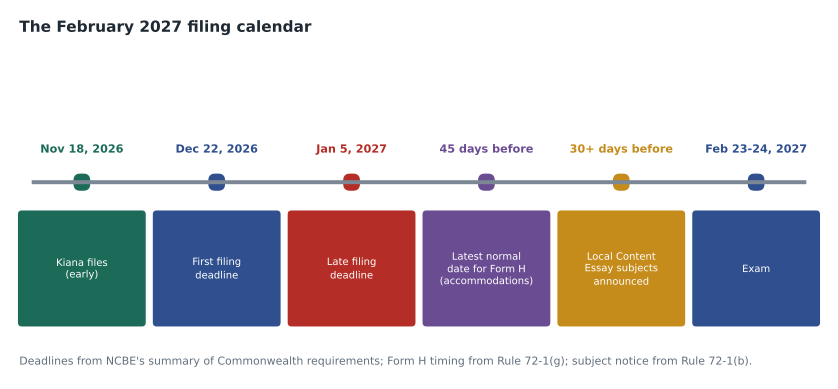
The Commonwealth gives the bar exam twice a year, in February and July, at the same time as the NCBE exam. Each administration has a first filing deadline and a later deadline. According to NCBE's current summary of Commonwealth requirements, the deadlines are as follows.
| Exam | First filing deadline | Late filing deadline |
|---|---|---|
| February 2027 | December 22, 2026 | January 5, 2027 |
| July 2027 (pattern) | May 22 | June 5 |
The deadlines are notably close to the exam compared with many states. A candidate who files on December 22 for a late February exam has roughly two months before test day. That compressed timetable has advantages and costs. A candidate can decide late, but the Board has less time to process a file that needs extra attention, and a candidate who files at the last moment and has something to explain in her character and fitness history may find that review is still open when the exam arrives. Rule 72-1(a) allows the Board to let an applicant sit while review is pending, but permission to sit is not approval, and a passing score does not guarantee admission if the review later comes out badly.
The NCBE summary lists a late filing deadline but does not list a late filing fee. The Board's own fee schedule, under Rule 71-6 on fees and refunds, controls. A candidate who must use the late deadline should check the schedule for any additional charge.
Hollis's rule for every jurisdiction is the same. 'Treat the first deadline as the real one,' she told Kiana. 'The late deadline is for emergencies.' Kiana filed on November 18, more than a month before the first deadline.
Fees
NCBE's summary lists the Commonwealth's fees. They are modest compared with many states, but they differ sharply depending on whether the applicant is already a lawyer.
| Applicant | Fee listed by NCBE |
|---|---|
| First-time applicant who is not an attorney | 500 dollars |
| Applicant who is already an attorney | 1,000 dollars |
| Repeat applicant | 500 dollars (non-attorney) or 1,000 dollars (attorney) |
| Attorney's Exam | 1,000 dollars |
| Admission on motion (limited) | 500 dollars plus the character and fitness fee |
| Laptop use | NCBE technology fee |
Some costs sit outside these fees. The MPRE is registered and paid for separately through NCBE. Character and fitness investigations conducted by NCBE carry their own charges for the applicants whose files NCBE investigates. After passing, a new admittee pays the Certificate of Admission fee to the Bar Association before taking the oath, under Rule 75-2(b). A candidate who travels from the mainland or a neighboring island also needs to budget for travel to Saipan, where the exam is given.
Fees are generally not refundable once the Board has processed an application. Rule 71-6 addresses fees and refunds for admission by examination, and a candidate who withdraws should read it before assuming money will come back.
The application itself
The application is filed with the Board on the forms it prescribes. The forms are lettered; the rules refer, for example, to Form E for legal intern applications and Form H for testing accommodations. The application asks for the applicant's education, employment, residence and legal history, and it collects the documents the Board needs to verify them.
Three practical points matter more than any others. First, completeness. NCBE's character and fitness guidance warns that incomplete or inaccurate answers cause delays, and that applicants should submit every requested document with the application. Second, consistency. The answers on the application should match the answers on the law school application, the MPRE registration and any other bar application the candidate has filed. Third, prompt responses. NCBE may contact schools, employers and courts named in the application, and the Board may follow up with questions. A candidate who answers slowly can lose a whole cycle.
Testing accommodations
Applicants who need testing accommodations file Form H. Under Rule 72-1(g), the form should generally be filed with the application and no later than 45 days before the exam, unless the applicant shows good cause for filing later. The Board may ask for documentation supporting the request.
Because the Commonwealth's filing deadlines fall so close to the exam, the 45-day rule can bite. For the February 2027 exam, an applicant who files on the late deadline of January 5 has only a few weeks before the 45-day mark. A candidate who needs accommodations should file the application and Form H together, well before the first deadline, and should gather documentation from her providers early.
Approval to sit
Once the Board has the application, the documents and the fees, it emails the applicant to say whether she is approved to sit. As noted above, the Board may allow an applicant to sit while its review of character, fitness or eligibility is still open. That is a practical accommodation for a small jurisdiction with tight deadlines, not a promise. The applicant who sits under that permission still needs final approval before she can be admitted.
Attempts and retakes
NCBE's summary states that the Commonwealth has no limit on the number of attempts. A candidate who fails may reapply for a later exam, paying the repeater fee. That is more generous than jurisdictions that cap attempts, but it is not a reason to sit unprepared. Each attempt costs money, months and morale, and scores on the two parts of the Commonwealth exam must both be passing within the same 18-month period under Rule 72-1(d), a rule lesson 6 explains.
Kiana's file
Kiana's application was straightforward. She had an ABA-approved J.D., a clean disciplinary history, an MPRE score of 88 from August 2026, and a work history that consisted of summer jobs on Rota, a law school externship and her clerkship at Quiles and Tudela. She disclosed one item she worried about: a minor traffic citation on Saipan during college that she had paid. Hollis told her that disclosure was the right decision and that a paid minor citation, candidly reported, is rarely a problem. Lesson 3 explains why candor matters more than the item itself.
She also made one decision Hollis praised. Instead of waiting for the Board's notice of Local Content Essay subjects, she started reading Commonwealth sources in November: the Covenant, the Constitution, recent Supreme Court decisions and the Commonwealth Code's titles on civil procedure, domestic relations and probate. 'You do not know the subjects yet,' Hollis said. 'But you know the universe they come from. Reading early means the announcement narrows your work instead of starting it.'
Worked problem
A late filer with an accommodation request
Benavente graduated from an ABA-approved law school in May 2026 and decides on December 30, 2026 to take the February 2027 Commonwealth exam. He has a documented disability and needs extra time. What problems does he face, and what should he do?
Show solution
- Deadline: the first deadline of December 22, 2026 has passed, so he must use the late deadline of January 5, 2027 and check Rule 71-6 for any late fee.
- Accommodations: Rule 72-1(g) says Form H should be filed with the application and no later than 45 days before the exam; with a late filing he is close to or past that mark and must show good cause.
- Documentation: he should gather supporting records immediately and file them with Form H.
- Character review: a late file gives the Board less time; he may be allowed to sit while review is pending, but that is not approval.
Answer: He should file the application and Form H together at once, with documentation and an explanation of good cause, and consider whether the July 2027 exam would be a safer choice.
Common mistakes
MistakeA degree from any accredited law school qualifies.
InsteadThe Commonwealth requires a J.D. from an ABA-approved law school.
MistakeForeign-trained lawyers can qualify with an LL.M.
InsteadNCBE lists foreign law graduates as not eligible in the Commonwealth.
MistakeThe late filing deadline is a normal filing date.
InsteadTreat the first deadline as the real one; the late deadline leaves little time for review.
MistakeAccommodation requests can be made any time before the exam.
InsteadForm H should be filed with the application and no later than 45 days before the exam, absent good cause.
MistakeApproval to sit means the applicant will be admitted.
InsteadThe Board may let an applicant sit while review is pending; final approval still comes later.
Gathering documents early
The documents that slow down a bar application are usually the ones that come from someone else. A law school's certification of graduation, transcripts, court records for any legal matter, records of past employment and, for some applicants, records from other jurisdictions all take time to obtain. A candidate who files close to the deadline and then waits for a court in another state to send a certified copy of an old record may find that her file is still incomplete on exam day.
The practical solution is to request records as soon as the decision to sit is made. A candidate should make a list of every document the application asks for, note who must provide each one and how long it usually takes, and send the requests in the same week. Copies of everything sent should be kept in a single folder, paper or electronic, along with the date of each request and any tracking information. When the Board or NCBE asks a follow-up question, the folder lets the candidate answer within a day rather than a week.
Planning around distance
The Commonwealth's location affects planning in ways candidates from the mainland may not anticipate. Mail between Saipan and the mainland takes longer than domestic mail on the mainland, courier services are more expensive, and the time difference means that a call to an office on the East Coast must be made very early in the morning or late in the evening on Saipan. A candidate living on Tinian or Rota also has to plan for travel to Saipan for the exam and, possibly, for other in-person steps. None of these are reasons to delay; they are reasons to start each step earlier than a candidate in a large state would.
Budgeting for the cycle
A candidate should build a simple budget for the whole cycle. It should include the Board's application fee, the MPRE fee, any NCBE character and fitness charges, the NCBE technology fee for laptop use, the cost of NextGen study materials, travel and lodging for the exam if she lives off Saipan, and, after passing, the Certificate of Admission fee and the first year's bar dues. Kiana's budget came to well under what classmates in large states expected to spend, mainly because the Commonwealth's application fee is modest and she did not need a commercial course for the local essays. The savings were real, but Hollis reminded her that the time cost of building her own local materials was the trade.
Summary and key terms
- The Commonwealth requires a J.D. from an ABA-approved law school; NCBE lists foreign law graduates as not eligible.
- For February 2027 the first filing deadline is December 22, 2026 and the late deadline is January 5, 2027; the July pattern is May 22 and June 5.
- NCBE lists fees of 500 dollars for non-attorneys and 1,000 dollars for attorneys and for the Attorney's Exam; Rule 71-6 governs fees and refunds.
- Accommodation requests go on Form H, generally with the application and no later than 45 days before the exam.
- The Board emails approval to sit and may allow an applicant to sit while review is pending.
- NCBE reports no limit on attempts.
- 0
- ABA-approved law school
- 1
- first filing deadline
- 2
- late filing deadline
- 3
- Rule 71-6
- 4
- Form H
- 5
- testing accommodations
- 6
- approval to sit
- 7
- repeater fee
- 8
- Certificate of Admission fee
Practice problems
Work each problem on paper first, then reveal the answer to check.
What law degree does the Commonwealth require?
Show answer
A J.D. from an ABA-approved law school.
What are the filing deadlines for the February 2027 exam?
Show answer
December 22, 2026, and a late deadline of January 5, 2027.
What fee does NCBE list for a first-time applicant who is not a lawyer?
Show answer
500 dollars.
When should Form H be filed?
Show answer
Generally with the application and no later than 45 days before the exam, absent good cause.
Lesson quiz · 5 questions
Score 60% or more to complete this lesson.
Create a free account to save your progress, take quizzes and earn a certificate.