
ACCT-351 · Lesson 1 of 12 · 29 min
The US federal income tax system: law, policy and administration
Income tax touches almost every financial decision a person makes: whether to take part of a raise as stock options, whether to buy or lease a vehicle for a side business, when to sell an investment, how to save for retirement and how to pass property to the next generation. Accountants are asked about all of these, often informally, and the answers depend on a large body of law that changes every year. This course teaches the federal income taxation of individuals under the Internal Revenue Code: who is taxed, how gross income, adjusted gross income and taxable income are computed, how wages, business income, investment income and capital gains are treated, which deductions and credits reduce tax, and how returns are filed, examined and disputed. ACCT-352 continues with C corporations, S corporations, partnerships, state and local taxes and tax planning.
Tax law changes often and depends on facts; figures are for the 2026 tax year as published by late 2025 and 2026, and should be confirmed with the IRS or a qualified tax professional before they are relied on.
Throughout the course we follow one invented family. Leah Brandt, 41, is a quality engineer at Red River Instruments Inc. in Des Moines, Iowa. She also runs a small drone inspection and photography business, Brandt Aerial, on evenings and weekends, owns a rental condominium, and holds a modest portfolio of shares. Her spouse, Tomás, works part time as a dental hygienist, and they have a six-year-old daughter, Nora. They file a joint return. Each lesson adds a piece of the Brandts' 2026 tax picture, and lesson 12 assembles their complete federal return. All of the people, businesses and numbers are invented.
Why governments tax income
The individual income tax is the largest source of federal revenue in the United States, providing roughly half of it in recent years; payroll taxes for Social Security and Medicare are the second largest. Governments use the income tax for three broad purposes. The first is to raise revenue to pay for public services and transfers. The second is to redistribute income: a progressive rate structure takes a larger share of higher incomes, and refundable credits such as the earned income tax credit deliver money to lower-income families through the same system. The third is to influence behavior: retirement accounts, health savings accounts, the charitable deduction and many other provisions reward activities that Congress wants to encourage.
Provisions of the third kind are often called tax expenditures, because they cost the government revenue in the same way a spending program would. Finance departments publish annual estimates of their cost. Looking at a deduction or credit as a spending program is useful discipline: it prompts questions about who benefits, whether the benefit reaches the intended group and whether a direct grant would work better.
What makes a tax system good
Economists and tax commissions have long judged tax systems against a short list of criteria. No real system satisfies all of them, because they pull against each other, but they give a vocabulary for evaluating proposals and for understanding why the law looks the way it does.
| Criterion | Meaning | Example of the trade-off |
|---|---|---|
| Horizontal equity | People in similar circumstances pay similar tax | Two families with the same income should pay the same, but defining "same circumstances" requires rules about family size, disability and costs of earning income |
| Vertical equity | People with greater ability to pay contribute a larger share | Progressive rates achieve this but raise the reward for shifting income to lower-taxed family members |
| Neutrality (efficiency) | Taxes should distort economic choices as little as possible | Preferential treatment of capital gains encourages investment but also encourages converting ordinary income into gains |
| Simplicity | Rules are easy to understand and comply with | Targeted credits help specific groups but add forms, conditions and errors |
| Certainty | Taxpayers can know their liability in advance | Broad anti-avoidance rules protect the tax base but leave some transactions uncertain |
| Adequacy | The system raises the revenue required | Rate cuts and new incentives reduce revenue unless other taxes rise |
US tax policy debates have revolved around these trade-offs since the income tax began. The Tax Reform Act of 1986 broadened the base and lowered rates in the name of neutrality and simplicity; later laws added many targeted credits and deductions. The Tax Cuts and Jobs Act of 2017 roughly doubled the standard deduction, which simplified filing for millions of households, while capping the deduction for state and local taxes. The One Big Beautiful Bill Act, signed on 4 July 2025, made most of the 2017 individual changes permanent and added new temporary deductions for tips, overtime pay, car loan interest and taxpayers aged 65 and over, a clear example of the system being used for targeted relief at the cost of simplicity.
Rates: marginal and average
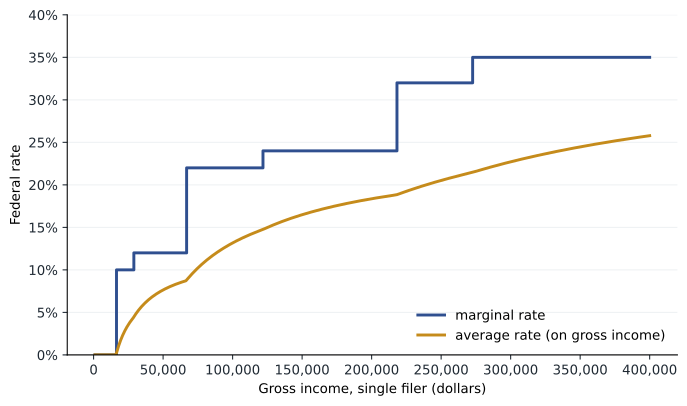
The federal income tax is progressive: taxable income is divided into brackets, and each bracket is taxed at its own rate. For 2026 a single filer pays 10 percent on the first $12,400 of taxable income, 12 percent up to $50,400, 22 percent up to $105,700, 24 percent up to $201,775, 32 percent up to $256,225, 35 percent up to $640,600 and 37 percent above that. Married couples filing jointly have brackets roughly twice as wide, so that marriage does not usually push a two-earner couple into a higher bracket, except in the top bracket. Thresholds are indexed to inflation each year. Most states levy their own income taxes, at flat or graduated rates, while a handful, including Texas and Florida, have no broad-based individual income tax.
Two rates matter for decisions. The marginal rate is the rate on the next dollar of income; it tells you how much of a raise, a bonus or an extra deduction is worth. The average rate is total tax divided by income; it tells you what share of income goes to tax overall. Because only income above each threshold is taxed at the higher rate, moving into a higher bracket never reduces after-tax income, a point many people misunderstand. The program below computes both rates for a range of incomes using the 2026 federal figures.
# Federal income tax on taxable income, single filer, 2026 (illustrative)
BRACKETS = [(12_400, 0.10), (50_400, 0.12), (105_700, 0.22), (201_775, 0.24),
            (256_225, 0.32), (640_600, 0.35), (float('inf'), 0.37)]
STANDARD_DEDUCTION = 16_100

def tax_on(taxable):
    tax, lower = 0.0, 0.0
    for upper, rate in BRACKETS:
        if taxable > lower:
            tax += (min(taxable, upper) - lower) * rate
        lower = upper
    return tax

def marginal_rate(taxable):
    for upper, rate in BRACKETS:
        if taxable <= upper:
            return rate

print(f"{'gross inc':>10}{'taxable':>10}{'tax':>10}{'avg (gross)':>12}{'marginal':>9}")
for income in [20_000, 45_000, 80_000, 120_000, 200_000, 400_000]:
    taxable = max(0, income - STANDARD_DEDUCTION)
    tax = tax_on(taxable)
    print(f"{income:>10,}{taxable:>10,}{tax:>10,.0f}{tax / income:>12.1%}"
f"{marginal_rate(taxable):>9.1%}") gross inc taxable tax avg (gross) marginal
20,000 3,900 390 1.9% 10.0%
45,000 28,900 3,220 7.2% 12.0%
80,000 63,900 8,770 11.0% 22.0%
120,000 103,900 17,570 14.6% 22.0%
200,000 183,900 36,734 18.4% 24.0%
400,000 383,900 103,134 25.8% 35.0%Two features stand out. First, the average rate is always well below the marginal rate, because the lower brackets apply to everyone. A single filer with $120,000 of gross income has a marginal federal rate of 22 percent, but pays only 14.6 percent of gross income in federal income tax. Second, the standard deduction of $16,100 works as a zero-rate band: the first $16,100 of income bears no federal income tax at all. The figures ignore payroll taxes, credits and state income taxes, all of which change the picture for real households; lesson 5 adds payroll taxes, and lesson 11 adds credits.
Worked problem
Is a raise ever bad for you?
A single colleague of Leah's has $104,000 of taxable income and is offered a $3,000 raise. He worries that it will "push him into the 24 percent bracket" and leave him worse off. Compute the additional federal income tax.
Show solution
- The 22 percent bracket ends at $105,700, so the first $1,700 of the raise is taxed at 22 percent: $374.00.
- The remaining $1,300 is taxed at 24 percent: $312.00.
- Additional federal income tax: $686.00; he keeps $2,314.00 before state tax and payroll taxes.
Answer: He pays $686 more federal income tax and is $2,314 better off. Only the income above the threshold is taxed at the higher rate.
Where tax law comes from
Article I of the Constitution gives Congress the power to lay and collect taxes, but the original text required "direct" taxes to be apportioned among the states by population. In Pollock v. Farmers' Loan & Trust Co. (1895) the Supreme Court held that a tax on income from property was a direct tax, effectively striking down the income tax of 1894. The Sixteenth Amendment, ratified in 1913, removed the apportionment requirement for taxes on incomes "from whatever source derived", and the modern federal income tax began that year. States tax income under their own constitutions and laws, usually starting from federal adjusted gross income or taxable income and then adjusting it.
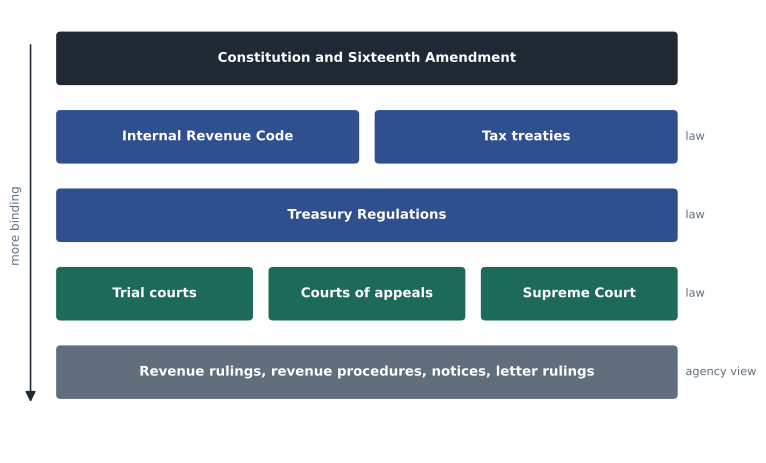
The main source of federal tax law is the Internal Revenue Code, Title 26 of the United States Code. The current code is the Internal Revenue Code of 1986, as amended many times since. Subtitle A covers income taxes. Section 1 imposes the tax and sets the rates; section 61 defines gross income as "all income from whatever source derived"; sections 62 and 63 define adjusted gross income and taxable income; sections 101 to 140 list exclusions; sections 161 to 199A allow deductions; and sections 1001 to 1092 and 1201 to 1298 govern gains, losses and capital assets. Citations such as section 162(a) or §162(a) refer to section 162, subsection (a). Students do not need to memorize section numbers, but practitioners use them constantly, and you will see the key ones throughout this course.
Below the Code sit Treasury Regulations, issued by the Treasury Department as final, temporary or proposed regulations. Tax treaties with more than 60 countries allocate taxing rights for cross-border income. Court decisions interpret the law: a taxpayer may litigate in the US Tax Court without paying the disputed tax first, or pay and sue for a refund in a federal district court or the Court of Federal Claims; appeals go to the circuit courts of appeals and, rarely, the Supreme Court. In Loper Bright Enterprises v. Raimondo (2024) the Supreme Court overruled the Chevron doctrine, so courts no longer defer to an agency's reasonable interpretation of an ambiguous statute; they decide for themselves what the statute means. Regulations that implement an express delegation of authority still carry weight, but interpretive regulations are now more open to challenge.
The IRS publishes a large body of administrative guidance: revenue rulings, which apply the law to specific facts and may be relied on by all taxpayers with the same facts; revenue procedures, which explain how to comply; notices and announcements; and private letter rulings, which bind the IRS only for the taxpayer that requested them. Publications and form instructions are helpful but are not authority. A careful adviser reads the statute first, then the regulations and cases, then the administrative position, and notes where they diverge.
Self-assessment and administration
The US income tax works on self-assessment: individuals calculate their own tax and file Form 1040, generally by 15 April of the following year. The IRS processes the return and may later examine it and propose adjustments. Information returns such as Form W-2 for wages and the Form 1099 series for interest, dividends, broker sales and payments to contractors let the IRS match most income automatically, and employers withhold income tax and payroll taxes from wages. The system depends on voluntary compliance backed by examinations, penalties and, for willful evasion, prosecution.
Individuals have rights in this process. The Taxpayer Bill of Rights, which the IRS adopted in 2014 and Congress wrote into section 7803(a)(3) in 2015, lists ten rights, including the right to be informed, to quality service, to pay no more than the correct amount of tax, to challenge the IRS's position and be heard, to appeal in an independent forum, to finality, to privacy and to confidentiality. Lesson 12 covers examinations, appeals and litigation in detail.
Evasion, avoidance and planning
Tax evasion is the willful attempt to evade or defeat tax; it is a felony under section 7201, punishable by fines and up to five years in prison. Tax avoidance is different: it uses the law to reduce tax, and most of it is legitimate tax planning, such as contributing to a 401(k), harvesting capital losses or timing a sale. Some avoidance, however, uses transactions that comply with the letter of the law while defeating its purpose. Courts have long applied judicial doctrines against such schemes: the sham transaction doctrine, the substance-over-form doctrine, the step transaction doctrine and the business purpose test from Gregory v. Helvering (1935). In 2010 Congress codified the economic substance doctrine in section 7701(o): where the doctrine is relevant, a transaction has economic substance only if it changes the taxpayer's economic position in a meaningful way apart from federal income tax effects and the taxpayer has a substantial non-tax purpose. A strict-liability penalty of 20 percent, rising to 40 percent if the transaction was not adequately disclosed, applies to underpayments from transactions lacking economic substance.
The line between planning and abusive avoidance is not always bright, and reasonable advisers disagree about particular arrangements. A useful question is whether the arrangement uses a provision for the purpose Parliament or Congress intended, such as saving for retirement through a registered plan, or uses a combination of provisions to reach a result nobody intended, such as creating losses that do not correspond to any real economic loss.
Professional responsibilities in tax practice
Paid preparers must obtain a preparer tax identification number (PTIN) and sign the returns they prepare. Accountants who practice before the IRS are governed by Circular 230 (Title 31 of the Code of Federal Regulations, Part 10), which requires due diligence, prohibits unreasonable delay and conflicts of interest without consent, sets standards for written advice and prohibits signing a return that takes a position lacking a reasonable basis or that is a willful attempt to understate tax. The AICPA's Statements on Standards for Tax Services, revised effective 1 January 2024, add professional standards for members, including the use of data, reasonable assumptions and quality control. Section 6694 imposes penalties on preparers for understatements due to unreasonable positions, and section 7216 makes it a crime to disclose or use return information without the taxpayer's consent. The limited federally authorized tax practitioner privilege in section 7525 does not cover return preparation or criminal matters.
In practice, the most common ethical problems are ordinary ones: a client who wants a deduction recorded without receipts, a client who asks to leave a cash receipt off the return, or an adviser who discovers an error in a prior year's return. The professional response is the same in both countries: explain the law and the consequences, recommend correcting the error, document the advice, and withdraw from the engagement if the client insists on filing a return the accountant knows to be false.
| Concept | United States | Why it matters |
|---|---|---|
| Main statute | Internal Revenue Code (Title 26) | All analysis starts with the statutory text |
| Administrator | Internal Revenue Service | Assesses, audits and collects |
| Annual return | Form 1040, due 15 April | Self-assessment is the base of the system |
| Trial court | US Tax Court, district courts, Court of Federal Claims | Where disputes are heard |
| Anti-avoidance | Economic substance doctrine, s. 7701(o) | Limits planning that defeats the purpose of the law |
| Sub-national tax | State and some local income taxes | Combined rates are much higher than federal rates alone |
Common mistakes
MistakeBelieving that moving into a higher bracket taxes all of your income at the higher rate.
InsteadOnly income above the threshold is taxed at the higher rate; a raise always increases after-tax income under the brackets alone.
MistakeTreating administrative guidance as if it were law.
InsteadRevenue rulings and publications show the IRS's view; the Code, regulations and court decisions are the law.
MistakeCalling all tax reduction 'avoidance' and therefore suspect.
InsteadMost tax planning uses provisions as intended; anti-avoidance rules target arrangements that defeat a provision's purpose.
MistakeQuoting only the federal rate when estimating someone's tax.
InsteadAdd state and local income taxes and payroll taxes.
MistakeAssuming communications with an accountant are privileged.
InsteadThe section 7525 privilege is narrow and does not cover return preparation or criminal matters.
Summary and key terms
- The individual income tax is the largest source of federal revenue in the United States.
- Income tax raises revenue, redistributes income and steers behavior through tax expenditures.
- Equity, neutrality, simplicity, certainty and adequacy are the standard criteria, and they trade off against each other.
- Federal 2026 rates run from 10 to 37 percent; most states add their own tax.
- The marginal rate guides decisions; the average rate measures the overall burden.
- The Code, regulations, treaties and court decisions are law; IRS guidance shows the agency's position.
- The system relies on self-assessment, information reporting and withholding, backed by audits and penalties.
- The codified economic substance doctrine and judicial doctrines limit abusive avoidance.
- Professional codes require integrity, due care and confidentiality in tax work.
- Economic substance doctrine
- The rule, codified in section 7701(o), that a transaction must change the taxpayer's economic position and have a substantial non-tax purpose to produce tax benefits.
- Revenue ruling
- Published IRS guidance applying the law to a specific set of facts.
- Circular 230
- The Treasury regulations governing practice before the IRS.
- Marginal tax rate
- The rate of tax on the next dollar of income.
- Average tax rate
- Total tax divided by income.
- Progressive tax
- A tax whose average rate rises as income rises.
- Tax expenditure
- Revenue given up through a deduction, exemption or credit, viewed as equivalent to spending.
- Horizontal equity
- The principle that people in similar circumstances should pay similar tax.
- Vertical equity
- The principle that people with greater ability to pay should pay more.
- Self-assessment
- A system in which taxpayers compute and report their own tax, subject to review.
- Tax evasion
- Deliberately not paying tax that is legally owed, a crime.
- Tax avoidance
- Arranging affairs to reduce tax within the law; abusive avoidance defeats the law's purpose.
Practice problems
Work each problem on paper first, then reveal the answer to check.
What are the three broad purposes of an income tax?
Show answer
Raising revenue, redistributing income and influencing behavior.
Explain the difference between horizontal and vertical equity.
Show answer
Horizontal equity treats people in similar circumstances alike; vertical equity asks those with greater ability to pay to pay more.
Using the 2026 single brackets, what is the tax on $60,000 of taxable income?
Show answer
$1,240 + $4,560 (12 percent of $38,000) + $2,112 (22 percent of $9,600) = $7,912.
In the rates program, add an income of $1,000,000. What happens to the average rate?
Show answer
It rises to about 32.0 percent of gross income, approaching but never reaching the 37 percent top rate.
Why must a resident of most states file a state return as well as a federal one?
Show answer
States levy their own income taxes under their own laws, usually starting from federal AGI.
Does a private letter ruling issued to another taxpayer bind the IRS in your case?
Show answer
No. It binds the IRS only for the taxpayer that requested it.
Distinguish tax evasion from tax avoidance.
Show answer
Evasion is deliberate non-compliance and a crime; avoidance uses the law to reduce tax and is legal unless an anti-avoidance rule applies.
What two conditions does section 7701(o) impose for a transaction to have economic substance?
Show answer
It must change the taxpayer's economic position in a meaningful way apart from tax effects, and the taxpayer must have a substantial non-tax purpose.
A client asks you to leave out cash fees from a side business. What should you do?
Show answer
Explain that the income is taxable and the consequences of omitting it, recommend reporting it, document the advice and withdraw if the client insists.
Lesson quiz · 5 questions
Score 60% or more to complete this lesson.
Create a free account to save your progress, take quizzes and earn a certificate.