
ACCT-212 · Lesson 9 of 12 · 24 min
Employee future benefits and pensions
Northlake's employees earn more than salary while they work. Many will receive pensions after they retire, some will keep health and dental benefits in retirement, and all have earned vacation and other benefits that will be paid later. These promises are compensation for service rendered now, so their cost belongs in the periods when employees work, not when cash is eventually paid decades later. Measuring that cost is hard: it depends on how long employees will work, how much their salaries will rise, how long they will live and what interest rates and investment returns will be. This lesson explains how pension and other post-employment benefits are accounted for, focusing on defined benefit plans, where the frameworks differ most.
Defined contribution and defined benefit plans
In a defined contribution plan, the employer promises only to contribute a specified amount, for example 5 percent of salary, to an account for each employee. The employee's eventual pension depends on the contributions and the investment returns earned on them; the employee bears the investment risk. Accounting is simple: the employer recognizes the required contribution as an expense in the period the employee works, and a liability for any contribution not yet paid. Most new private-sector plans in both countries are defined contribution plans, including group registered retirement savings plans in Canada and 401(k) plans in the United States.
In a defined benefit plan, the employer promises a specified pension at retirement, typically based on years of service and final or average salary, for example 2 percent of the average of the best five years' salary for each year of service. The employer bears the investment and longevity risk: if plan assets earn less than expected or retirees live longer, the employer must contribute more. Defined benefit plans remain common in the public sector, in large unionized companies and among older employers. Their accounting requires actuarial estimates and is the subject of the rest of this lesson.
In the United States, private pension plans are regulated by the Employee Retirement Income Security Act of 1974 (ERISA), which sets minimum funding standards, and are insured up to limits by the Pension Benefit Guaranty Corporation. Funding contributions are set under ERISA and the Internal Revenue Code and usually differ from the accounting cost. Social Security contributions (lesson 1) are payroll taxes, not employer pension plans.
Measuring a defined benefit obligation
The defined benefit obligation (called the projected benefit obligation in US GAAP) is the present value of the benefits employees have earned to date, taking into account expected future salary increases. Actuaries measure it using the projected unit credit method: each year of service earns one unit of benefit, projected to retirement using expected salary growth, and discounted to the present. The main assumptions are demographic (employee turnover, retirement age, mortality, using tables such as the Canadian Pensioners' Mortality tables or the US Pri-2012 tables with improvement scales) and financial (salary growth, inflation and the discount rate).
ASC 715, Compensation – Retirement Benefits, requires the discount rate to reflect the rates at which the benefits could be effectively settled, typically derived from a yield curve of high-quality (AA) corporate bonds matching the plan's expected cash flows. Because the obligation is long-dated, small changes in the discount rate have large effects. Plan assets are measured at fair value. The funded status, the projected benefit obligation minus plan assets, is recognized on the balance sheet as a liability (underfunded) or asset (overfunded); there is no asset ceiling as under IFRS.
Recognizing the cost under ASC 715
ASC 715 computes net periodic pension cost from several components: service cost; interest cost on the projected benefit obligation; minus the expected return on plan assets, using a long-term expected rate of return chosen by management; plus amortization of prior service cost from plan amendments; and plus amortization of net actuarial gains or losses. Actuarial gains and losses, including the difference between actual and expected returns on assets, are first recognized in other comprehensive income. They are amortized into net periodic cost only to the extent the cumulative net gain or loss in accumulated OCI exceeds a 'corridor' of 10 percent of the greater of the projected benefit obligation and the market-related value of plan assets at the start of the year, spread over the average remaining service period of active employees. Since ASU 2017-07, only service cost is presented in operating income; the other components are presented outside operating income.
Worked problem
One year of Northlake's pension plan
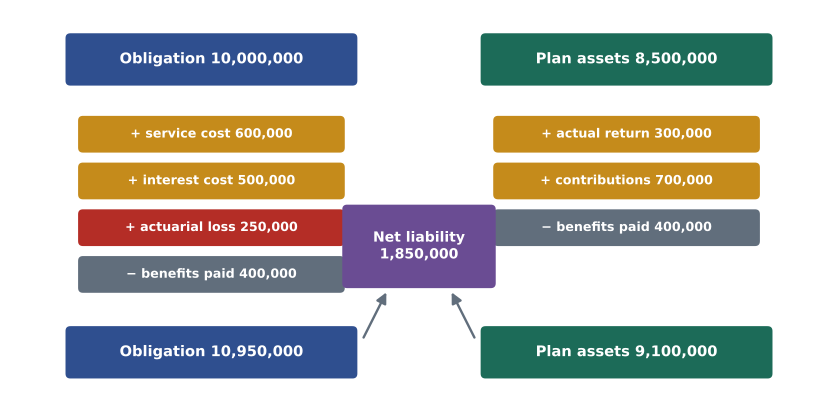
At 1 January 2027, Northlake's defined benefit obligation is $10,000,000 and plan assets are $8,500,000. The discount rate is 5 percent. During 2027: service cost $600,000; contributions $700,000 (paid at year end); benefits paid $400,000 (at year end); actual return on assets $300,000; an actuarial loss of $250,000 on the obligation from lower assumed mortality.
Show solution
- Service cost (operating): $600,000. Interest cost: 5% × 10,000,000 = $500,000.
- Expected return on assets at an assumed 6.5 percent: 8,500,000 × 6.5% = $552,500, reducing cost.
- Amortization of the opening net loss in AOCI of $1,400,000: corridor 10% × 10,000,000 = 1,000,000; excess 400,000 ÷ 10 years = $40,000.
- Net periodic pension cost: 600,000 + 500,000 − 552,500 + 40,000 = $587,500. Funded status at year end: 10,950,000 − 9,100,000 = $1,850,000 liability.
Answer: Net periodic pension cost $587,500 ($600,000 operating, −$12,500 non-operating); funded status liability $1,850,000.
# One year of a defined benefit plan: IAS 19 compared with ASC 715
dbo0, assets0, rate = 10_000_000, 8_500_000, 0.05
service, contrib, benefits = 600_000, 700_000, 400_000
actual_return, actuarial_loss = 300_000, 250_000
expected_rate, aoci_loss0, service_years = 0.065, 1_400_000, 10

dbo1 = dbo0 + service + dbo0 * rate - benefits + actuarial_loss
assets1 = assets0 + actual_return + contrib - benefits
print(f"Closing obligation {dbo1:,.0f}; closing assets {assets1:,.0f}; net liability {dbo1 - assets1:,.0f}")

# IAS 19
net_interest = rate * (dbo0 - assets0)
remeasure = actuarial_loss + (assets0 * rate - actual_return)
print(f"IAS 19: profit or loss {service + net_interest:,.0f} (service {service:,} + net interest {net_interest:,.0f}); OCI loss {remeasure:,.0f}")

# ASC 715
interest_cost = dbo0 * rate
expected_return = assets0 * expected_rate
corridor = 0.10 * max(dbo0, assets0)
amort = max(0, aoci_loss0 - corridor) / service_years
npc = service + interest_cost - expected_return + amort
oci_loss = actuarial_loss + (expected_return - actual_return)
print(f"ASC 715: net periodic cost {npc:,.0f} (operating {service:,}, other {npc - service:,.0f})")
print(f"ASC 715: OCI loss {oci_loss:,.0f}; amortization out of AOCI {amort:,.0f}; closing AOCI loss {aoci_loss0 + oci_loss - amort:,.0f}")Closing obligation 10,950,000; closing assets 9,100,000; net liability 1,850,000 IAS 19: profit or loss 675,000 (service 600,000 + net interest 75,000); OCI loss 375,000 ASC 715: net periodic cost 587,500 (operating 600,000, other -12,500) ASC 715: OCI loss 502,500; amortization out of AOCI 40,000; closing AOCI loss 1,862,500
The program confirms that both frameworks report the same net liability, $1,850,000, because both recognize the funded status in full. They differ in how much goes through profit or loss. IAS 19 charges $675,000 to profit or loss and $375,000 to OCI, and the OCI amount never returns to profit or loss. ASC 715 charges $587,500 to net income, lower because the 6.5 percent expected return exceeds the 5 percent discount rate, and records a $502,500 loss in OCI, of which a portion will be amortized into future pension cost through the corridor. The choice of expected return is a management assumption under US GAAP, which is why analysts scrutinize it; IAS 19 removed that judgment from profit or loss in 2013.
Past service cost, settlements and curtailments
When a plan is amended to grant benefits for past service, ASC 715 recognizes the cost in OCI as prior service cost and amortizes it into net periodic cost over the remaining service period of affected employees. Reductions in benefits create prior service credits treated similarly. Settlements and curtailments trigger recognition of part of the gains, losses and prior service cost held in AOCI. US GAAP therefore spreads the effect of plan amendments, while IFRS recognizes it at once. Large annuity purchases, often called pension risk transfers, have become common for US companies seeking to shrink their pension exposure.
Other post-employment and long-term benefits
Other post-retirement benefits (OPEB), such as retiree health care and life insurance, are accounted for under ASC 715-60 using the same approach as pensions, with assumptions about health care cost trend rates. Because many US employers historically promised retiree health coverage before Medicare eligibility at 65, OPEB obligations can be large, and many companies have cut or capped these benefits. Postemployment benefits for former employees before retirement, such as severance and disability, fall under ASC 712.
How IFRS and US GAAP compare
Both IFRS and US GAAP recognize the full funded status on the balance sheet, but their income statement effects differ. IFRS uses the discount rate for both interest cost and the return on assets (net interest), sends all remeasurements to OCI permanently and recognizes past service cost immediately. US GAAP uses an expected return on assets, amortizes gains and losses through the corridor and amortizes prior service cost. Canada's ASPE recognizes everything in net income and allows the funding valuation to be used. An IFRS reporter with the same plan usually reports higher pension cost in profit or loss than a US GAAP reporter when expected returns exceed the discount rate.
| Feature | ASC 715 | IAS 19 (for comparison) |
|---|---|---|
| Balance sheet | Funded status, no ceiling | Net liability or asset, with asset ceiling |
| Return on assets in income | Expected long-term rate | Discount rate (within net interest) |
| Actuarial gains and losses | OCI, amortized through the corridor | OCI, never recycled |
| Prior service cost | OCI, then amortized | Immediately in profit or loss |
| Presentation | Only service cost in operating income | Entity chooses where to present net interest |
Reading pension disclosures
Pension notes are long but informative. They show reconciliations of the obligation and plan assets, the components of cost, the major assumptions and a sensitivity analysis showing how the obligation would change if the discount rate, salary growth or life expectancy changed. Readers should compare the discount rate with those of peers, check whether the plan's deficit is growing, and look at expected contributions for the coming year, which affect cash flow. A large deficit is effectively debt: analysts often add the net pension liability, after tax, to borrowings when computing leverage.
Common mistakes
MistakeExpensing only the cash contributed to a defined benefit plan.
InsteadRecognize the service cost and interest (and, under US GAAP, expected returns and amortization) regardless of funding.
MistakeUsing the discount rate for the return on plan assets.
InsteadASC 715 uses the expected long-term rate of return in net periodic cost.
MistakeLeaving all actuarial losses in AOCI indefinitely.
InsteadLosses beyond the 10 percent corridor are amortized into net periodic cost.
MistakeIgnoring a plan amendment that raises benefits for past service.
InsteadRecognize prior service cost in OCI and amortize it.
MistakeTreating the funding valuation as the accounting measure for every entity.
InsteadOnly ASPE allows a funding valuation; IFRS and US GAAP require an accounting valuation using their own assumptions.
Summary and key terms
- Defined contribution plans are expensed as contributions are required; the employee bears the investment risk.
- Defined benefit plans promise a pension formula; the employer bears investment and longevity risk.
- The obligation is measured actuarially using the projected unit credit method and a high-quality corporate bond discount rate.
- Both frameworks recognize the net funded status on the balance sheet.
- ASC 715 uses an expected return and the 10 percent corridor to amortize gains and losses from AOCI.
- Prior service cost is recognized in OCI and amortized; only service cost is operating.
- Pension deficits and assumptions deserve the same attention as borrowings.
- Projected benefit obligation
- The present value of benefits earned to date, including expected salary growth.
- Expected return on plan assets
- Management's long-term expected rate of return, used in net periodic pension cost.
- Corridor
- Ten percent of the greater of the obligation and asset value, beyond which gains and losses are amortized.
- Prior service cost
- The cost of plan amendments granting benefits for past service, amortized from AOCI.
- Defined contribution plan
- A plan in which the employer's obligation is limited to specified contributions.
- Defined benefit plan
- A plan that promises a pension determined by a formula, usually based on service and salary.
- Projected unit credit method
- An actuarial method that attributes benefits to each year of service, projected with expected salary growth.
- Plan assets
- Investments held by a separate fund to pay employee benefits.
- Service cost
- The present value of benefits earned by employees in the period.
- Actuarial gains and losses
- Changes in the obligation from experience and changes in assumptions.
- Settlement
- A transaction that eliminates further obligation for some or all benefits, such as an annuity purchase.
- Funded status
- The difference between the benefit obligation and plan assets.
Practice problems
Work each problem on paper first, then reveal the answer to check.
An employer must contribute 6 percent of a $50,000 salary to a defined contribution plan. Expense?
Show answer
$3,000.
Opening obligation $4 million, assets $3.4 million, discount rate 4 percent. IAS 19 net interest?
Show answer
$24,000.
Same plan: actual return $100,000. IAS 19 remeasurement on assets?
Show answer
Interest income $136,000; shortfall of $36,000 to OCI.
Under ASC 715, expected return 6 percent on $3.4 million. Expected return?
Show answer
$204,000.
Opening AOCI net loss $900,000; obligation $5 million; assets $4.2 million; service period 12 years. Amortization?
Show answer
(900,000 − 500,000) ÷ 12 = $33,333.
Rerun the pension program with an expected return of 5 percent. What happens to ASC 715 cost?
Show answer
The expected return falls to $425,000, so net periodic cost rises to $715,000; IAS 19 cost is unchanged.
A plan amendment raises past benefits by $300,000. IFRS treatment?
Show answer
Past service cost of $300,000 in profit or loss immediately.
Same amendment under US GAAP?
Show answer
Prior service cost in OCI, amortized over remaining service.
Why does a fall in the discount rate increase the obligation?
Show answer
Future benefits are discounted at a lower rate, raising their present value.
How might an analyst treat a $1.85 million pension deficit when computing leverage?
Show answer
Add it, after tax, to debt.
Lesson quiz · 5 questions
Score 60% or more to complete this lesson.
Create a free account to save your progress, take quizzes and earn a certificate.