
ACCT-212 · Lesson 6 of 12 · 29 min
Leases II: remeasurement, sale-and-leaseback and lessors
Lesson 5 measured a simple lease at commencement and followed it to the end. Leases in practice change: rents rise with inflation, tenants extend or shrink their space, companies sell buildings and lease them back, and many companies are lessors as well as lessees. This lesson covers remeasurement and modifications of lessee leases, sale-and-leaseback transactions, subleases and the lessor's side, which both boards largely carried forward from the earlier standards. Northlake provides the examples: its warehouse lease is indexed to inflation, it sells and leases back its head office, and it leases monitoring stations to municipalities that prefer not to buy them.
Remeasuring the lease liability
After commencement, the lessee remeasures the lease liability when the lease payments change. The remeasurement is recognized as an adjustment to the right-of-use asset (or in profit or loss if the asset has been reduced to zero). The rate used depends on why the payments changed. If the change results from a reassessment of the lease term, of a purchase option or of a floating interest rate, the liability is remeasured using a revised discount rate at the reassessment date. If the change results from an index or rate, such as the consumer price index, or from a change in amounts expected under a residual value guarantee, the original discount rate is kept.
Under ASC 842, a lessee does not remeasure the liability merely because an index or rate changes; the changes are recognized as variable lease cost in the period incurred, unless the liability is remeasured for another reason, such as a change in lease term, at which point the updated index is used. This is a further IFRS–US GAAP difference.
Worked problem
An inflation-indexed rent
Northlake's warehouse lease from lesson 5 provides that, from year 3, rent is adjusted for the change in the consumer price index since commencement. At the start of year 3 the index has risen 3 percent, so the remaining three payments become $206,000. The carrying amount of the liability at that date is $534,602. What happens?
Show solution
- Under ASC 842 the liability is not remeasured for the index change alone.
- The extra $6,000 a year is recognized as variable lease cost when incurred.
- An IFRS 16 reporter would instead increase the liability and right-of-use asset by $16,038 and spread the effect through depreciation and interest.
- If Northlake later reassessed the lease term, it would remeasure the liability using the current index then.
Answer: No remeasurement; $6,000 a year of variable lease cost.
Lease modifications
A lease modification is a change in the scope of a lease or its consideration that was not part of the original terms, such as adding or removing space, extending or shortening the term, or changing the rent. A modification is accounted for as a separate new lease if it increases the scope by adding the right to use one or more underlying assets and the consideration increases by an amount commensurate with the standalone price for that added scope. Otherwise, the lessee remeasures the existing lease liability using a revised discount rate at the modification date. For a modification that decreases scope, such as giving up a floor of a building, the lessee first reduces the right-of-use asset proportionately and recognizes a gain or loss, then adjusts for the remaining change in the liability.
During the COVID-19 pandemic, both boards offered temporary relief so that lessees did not have to assess whether rent concessions were modifications. That relief has expired, but the episode showed how often lease terms change in practice and how much work remeasurements require. Many companies now use lease accounting software that tracks each lease's payments, options and index provisions.
Sale-and-leaseback transactions
In a sale-and-leaseback, a company sells an asset, often real estate, and leases it back from the buyer. The seller-lessee raises cash while keeping the use of the asset. The first question in both frameworks is whether the transfer is a sale under the revenue standard (IFRS 15 or ASC 606): has control of the asset passed to the buyer-lessor? A leaseback alone does not prevent sale treatment, but a repurchase option at anything other than fair value usually does. If the transfer is not a sale, the seller keeps the asset on its books and treats the cash as a financial liability.
If the transfer is a sale and the leaseback is not a finance lease, ASC 842 recognizes the full gain on sale immediately, measured as the difference between the sale price (adjusted for off-market terms) and the carrying amount, and accounts for the leaseback as a new lease with the right-of-use asset measured at the present value of the leaseback payments. If the leaseback is a finance lease, the transfer is not a sale, and the seller treats it as a financing. IFRS 16 instead restricts the gain to the rights actually transferred.
Worked problem
Selling and leasing back the head office
Northlake sells its head office, carrying amount $4 million, for its fair value of $6 million and leases it back for ten years. The present value of the leaseback payments is $2.4 million. The transfer qualifies as a sale. What is recognized?
Show solution
- The leaseback is not a finance lease, so sale accounting applies.
- Gain on sale: 6.0 − 4.0 = $2.0 million, recognized in full.
- Right-of-use asset and lease liability: $2.4 million each, the present value of the leaseback payments.
- An IFRS reporter would recognize only $1.2 million of gain and a $1.6 million right-of-use asset.
Answer: Gain of $2.0 million and a right-of-use asset of $2.4 million.
Lessor accounting
Both boards decided that lessor accounting under the old standards worked well enough, so IFRS 16 and ASC 842 largely carried it forward. A lessor classifies each lease at inception. Under ASC 842, a lessor classifies a lease as a sales-type lease if it meets any of the five criteria used by lessees (lesson 5). If none is met, it is a direct financing lease if the present value of payments plus any residual value guaranteed by third parties is substantially all of the fair value and collection is probable; otherwise it is an operating lease.
For a finance (or sales-type) lease, the lessor derecognizes the underlying asset and recognizes a net investment in the lease, the present value of lease payments receivable plus any unguaranteed residual value. A manufacturer or dealer lessor, such as Northlake leasing its own stations, recognizes revenue at the lower of the asset's fair value and the present value of lease payments, cost of sales equal to the carrying amount less the present value of any unguaranteed residual, and therefore selling profit at commencement. Interest income is then recognized over the lease term on the net investment using the rate implicit in the lease. For an operating lease, the lessor keeps the asset, depreciates it and recognizes lease income on a straight-line basis.
Worked problem
Northlake as a manufacturer lessor
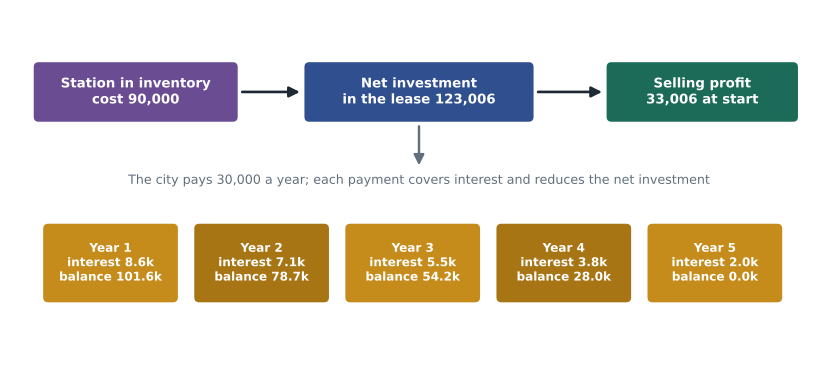
A city leases a monitoring station from Northlake for its five-year economic life, paying $30,000 at the end of each year. The rate implicit in the lease is 7 percent; the station cost Northlake $90,000 to build. There is no residual value. How does Northlake account for the lease?
Show solution
- The lease covers the whole economic life, so it is a finance (sales-type) lease.
- Present value of payments: 30,000 × [1 − 1.07⁻⁵] ÷ 0.07 = $123,006, equal to the fair value.
- At commencement: revenue $123,006; cost of sales $90,000; selling profit $33,006. Debit net investment in the lease $123,006; credit revenue. Debit cost of sales; credit inventory $90,000.
- Year 1 interest income: 123,006 × 7% = $8,610. The first payment reduces the net investment by 30,000 − 8,610 = $21,390.
Answer: Selling profit of $33,006 at commencement, then interest income on the net investment over five years.
# Net investment in a sales-type (finance) lease: five payments of 30,000 at 7%
payment, rate, years = 30_000, 0.07, 5
net_inv = sum(payment / (1 + rate) ** t for t in range(1, years + 1))
cost = 90_000
print(f"Revenue {net_inv:,.0f}; cost of sales {cost:,}; selling profit {net_inv - cost:,.0f}")
print(f"{'Year':>4} {'Payment':>8} {'Interest':>9} {'Principal':>10} {'Net investment':>15}")
total_interest = 0
for y in range(1, years + 1):
    interest = net_inv * rate
    principal = payment - interest
    net_inv -= principal
    total_interest += interest
    print(f"{y:>4} {payment:>8,} {interest:>9,.0f} {principal:>10,.0f} {max(net_inv, 0):>15,.0f}")
print(f"Total interest income {total_interest:,.0f}; total profit {total_interest + 123_006 - cost:,.0f}")Revenue 123,006; cost of sales 90,000; selling profit 33,006 Year Payment Interest Principal Net investment 1 30,000 8,610 21,390 101,616 2 30,000 7,113 22,887 78,729 3 30,000 5,511 24,489 54,241 4 30,000 3,797 26,203 28,037 5 30,000 1,963 28,037 0 Total interest income 26,994; total profit 60,000
Over the lease, Northlake earns $26,994 of interest income on top of the $33,006 selling profit, for total income of $60,000: the $150,000 of payments less the $90,000 cost. If the city had instead signed a two-year lease of the same station, the lease would be an operating lease: Northlake would keep the station in property, plant and equipment, depreciate it and recognize rental income straight-line.
Subleases and intermediate lessors
When a lessee subleases an asset, it becomes an intermediate lessor. Under ASC 842 it classifies the sublease by reference to the underlying asset, not the right-of-use asset, so a sublease is more often an operating lease than under IFRS. If it is an operating sublease, the intermediate lessor continues to account for the head lease as before and recognizes sublease income straight-line, testing the right-of-use asset for impairment if sublease income is lower than head-lease cost.
Disclosure and analysis
Lessees disclose the carrying amounts of right-of-use assets by class, depreciation, interest on lease liabilities, short-term and variable lease expense, total cash outflows for leases, additions, and a maturity analysis of lease liabilities. Lessors disclose selling profit, finance income on the net investment, operating lease income and a maturity analysis of payments receivable. Because lease liabilities are often among a company's largest obligations, these disclosures repay careful reading: a retailer's store leases, an airline's aircraft leases and a telecom company's tower leases can rival its bonded debt.
| Topic | ASC 842 | IFRS 16 (for comparison) |
|---|---|---|
| Index-based rent increases | Variable cost when incurred | Remeasure the liability when payments change |
| Sale-and-leaseback gain | Full gain if sale and operating leaseback | Only on rights transferred |
| Lessor classification | Sales-type, direct financing or operating | Finance or operating |
| Sublease classification | By reference to the underlying asset | By reference to the right-of-use asset |
Common mistakes
MistakeRemeasuring an operating lease liability every time CPI changes.
InsteadASC 842 recognizes index changes as variable cost unless the liability is remeasured for another reason.
MistakeTreating every sale-and-leaseback as a sale.
InsteadFirst test whether control transfers under the revenue standard; otherwise it is a financing.
MistakeRestricting the gain on a qualifying sale-and-leaseback to the rights transferred.
InsteadASC 842 recognizes the full gain when the transfer is a sale and the leaseback is an operating lease.
MistakeRecognizing all lease payments received as revenue in a sales-type lease.
InsteadRecognize selling profit at commencement and interest income over the term; payments reduce the net investment.
MistakeUsing the original discount rate after a lease term reassessment.
InsteadA change in lease term or purchase option uses a revised discount rate.
Summary and key terms
- Lease liabilities are remeasured when payments change, with the asset adjusted.
- Index-based changes keep the original discount rate; changes in term or options use a revised rate.
- ASC 842 treats index changes as variable cost unless remeasuring for another reason.
- Modifications that add scope at a standalone price are separate leases; others are remeasured.
- Qualifying sale-and-leasebacks recognize the full gain.
- Lessors classify leases at inception; finance or sales-type leases replace the asset with a net investment.
- Manufacturer lessors recognize selling profit at commencement and interest over the term.
- Sales-type lease
- A lessor's lease meeting any of the five ASC 842 criteria.
- Direct financing lease
- A lessor's lease that is not sales-type but whose payments and third-party guarantees cover substantially all fair value.
- Remeasurement
- Updating the lease liability for changed payments, with a matching adjustment to the right-of-use asset.
- Lease modification
- A change in the scope or consideration of a lease that was not part of its original terms.
- Sale-and-leaseback
- A transaction in which an entity sells an asset and leases it back from the buyer.
- Net investment in the lease
- The present value of lease payments receivable plus any unguaranteed residual value.
- Selling profit
- Revenue less cost of sales recognized by a manufacturer or dealer lessor at commencement.
- Unguaranteed residual value
- The portion of the asset's residual value whose realization by the lessor is not assured.
- Intermediate lessor
- A lessee that subleases the underlying asset to a third party.
- Rate implicit in the lease
- The rate that discounts lease payments and unguaranteed residual value to the asset's fair value plus the lessor's initial direct costs.
Practice problems
Work each problem on paper first, then reveal the answer to check.
Remaining payments rise from $50,000 to $52,000 for 4 years because of CPI; rate 5 percent. Increase in liability (IFRS 16)?
Show answer
2,000 × 3.5460 = $7,092.
Why is the original rate kept for index-based changes?
Show answer
The change reflects the existing pricing mechanism, not a new financing decision.
A tenant adds a floor at its market rent for the remaining term. Accounting?
Show answer
A separate new lease.
Asset carrying amount $1 million, sold at fair value $1.5 million; leaseback PV $600,000. IFRS right-of-use asset and gain?
Show answer
ROU $400,000; gain 0.5 × 0.9/1.5 = $300,000.
Same facts under US GAAP with an operating leaseback?
Show answer
Gain $500,000; ROU $600,000.
Lease payments PV $80,000; equipment cost $60,000; manufacturer lessor. Selling profit?
Show answer
$20,000.
Rerun the lessor program with a 6 percent implicit rate. What changes?
Show answer
Revenue rises to about $126,371 and total interest falls; total profit stays $60,000.
A lessor's lease covers 40 percent of the asset's life and 50 percent of its fair value. Classification?
Show answer
Operating lease: the lessor depreciates the asset and recognizes straight-line income.
How is a sublease classified under ASC 842?
Show answer
By reference to the underlying asset.
A seller-lessee has an option to repurchase the asset at a fixed price. Sale?
Show answer
Usually not; the buyer has not obtained control, so it is a financing.
Lesson quiz · 5 questions
Score 60% or more to complete this lesson.
Create a free account to save your progress, take quizzes and earn a certificate.