
ACCT-212 · Lesson 2 of 12 · 27 min
Loss contingencies, gain contingencies and asset retirement obligations
Some obligations come with a known amount and due date: an invoice, a loan installment, a payroll remittance. Others are uncertain. A customer sues; a product may fail under warranty; a mine site must be restored when operations end; a factory is to be closed and its workers paid severance. These obligations are real, but their timing, amount or even existence is uncertain. This lesson explains how each framework decides whether to recognize such an obligation, how to measure it, and what to disclose when it is not recognized. It is one of the areas where IFRS, ASPE and US GAAP use different words and different thresholds, so the same lawsuit can produce different numbers in Canada and the United States.
Loss contingencies under ASC 450
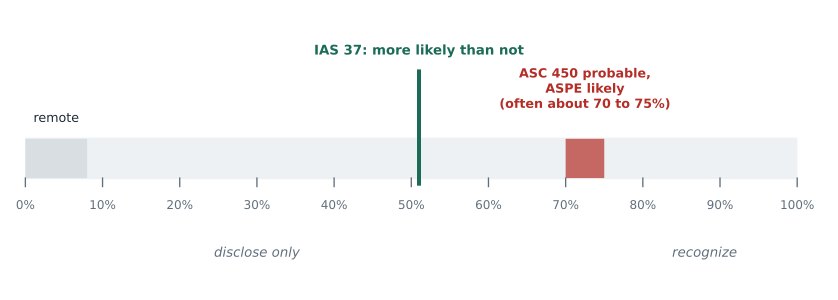
ASC 450, Contingencies, defines a contingency as an existing condition involving uncertainty about a possible gain or loss that will be resolved when future events occur or fail to occur. A loss contingency is accrued when information available before the financial statements are issued indicates that it is probable that a liability has been incurred at the balance sheet date and the amount of loss can be reasonably estimated. 'Probable' means the future event is likely to occur. If the loss is only reasonably possible, meaning more than remote but less than likely, the entity discloses its nature and an estimate of the possible loss or range, or states that an estimate cannot be made. Remote contingencies need not be disclosed, except for certain guarantees under ASC 460. US GAAP uses 'accrued loss contingency' where IFRS says 'provision'.
Accountants and auditors usually treat 'probable' under ASC 450 as a high threshold, often described in practice as roughly 70 to 75 percent, although the standard gives no number. This is a key difference from IAS 37, where 'probable' means more likely than not, just over 50 percent. A lawsuit that a company's lawyers think it will lose with 60 percent likelihood would therefore be recognized as a provision by an IFRS reporter but only disclosed by a US GAAP reporter. ASPE, Canada's standard for private enterprises, uses a 'likely' threshold similar to US GAAP.
Measuring the obligation
A loss contingency is accrued at the best estimate within a range of loss. When no amount within the range is a better estimate than any other, ASC 450-20 requires the minimum amount in the range to be accrued, with disclosure of the reasonably possible additional loss. This differs from IAS 37, which uses the mid-point in that situation. Loss contingencies are usually not discounted unless the amount and timing of payments are fixed or reliably determinable, as with some environmental and structured settlements. Expected insurance recoveries are recognized as a separate receivable when realization is probable and are not netted against the liability.
Worked problem
A lawsuit under both frameworks
A customer has sued Northlake, claiming that a failed air-quality station caused it to miss regulatory reporting deadlines. Northlake's lawyers estimate a 60 percent chance of losing. If it loses, damages are equally likely to be anywhere between $800,000 and $1,200,000. What is recognized at year end?
Show solution
- Probability: a 60 percent chance of losing is usually treated as reasonably possible rather than probable under ASC 450.
- So no accrual is recorded; Northlake discloses the claim and the range of possible loss, $800,000 to $1,200,000.
- If the probability rose above the probable threshold, Northlake would accrue the minimum of the range, $800,000, because no amount is a better estimate.
- An IFRS reporter would recognize a $1,000,000 provision for the same facts: a lower threshold and the mid-point of the range.
Answer: Disclosure only under ASC 450 at 60 percent; if probable, accrue $800,000. IFRS would record $1,000,000.
Warranties and other expected-value provisions
ACCT-211 lesson 5 distinguished assurance-type warranties, which promise only that a product works as specified, from service-type warranties, which provide an extra service and are a separate performance obligation. Assurance-type warranties are a cost of the sale: a provision is recognized when the product is sold, measured at the expected cost of repairs and replacements for the units under warranty. Because Northlake sells hundreds of stations, the expected value approach fits.
# Assurance-type warranty provision for stations sold this year (expected value)
units_sold = 1_250
outcomes = [            # (share of units, cost per unit if it occurs)
    ("No claim",            0.82,      0),
    ("Minor repair",        0.13,    450),
    ("Sensor replacement",  0.04,  2_100),
    ("Full station swap",   0.01,  9_800),
]
assert abs(sum(p for _, p, _ in outcomes) - 1) < 1e-9
ev_per_unit = sum(p * c for _, p, c in outcomes)
provision = units_sold * ev_per_unit
for name, p, c in outcomes:
    print(f"{name:<20} {p:>5.0%}  x {c:>6,}  = {p * c:>8,.2f} per unit")
print(f"Expected cost per unit {ev_per_unit:,.2f}")
print(f"Warranty provision for {units_sold:,} units: {provision:,.0f}")
claims_paid = 180_000
print(f"Claims paid during the year reduce the provision to {provision - claims_paid:,.0f}")No claim 82% x 0 = 0.00 per unit Minor repair 13% x 450 = 58.50 per unit Sensor replacement 4% x 2,100 = 84.00 per unit Full station swap 1% x 9,800 = 98.00 per unit Expected cost per unit 240.50 Warranty provision for 1,250 units: 300,625 Claims paid during the year reduce the provision to 120,625
The expected cost per station is $240.50, so a provision of $300,625 is recognized for the year's sales, debited to warranty expense in cost of sales. As claims are paid, the provision is reduced; if actual experience differs from the estimate, the change is recognized in profit or loss of the period, not by restating past years. The same expected-value thinking applies to other large populations of small obligations, such as refunds for defective products and some environmental remediation programs.
Onerous contracts and restructurings
US GAAP has no general onerous-contract rule like IAS 37. Losses on firm purchase commitments for inventory are recognized under ASC 330 (covered in ACCT-211 lesson 8), and expected losses on contracts with customers are recognized in specific industries, such as construction and production-type contracts under ASC 605-35, which survived the revenue standard for loss provisions. Costs of exiting an operating lease of an unused property are now handled through impairment of the right-of-use asset under ASC 842 rather than a separate liability.
ASC 420, Exit or Disposal Cost Obligations, requires a liability for costs associated with an exit or disposal activity to be recognized when it is incurred, not when management commits to a plan. One-time termination benefits are recognized when the plan has been communicated to employees and meets specified criteria; if employees must render service beyond a minimum retention period to receive the benefits, the cost is recognized over that service period. Contract termination costs are recognized when the contract is terminated. Ongoing severance arrangements under an existing plan are accounted for under ASC 712 when probable and estimable. US GAAP therefore often recognizes restructuring costs later than IAS 37.
Asset retirement obligations
ASC 410-20, Asset Retirement Obligations, requires a liability for a legal obligation to retire a long-lived asset to be recognized when incurred, if fair value can be reasonably estimated. It is measured at fair value, usually the expected present value of the costs discounted at a credit-adjusted risk-free rate, and capitalized as part of the asset. Accretion of the discount is classified as an operating expense (accretion expense), not interest. Upward revisions in estimated cash flows are discounted at the current credit-adjusted rate as a new layer; downward revisions use the rate of the original layer, so existing layers are not remeasured for rate changes. IFRS, by contrast, remeasures the whole provision at the current rate each period and covers constructive as well as legal obligations.
Worked problem
Station removal obligation
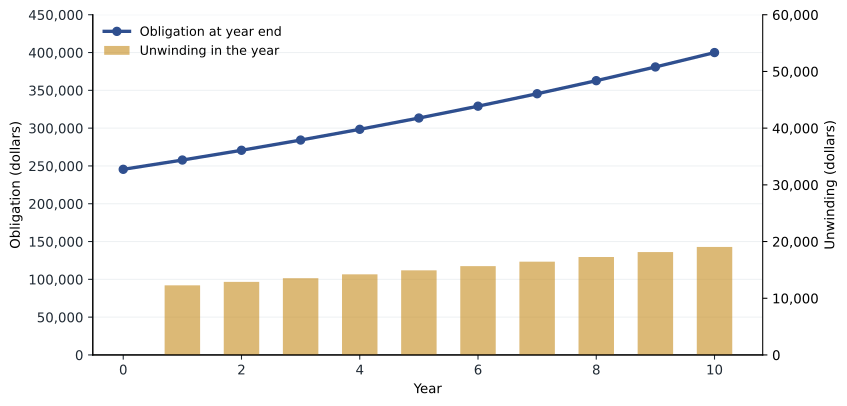
Northlake installs a network of remote monitoring stations on federal land under a ten-year permit that requires removal of all equipment and restoration of the sites. The expected removal cost in ten years is $400,000. Northlake's credit-adjusted risk-free rate is 5 percent. What is recorded?
Show solution
- Present value: 400,000 ÷ 1.05¹⁰ = $245,565.
- Debit the stations (property, plant and equipment) $245,565; credit the asset retirement obligation $245,565.
- Depreciate the capitalized amount over ten years with the stations: $24,557 a year on a straight-line basis.
- Year 1 accretion: 245,565 × 5% = $12,278, an operating expense.
Answer: Obligation of $245,565 at installation, accreting to $400,000 by year 10.
# Unwinding the removal obligation: PV 245,565 at 5% over ten years
cost, rate, years = 400_000, 0.05, 10
balance = cost / (1 + rate) ** years
print(f"{'Year':>4} {'Opening':>10} {'Unwinding':>10} {'Closing':>10}")
for y in range(1, years + 1):
    unwind = balance * rate
    print(f"{y:>4} {balance:>10,.0f} {unwind:>10,.0f} {balance + unwind:>10,.0f}")
balance += unwindYear Opening Unwinding Closing 1 245,565 12,278 257,844 2 257,844 12,892 270,736 3 270,736 13,537 284,273 4 284,273 14,214 298,486 5 298,486 14,924 313,410 6 313,410 15,671 329,081 7 329,081 16,454 345,535 8 345,535 17,277 362,812 9 362,812 18,141 380,952 10 380,952 19,048 400,000
Gain contingencies
Gain contingencies are not recognized until realized or realizable, usually when the claim is settled or a court judgment is final and collectible. They may be disclosed, but care is needed to avoid misleading implications about the likelihood of realization. The asymmetry, accruing probable losses but not gains, reflects conservatism in the face of uncertainty.
| Likelihood of outflow | US GAAP (ASC 450) | IFRS (IAS 37), for comparison |
|---|---|---|
| Remote | No recognition or disclosure (except certain guarantees) | No recognition or disclosure |
| Reasonably possible | Disclose nature and estimated range | Disclose; recognize if more likely than not |
| More likely than not, but not probable | Disclose | Recognize a provision |
| Probable | Accrue if reasonably estimable | Recognize a provision |
| Range, no best estimate | Minimum of the range, disclose the rest | Mid-point of the range |
Disclosure and judgment
Disclosures about provisions and contingencies are among the most read notes in a set of financial statements. IAS 37 requires a reconciliation of each class of provision (opening balance, additions, amounts used, unused amounts reversed, unwinding and closing balance), a description of the nature and expected timing of outflows, and the major assumptions. US GAAP requires disclosure of the nature of accrued contingencies and, often, the amount, and of reasonably possible losses. Both frameworks allow an entity, in extremely rare cases, to withhold information that would seriously prejudice its position in a dispute, but it must still describe the general nature of the dispute.
Provisions involve more judgment than almost any other liability, which makes them a target for earnings management. A company can overstate a provision in a good year and release it in a bad one, smoothing profits; this was part of the pattern regulators found at Nortel Networks in the early 2000s. Auditors respond by testing management's estimates against legal letters, historical claims data and subsequent events, and by reviewing reversals of provisions recognized in earlier years. Readers should compare the reconciliation of provisions from year to year: large unused amounts reversed, or provisions that rise and fall with profits, deserve questions.
Common mistakes
MistakeRecording a restructuring liability when management commits to a plan.
InsteadASC 420 recognizes exit costs when incurred, for example when termination benefits are communicated.
MistakeUsing the mid-point of a range when no amount is a better estimate.
InsteadASC 450-20 accrues the minimum and discloses the reasonably possible additional loss.
MistakeNetting an expected insurance recovery against the provision.
InsteadRecognize the recovery as a separate asset when it meets the framework's threshold.
MistakeRecognizing a contingent asset when a favorable outcome is probable.
InsteadContingent assets are recognized only when realization is virtually certain, or realized, depending on the framework; until then, disclose.
MistakeExpensing the full removal cost at the end of the asset's life.
InsteadRecognize the obligation when incurred at present value, add it to the asset and unwind the discount over time.
Summary and key terms
- A loss contingency is accrued when a loss is probable and reasonably estimable.
- In practice 'probable' under ASC 450 is a higher threshold than IFRS's more likely than not.
- Within a range with no best estimate, accrue the minimum and disclose the reasonably possible excess.
- Assurance-type warranty costs are provided for when the product is sold.
- US GAAP has no general onerous contract rule; exit costs are recognized when incurred under ASC 420.
- Asset retirement obligations are measured at fair value, capitalized and accreted as an operating expense, with layered revisions.
- Contingent assets and gain contingencies are not recognized until realization is virtually certain or realized.
- Loss contingency
- An uncertain situation that may result in a loss, accrued when probable and reasonably estimable.
- Reasonably possible
- More than remote but less than likely.
- Gain contingency
- An uncertain situation that may result in a gain, recognized only when realized or realizable.
- Asset retirement obligation
- A legal obligation to retire a long-lived asset, recognized at fair value when incurred.
- Remote
- Having only a slight chance of occurring.
- Best estimate
- The amount an entity would rationally pay to settle or transfer an obligation at the reporting date.
- Expected value
- A probability-weighted average of possible outcomes.
- Assurance-type warranty
- A promise that a product will work as specified, provided for as a cost of sale.
- Onerous contract
- A contract whose unavoidable costs exceed the benefits expected from it.
- Unwinding of the discount
- The annual increase in a discounted liability as settlement approaches.
- Constructive obligation
- An obligation arising from an entity's actions that create a valid expectation it will act.
- Restructuring
- A program planned and controlled by management that materially changes the scope or manner of a business.
Practice problems
Work each problem on paper first, then reveal the answer to check.
A customer sues after year end over a product shipped before year end. Is there a past event?
Show answer
Yes; the shipment of a defective product occurred before year end.
Probability of losing 55 percent; loss most likely $300,000. US GAAP treatment?
Show answer
Usually disclose only; 55 percent is generally not probable.
Range $2 million to $3 million, no best estimate, loss probable. Amount accrued?
Show answer
$2 million, with disclosure of up to $1 million more.
Warranty: 90 percent no claim, 8 percent $200, 2 percent $1,500 on 2,000 units. Provision?
Show answer
2,000 × (16 + 30) = $92,000.
Rerun the warranty program with 1,500 units. New provision?
Show answer
1,500 × 240.50 = $360,750.
Removal cost of $1 million in 20 years at 4 percent. Initial obligation?
Show answer
1,000,000 ÷ 1.04²⁰ = $456,387.
Under US GAAP, where is ARO accretion presented?
Show answer
As an operating expense.
A company has filed a claim that it will probably win. Recognize an asset?
Show answer
No; disclose it. Recognize only when realization is virtually certain or realized.
When is a one-time termination benefit recognized if no further service is required?
Show answer
When the plan is communicated to employees.
Why compare provision reconciliations across years?
Show answer
Large reversals or provisions that move with profits can signal earnings smoothing.
Lesson quiz · 5 questions
Score 60% or more to complete this lesson.
Create a free account to save your progress, take quizzes and earn a certificate.