
ACCT-212 · Lesson 3 of 12 · 28 min
Long-term debt I: bonds and the effective interest method
Northlake is growing. To build a second factory for its sensor stations, it needs $10 million for at least five years. It could borrow from a bank, issue bonds to investors, or sell more shares. This lesson and the next look at the first two choices from the borrower's side: how long-term debt is recorded when it is issued, how interest expense is measured over its life, and how it is presented. FIN-201 lesson 5 showed how investors price a bond by discounting its cash flows; here the same present-value arithmetic determines the borrower's liability and its interest expense.
Bonds and their terms
A bond is a long-term debt security, usually issued in denominations of $1,000, that promises periodic interest payments and repayment of the principal, or face value, at maturity. The bond indenture, the contract between the issuer and the bondholders (usually represented by a trustee), sets out the terms: face value, stated or coupon rate, payment dates, maturity, any security pledged and covenants restricting the issuer's actions, such as limits on further borrowing or dividends. Bonds come in many varieties: secured or unsecured (debentures), term or serial, callable by the issuer, convertible into shares, or zero-coupon, paying no interest until maturity.
In the United States, public bond issues are registered with the SEC under the Securities Act of 1933, and the Trust Indenture Act of 1939 requires a qualified indenture and trustee. Many corporate bonds are sold to institutional investors under Rule 144A without full registration. Most US corporate bonds pay interest semi-annually and are quoted as a spread over US Treasury yields.
The stated rate fixes the cash interest: a $10 million bond with a 4 percent stated rate paid semi-annually pays $200,000 every six months. The market rate, also called the effective or yield rate, is the return investors demand for bonds of similar risk and maturity on the day of issue. If the stated rate equals the market rate, the bond sells at face value, or par. If the stated rate is below the market rate, investors pay less than face value: the bond sells at a discount. If the stated rate is above the market rate, the bond sells at a premium.
Pricing the issue
The issue price is the present value of the bond's cash flows, discounted at the market rate per period. For semi-annual bonds, both the rate and the number of periods are adjusted: a five-year bond has ten semi-annual periods, and a 5 percent annual market rate becomes 2.5 percent per period.
Worked problem
Pricing Northlake's bonds
On 1 January 2027 Northlake issues $10 million of five-year bonds with a 4 percent stated rate, paid on 30 June and 31 December. The market rate for bonds of similar risk is 5 percent. What is the issue price?
Show solution
- Cash interest per period: 10,000,000 × 4% ÷ 2 = $200,000. Periods: 10. Market rate per period: 2.5%.
- Present value of the interest annuity: 200,000 × [1 − 1.025⁻¹⁰] ÷ 0.025 = $1,750,412.
- Present value of the face value: 10,000,000 ÷ 1.025¹⁰ = $7,811,984.
- Issue price: $9,562,397. The bonds sell at a discount of $437,603 because the stated rate is below the market rate.
Answer: Cash received $9,562,397; the liability is initially measured at this amount.
Initial measurement and transaction costs
Under ASC 835-30, debt issuance costs are presented on the balance sheet as a direct deduction from the carrying amount of the debt, like a discount (ASU 2015-03), and amortized to interest expense using the effective interest method. Costs of revolving lines of credit may be presented as an asset. The effective interest method is required, but the straight-line method may be used if the results are not materially different. The issuer may also elect the fair value option under ASC 825 (lesson 4).
Worked problem
Including transaction costs
Northlake pays underwriting and legal costs of $150,000 to issue the bonds above. How is the liability measured, and what is the effective rate?
Show solution
- Net proceeds: 9,562,397 − 150,000 = $9,412,397.
- Initial carrying amount under ASC 835-30: $9,412,397, the face value less the discount and issuance costs presented as a direct deduction.
- Solve for the semi-annual rate that discounts $200,000 for ten periods plus $10,000,000 at period 10 to $9,412,397: about 2.678 percent per period.
- Effective annual rate: about 5.36 percent nominal (5.43 percent compounded), higher than the 5 percent market rate because the costs are spread over the bond's life as interest.
Answer: Carrying amount $9,412,397; effective rate about 2.678 percent per half-year.
The effective interest method
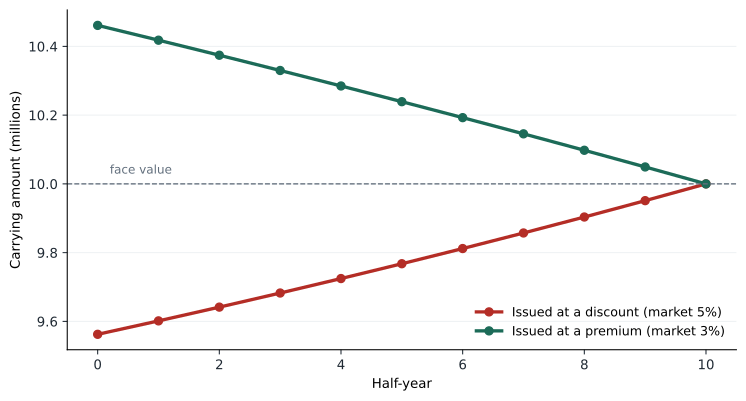
Under the effective interest method, interest expense each period equals the carrying amount of the liability at the start of the period multiplied by the effective interest rate. The cash paid is the stated rate times face value. The difference amortizes the discount or premium: for a discount, interest expense exceeds the cash paid and the carrying amount rises; for a premium, interest expense is less than the cash paid and the carrying amount falls. Either way, by maturity the carrying amount equals face value. The method produces a constant rate of interest on the outstanding balance, which is why it is preferred to straight-line amortization, which produces a constant dollar amount.
# Amortization table for Northlake's bonds (issued at a discount, no transaction costs)
face, stated, market, periods = 10_000_000, 0.04 / 2, 0.05 / 2, 10
cash = face * stated
price = sum(cash / (1 + market) ** t for t in range(1, periods + 1)) + face / (1 + market) ** periods
carrying = price
print(f"Issue price {price:,.2f}; discount {face - price:,.2f}")
print(f"{'Period':>6} {'Cash paid':>10} {'Interest exp':>13} {'Amortized':>10} {'Carrying':>14}")
total_interest = 0
for t in range(1, periods + 1):
    interest = carrying * market
    amort = interest - cash
    carrying += amort
    total_interest += interest
    print(f"{t:>6} {cash:>10,.0f} {interest:>13,.2f} {amort:>10,.2f} {carrying:>14,.2f}")
print(f"Total interest expense {total_interest:,.2f} = cash interest {cash * periods:,.0f} + discount {face - price:,.2f}")Issue price 9,562,396.80; discount 437,603.20
Period Cash paid Interest exp Amortized Carrying
1 200,000 239,059.92 39,059.92 9,601,456.72
2 200,000 240,036.42 40,036.42 9,641,493.14
3 200,000 241,037.33 41,037.33 9,682,530.47
4 200,000 242,063.26 42,063.26 9,724,593.73
5 200,000 243,114.84 43,114.84 9,767,708.58
6 200,000 244,192.71 44,192.71 9,811,901.29
7 200,000 245,297.53 45,297.53 9,857,198.82
8 200,000 246,429.97 46,429.97 9,903,628.79
9 200,000 247,590.72 47,590.72 9,951,219.51
10 200,000 248,780.49 48,780.49 10,000,000.00
Total interest expense 2,437,603.20 = cash interest 2,000,000 + discount 437,603.20The table shows the pattern. In the first half-year, interest expense is $239,060, of which $200,000 is paid in cash and $39,060 is added to the carrying amount through amortization of the discount. Each period the carrying amount grows, so interest expense grows too, reaching about $248,780 in the last period, when the carrying amount reaches exactly $10 million. Over five years total interest expense is $2,437,603: the $2 million of cash interest plus the $437,603 discount. A discount is really extra interest paid at maturity, and the effective interest method spreads it over the bond's life.
The journal entry on 30 June 2027 debits interest expense $239,060, credits cash $200,000 and credits the bonds payable (or the discount account, if a separate contra account is used) $39,060. Many companies record bonds net of the discount in a single account; others keep a separate discount on bonds payable account. The carrying amount presented is the same either way.
Bonds issued at a premium
Worked problem
A premium issue
Suppose instead that market rates were 3 percent when Northlake issued the 4 percent bonds. The price would be $10,461,109. How does the first interest period look?
Show solution
- Semi-annual market rate: 1.5 percent. Issue price: $10,461,109, a premium of $461,109.
- Interest expense, period 1: 10,461,109 × 1.5% = $156,917.
- Cash paid: $200,000. Premium amortized: 200,000 − 156,917 = $43,083.
- Carrying amount after period 1: 10,461,109 − 43,083 = $10,418,026, falling toward $10 million.
Answer: Interest expense $156,917 in period 1; the premium reduces interest expense below the cash coupon.
Issuing between interest dates
Bonds are often sold on a date between interest payment dates. Because the issuer will pay a full six months' interest on the next payment date, investors pay the issue price plus interest accrued since the last interest date, and the issuer records that accrued interest as a liability (or as a credit to interest expense, which nets out when the full coupon is paid). For example, if $10 million of 4 percent bonds dated 1 January are sold at par on 1 March, investors pay $10,066,667: face value plus two months' interest of $66,667. On 30 June the issuer pays $200,000, of which $66,667 settles the accrued interest and $133,333 is interest expense for the four months the bonds were outstanding.
Zero-coupon bonds and long-term notes
A zero-coupon bond pays no periodic interest; the investor's return comes entirely from the discount. A five-year, $10 million zero-coupon bond issued when market rates are 5 percent compounded annually sells for $7,835,262. The issuer recognizes interest expense each year at 5 percent of the carrying amount, with no cash paid, so the liability grows to $10 million at maturity. The same approach applies to long-term notes issued for cash or for property: the note is recorded at the present value of its cash flows at the market rate, and interest is recognized using the effective interest method. If a note's stated rate is unreasonably low, the note is imputed at a market rate, and the cost of any asset acquired is measured at the cash price equivalent.
| Situation | Issue price | Interest expense compared with cash coupon | Carrying amount over time |
|---|---|---|---|
| Stated rate = market rate | Face value (par) | Equal | Constant |
| Stated rate < market rate | Below face (discount) | Higher | Rises to face value |
| Stated rate > market rate | Above face (premium) | Lower | Falls to face value |
| Zero-coupon | Deep discount | All interest is non-cash | Rises to face value |
| Transaction costs paid | Net proceeds below price | Higher (effective rate rises) | Rises to face value |
Presentation and disclosure
Bonds payable are presented at amortized cost, with the portion due within twelve months classified as current (lesson 1). Interest expense is presented in finance costs. US GAAP requires disclosure of the terms of debt, maturities for each of the next five years, the fair value of debt (ASC 825), and covenants and defaults. SEC registrants also discuss liquidity and capital resources in Management's Discussion and Analysis, including contractual obligations.
Readers watch the interest coverage ratio (earnings before interest and taxes divided by interest expense) and debt to equity. Because the effective interest method spreads discounts into interest expense, a company that issues deep-discount bonds reports interest expense well above the cash it pays; the statement of cash flows and the reconciliation of financing liabilities make the difference visible.
Common mistakes
MistakeRecording bonds at face value when they are issued at a discount.
InsteadRecord the cash received; the discount is amortized to interest expense over the bond's life.
MistakeUsing the stated rate to compute interest expense.
InsteadInterest expense is the carrying amount times the effective (market) rate; the stated rate gives only the cash paid.
MistakeUsing the annual rate and number of years for semi-annual bonds.
InsteadHalve the rate and double the number of periods.
MistakeExpensing debt issuance costs immediately.
InsteadDeduct them from the carrying amount and amortize them through the effective interest rate.
MistakeRecording accrued interest received on issuance between interest dates as revenue.
InsteadIt is a liability (or a credit to interest expense) settled by the next coupon payment.
Summary and key terms
- A bond's issue price is the present value of its interest and principal at the market rate.
- Bonds sell at a discount when the stated rate is below the market rate and at a premium when it is above.
- Debt issuance costs are presented as a direct deduction from the debt and amortized as interest.
- Interest expense equals the opening carrying amount times the effective rate; the difference from cash amortizes the discount or premium.
- By maturity the carrying amount equals face value.
- Bonds sold between interest dates include accrued interest in the proceeds.
- Zero-coupon bonds and low-interest notes are recorded at present value, with interest imputed at the market rate.
- Bond indenture
- The contract setting out a bond's terms and covenants.
- Face value
- The principal amount repaid at maturity.
- Stated (coupon) rate
- The rate applied to face value to determine cash interest.
- Market (effective) rate
- The yield investors demand, used to price the bond and measure interest expense.
- Discount
- The amount by which face value exceeds the issue price.
- Premium
- The amount by which the issue price exceeds face value.
- Effective interest method
- Measuring interest as a constant rate on the opening carrying amount.
- Amortized cost
- Initial amount adjusted for repayments and cumulative amortization of discounts, premiums and costs.
- Debenture
- An unsecured bond backed only by the issuer's general credit.
- Zero-coupon bond
- A bond that pays no periodic interest and is issued at a deep discount.
Practice problems
Work each problem on paper first, then reveal the answer to check.
$1,000,000 five-year bonds, 6 percent stated, semi-annual, market 6 percent. Price?
Show answer
$1,000,000 (par).
Same bonds with a market rate of 7 percent. Price?
Show answer
About $958,417 (3 percent stated, 3.5 percent market, 10 periods).
Carrying amount $958,417, period market rate 3.5 percent, coupon $30,000. First-period interest expense and amortization?
Show answer
Interest $33,545; amortization $3,545.
Why does interest expense on a discount bond rise over time?
Show answer
The carrying amount rises, and expense is a constant rate on it.
Rerun the amortization program with a market rate of 4 percent. What happens?
Show answer
The bonds sell at par; interest expense equals the $200,000 coupon each period.
$5 million of 4 percent bonds dated 1 April are sold at par on 1 June. Cash received?
Show answer
$5,033,333 (face plus two months' interest).
A three-year $1 million zero-coupon note at 6 percent annual. Initial carrying amount and year 1 interest?
Show answer
$839,619; interest $50,377.
How do transaction costs affect the effective interest rate?
Show answer
They reduce net proceeds and so raise the effective rate.
Total interest expense over a discount bond's life equals?
Show answer
Total cash interest plus the discount.
EBIT $6 million; interest expense $1.2 million. Interest coverage?
Show answer
5 times.
Lesson quiz · 5 questions
Score 60% or more to complete this lesson.
Create a free account to save your progress, take quizzes and earn a certificate.