
PWR-110 · Lesson 9 of 12 · 33 min
Basic plant math and units
▶ Video coming soon A video version of this lesson is on the way.
On Monday, October 26, 2026, the steam flow meter on the header read 14,600 kg/h, the deaerator gauge read 35 kPa, the barometer in the control room read 99.8 kPa, and a contractor's report on Grazyna's desk gave the new hot water pump's capacity in US gallons per minute. Tamar spent her break turning everything into the same units on a scrap of log paper. Lorne looked over her shoulder and pointed at one line. "Gauge or absolute?" he asked. She had added the barometer reading to a pressure that was already absolute. It was a small mistake on paper; in a steam table it would have given her the wrong temperature by several degrees.
Power engineers in Canada work in SI units (the metric system), but they meet US customary units every day on older equipment, imported nameplates and manufacturers' data. This lesson covers the units of a boiler plant, how to convert between them, the difference between gauge and absolute pressure, and the handful of calculations that come up on every shift. Calculators are fine; what matters is knowing which units go in and checking that the answer makes sense.
Units and prefixes
The SI system is built from a few base units, such as the metre for length, the kilogram for mass, the second for time, the kelvin for temperature and the ampere for electric current, and units made from them, such as the newton for force, the pascal for pressure, the joule for energy and the watt for power. Prefixes scale them by powers of ten: kilo (k) means a thousand, mega (M) a million, milli (m) a thousandth and micro (µ) a millionth. A steam pressure of 1,035 kPa is 1.035 MPa; a boiler of 8,000 kW is 8 MW.
The US customary system has its own units: the foot and inch, the pound (used for both mass and force, which is a common source of confusion), the degree Fahrenheit, the British thermal unit (Btu), and pounds per square inch (psi) for pressure. Many plants mix the two, so conversion factors are part of every engineer's toolkit.
| Quantity | SI unit | US customary unit | Conversion (rounded) |
|---|---|---|---|
| Length | metre (m) | foot (ft), inch (in) | 1 m = 3.281 ft; 1 in = 25.4 mm |
| Mass | kilogram (kg) | pound (lb) | 1 kg = 2.205 lb |
| Volume | cubic metre (m³), litre (L) | cubic foot (ft³), US gallon (gal) | 1 m³ = 1,000 L = 35.31 ft³; 1 gal = 3.785 L |
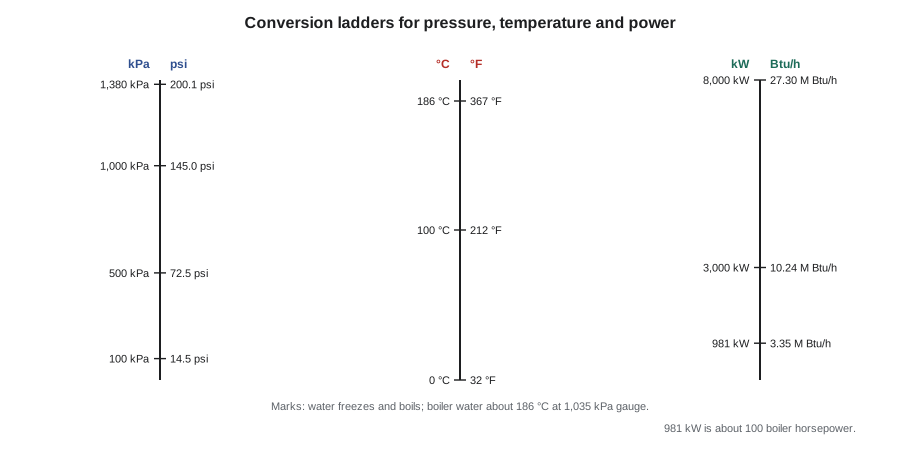
| Pressure | kilopascal (kPa) | pound per square inch (psi) | 1 psi = 6.895 kPa; 1 bar = 100 kPa |
| Energy | kilojoule (kJ) | British thermal unit (Btu) | 1 Btu = 1.055 kJ |
| Power | kilowatt (kW) | Btu per hour, horsepower | 1 kW = 3,412 Btu/h; 1 hp = 0.7457 kW |
| Boiler output | kilowatt (kW) | boiler horsepower (BoHP) | 1 BoHP = 33,475 Btu/h = 9.81 kW |
| Water flow | litres per second (L/s) | US gallons per minute (gpm) | 1 gpm = 0.0631 L/s |
Gauge pressure and absolute pressure
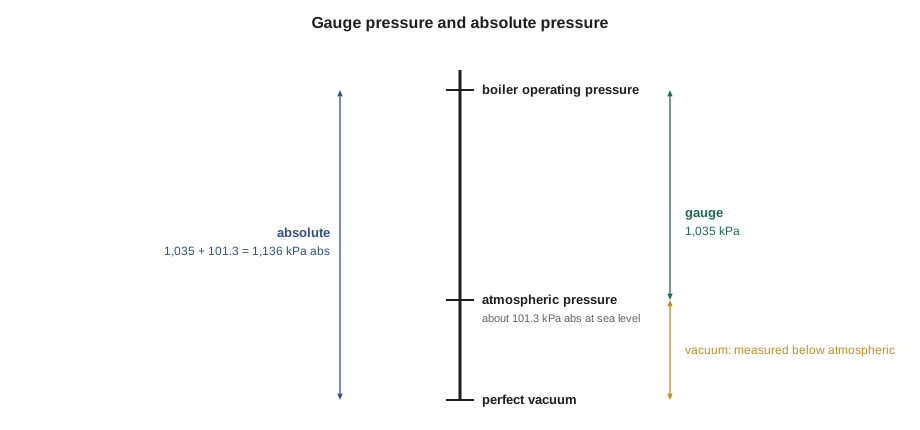
The air around us presses on everything with atmospheric pressure, about 101.3 kPa (14.7 psi) at sea level, a little less at higher elevations and changing slightly with the weather. Most pressure gauges in a plant read gauge pressure: the pressure above atmospheric, so they read zero when open to the air. Absolute pressure is measured from a perfect vacuum, so it equals gauge pressure plus atmospheric pressure. Steam tables and many calculations need absolute pressure; gauges and nameplates use gauge pressure. Pressures below atmospheric are called vacuum, measured as how far below atmospheric they are, often in kPa below atmosphere or millimetres of mercury.
Engineers write which is meant: kPa(g) or kPa gauge, and kPa(a) or kPa absolute. In US units the same idea is written psig and psia. When a figure has no label, the context usually means gauge pressure, but on exams and in calculations it pays to check.
Worked problem
Gauge to absolute
The boiler steam gauge reads 1,035 kPa and the barometer reads 99.8 kPa. What is the absolute pressure? And what is 1,035 kPa in psi gauge?
Show solution
- Absolute:
- \[1{,}035 + 99.8 = 1{,}134.8 \text{ kPa(a)}\]
- In psi gauge:
- \[1{,}035 \div 6.895 \approx 150 \text{ psig}\]
Answer: About 1,135 kPa absolute, and the gauge reading is about 150 psig. Tamar's mistake was to add the barometer reading a second time to a figure that was already absolute.
Pressure also comes from a column of liquid. A column of water 1 m high exerts about 9.81 kPa at its base, which is why a gauge at the bottom of a tall tank reads more than one at the top, and why a pump's suction pressure depends on how high the water level in the deaerator stands above it. Low pressures, such as draft in a furnace or a fan's pressure, are often given in pascals or millimetres of water column.
Temperature
Temperature scales differ in their zero points and the size of their degrees. On the Celsius scale water freezes at 0 °C and boils at 100 °C at atmospheric pressure; on the Fahrenheit scale the same points are 32 °F and 212 °F. A change of 1 °C equals a change of 1.8 °F. Absolute scales start at absolute zero: the kelvin (K) uses Celsius-sized degrees, so K = °C + 273.15, and the Rankine (°R) uses Fahrenheit-sized degrees, so °R = °F + 459.67. Gas law calculations need absolute temperatures.
Worked problem
Converting temperatures
Feedwater leaves the deaerator at about 105 °C. Convert it to Fahrenheit and to kelvin.
Show solution
- To Fahrenheit:
- \[105 \times 1.8 + 32 = 221 \ ^\circ\text{F}\]
- To kelvin:
- \[105 + 273.15 = 378.15 \text{ K}\]
Answer: 105 °C is 221 °F and about 378 K. A temperature difference converts differently: a rise of 10 °C is a rise of 18 °F, with no 32 added.
Heat, energy and power
Heat is energy moving because of a temperature difference. In SI it is measured in joules (J), usually kilojoules (kJ); in US units in British thermal units (Btu). One Btu is roughly the heat needed to warm one pound of water by 1 °F, and one kilojoule warms about 0.24 kg of water by 1 °C. The heat needed to change the temperature of a substance is its mass times its specific heat times the temperature change:
Water's specific heat is about 4.19 kJ/kg·K. Power is the rate of energy flow: a watt is a joule per second, and a kilowatt is a kilojoule per second; in US units power is often given in Btu per hour. A boiler's rating in kW or Btu per hour is therefore how fast it can deliver heat.
Worked problem
Heating water in a tank
The hot water loop's expansion tank and piping hold about 18,000 kg of water. How much heat does it take to warm it from 15 °C to 80 °C, and how long would one 3,000 kW hot water boiler take, ignoring losses?
Show solution
- Heat:
- \[18{,}000 \times 4.19 \times (80 - 15) \approx 4{,}902{,}000 \text{ kJ}\]
- Time at 3,000 kJ/s:
- \[4{,}902{,}000 \div 3{,}000 \approx 1{,}634 \text{ s} \approx 27 \text{ min}\]
Answer: About 27 minutes of full firing, in theory. In practice it takes longer, because heat is lost from the piping and the boiler is fired gently while the system warms, to limit thermal stress. The example shows the size of the energy involved in a modest volume of water.
Worked problem
Boiler output in different units
A boiler is rated 8,000 kW. Express its output in Btu per hour and in boiler horsepower.
Show solution
- Btu per hour:
- \[8{,}000 \times 3{,}412 \approx 27{,}300{,}000 \text{ Btu/h}\]
- Boiler horsepower:
- \[8{,}000 \div 9.81 \approx 815 \text{ BoHP}\]
Answer: About 27.3 million Btu per hour, about 8,000 kW, or about 815 boiler horsepower. Small differences in the last figure come from rounding the conversion factors.
Mass, flow and volume
Steam flow is measured as a mass flow, kilograms per hour (kg/h), because the mass of steam is what carries the energy. Water flow is often given as a volume flow, litres per second (L/s) or cubic metres per hour. For cold water, one litre has a mass of about one kilogram and one US gallon weighs about 8.34 lb; hot water is less dense, which matters for accurate tank and flow calculations.
Worked problem
Volume of a tank
The condensate receiver is a horizontal cylinder about 1.8 m in diameter and 4.2 m long. What is its volume, and roughly what mass of water does it hold when full?
Show solution
- Volume:
- \[V = \pi r^{2} L = 3.1416 \times 0.9^{2} \times 4.2 \approx 10.7 \text{ m}^3\]
- In litres:
- \[10.7 \times 1{,}000 = 10{,}700 \text{ L}\]
- Mass at about 1 kg/L:
- \[\approx 10{,}700 \text{ kg}\]
Answer: About 10.7 m³, holding roughly 10,700 kg of cold water, a little less of hot condensate.
Worked problem
Converting a pump flow
A new hot water pump is rated at 450 US gpm. What is that in litres per second?
Show solution
- Conversion:
- \[450 \times 0.0631 \approx 28.4 \text{ L/s}\]
Answer: 450 gpm is about 28.4 L/s. A quick check: a litre per second is about 16 gpm, so 450 gpm should be a little under 30 L/s, which it is.
Checking answers
The best protection against errors is a habit of checking. Write the units on every number and carry them through the calculation; if the units of the answer are wrong, so is the answer. Estimate before calculating: a boiler of a few thousand kilowatts should take minutes to tens of minutes to heat a few tonnes of water, not seconds or days. And keep gauge and absolute pressure clearly labelled. Lorne's last word on the subject was practical: "If it doesn't look right, it probably isn't. Do it again before you act on it."
Ratios, efficiency and fractions
Much plant math is about comparing one quantity with another. Efficiency is useful output divided by input: a boiler that puts 82 units of heat into steam for every 100 units of heat in the fuel has an efficiency of 0.82, often stated as 82 in 100. Efficiency is always less than one, and a calculation that gives more than one has an error somewhere. The same kind of ratio appears in condensate return (lesson 10), cycles of concentration in water treatment (lesson 8), and load as a fraction of a boiler's rating.
Worked problem
Boiler efficiency
A boiler burns natural gas with an energy input of 9,760 kW (heat in the fuel) and delivers 8,000 kW to the steam. What is its efficiency, and how much heat is lost?
Show solution
- Efficiency:
- \[8{,}000 \div 9{,}760 \approx 0.82\]
- Heat lost:
- \[9{,}760 - 8{,}000 = 1{,}760 \text{ kW}\]
Answer: About 0.82, with about 1,760 kW lost, most of it as heat in the flue gas going up the stack. Plant improvements such as cleaning heating surfaces, trimming excess air and recovering condensate all aim to shrink that loss.
Reading the meters
Plant meters often show two kinds of number: a rate, such as steam flow in kg/h (lb/h) right now, and a totalizer, the running total since the meter was installed or reset. To find how much was used in a period, the engineer subtracts the earlier totalizer reading from the later one; to find the average rate, they divide that difference by the time. The log sheet records totalizers at fixed times for this reason.
Worked problem
Steam made in a shift
At 07:00 the steam totalizer read 48,215,600 kg and at 19:00 it read 48,390,800 kg. How much steam was made during the shift, and what was the average flow?
Show solution
- Steam made:
- \[48{,}390{,}800 - 48{,}215{,}600 = 175{,}200 \text{ kg}\]
- Average flow over 12 h:
- \[175{,}200 \div 12 = 14{,}600 \text{ kg/h}\]
Answer: 175,200 kg of steam, an average of 14,600 kg/h, which matches the rate Tamar read at the start of the lesson.
Common mistakes
MistakeAdding atmospheric pressure to a pressure that is already absolute.
InsteadLabel every pressure as gauge or absolute and convert only once.
MistakeConverting a temperature difference with the 32-degree offset.
InsteadDifferences convert by the factor only: 10 °C of change is 18 °F of change.
MistakeTreating the pound as the same thing in mass and force calculations without thinking.
InsteadKnow whether the problem is about mass (how much stuff) or force (how hard it pushes).
MistakeUsing cold-water density for hot water.
InsteadHot water is less dense; use the right value for accurate mass and flow.
MistakeDropping units during a calculation.
InsteadWrite units on every number and check the units of the answer.
Summary and key terms
- SI units use prefixes such as kilo and mega; US customary units include psi, Btu and the pound.
- Key conversions: 1 psi = 6.895 kPa, 1 Btu = 1.055 kJ, 1 kW = 3,412 Btu/h, 1 BoHP = 9.81 kW.
- Absolute pressure equals gauge pressure plus atmospheric pressure; label which you mean.
- A water column of 1 m exerts about 9.81 kPa.
- °F = °C × 1.8 + 32; K = °C + 273.15; temperature differences convert by the factor only.
- Heat equals mass times specific heat times temperature change; water's specific heat is about 4.19 kJ/kg·K.
- Estimate first, carry units and check every answer before acting on it.
- Gauge pressure
- Pressure measured above atmospheric pressure.
- Absolute pressure
- Pressure measured from a perfect vacuum; gauge plus atmospheric.
- Vacuum
- Pressure below atmospheric.
- Specific heat
- The heat needed to raise a unit mass of a substance by one degree.
- Kilowatt
- A unit of power equal to one kilojoule per second.
- British thermal unit
- The heat to raise about one pound of water by 1 °F; about 1.055 kJ.
- Boiler horsepower
- A unit of boiler output, about 9.81 kW or 33,475 Btu/h.
Practice problems
Work each problem on paper first, then reveal the answer to check.
A gauge reads 500 kPa and the barometer 101 kPa. What is the absolute pressure?
Show answer
601 kPa(a).
Convert 80 °C to Fahrenheit.
Show answer
176 °F.
How many Btu per hour is 1 kW?
Show answer
About 3,412 Btu/h.
What pressure does a water column 1 m high exert?
Show answer
About 9.81 kPa.
What is 450 US gpm in L/s?
Show answer
About 28.4 L/s.
Lesson quiz · 5 questions
Score 60% or more to complete this lesson.
Create a free account to save your progress, take quizzes and earn a certificate.