
PWR-110 · Lesson 12 of 12 · 24 min
Safety walk of a heating plant
▶ Video coming soon A video version of this lesson is on the way.
On Thursday, November 12, 2026, Grazyna led Cantwell's fall safety walk. Twice a year she walks the whole plant with a shift engineer, the maintenance planner and the worker member of the joint health and safety committee, using a checklist built from the plant's procedures, the Occupational Health and Safety Act and the TSSA requirements. This time the group was Grazyna, Lorne, Fenella, the committee's worker member Pilar Quenneville, and Tamar, who carried the clipboard and wrote down every finding. The walk took two and a half hours. It found eleven things to fix, none of them dramatic, all of them the kind of small problem that, left alone, turns into an injury or an incident.
This last lesson follows that walk from start to finish. It uses everything in the course: the laws and records of lessons 2, 3 and 10, the hazards of lesson 4, lockout and confined spaces from lessons 5 and 6, fire and emergencies from lesson 7, chemicals from lesson 8, the units of lesson 9 and the rounds habits of lesson 11. It also shows how findings are ranked, assigned and followed up, which is what turns an inspection into safer work.
Planning the walk
A safety walk is not a casual stroll. Grazyna's checklist is organized by area, from the control room to the roof, and for each area it lists what to look at: guarding, housekeeping, lighting, signs, emergency equipment, chemicals, electrical panels, pressure equipment, ladders and platforms, and records. Ontario's Occupational Health and Safety Act requires a member of the joint health and safety committee to inspect the workplace at least once a month, inspecting all of it at least once a year, and Cantwell's committee does its monthly inspections by area. The twice-yearly walk with the chief is extra, and is aimed at the plant as a whole.
Before setting out, Grazyna reviewed the plant's injury and near-miss reports since the spring walk, the open work orders, and the findings from TSSA's and the insurer's inspections, so the group knew where to look harder. She also reminded everyone of the ground rules: the walk follows the plant's own safety rules, nobody opens a guard or panel or enters a confined space during it, and anything dangerous enough to need action right away is acted on right away, not written down for later.
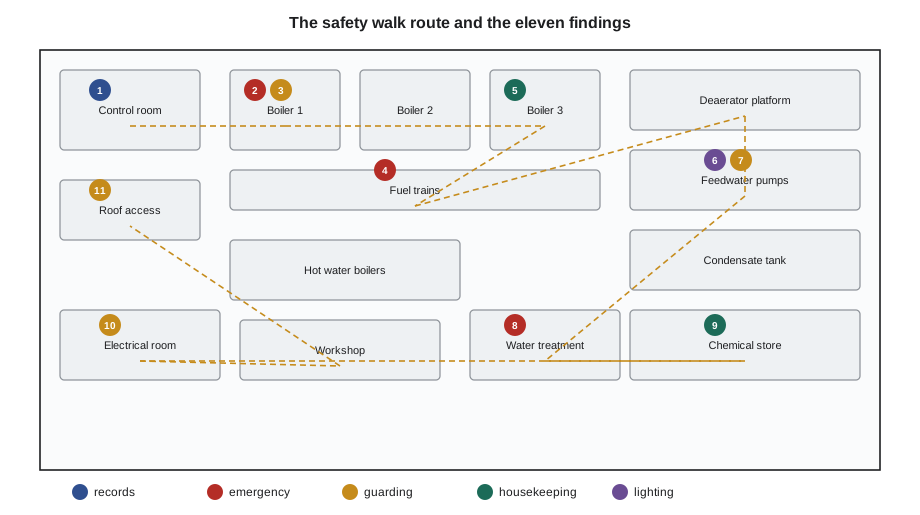
What the walk found
The group started in the control room and worked outward. Tamar's list, in the order they were found:
| No. | Area | Finding | Hazard |
|---|---|---|---|
| 1 | Control room | Two engineers' certificates on the wall were last year's copies | Records: displayed certificates must be current |
| 2 | Boiler room exit | A pallet of salt bags stored in front of the emergency shutdown switch | Emergency: switch must be reachable |
| 3 | Boiler 1 front | Gauge glass guard cracked | Burns from a gauge glass failure |
| 4 | Boiler 2 fuel train | A rope tied round a manual gas valve handle "to stop it being bumped" | The valve could not be closed quickly in an emergency |
| 5 | Steam header | Insulation missing from a 150 mm (6 in) valve after a repair | Burns and wasted heat |
| 6 | Pump area | Two light fixtures out over feedwater pumps 1 and 2 | Slips; gauges hard to read |
| 7 | Pump area | Coupling guard on condensate pump 2 fastened with one bolt of four | Rotating equipment exposure |
| 8 | Water treatment | Eyewash station inspection tag last signed three weeks ago | Untested eyewash may fail when needed |
| 9 | Chemical store | Oily rags in an open cardboard box | Fire |
| 10 | Electrical room | Panel door in the motor control centre left unlatched | Electrical shock and arc flash exposure |
| 11 | Roof access | Fixed ladder's top rung bracket loose | Falls |
Two findings were handled on the spot. Lorne cut the rope off the gas valve handle at once and put a proper valve guard request on the work order list; a manual gas valve that cannot be closed in seconds defeats the purpose of having it. And the pallet in front of the emergency shutdown switch was moved by hand before the group left the boiler room. Grazyna wrote both into the log as hazards found and corrected, with the time.
Ranking the findings
Not every finding is equally urgent. Cantwell uses a simple risk matrix: each finding is given a severity score from 1 (minor first aid) to 5 (death or major damage) and a likelihood score from 1 (very unlikely) to 5 (almost certain if nothing changes), and the two are multiplied. A score of 15 or more is fixed the same day; 8 to 14 within a week; 4 to 7 within a month; below 4 at the next planned opportunity. The scores are judgements, not measurements, but scoring them together makes the group talk through each one and agree.
| Finding | Severity | Likelihood | Risk score | Deadline |
|---|---|---|---|---|
| 4 Rope on gas valve | 5 | 3 | 15 | Same day (done on the spot) |
| 2 Pallet blocking emergency switch | 5 | 3 | 15 | Same day (done on the spot) |
| 3 Cracked gauge glass guard | 4 | 3 | 12 | Within a week |
| 10 Unlatched panel door | 4 | 3 | 12 | Within a week (latched during the walk) |
| 7 Loose coupling guard | 4 | 2 | 8 | Within a week |
| 9 Oily rags | 4 | 2 | 8 | Within a week (removed during the walk) |
| 11 Loose ladder bracket | 4 | 2 | 8 | Within a week |
| 8 Eyewash not tested | 3 | 2 | 6 | Within a month (tested the same day) |
| 5 Missing valve insulation | 3 | 2 | 6 | Within a month |
| 6 Lights out | 2 | 3 | 6 | Within a month |
| 1 Out-of-date certificate copies | 2 | 2 | 4 | Within a month |
Worked problem
Working the risk matrix
The cracked gauge glass guard on boiler 1 was given a severity of 4, because a gauge glass that fails without a guard can spray steam and glass into someone's face, and a likelihood of 3, because gauge glasses are blown down every shift and occasionally break. What is the risk score, which deadline band does it fall in, and what is the score if a new guard brings the likelihood of injury down to 1?
Show solution
- Score now:
- \[4 \times 3 = 12\]
- Band:
- \[8 \le 12 \le 14 \Rightarrow \text{within a week}\]
- After a new guard:
- \[4 \times 1 = 4 \Rightarrow \text{within a month band}\]
Answer: A score of 12 means a repair within a week; Fenella ordered the guard that afternoon and it was fitted on Friday, November 13. With the guard in place the severity stays the same, because a failure would still be serious, but the likelihood of anyone being hurt drops, and the score falls to 4. Controls usually reduce likelihood; only removing a hazard reduces severity.
Assigning and following up
Each finding went onto Cantwell's action list with an owner, a deadline and the action needed. Fenella turned the maintenance items into work orders. Lorne took the eyewash: he tested it that afternoon, found it worked, and added a weekly reminder to the day shift's Monday round sheet, because the weekly test had been falling between two people's jobs. Grazyna took the certificates, which turned out to be a filing problem: two engineers had renewed and handed her their new copies, which she had not yet posted. Pilar took the findings to the next safety committee meeting so the other crews would hear about them.
The most useful part of a walk is often asking why. The rope on the gas valve had been tied by a contractor during a summer job, when a cart kept bumping the handle; nobody had noticed it since because the valve was never operated. The fix was a proper guard and a change to the contractor orientation: no one ties or blocks a valve without the shift engineer's permission. The oily rags had been left by a crew that had run out of closed metal rag cans; the fix was a second can in the chemical store. Fixing the cause stops the same finding appearing again at the spring walk.
Worked problem
Tracking completion
Three weeks after the walk, the action list shows 9 of the 11 findings closed. What fraction is closed, and how many are still open?
Show solution
- Fraction closed:
- \[9 \div 11 \approx 0.82\]
- Still open:
- \[11 - 9 = 2\]
Answer: About 82 in 100 of the findings are closed and 2 remain. Grazyna checks that the two still open, the replacement lights and the ladder bracket, are within their deadlines and have work orders, and reviews the whole list again at the next committee meeting.
What the walk taught Tamar
Walking the plant with fresh eyes showed Tamar how quickly normal becomes invisible. Every one of the eleven findings had been passed by engineers on rounds for days or weeks: the rope, the pallet, the missing insulation, the dark corner by the pumps. Rounds are about the process; a safety walk is about the people. Both matter, and the best engineers carry a little of the safety walk into every round: they notice the guard with one bolt as well as the bearing temperature.
By the end of her first nine weeks Tamar had logged about 390 hours toward her 480, traced every system in the plant, prepared a lockout, helped at a boiler entry, sat through a night flame failure, run a chemical delivery and found a condensate leak from the log. None of it was glamorous. All of it was the work of an engineer. Lorne's comment on her monthly experience record for October said only: "Asks the right questions. Writes everything down." Grazyna added one line underneath: "Ready for more."
Areas the walk checked closely
Some parts of the plant got extra attention because the consequences of a problem there would be severe. At each boiler the group checked that the emergency shutdown switch outside the boiler room door was labelled and reachable, that the manual gas shutoff valves were tagged and could be closed by hand, that the safety valve discharge pipes were supported and ran to a safe place, and that the gauge glasses had guards. In the water treatment room they checked the eyewash and shower, the chemical labels, the secondary containment under the totes and the incompatibility signs. In the electrical room they checked that panel doors were closed and latched, arc flash labels were in place, and nothing was stored in front of the switchgear.
They also checked records, because a safety device that has not been tested is only assumed to work. Grazyna pulled the low water cutoff test records for all three steam boilers, the safety valve test records, the fire extinguisher inspection tags, the gas detector calibration certificates and the last fire alarm test report. All were current except the eyewash weekly check, which became finding 8. She noted that the gas detectors were due for their next calibration in December and added it to the planning calendar.
Reporting the walk
Within two days Grazyna wrote a one-page summary for the plant manager and the safety committee: the date and the people on the walk, the eleven findings with their risk scores, owners and deadlines, the two corrected on the spot, and the causes found. She attached Tamar's handwritten list, because the original notes are part of the record. The summary ended with three points for all crews: keep the space in front of emergency switches and electrical panels clear, report missing guards and insulation on rounds, and do not tie, block or wedge any valve. The summary was posted on the board in the lunch room and read out at each crew's next shift briefing.
Worked problem
Lighting levels
The pump area's two failed fixtures each lit about 15 m² of floor. If the area is 60 m², what fraction of it was poorly lit until they were replaced?
Show solution
- Area affected:
- \[2 \times 15 = 30 \text{ m}^2\]
- Fraction:
- \[30 \div 60 = 0.5\]
Answer: About half of the pump area was poorly lit, including the spot where engineers read the pump discharge gauges. The replacement was scored within a month because the area had other lighting, but Fenella moved it up to the following week once the group realized how much of the floor it affected.
Common mistakes
MistakeWriting a dangerous finding down for later.
InsteadAct on it at once if it can be made safe on the spot, then record it.
MistakeTreating findings as a list to tick off without asking why they happened.
InsteadFind and fix the cause so the finding does not return.
MistakeOpening panels or guards during the walk to look inside.
InsteadFollow the plant's safety rules; the walk looks, it does not take shortcuts.
MistakeScoring every finding the same.
InsteadRank by severity and likelihood so the worst risks are fixed first.
MistakeClosing an action without checking it was done.
InsteadVerify the fix in the field before closing the item.
Summary and key terms
- A safety walk uses a checklist by area and reviews past injuries, near misses and inspection findings first.
- In Ontario a joint health and safety committee member inspects the workplace monthly; the chief's walk adds a whole-plant view.
- Dangerous findings are fixed on the spot and logged.
- A risk matrix multiplies severity and likelihood to set deadlines.
- Each finding gets an owner, a deadline and a work order, and the cause is fixed as well as the symptom.
- Controls usually reduce likelihood; only removing a hazard reduces severity.
- Everyday rounds should carry some of the safety walk's attention to people as well as process.
- Safety walk
- A planned inspection of a whole plant for hazards to people.
- Joint health and safety committee
- The worker and management committee that inspects the workplace and advises on safety.
- Risk matrix
- A table that scores hazards by severity and likelihood.
- Severity
- How bad the harm would be if the hazard caused an incident.
- Likelihood
- How probable it is that the hazard causes harm if nothing changes.
- Action list
- The record of findings, owners, deadlines and completion.
- Root cause
- The underlying reason a problem occurred.
Practice problems
Work each problem on paper first, then reveal the answer to check.
Why was the rope on the gas valve dangerous?
Show answer
The valve could not be closed quickly in an emergency.
A finding has severity 4 and likelihood 2. What is its score and deadline band?
Show answer
8; within a week.
Which part of a risk score do most controls reduce?
Show answer
Likelihood.
Nine of eleven findings are closed. What fraction is that?
Show answer
About 0.82, or 82 in 100.
Why ask why a finding happened?
Show answer
To fix the cause so it does not happen again.
Lesson quiz · 5 questions
Score 60% or more to complete this lesson.
Create a free account to save your progress, take quizzes and earn a certificate.