
PWR-110 · Lesson 5 of 12 · 21 min
Lockout and isolation in a boiler plant
▶ Video coming soon A video version of this lesson is on the way.
On Tuesday, October 6, 2026, feedwater pump 2 needed a new mechanical seal. Tamar had watched lockouts before, but this was the first one Lorne asked her to prepare. She wrote the isolation list from the plant drawings: the motor breaker in the motor control centre, the pump's suction valve from the deaerator, its discharge valve to the feed header, the recirculation line, the cooling water to the seal, and the casing drain and vent. Lorne read it twice, added the pump's balance line, which Tamar had missed because it was drawn on a second sheet, and then walked the list with her valve by valve. When the millwright, Ravi, arrived, all three of them put their personal locks on the group lockbox, opened the casing vent, watched the gauge fall to zero and tried the start button. Nothing turned. Only then did Ravi pick up a wrench.
This lesson covers the control of hazardous energy, usually called lockout, and the special problems of isolating steam and water systems in a boiler plant: shutting valves in the right order, double block and bleed, draining and venting, proving zero energy, and bringing systems back without water hammer. In Ontario the lockout rules for industrial establishments are in Regulation 851 under the Occupational Health and Safety Act, and CSA Z460 is the Canadian standard on controlling hazardous energy.
What lockout is for
Lockout protects people from the unexpected start-up of machinery or the unexpected release of stored energy while they service or maintain equipment. It works by placing energy-isolating devices, such as breakers, disconnects and valves, in the safe position and fixing them there with locks that only the person who applied them can remove. A tag with the person's name, the date and the reason goes with each lock, but a tag on its own does not stop anyone; it only warns.
Ontario's Regulation 851 requires that a machine be stopped and that its starting device and any other source of energy be locked out or otherwise made inoperative before anyone repairs or adjusts it, where an unexpected start could endanger a worker. CSA Z460 describes a full hazardous energy control program in more detail, and most large employers, including Cantwell, write their lockout procedures to follow it.
Energy in a boiler plant comes in many forms: electrical (motors, heaters, control power), mechanical (rotating parts, springs, raised loads), thermal (steam, hot water, hot surfaces), pressure (steam, water, compressed air, hydraulic oil, gas), chemical (treatment chemicals, fuel) and gravity (water above a valve, a counterweight). A pump like feedwater pump 2 has at least four: its motor, the pressure of water from the deaerator above it, the pressure from the feed header it pumps into, and the heat of water at about 105 °C (220 °F).
The steps of a lockout
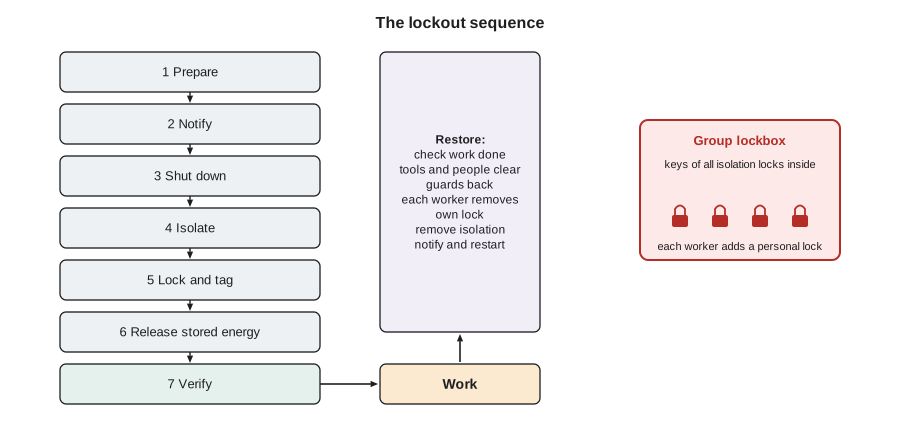
Every lockout follows the same sequence, though the details come from the procedure for the equipment:
- Prepare. Identify every energy source, from the drawings, the written procedure and a walk of the equipment. List every isolation point.
- Notify. Tell everyone affected: the shift engineer, operators who might start the equipment, and anyone working nearby.
- Shut down. Stop the equipment by its normal controls, so that it stops in an orderly way.
- Isolate. Open breakers and disconnects; close valves. Never rely on a control switch, a push button or a closed control valve as isolation.
- Lock and tag. Each worker applies a personal lock and tag to every isolation point, or to a group lockbox holding the keys of locks on every point.
- Release stored energy. Drain, vent, bleed and discharge: open drains and vents, release springs, block raised parts, discharge capacitors, let hot parts cool.
- Verify. Prove zero energy: try the start button, check the gauges read zero, confirm with a tester that the electrical supply is dead, and confirm that drains are flowing freely or have stopped.
Only after verification does work begin. At the end, the order reverses: work is finished, tools and people are clear, guards are back, each worker removes their own lock, and the equipment is restored and tested. A lock is removed only by the person who put it on. If that person has gone home with their key, the procedure for removing an abandoned lock applies, with the supervisor confirming the person is off site and the equipment is safe; nobody cuts a lock for convenience.
Group lockout
A big job, such as a boiler outage, can involve dozens of isolation points and many workers from different trades. Placing every worker's lock on every point is impractical, so plants use group lockout. The shift engineer, or a designated authorized person, isolates and locks every point with a set of plant locks, records each point on a lockout list, and puts all the keys in a lockbox. Each worker then applies a personal lock to the lockbox, after verifying the isolation themselves or witnessing the verification. The plant locks cannot be removed until every personal lock is off the box, so no one can restore energy while anyone is still at work.
Isolating steam and water
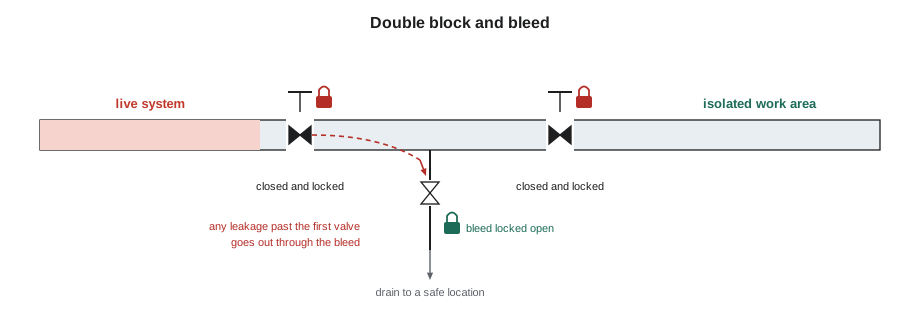
Valves are not as simple as breakers. A closed valve can leak, especially an old gate valve with debris on its seat, and steam or hot water passing a leaking valve can fill the isolated section again. For low-hazard work, a single closed and locked valve with an open drain or vent beyond it may be enough. For steam, high-pressure or high-temperature systems, plants use double block and bleed: two closed and locked valves in series, with a bleed (a drain or vent) between them left open and locked open. If the first valve leaks, the leak escapes through the bleed instead of building up pressure against the second valve and the work site.
The same idea is built into the boilers themselves. A boiler connected to a common steam header with other boilers has two stop valves on its steam outlet with a free-blow drain between them, so that when the boiler is opened for inspection, steam leaking back from the header past the first valve is drained away before it can reach the second. At Cantwell, boiler 3's inspection isolation in September used the two steam stop valves with the drain open between them, the feedwater stop and check valves, the blowdown valves and the chemical feed valve, each locked.
Worked problem
How much energy is in hot water?
The isolated section of feed line holds about 120 L of water at 105 °C. If it were opened to atmosphere, about what mass of water would flash to steam? Use water's heat content at 105 °C of 440 kJ/kg, at 100 °C of 419 kJ/kg, and a latent heat of 2,257 kJ/kg. Take the water's density as 0.955 kg/L.
Show solution
- Mass of water:
- \[120 \times 0.955 \approx 115 \text{ kg}\]
- Fraction that flashes:
- \[(440 - 419) \div 2{,}257 \approx 0.0093\]
- Mass of steam:
- \[115 \times 0.0093 \approx 1.1 \text{ kg}\]
Answer: About 1.1 kg of steam, enough to fill well over a cubic metre at atmospheric pressure, and the rest sprays out at boiling point. Water at boiler pressure flashes far more. That is why the line is drained to a safe place and allowed to cool before anyone opens a flange.
Proving zero energy
Verification is the step people are most tempted to skip, and the one that catches mistakes. For electrical isolation, the equipment is tried at its local start button and the control system, and where the work involves conductors, a qualified person tests for absence of voltage. For pressure, gauges on the isolated section must read zero, but a gauge can be broken or isolated itself, so the vent or drain is opened and watched: steam or water flow should stop. For heat, the equipment is touched cautiously with a gloved hand or checked with an infrared thermometer. If anything does not behave as expected, work stops and the isolation is checked again.
Lorne's habit, which Tamar copied, was to say each verification out loud: "Breaker open, locked, tested at the button, no start. Suction closed and locked. Discharge closed and locked. Casing vent open, no flow. Gauge zero." It sounds theatrical, but saying it forces the engineer to look at each point instead of assuming.
Returning a steam system to service
Restoring isolated steam or water lines is its own hazard. Cold steam lines fill with condensate, and if steam is let in quickly the condensate can be swept along the pipe as a slug of water travelling at high speed. When it hits a bend, a valve or a closed end, the impact, called water hammer, can crack fittings, burst gaskets and break pipe supports. A related form happens when steam meets cold water in a pipe and the bubbles collapse violently. Water hammer sounds like hammer blows in the pipe, and it is a warning to stop.
The safe way to return a steam line is slow and methodical: open the drains and traps first so condensate can leave, then crack open a small warm-up bypass or the main valve just off its seat, and let the line warm gradually over minutes or longer, as the procedure says. Once the line is hot, drains are closed and the main valve is opened fully, then backed off a little so it does not jam open when the stem expands. Valves on steam and hot water lines are opened slowly, with the engineer standing to the side.
| Step | Why |
|---|---|
| Confirm all work is complete, people clear, locks off by their owners | No one is exposed when energy returns |
| Close vents; check drains and traps are open to a safe place | Condensate can escape as the line warms |
| Crack the warm-up bypass or main valve | Steam enters slowly and heats the pipe gradually |
| Watch pressure and listen; stop at any banging | Water hammer is a warning |
| When hot, close drains, open the valve fully, then back it off slightly | Full flow without the valve jamming open |
| Log the return to service | The next shift knows the system is live |
When isolation goes wrong
Most lockout incidents in boiler plants follow a few patterns. A worker isolates the wrong pump of an identical pair because the labels have faded. A second energy source, such as a bypass line, a cross-connection or a second power supply, is missed because it is on another drawing. A valve that is closed but passing lets hot water or steam back into the work area. A worker skips verification because the gauge reads zero, but the gauge is itself isolated. Or a lock is removed by someone other than its owner because they were sure the work was finished. Each pattern has a defence: clear labels and checking tag numbers against the list, a complete review of the drawings, double block and bleed, verification at the vent or drain, and the rule that only the owner removes a lock.
Cantwell keeps written equipment-specific lockout procedures for each pump, fan, boiler and major valve, listing every isolation point with its tag number, the order in which to isolate, the vents and drains to open and the method of verification. Engineers are expected to follow the written procedure, not their memory. When Tamar found the balance line missing from her own list, Lorne checked the written procedure for pump 2 and found the line was on it; her mistake had been to write a list from the drawing instead of starting from the procedure.
Contractors and lockout
Contractors working in the plant follow the plant's lockout program, not their own. Before starting, each contractor worker receives the plant's orientation, is shown the isolation and the verification, and applies their own personal lock to the lockbox. When several contractors and plant staff work on the same equipment, the group lockout keeps everyone protected. At the end of each day a contractor who is leaving the site removes their own lock, and the shift engineer checks the lockbox before handover so that the next shift knows exactly who is still working and where.
Common mistakes
MistakeUsing a control switch or a closed control valve as the isolation point.
InsteadIsolate at the breaker or disconnect and at manual isolating valves, then lock them.
MistakeTrusting a single closed valve on a steam line.
InsteadUse double block and bleed for steam and high-pressure systems; valves leak.
MistakeSkipping verification because the gauge reads zero.
InsteadOpen the vent or drain and watch it; try the start button.
MistakeRemoving someone else's lock.
InsteadOnly the owner removes a lock; abandoned locks follow the special procedure.
MistakeOpening a steam valve quickly on a cold line.
InsteadDrain the line, crack the valve and warm it slowly; stop if you hear water hammer.
Summary and key terms
- Lockout places energy-isolating devices in the safe position and secures them with personal locks and tags.
- Regulation 851 and CSA Z460 govern lockout in Ontario industrial plants.
- Boiler plants hold electrical, mechanical, thermal, pressure, chemical and gravity energy.
- The steps are prepare, notify, shut down, isolate, lock and tag, release stored energy, and verify.
- Group lockout uses plant locks, a lockout list and a lockbox carrying every worker's personal lock.
- Steam and high-pressure systems use double block and bleed; boilers on a common header have two stops with a free-blow drain.
- Steam lines are returned slowly, with drains open, to avoid water hammer.
- Lockout
- Securing energy-isolating devices in the safe position with personal locks.
- Energy-isolating device
- A breaker, disconnect, valve or similar device that physically stops energy reaching equipment.
- Group lockout
- Isolation with plant locks whose keys go in a lockbox carrying each worker's lock.
- Double block and bleed
- Two closed valves with an open bleed between them.
- Free-blow drain
- The drain between a boiler's two steam stop valves.
- Water hammer
- The violent impact of water slugs or collapsing steam bubbles in a pipe.
- Verification
- Proving that isolation works before work begins.
Practice problems
Work each problem on paper first, then reveal the answer to check.
Name four forms of energy that might need to be isolated on a feed pump.
Show answer
Electrical (motor), pressure from the suction and discharge, thermal (hot water), and mechanical (rotation).
Why is a tag alone not enough?
Show answer
It only warns; it does not physically stop energy.
What is the bleed for in double block and bleed?
Show answer
To carry away any leakage past the first valve so it cannot reach the work.
Who may remove a personal lock?
Show answer
Only the person who applied it, except under the abandoned-lock procedure.
What should an engineer do on hearing banging while warming a steam line?
Show answer
Stop, close the valve back down, drain more condensate and warm more slowly.
Lesson quiz · 5 questions
Score 60% or more to complete this lesson.
Create a free account to save your progress, take quizzes and earn a certificate.