
PWR-110 · Lesson 11 of 12 · 22 min
Shift work, rounds and handover
▶ Video coming soon A video version of this lesson is on the way.
At 6:45 in the evening on Friday, November 6, 2026, Tamar and Lorne met Desmond in the control room for the night handover. Desmond read the log back through the day: boiler 3 back on line after its inspection and on low fire; boiler 1 carrying the load; the trap on the tower return replaced; softener B regenerated at 13:10; one standing order changed by Grazyna that afternoon, raising the low-load alarm on the steam header. Then he asked his usual three questions. "What's running? What's not normal? What's left for me?" Lorne answered each, and they walked out to look at boiler 3 together before Lorne signed the log and went home. Desmond's handover took twenty minutes. Lorne said it was the most valuable twenty minutes of the day.
This lesson covers the working rhythm of a plant: rotating shifts and how to stay alert through them, rounds and what to look for on them, and the handover that passes the plant from one engineer to the next. It brings together the safety, records and units of the earlier lessons in the routine of a normal shift.
Shift patterns and fatigue
A plant that never stops needs people on duty every hour of the year. Many plants use 12-hour shifts on a rotation such as two days, two nights and four off, so that each engineer works days and nights in turn and averages about 42 hours a week. Others use 8-hour shifts. Whatever the pattern, the hard part is the night, when the body's internal clock says sleep and the plant still needs full attention.
Fatigue slows reactions, narrows attention and makes people miss alarms and make simple mistakes in calculations. It builds over consecutive night shifts and long overtime. Engineers manage it by sleeping in a dark, quiet room after nights, keeping regular meals, using caffeine early in a night shift rather than late, keeping busy on rounds in the small hours, and telling the shift engineer when they are too tired to work safely. Employers manage it with sensible schedules, limits on overtime and consecutive shifts, and a culture where admitting fatigue is acceptable.
Cantwell's rules are that no one works more than 16 hours in a row, there are at least 10 hours off between shifts, and no one is asked to cover a third night in a row without the chief engineer's approval. Tamar found her first set of nights harder than any exam. Lorne's advice was practical: the critical tasks, such as light-offs, tests and isolations, get done carefully whatever the hour, and the routine ones get a second look before 6 a.m., when attention is lowest.
Worked problem
Hours on a rotation
Cantwell's rotation is 2 day shifts, 2 night shifts, then 4 days off, all 12 hours long, repeating every 8 days. How many hours does an engineer work on average per week?
Show solution
- Hours per cycle:
- \[4 \times 12 = 48 \text{ h in } 8 \text{ days}\]
- Per day on average:
- \[48 \div 8 = 6 \text{ h}\]
- Per week:
- \[6 \times 7 = 42 \text{ h}\]
Answer: 42 hours a week on average, which is the figure used in lesson 3 to estimate Tamar's hours toward her certificate. Four crews on this rotation cover every hour of the year.
Rounds
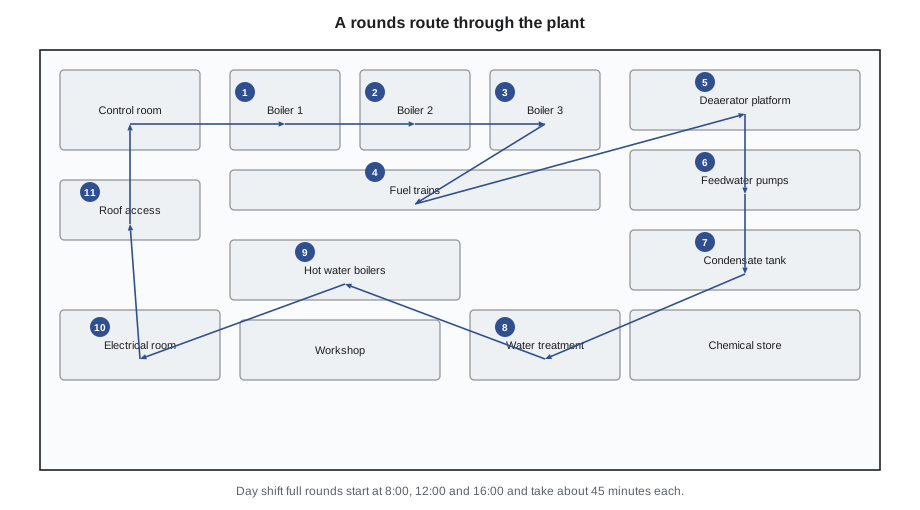
Rounds follow a set route through the plant, at set times, with a log sheet to fill in and a list of things to check. The route covers every operating boiler and its fuel train, the feedwater and condensate systems, the deaerator, the water treatment room, pumps and fans, compressors, chemical tanks, the electrical room, the stack and the plant's exterior. The order is planned so the engineer does not miss a section, and many plants record each stop with a tag reader or tablet.
On rounds an engineer uses every sense. They look at gauges and gauge glasses, for leaks, drips and steam plumes, for loose insulation, for oil on floors, and at flames through sight ports. They listen for changes in the sound of pumps, fans and burners, for steam hiss and water hammer, and for bearing noise. They feel, cautiously and with a glove or the back of the hand held near rather than on, for heat where it should not be, and for vibration. They smell for gas, oil, hot insulation, burning electrical equipment and chemicals.
| Equipment | Typical round checks |
|---|---|
| Steam boiler | Gauge glass level and clarity, pressure, flame appearance, flue gas readings, leaks, safety valve outlets clear |
| Fuel train | Gas pressure, valve positions, no gas smell, leak test indications where fitted |
| Feedwater pumps | Suction and discharge pressure, seal leakage, bearing temperature and noise, vibration |
| Deaerator | Pressure, temperature, level, vent plume |
| Water treatment | Softener status and hardness test, salt level, chemical tank levels and pump strokes |
| Condensate system | Tank level and temperature, pump operation, signs of flash steam |
| Electrical room | No alarms or burning smell, panels closed, temperature normal |
| Exterior and stack | Stack appearance (no dark smoke), roof and yard condition, delivery areas |
The gauge glass and the low water cutoff
Two round tasks deserve special mention because they guard against the most serious boiler failures. The gauge glass shows the true water level in the drum. On rounds, the engineer checks that the level is where it should be and moving slightly, which shows the connections are clear, and blows down the gauge glass as the procedure requires, typically once a shift, to clear sediment from its connections. A gauge glass whose level does not move during a blowdown, or that drains and refills slowly, has a blocked connection and cannot be trusted.
The low water cutoff shuts off the burner if the water level falls too low. Float-type cutoffs are typically blown down to clear sediment and to prove that the burner shuts off, at intervals set by the maker, the code and the plant procedure, often daily on steam boilers; other tests, such as slowly lowering the water level to prove the cutoff operates (an evaporation test), are done less often under controlled conditions. Each test and its result are logged. Many boiler accidents begin with a low water cutoff that had not been tested and did not work when it was needed.
Worked problem
Planning round times
Cantwell's day shift runs from 7:00 to 19:00 with full rounds every 4 hours, starting one hour into the shift. The full round takes about 45 minutes. At what times do rounds start, and how much of the shift do they take?
Show solution
- Start times:
- \[8{:}00, \ 12{:}00, \ 16{:}00\]
- Time on rounds:
- \[3 \times 45 = 135 \text{ min} = 2.25 \text{ h}\]
- Fraction of the 12-hour shift:
- \[2.25 \div 12 \approx 0.19\]
Answer: Rounds start at 8:00, 12:00 and 16:00 and take about 2.25 hours, close to a fifth of the shift. Shorter checks of the boilers in service are made between rounds, and an extra round is made whenever conditions change, such as after a start-up or a trip.
Handover
The handover is where accidents are often born, because information that one engineer knows but does not pass on can leave the next engineer making decisions blind. A good handover is done face to face, in the control room and, where anything is abnormal, at the equipment itself. It covers the state of the plant (what is running and at what load), anything abnormal and what is being done about it, permits and lockouts in force, work in progress and contractors on site, tests done and due, instructions from the chief, and the weather or customer events that may affect the load.
Both engineers read the log together, and the outgoing engineer does not leave until the incoming one is satisfied. If the incoming engineer is not fit for duty, or has not arrived, the outgoing engineer stays; the plant is never left without a qualified engineer on duty, as lesson 3 explained. Once the handover is complete, the incoming engineer records the time they took charge, and responsibility for the plant passes with that entry.
| Handover topic | Example |
|---|---|
| Plant state | Boiler 1 on line at 60 in 100 load; boiler 3 on low fire after inspection; HW boiler 4 on line |
| Abnormal conditions | Condensate return lower than usual; tower trap replaced at 15:30 |
| Permits and lockouts | None open; boiler 3 isolations all removed and logged |
| Work in progress | Softener A resin sample sent to supplier |
| Tests | Low water cutoff blowdowns done on boilers 1 and 3; gauge glasses blown down |
| Orders and events | New header low-load alarm setting; cold front forecast overnight |
Standing orders and communication
Standing orders are written instructions from the chief engineer that stay in force until changed: setpoints, alarm settings, which boilers lead and lag, which tests are done when, and who must be called about what. They are kept with the log, and each change is dated and signed. Engineers read new standing orders at handover and sign to show they have read them.
Shift engineers also communicate beyond the plant. They call customers before planned interruptions, warn the chief engineer of anything serious at any hour, call contractors and the utility, and record every important call in the log. Grazyna's rule for calls was simple: if you are not sure whether to call, call. A chief engineer woken at 3 a.m. for something that turns out to be minor is far better than one who learns about a serious problem in the morning.
A night round
Tamar's first full night round, on Tuesday, October 20, after the flame failure, took her an hour instead of the usual 45 minutes, because Desmond made her stop at every stop and say what she was looking at. At boiler 1 she checked the gauge glass, the steam pressure, the flame through the sight port, the stack oxygen and temperature on the panel, and the burner's safety shutoff valves, then wrote the readings on the sheet. At the feedwater pumps she held a gloved hand near each bearing housing and noticed that pump 1's outboard bearing felt warmer than the others; the infrared thermometer read about 58 °C (136 °F), within its normal range but higher than the week before. She circled it and wrote a note. Desmond added it to his handover for the day shift, and a week later the millwright found that the bearing's grease was breaking down and changed it before it failed.
At the deaerator she checked the pressure and level and looked up at the vent: a thin, steady plume of steam, which is normal, because the deaerator vents a little steam to carry away the oxygen and carbon dioxide it removes. A heavy plume would mean too much steam; no plume at all could mean a blocked vent and oxygen staying in the feedwater. In the water treatment room she checked the softener's status and the salt level, and ran a hardness test on the softener outlet, which showed none. Back in the control room she compared her readings with the screen, wrote the round into the log, and only then made coffee.
Communication with other trades
Shift engineers are the plant's contact for everyone who works there: maintenance staff, electricians, instrument technicians, contractors, inspectors and the water treatment supplier. They issue work permits and lockouts, decide when equipment can be taken out of service, and accept equipment back. Good communication with other trades means explaining the plant's condition before work starts, telling them about any changes during the work, and checking the job is finished properly before accepting the equipment back. Lorne's habit was to walk every job at the end with the person who did it, and to write in the log not only that it was finished but what had been tested.
Common mistakes
MistakeHanding over in a hurry, or by a note left on the desk.
InsteadHand over face to face, read the log together, and walk to any abnormal equipment.
MistakeLeaving when the shift ends although the next engineer has not arrived.
InsteadStay until relieved by a qualified engineer.
MistakeTreating a gauge glass as reliable without blowing it down.
InsteadBlow it down as the procedure requires; a sluggish glass has a blocked connection.
MistakeSkipping a low water cutoff test because the boiler is busy.
InsteadTest as scheduled and log the result; untested cutoffs fail when needed.
MistakeWorking a third straight night while exhausted without saying so.
InsteadTell the shift engineer; fatigue causes errors.
Summary and key terms
- Rotating 12-hour shifts are common; a 2-2-4 rotation averages 42 hours a week.
- Fatigue is managed by sleep, schedules, overtime limits and a culture that allows people to say they are tired.
- Rounds follow a set route and use sight, hearing, touch and smell.
- The gauge glass shows the true water level and is blown down to keep its connections clear.
- Low water cutoffs are blown down and tested on schedule, and every test is logged.
- Handover is face to face and covers plant state, abnormal conditions, permits, work, tests and orders.
- Standing orders are written, dated and signed; when in doubt, call the chief engineer.
- Rotation
- The repeating pattern of day shifts, night shifts and days off.
- Fatigue
- Tiredness that slows reactions and narrows attention.
- Rounds route
- The set path and stops of a plant inspection round.
- Gauge glass
- The glass tube on a boiler drum that shows the actual water level.
- Low water cutoff
- The device that shuts off the burner when water falls too low.
- Evaporation test
- A controlled test letting the water level fall to prove the low water cutoff operates.
- Standing order
- A written instruction from the chief engineer that stays in force until changed.
Practice problems
Work each problem on paper first, then reveal the answer to check.
On a 2-2-4 rotation of 12-hour shifts, what are the average weekly hours?
Show answer
42 hours.
What four senses does an engineer use on rounds?
Show answer
Sight, hearing, touch and smell.
What does a gauge glass that refills slowly after a blowdown suggest?
Show answer
A blocked connection; the reading cannot be trusted.
What three questions did Desmond ask at every handover?
Show answer
What is running? What is not normal? What is left for me?
May an outgoing engineer leave if the relief has not arrived?
Show answer
No; they stay until relieved by a qualified engineer.
Lesson quiz · 5 questions
Score 60% or more to complete this lesson.
Create a free account to save your progress, take quizzes and earn a certificate.