
PWR-110 · Lesson 8 of 12 · 24 min
Hazardous materials and chemical handling
▶ Video coming soon A video version of this lesson is on the way.
On Thursday, October 22, 2026, a delivery of boiler chemicals arrived from the plant's water treatment supplier: two totes of catalyzed sodium sulfite solution, a drum of neutralizing amine and four pails of a caustic soda based alkalinity builder. Before anything was unloaded, Pilar had Tamar find the safety data sheet for each product in the binder and on the supplier's portal, read the hazard statements aloud and check that each container's supplier label matched. One pail had a torn label. Pilar set it aside, made a workplace label for it from the safety data sheet and wrote the replacement in the log. "If you can't read the label, you don't know what's in it," she said. "And if you don't know what's in it, it doesn't go anywhere near a chemical feed tank."
This lesson covers the hazard communication system that applies in every Canadian workplace, the Workplace Hazardous Materials Information System (WHMIS), and the chemicals a boiler plant handles every day: why they are used, how they can hurt people, and how they are stored, transferred, fed and cleaned up safely. It ends with older hazards, such as asbestos insulation, that engineers may meet in older plants.
WHMIS: labels, safety data sheets and training
WHMIS 2015 is Canada's hazard communication system, aligned with the United Nations Globally Harmonized System (GHS). Federal law (the Hazardous Products Act and the Hazardous Products Regulations) requires suppliers to classify their products and provide labels and safety data sheets; provincial occupational health and safety law, in Ontario the WHMIS regulation under the Occupational Health and Safety Act, requires employers to keep labels and safety data sheets available, make workplace labels where needed, and educate and train workers. The federal regulations were amended in 2022 to align with a newer GHS edition, with the transition for suppliers completed by the end of 2025.
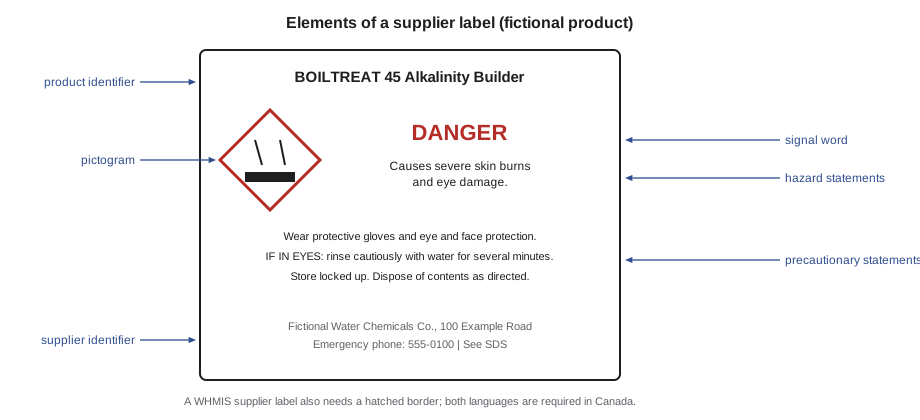
The system has three parts. A supplier label on each container shows the product identifier, a signal word (Danger for more severe hazards or Warning for less severe), pictograms showing the hazard classes, hazard statements, precautionary statements and the supplier's name and contact. A safety data sheet (SDS) in a standard 16-section format gives the full information: hazards, composition, first aid, firefighting, spill response, handling and storage, exposure controls and personal protection, physical and chemical properties, stability and reactivity, toxicology, ecological information, disposal, transport, regulations and the date of the last revision. And training teaches workers what the labels and SDSs mean and how to work safely with the products they use.
When a chemical is moved from its original container into another, such as a day tank, a spray bottle or a sample bottle, the new container needs a workplace label with at least the product name, safe handling information and a reference to the SDS, unless the product is used up immediately by the person who transferred it. Unlabelled containers are one of the most common causes of chemical injuries in plants.
| Pictogram (symbol) | Meaning | Plant examples |
|---|---|---|
| Corrosion | Severe skin burns, eye damage, corrosive to metals | Caustic soda, acids, some amines |
| Flame | Flammable | Fuel oil, solvents, some amines |
| Skull and crossbones | Acute toxicity (can kill in small amounts) | Hydrazine (older plants), some biocides |
| Health hazard | Cancer, reproductive or organ toxicity, sensitization | Hydrazine, some solvents |
| Exclamation mark | Irritant, skin sensitizer, less severe toxicity | Many water treatment blends |
| Gas cylinder | Gas under pressure | Nitrogen, carbon dioxide, calibration gas |
| Flame over circle | Oxidizer | Sodium hypochlorite, some cleaning agents |
Why boiler plants use chemicals
Boiler water treatment keeps the steel clean and intact. Untreated water contains dissolved oxygen, which pits steel; hardness (calcium and magnesium), which forms scale on heating surfaces; silica, which forms hard glassy scale and can carry over into turbines; and carbon dioxide, released as bicarbonates break down in the boiler, which dissolves in condensate to form carbonic acid that eats return lines. Most treatment programs combine mechanical steps, such as softening and deaeration, with chemical feed:
- Oxygen scavengers, such as catalyzed sodium sulfite, remove the last traces of oxygen after the deaerator. Some plants use other scavengers; older plants used hydrazine, which is toxic and a suspected carcinogen and has largely been replaced.
- Alkalinity builders, often based on caustic soda (sodium hydroxide), keep boiler water at a pH where steel forms a protective layer. Concentrated caustic is highly corrosive to skin and eyes.
- Scale inhibitors and dispersants, such as phosphates and polymers, keep hardness that gets past the softener from sticking to heating surfaces, so it can be removed by blowdown.
- Neutralizing amines raise the pH of condensate so carbonic acid does not corrode the return lines, and filming amines coat the inside of steam and condensate piping. Amines are irritants and some are flammable.
- Salt (sodium chloride) regenerates the water softeners, and some plants use acids or caustic to regenerate demineralizers or to clean equipment.
Each of these is safe to handle with the right precautions and harmful without them. The water treatment supplier provides the products, the SDSs and a program of tests and target ranges; the engineers do the daily tests, adjust the feed rates and keep the records.
Handling, storage and feeding
Most chemical injuries in boiler plants happen during transfers: pumping from a tote to a day tank, pouring from a pail, breaking a line to change a pump, or cleaning up after a leak. The basic rules are to read the SDS before handling a product for the first time, to wear the protective equipment it calls for (typically chemical splash goggles and a face shield, chemical-resistant gloves and apron or suit, and boots), to use transfer pumps and closed connections rather than pouring where possible, and to have the eyewash station and safety shower tested and within reach. Eyewash and shower units are commonly tested weekly by running them, and an eye or skin exposure is flushed for at least 15 minutes (typical first aid guidance; the SDS gives the specific first aid).
Storage keeps incompatible chemicals apart. Acids and caustics react violently; acids and sodium hypochlorite release chlorine gas; oxidizers and flammables can start fires. Chemicals are stored in their original labelled containers, on or in secondary containment that can hold a spill from the largest container, away from drains, heat and direct sunlight, and segregated by compatibility as the SDSs describe. When concentrated acid or caustic must be diluted, the chemical is added slowly to water, never water to the chemical, because the heat released can boil the water and spatter.
Worked problem
Mixing a day tank
The water treatment program calls for the sulfite day tank to be mixed at 1 part product to 4 parts water by volume. The tank holds 200 L. How much product and how much water are needed?
Show solution
- Total parts:
- \[1 + 4 = 5\]
- Product:
- \[200 \div 5 = 40 \text{ L}\]
- Water:
- \[200 - 40 = 160 \text{ L}\]
Answer: 40 L of product and 160 L of water. Water goes into the tank first, then the product is pumped in, so that a splash at the start is mostly water. The mix, date and initials go on the tank's workplace label and in the log.
Worked problem
Feed rate check
A chemical feed pump delivers 2.4 L/h of the mixed sulfite solution. How many litres does it use in a 24-hour day, and how many days will a full 200 L day tank last?
Show solution
- Daily use:
- \[2.4 \times 24 = 57.6 \text{ L/day}\]
- Days per tank:
- \[200 \div 57.6 \approx 3.5 \text{ days}\]
Answer: A little over three days. If the tank level drops much faster or slower than this, something has changed: the pump stroke, a leak, a siphon through the injection line, or a change in plant load. Tank levels are logged each shift for that reason.
Spills and exposures
A spill response starts with people: warn others, keep away from the spill, and help anyone who has been splashed to the eyewash or shower. Then the source is stopped if it can be done safely, the spill is contained with absorbent socks or dikes to keep it out of drains, and it is cleaned up with the absorbents and neutralizers the SDS calls for, wearing the protective equipment it lists. Large spills, unknown chemicals, or any spill that releases gas or fumes are left to the plant's emergency responders or the fire department. Spills that reach a sewer or the environment must be reported to the authorities as the law requires.
Every exposure, however minor it seems, is reported to the shift engineer and recorded. Some chemical injuries, such as eye burns from caustic, get worse after the first minutes, and amines and solvents can cause effects hours later. The SDS goes with the injured person to the clinic or hospital.
Older hazards: asbestos and other legacy materials
Plants built before the 1980s often have asbestos in pipe and boiler insulation, gaskets, rope packing, boiler refractory, and floor and ceiling materials. Asbestos is dangerous when its fibres are released into the air by cutting, breaking or removing it. Ontario's O. Reg. 278/05 requires building owners to identify asbestos-containing materials, and only trained workers, following set procedures, may disturb them. Engineers should know where the plant's asbestos survey is kept, never cut or remove old insulation or gaskets without checking the survey, and stop work if they find suspect material that has not been tested. Old fluorescent ballasts may contain PCBs, and some old paints contain lead; the same rule applies: check before disturbing.
Daily water tests
Engineers test boiler water, feedwater and condensate every shift or every day, following the supplier's program. Typical tests include hardness in the softener outlet (it should be close to zero), sulfite residual in the boiler water to prove the oxygen scavenger is present, alkalinity or pH in the boiler water, conductivity or total dissolved solids to set the blowdown rate, and condensate pH and sometimes iron to check for corrosion in the return lines. Each test uses reagents that are themselves chemicals with SDSs; some are corrosive, and the test kit's instructions and protective equipment are followed every time.
Results go on the log sheet beside the target ranges, and any result outside the range leads to an action, such as adjusting a feed pump, increasing blowdown or regenerating a softener, which is also logged. Lorne's view was that the water tests were the most important readings of the shift, because a boiler can run for months with poor water and look perfectly normal until a tube fails. The supplier's technician visits monthly, reviews the logs, runs a fuller set of tests and adjusts the program.
Worked problem
Blowdown and dissolved solids
The supplier's program allows boiler water conductivity up to 3,500 µS/cm, and the feedwater conductivity is 140 µS/cm. If the boiler water is held at the limit, the ratio of the two, called the cycles of concentration, tells what fraction of the feedwater must leave as blowdown. What are the cycles and the blowdown fraction?
Show solution
- Cycles of concentration:
- \[3{,}500 \div 140 = 25\]
- Blowdown fraction:
- \[1 \div 25 = 0.04\]
Answer: 25 cycles, so about 4 in 100 of the feedwater leaves as blowdown. If the conductivity creeps above the limit, more blowdown is needed; if it runs far below, the plant is wasting hot treated water, fuel and chemicals. The test result and the blowdown adjustment are logged together, as the inspector suggested in September.
Exposure limits and monitoring
Some substances in a boiler plant have occupational exposure limits: the airborne concentrations that most workers can be exposed to day after day without harm. In Ontario the limits are set in Regulation 833 under the Occupational Health and Safety Act. Ammonia from a refrigeration plant, amines from condensate treatment vents, carbon monoxide from burners and welding fumes are examples. Where exposure is possible, the employer assesses it, sometimes by air sampling, and controls it with ventilation, closed systems or respiratory protection.
Common mistakes
MistakeMoving a chemical into an unlabelled container.
InsteadPut a workplace label on any container that a chemical is transferred into.
MistakeAdding water to concentrated caustic or acid.
InsteadAdd the chemical slowly to water, never water to the chemical.
MistakeStoring acids next to caustic or hypochlorite.
InsteadSegregate incompatible chemicals as the SDSs describe, with secondary containment.
MistakeRinsing an eye splash for a minute and going back to work.
InsteadFlush for at least 15 minutes, report it and follow the SDS first aid.
MistakeCutting old insulation to repair a leak.
InsteadCheck the asbestos survey first; suspect material is tested before it is disturbed.
Summary and key terms
- WHMIS 2015 is Canada's hazard communication system, aligned with the GHS.
- Supplier labels show the product identifier, signal word, pictograms, hazard and precautionary statements and supplier.
- Safety data sheets have 16 standard sections; workers are trained to read and use them.
- Containers that a chemical is transferred into need workplace labels.
- Boiler chemicals control oxygen, scale, pH and condensate corrosion; each has hazards.
- Transfers need the right PPE, closed connections, eyewash and shower; incompatibles are stored apart over containment.
- Asbestos and other legacy materials are identified and never disturbed without checking.
- WHMIS 2015
- Canada's Workplace Hazardous Materials Information System, aligned with the GHS.
- SDS
- Safety data sheet, the 16-section document describing a product's hazards and safe use.
- Signal word
- Danger or Warning on a label, showing the severity of the hazard.
- Workplace label
- A label applied to a container a product has been transferred into.
- Oxygen scavenger
- A chemical that removes dissolved oxygen from boiler feedwater.
- Neutralizing amine
- A chemical that raises condensate pH to prevent carbonic acid corrosion.
- Secondary containment
- A tray, dike or tank that holds a spill from the containers above it.
Practice problems
Work each problem on paper first, then reveal the answer to check.
What are the three parts of a hazard communication system?
Show answer
Labels, safety data sheets and training.
How many sections does a safety data sheet have?
Show answer
Sixteen.
Why are oxygen scavengers fed to boiler feedwater?
Show answer
To remove the last dissolved oxygen, which would pit the steel.
A 200 L tank is mixed 1 part product to 4 parts water. How much product is needed?
Show answer
40 L.
Which chemicals must never be stored together because they release chlorine?
Show answer
Acids and sodium hypochlorite.
Lesson quiz · 5 questions
Score 60% or more to complete this lesson.
Create a free account to save your progress, take quizzes and earn a certificate.