
PWR-110 · Lesson 3 of 12 · 25 min
Certificates, plant ratings and supervision rules
▶ Video coming soon A video version of this lesson is on the way.
On Friday, September 25, 2026, Grazyna called Tamar into the chief engineer's office with a folder. Inside were the plant's certificate of registration from TSSA, a copy of each engineer's certificate, the shift schedule for October and Tamar's own record of qualifying experience, which Lorne signed at the end of each month. "You'll need this record when you apply for your Fourth Class," Grazyna said, "and I need the rest to prove to TSSA that this plant is never run by anyone less qualified than the regulation says. Let's go through how that works."
This lesson explains how Ontario certifies operating engineers, how a plant's rating is worked out, how the rating sets the certificates its chief and shift engineers must hold, and the rules for attending a plant. Exact values come from the tables in O. Reg. 219/01 and TSSA's orders, which an engineer always checks for the plant in question; this lesson explains how the system works.
Ontario's certificates
O. Reg. 219/01 sets out operating engineer certificates in four classes, Fourth, Third, Second and First Class, and operator certificates for particular kinds of plant: Refrigeration Operator Class A and Class B, Compressor Operator, and Steam Traction Operator. Each certificate needs a combination of qualifying experience, which is time spent operating equipment in a registered plant under a certified engineer, and passing TSSA's exams. Each higher class also needs the class below it.
For the Fourth Class certificate, TSSA's current guide asks for 1,920 hours of qualifying experience as a trainee in a registered plant, or 480 hours for someone who completes a full-time program that TSSA has approved for time reduction. At least a third of the hours must be spent operating boilers, and no more than a third may be maintenance work on regulated equipment. The applicant also passes two multiple-choice exams, 4A and 4B, each of 150 questions, based on the SOPEEC Fourth Class syllabus; the pass mark is 65 in 100 on each, and a failed exam may be rewritten after 60 days. Exam results stay valid for five years, so the certificate must be obtained within five years of passing.
| Certificate | Builds on | Typical use |
|---|---|---|
| Fourth Class Operating Engineer | Qualifying experience and exams 4A and 4B | Chief of a small plant, shift engineer in a larger one |
| Third Class Operating Engineer | Fourth Class, more experience, Third Class exams | Shift engineer or chief of medium plants |
| Second Class Operating Engineer | Third Class, more experience, Second Class exams | Chief of larger plants |
| First Class Operating Engineer | Second Class, more experience, First Class exams | Chief of the largest plants |
| Refrigeration, compressor and steam traction operator | Experience on that kind of plant and exams | Plants of those types only |
Tamar's college program is approved for time reduction, so she needs 480 hours in the plant rather than 1,920. At Cantwell's 12-hour shifts, working an average of 42 hours a week, she reaches that in about 11.4 weeks of shifts. Lorne still logs every hour; any extra time counts toward her Third Class later.
How a plant is rated in Ontario
In Ontario, a plant's rating is the total, in kilowatts, of its registered units. The rating of a boiler is its maximum output in kW as shown on its nameplate. The rating of a steam engine or turbine, or of a compressor's driving motor or engine, comes from its nameplate horsepower converted to kilowatts (1 horsepower is about 0.7457 kW). What is counted depends on the kind of plant: a steam plant or water plant totals its registered boilers, a refrigeration plant totals its refrigeration compressors, and a power plant combines registered boilers with registered steam prime movers and compressors. Units belonging to the same user on the same premises are normally registered together as one plant. Some special equipment, such as low water volume watertube boilers, is handled separately.
The plant's rating, and its type, are compared with tables in the regulation to give the plant a class, from first class down to fourth class for operating engineer plants. The class sets the certificate the chief operating engineer must hold, and the certificates required of shift engineers. In a power plant, the chief's class is the highest required by any part of the plant. A rating may be reduced only with notice to TSSA, and an inspector then seals the change; running an unregistered or unsealed unit is not allowed.
Worked problem
Working out a plant rating
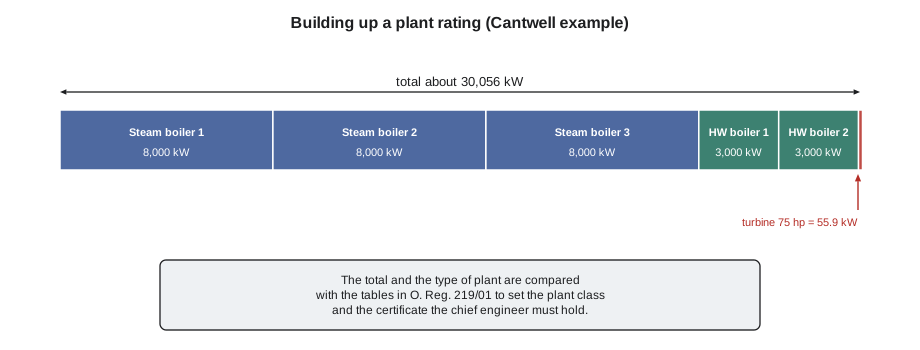
Cantwell has three steam boilers of 8,000 kW and two hot water boilers of 3,000 kW, all registered together. Its backup feed pump is driven by a steam turbine with a nameplate rating of 75 horsepower. If the turbine is registered as part of a power plant, what is the combined rating?
Show solution
- Boilers:
- \[3 \times 8{,}000 + 2 \times 3{,}000 = 30{,}000 \text{ kW}\]
- Turbine:
- \[75 \times 0.7457 \approx 55.9 \text{ kW}\]
- Combined:
- \[30{,}000 + 55.9 \approx 30{,}056 \text{ kW}\]
Answer: The combined rating is about 30,056 kW. The turbine adds very little to the total, but because it is a steam prime mover it can change the type of plant, and TSSA's registration records how Cantwell is classed. The plant's registration sets the chief's certificate; Grazyna's Second Class certificate meets it.
Who may be in charge
Under O. Reg. 219/01 the owner appoints one chief operating engineer (or chief operator) holding at least the class the plant requires, and notifies TSSA of the appointment and of any change. The chief is responsible for the plant's safe condition, for supervising and training staff, for authorizing maintenance and repairs, and for the records. Each shift engineer must generally hold a certificate no more than one class below the chief's required class, and an assistant shift engineer no more than one class below the shift engineer. If the chief is absent, the replacement must be at most one class below what the plant requires. As a trainee, Tamar may operate equipment only under the direct supervision of a certified engineer on shift.
The regulation also says when an engineer must be present. In general a qualified shift engineer must be on duty whenever any unit in the plant is running, and must be in the boiler, engine or compressor room or its immediate vicinity. An engineer may not leave duty until relieved by a qualified person or until the plant is safely shut down. Some plants can be registered as guarded or guarded attended plants, where approved safety devices allow the engineer to leave the room for other duties on the premises under set conditions, and some small low pressure installations may run unattended if their safety devices are in place. Those arrangements are approved by TSSA and come with conditions; an engineer never assumes a plant qualifies.
Worked problem
Counting the hours
Tamar works 12-hour shifts and averages 42 hours a week. How many weeks does she need for 480 hours of qualifying experience, and how many hours of it must be boiler operation?
Show solution
- Weeks:
- \[480 \div 42 \approx 11.4 \text{ weeks}\]
- Boiler operation, at least a third:
- \[480 \div 3 = 160 \text{ h}\]
Answer: About 11.4 weeks, with at least 160 hours operating boilers; the rest can be other regulated equipment, with no more than a third (160 hours) as maintenance.
Keeping certificates current
Certificates are personal: they belong to the engineer, not the employer, and must be displayed in the plant where the engineer works. TSSA expects certificate holders to keep their contact details current and to follow its rules for renewal and reinstatement; an engineer whose certificate has lapsed may need to pass a reinstatement exam. An engineer who moves to Ontario with a certificate from another province applies to TSSA, which may accept it outright or ask for more. Grazyna checks each certificate's status when she schedules a shift, because a shift engineer whose certificate has lapsed is, legally, not qualified to be in charge.
Why the system is built this way
The certificate system rests on a simple idea: the bigger and more complex the plant, the more knowledge and experience the person in charge must have. A small heating plant in an apartment building can be safely run by a Fourth Class engineer. A refinery's steam plant, with high-pressure boilers, turbines and complex controls, needs engineers who have studied thermodynamics, metallurgy and control systems in depth and have years of experience. The plant rating is the tool that matches the two: it turns the size of the equipment into a class, and the class into a certificate.
Experience requirements exist because exams test knowledge, not judgement. The hours in a registered plant under a certified engineer are where a new engineer learns to recognize the sound of a cavitating pump, the smell of an overheating motor and the feel of a valve that is about to stick. That is why the regulation counts only experience in registered plants under supervision, limits how much maintenance time counts, and requires boiler operation as part of every operating engineer's experience.
Tamar's experience record
Tamar's experience record is a simple form: for each month, the plant, the hours worked, the hours spent operating boilers, the hours on other regulated equipment such as compressors and refrigeration, and the hours spent on maintenance, each signed by Lorne as her supervising engineer and countersigned by Grazyna. TSSA's guide asks for the experience to be documented in this way, and for out-of-province experience in a signed letter from the chief engineer. Tamar keeps a copy at home as well, because the record follows her career, not the job.
Her September and October record showed 336 hours in total, of which 198 were boiler operation, 92 were on the feedwater, condensate and water treatment systems, and 46 were maintenance assisting Fenella's crew. Lorne checked the proportions against the guide before signing: more than a third of the hours were boiler operation, and well under a third were maintenance. If she had spent a month mostly helping the maintenance crew, he would have had to keep those hours out of the count beyond the limit.
Worked problem
Checking the proportions
Tamar's record shows 336 hours: 198 operating boilers, 92 on other regulated systems and 46 on maintenance. What fraction is boiler operation, and what fraction is maintenance?
Show solution
- Boiler fraction:
- \[198 \div 336 \approx 0.59\]
- Maintenance fraction:
- \[46 \div 336 \approx 0.14\]
Answer: About 0.59 of her hours are boiler operation, well above the one-third minimum, and about 0.14 are maintenance, well below the one-third limit. All 336 hours count.
Operator certificates and special plants
Besides operating engineers, O. Reg. 219/01 provides for operators of plants that are not steam or water plants. A refrigeration plant above certain sizes, such as an ice rink or a cold storage warehouse, needs a Refrigeration Operator, Class A or Class B depending on its size; a large compressed air plant may need a Compressor Operator; and steam traction engines, such as the steam tractors at agricultural fairs, need a Steam Traction Operator. A power engineer whose plant includes large refrigeration compressors, as many hospitals and district cooling plants do, may need both kinds of qualification, or a plant may be classed by its largest requirement. The plant's registration shows which certificates apply.
Whatever the plant, the principle is the same: the people who run equipment that stores dangerous energy must be qualified for it, and must be able to prove it. Grazyna keeps a matrix on her office wall showing every engineer, every certificate or licence they hold, and its expiry date, and she checks it each time she builds a schedule.
Renewing and upgrading a certificate
A certificate is not permanent proof of competence. Ontario's certificates are renewed on a fixed cycle, and an engineer who wants a higher class applies with a new record of experience and writes the next exams. Tamar's plan, sketched with Lorne in October, was to finish her Fourth Class hours by the end of the year, write 4A and 4B in the spring, and then keep logging hours toward Third Class, because the experience for the next class can only be earned while holding the current one. Lorne pointed out that the plant's class also matters: experience gained in a plant of a higher class can count toward a higher certificate, while experience in a very small plant may not count at all.
Grazyna's advice was more practical: keep every signed record, keep a copy of every certificate, and read the regulator's notices each year, because the requirements for experience and exams are revised from time to time, and an engineer who applies under old assumptions can lose months.
Common mistakes
MistakeCounting maintenance hours as all of Tamar's qualifying experience.
InsteadNo more than a third of the hours may be maintenance, and at least a third must be boiler operation.
MistakeUsing a rule of thumb to decide a plant's rating.
InsteadUse the nameplate ratings and the regulation's tables.
MistakeLetting a trainee run a boiler while the shift engineer is elsewhere.
InsteadTrainees operate only under direct supervision of a qualified engineer.
MistakeLeaving duty before the next shift engineer arrives.
InsteadStay until relieved by a qualified person or until the plant is safely shut down.
MistakeAssuming a lapsed certificate still counts.
InsteadCheck status; a lapsed certificate or licence means the person is not qualified to be in charge.
Summary and key terms
- Ontario certifies Fourth to First Class Operating Engineers and several kinds of operators under O. Reg. 219/01.
- The Fourth Class needs 1,920 hours of qualifying experience, or 480 with an approved program, and exams 4A and 4B.
- A plant's rating is the sum of its registered units in kW; boiler ratings come from nameplate output and engines from horsepower.
- The rating and plant type set the plant class, which sets the chief's and shift engineers' certificates.
- Trainees operate only under the direct supervision of a qualified engineer.
- A qualified engineer stays on duty until relieved or until the plant is safely shut down.
- Certificates and licences are personal, must be current, and are checked when shifts are scheduled.
- Qualifying experience
- Time spent operating equipment in a registered plant under a certified engineer.
- Plant rating
- The total kW of a plant's registered units, used to set its class.
- Plant class
- The category, from first to fourth class, set by a plant's rating and type.
- Chief operating engineer
- The certified engineer appointed to be responsible for a plant.
- Guarded plant
- A plant with approved safety devices that allow set absences of the engineer.
- Time reduction program
- A TSSA-approved training program that reduces required plant hours.
Practice problems
Work each problem on paper first, then reveal the answer to check.
Which certificate classes does O. Reg. 219/01 set for operating engineers?
Show answer
Fourth, Third, Second and First Class.
How many hours does TSSA's guide ask for a Fourth Class without an approved program?
Show answer
1,920 hours.
A turbine is rated 75 horsepower. What is that in kW?
Show answer
About 55.9 kW.
May a trainee run a boiler while the qualified engineer is away?
Show answer
No; only under direct supervision.
When may a shift engineer leave duty?
Show answer
When relieved by a qualified person or when the plant is safely shut down.
Lesson quiz · 5 questions
Score 60% or more to complete this lesson.
Create a free account to save your progress, take quizzes and earn a certificate.