
PWR-110 · Lesson 1 of 12 · 21 min
What power engineers do
▶ Video coming soon A video version of this lesson is on the way.
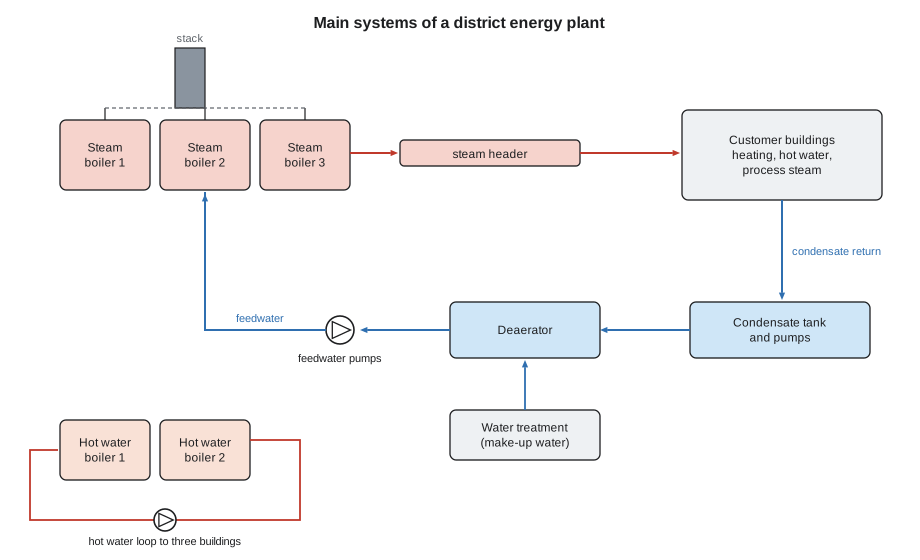
At ten to seven on the morning of Tuesday, September 8, 2026, Tamar Ellingsen signed the visitor book at the Cantwell Energy Centre on Cannon Street East for the last time as a visitor. From that shift on she was a trainee operator, working toward her Fourth Class Operating Engineer certificate while taking a college power engineering program two evenings a week. The plant makes steam and hot water for 26 downtown buildings, including two office towers, a hotel, a seniors' residence and the city's main library. Lorne Fitzwilliam, the shift engineer who would be her mentor, walked her past three watertube steam boilers, two hot water boilers, the deaerator, the feedwater pumps and the water treatment room, then stopped at the logbook on the control room desk. "Everything we do ends up written here," he said. "The boilers can run themselves for a while. The plant can't."
This lesson describes the work of a power engineer: the plants they run, what a shift involves, the skills the job demands, and the ladder of certificates that leads from a first certificate to the top of the trade. The rest of the course turns to the laws behind that ladder, plant safety, and the everyday tools of the job: plant math, drawings, logs and rounds.
Who power engineers are
A power engineer (in Ontario's regulation, an operating engineer) is a certified person who operates and maintains boilers, pressure vessels, steam and gas turbines, compressors, refrigeration systems and the auxiliary equipment around them. The title has nothing to do with a university engineering degree. It comes from the law: in every province, plants above certain sizes must be supervised by people who hold a certificate of the class the plant's rating requires. Power engineers work in hospitals, universities, district energy plants like Cantwell, food and beverage plants, pulp and paper mills, refineries, chemical plants, oil sands and gas processing sites, and electricity generating stations.
The common thread is stored energy under control. A steam boiler holds water far above its atmospheric boiling point; if the shell fails, that water flashes to steam in an instant and the expansion can level a building. A furnace full of unburned gas can explode. A refrigeration plant can release a toxic gas. The engineer's job is to keep all of that energy doing useful work, day and night, and to notice early when something is drifting toward trouble.
What happens on a shift
Most large plants run around the clock, so engineers work rotating shifts, often 12 hours long. A shift begins with a handover: the outgoing engineer walks the incoming one through the log, anything abnormal, work in progress and standing orders. Then come rounds: a set route through the plant, looking at gauges and gauge glasses, listening to pumps and fans, feeling for heat where it should not be, smelling for gas, oil or burning insulation, and writing readings on the log sheet. Between rounds the engineer adjusts the plant to the load, starts and stops equipment, tests safety controls on schedule, does blowdowns, checks water chemistry, issues and closes work permits, and supervises contractors.
Lorne's first rule for Tamar was that the gauges are only half the story. A feedwater pump can show normal pressure and still be failing; its bearing may run hot, or it may make a new sound. A control room screen can show a steady drum level while the gauge glass on the boiler, which is the level that counts, shows something else. Good engineers use every sense and believe the plant before they believe the screen.
| Part of the shift | What the engineer does | Why it matters |
|---|---|---|
| Handover | Read the log, discuss abnormal conditions, permits and orders face to face | Nothing important is lost between shifts |
| Rounds | Walk the route, take readings, look, listen, feel and smell | Problems are caught while they are small |
| Load following | Start, stop and adjust boilers and pumps as demand changes | Steam and hot water meet the customers' needs efficiently |
| Testing | Low water cutoffs, safety valves (as scheduled), flame safeguards, alarms | Safety devices that are never tested may not work |
| Water treatment | Test boiler water, condensate and feedwater; adjust chemical feed; blow down | Scale and corrosion cause most boiler damage |
| Records | Log every reading, event, test and abnormal condition in ink | The log is the legal and technical memory of the plant |
The skills the job demands
Power engineering is a trade of systems. An engineer has to understand thermodynamics well enough to know why a boiler makes more steam per unit of fuel when its water is hotter going in, mechanics well enough to know why a pump starved of suction pressure will cavitate, electricity well enough to isolate a motor safely, and chemistry well enough to read a boiler water test. The certificate exams test all of that, starting simply and climbing in difficulty with each class.
The job also demands judgement and discipline. Many incidents in boiler plants begin with a shortcut: a low water cutoff jumpered "just for now", a safety valve test skipped because the plant was busy, a valve opened too quickly on a cold steam line. Engineers are the people who say no to those shortcuts, including to managers. Lorne put it to Tamar this way on her second day: "You will never be blamed for shutting a boiler down when you weren't sure. You might be for keeping it running."
Communication matters as much as technical skill. Engineers write clear log entries, explain conditions to the next shift, call contractors and inspectors, and talk to customers when a building loses heat. In a district energy plant, a careful phone call to a hotel's maintenance manager can prevent a much bigger problem later.
The certificate ladder in Canada
Canada regulates power engineers province by province, but the provinces cooperate through the Standardization of Power Engineer Examinations Committee (SOPEEC), which publishes common syllabi and exam blueprints so that a certificate earned in one province is recognized in the others. Most provinces, including Alberta and British Columbia, have five classes, from Fifth Class up to First Class. Ontario, where Cantwell operates, certifies Fourth Class to First Class Operating Engineers through the Technical Standards and Safety Authority (TSSA), plus separate operator certificates for refrigeration plants, compressor plants and steam traction engines. Ontario has no Fifth Class certificate; the entry-level material that other provinces test at the Fifth Class level is taught at the start of an Ontario Fourth Class program, which is what this course covers.
Each class above the first depends on the one below it, on more qualifying experience in a registered plant, and on more exams. A Fourth Class certificate in Ontario allows its holder to be chief engineer of a small plant or a shift engineer in a larger one, and the higher classes open the door to larger and more complex plants, up to the chief engineer of a major generating station or refinery.
| Level | Typical role | Plants |
|---|---|---|
| Fourth Class (Ontario's first certificate) | Shift engineer in a larger plant, or chief of a small one | Heating plants, small process plants |
| Third Class | Shift engineer or assistant chief | Hospitals, universities, medium process plants |
| Second Class | Chief of a medium plant, shift engineer in a large one | District energy, larger process plants |
| First Class | Chief of the largest plants | Generating stations, refineries, large mills |
A plant like Cantwell
Cantwell's three steam boilers are each rated at 8,000 kW (about 28,000 lb/h of steam) and supply steam at about 1,035 kPa (150 psi) to the distribution piping that runs under the downtown streets. The two hot water boilers, each rated 3,000 kW (about 10,200,000 Btu/h), serve a newer hot water loop for three buildings. A backup boiler feed pump is driven by a small steam turbine so that the plant can keep feeding its boilers during a power failure. The chief engineer, Grazyna Wolanski, holds a Second Class certificate. Each shift is run by a shift engineer such as Lorne or Pilar Quenneville, with a trainee or an assistant beside them, and the plant is never left without a qualified engineer on duty.
Worked problem
Steam boilers and the size of a plant
Cantwell's three steam boilers are each rated at 8,000 kW and its two hot water boilers at 3,000 kW. What is the combined boiler output, and what fraction comes from the steam boilers?
Show solution
- Steam boilers:
- \[3 \times 8{,}000 = 24{,}000 \text{ kW}\]
- Hot water boilers:
- \[2 \times 3{,}000 = 6{,}000 \text{ kW}\]
- Total and fraction:
- \[24{,}000 + 6{,}000 = 30{,}000 \text{ kW}; \quad 24{,}000 \div 30{,}000 = 0.80\]
Answer: The boilers total 30,000 kW, and 80 in 100 of that capacity is steam. Lesson 3 shows how the regulation uses figures like these, together with any registered prime movers and compressors, to set a plant's rating.
How a career is built
A new power engineer usually starts the way Tamar did: in a college program, as a trainee in a registered plant, or both. The college program gives the theory and, if it is approved by TSSA for time reduction, cuts the plant experience needed for the Fourth Class certificate. Plant time teaches what no textbook can: what a healthy pump sounds like, how a boiler behaves on a cold morning, and how to keep calm when an alarm sounds. After the first certificate, most engineers keep studying while they work, write the higher exams one part at a time, and move up as plants hire for higher classes.
Pay and responsibility rise with each step, and the skills transfer widely. Engineers move between hospitals, factories and power plants, into maintenance and energy management, and into inspection, sales and training. The common thread is the habit Lorne was trying to build in Tamar from her first hour: notice, check, record and never assume.
Tamar's first week
Lorne did not let Tamar touch a valve on her first day. Instead he gave her a clipboard, a flashlight and a copy of the plant drawings, and asked her to trace one system each shift: steam from a boiler outlet to the header and out to the street, then condensate back from the receiving tank to the deaerator, then feedwater from the deaerator to the boilers. By Friday, September 11, she could stand at any valve on the feedwater system and say where the water came from, where it went and what would happen if the valve were closed. "That is the whole trade," Lorne told her. "Knowing what your hand is about to do before it does it."
She also learned the plant's rhythm. On a mild September day the steam load was low enough that one boiler carried the whole system while a second sat on standby, warm and ready, and the third was down for its annual inspection. The hot water loop ran on one boiler. Each morning the load climbed as the office towers' air handlers came on, and each evening it fell away. Lorne showed her the trend screens that plotted steam flow through the day and taught her to look at them before every round, because a load that did not match the usual pattern could mean a leak in the street, a customer valve left open, or a meter that had failed.
Not everything was technical. Tamar met Fenella Thorncroft, the plant's maintenance planner, who issued the work orders and kept the spare parts, and Desmond Kirwan, the night shift engineer, whose log entries were famously short but never missed anything that mattered. She learned where the eyewash stations, the emergency stop buttons, the gas shutoff and the fire extinguishers were, and she walked the evacuation route with Grazyna, who made every new employee do it before their first night shift. She learned that the plant's phone number was printed on the side of every customer's meter room door, so a call could come from anyone at any hour, and that the person who answered spoke for Cantwell.
At the end of the week Grazyna asked her one question: "If you walked into the boiler room and smelled gas, what would you do?" Tamar's answer, worked out with Lorne during the week, was the plant's procedure: do not touch a switch, leave the area, warn others, call the shift engineer from outside the room, and let the shift engineer shut off the gas at the main valve outside and call the utility. Grazyna nodded. "Good. Most of this job is knowing what to do before you need to."
Common mistakes
MistakeTreating the control room screen as the truth about the boiler.
InsteadCheck the local gauges and the gauge glass; the screen is only a copy of what instruments report.
MistakeThinking a boiler that runs automatically does not need attention.
InsteadAutomatic controls fail; the engineer's rounds, tests and log catch failures before they cause harm.
MistakeAssuming a certificate from another province means nothing in Ontario.
InsteadSOPEEC syllabi let provinces recognize each other's certificates; check TSSA's process for out-of-province holders.
MistakeTaking a shortcut on a safety device because the plant is busy.
InsteadSafety devices are tested and kept in service every time; a busy plant is when they matter most.
Summary and key terms
- Power engineers operate and maintain boilers, pressure vessels, turbines, compressors and refrigeration plants under certificates required by law.
- The core of the job is keeping stored energy under control, around the clock.
- A shift includes handover, rounds, load following, testing, water treatment and records.
- Good engineers trust local gauges and their senses, not only the control screen.
- SOPEEC standardizes exams across Canada; Ontario certifies Fourth to First Class Operating Engineers through TSSA and has no Fifth Class.
- Each higher certificate or licence requires the one below, more experience and more exams.
- Judgement and refusing unsafe shortcuts are as important as technical knowledge.
- Power engineer
- A person certified to operate and maintain boilers, pressure plants and related equipment.
- Operating engineer
- Ontario's legal term for a certified power engineer.
- SOPEEC
- The interprovincial committee that standardizes power engineer exam syllabi in Canada.
- TSSA
- The Technical Standards and Safety Authority, which certifies operating engineers in Ontario.
- Rounds
- A regular inspection route through the plant to take readings and check equipment.
- Handover
- The face-to-face exchange of plant information between outgoing and incoming shifts.
- Shift engineer
- The certified engineer in charge of the plant during a shift.
Practice problems
Work each problem on paper first, then reveal the answer to check.
Why is a failed boiler shell so dangerous?
Show answer
The water inside is far above its atmospheric boiling point and flashes to steam, expanding violently.
What are the first two parts of most shifts?
Show answer
Handover, then rounds.
Which level counts in a steam boiler: the control screen reading or the gauge glass?
Show answer
The gauge glass on the boiler; the screen is a copy of the transmitter signal.
Does Ontario have a Fifth Class certificate?
Show answer
No; Ontario starts at Fourth Class, and the entry-level material is taught at the start of a Fourth Class program.
What is the backup feed pump at Cantwell driven by, and why?
Show answer
A small steam turbine, so the boilers can still be fed during a power failure.
Lesson quiz · 5 questions
Score 60% or more to complete this lesson.
Create a free account to save your progress, take quizzes and earn a certificate.