
PWR-110 · Lesson 3 of 12 · 24 min
Certificates, plant ratings and supervision rules
▶ Video coming soon A video version of this lesson is on the way.
On Friday, September 25, 2026, Grazyna called Tamar into the chief engineer's office with a folder. Inside were the boilers' certificates of operation, a copy of each operator's Ohio license, the shift schedule for October and Tamar's own record of operating hours, which Lorne signed at the end of each month. "You'll need this record when you apply for your license," Grazyna said, "and I need the rest to prove that this plant is never run by anyone less qualified than the law says. Let's go through how that works."
This lesson explains how Ohio licenses boiler operators and steam engineers, how boiler size is measured for licensing, how US plants describe boiler capacity, and the rules for supervising a plant. Exact values come from Ohio's law and rules and, elsewhere, from each state or city, which an engineer always checks for the plant in question; this lesson explains how the system works.
Ohio's licenses
Ohio's boiler law sets out three operator licenses. A low pressure boiler operator license covers steam boilers at 15 psi or less. A high pressure boiler operator license covers power boilers, which run above 15 psi, as well as low pressure boilers. A stationary steam engineer license covers boilers and also stationary steam engines and turbines. The superintendent of the Division of Industrial Compliance issues the licenses after an applicant shows documented experience, verified in writing by a licensed person, and passes the state exam. Licenses are renewed periodically.
For the low pressure boiler operator license, Ohio's rules ask for 2,000 hours of operating experience, or 400 hours plus an approved 50-hour steam boiler course. For the high pressure boiler operator license they ask for 2,000 hours, or 700 hours plus an approved 75-hour course, or a low pressure license plus 400 further hours on a high pressure boiler and the 75-hour course. For the stationary steam engineer license they ask for 2,000 hours on a turbine of more than 30 horsepower or on a high pressure boiler, or 700 hours plus an approved 125-hour course, or a high pressure license plus 400 hours on a turbine and the 125-hour course, among other routes. In every case the experience is documented in writing and verified by a licensed person.
| License | Experience routes (paraphrased) | Covers |
|---|---|---|
| Low pressure boiler operator | 2,000 h, or 400 h and a 50-hour course | Steam boilers at 15 psi or less |
| High pressure boiler operator | 2,000 h, or 700 h and a 75-hour course, or LP license plus 400 h and the course | Power boilers and low pressure boilers |
| Stationary steam engineer | 2,000 h on a turbine or HP boiler, or 700 h and a 125-hour course, and other routes | Boilers plus steam engines and turbines |
Tamar's evening program is approved as a 75-hour course, so she is aiming for the high pressure boiler operator license by the 700-hour route. At Cantwell's 12-hour shifts, working an average of 42 hours a week, she reaches 700 hours in about 16.7 weeks of shifts. Lorne still logs every hour, because the extra time will count toward her steam engineer license later.
How boiler size is measured
Licensing rules measure boilers in different ways. Ohio's law uses heating surface: an operator license is needed for a low pressure steam boiler or a power boiler with more than 360 square feet of heating surface, and for a stationary steam engine of more than 30 horsepower. Heating surface is the area of the boiler's metal that has hot gases on one side and water on the other, and it is stamped or listed in the boiler's data. Other states use boiler horsepower, Btu per hour, kilowatts, or the steam pressure, so the same boiler may need a license in one state and not in another.
US plants also describe capacity in boiler horsepower (BoHP). One boiler horsepower is about 33,475 Btu per hour, or about 9.81 kW, which is the heat needed to boil about 34.5 pounds of water per hour from and at 212 °F. A rough rule of thumb, which varies with design, is about 5 square feet of heating surface per boiler horsepower for a modern firetube boiler, and older figures used 10 (typical). Licensing questions are settled by the boiler's actual data, not by rules of thumb.
Worked problem
Boiler horsepower and heating surface
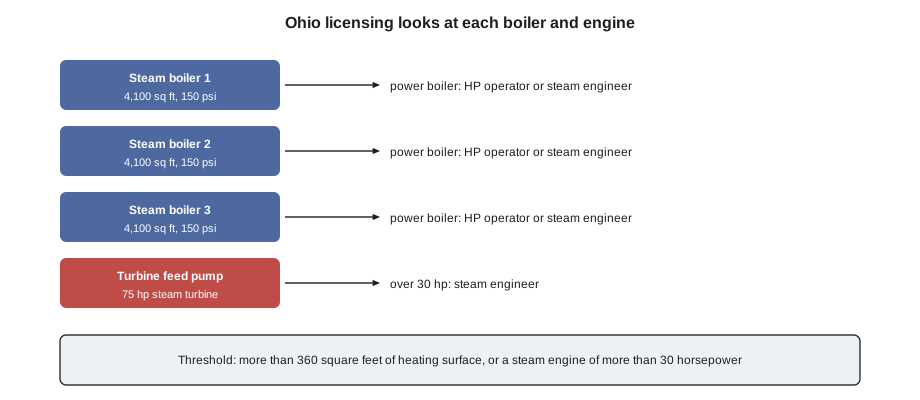
Cantwell's steam boilers each make about 28,000 lb/h of steam. How many boiler horsepower is that, what is it in kW, and does Ohio's heating surface rule apply if each boiler has 4,100 square feet of heating surface?
Show solution
- Boiler horsepower:
- \[28{,}000 \div 34.5 \approx 812 \text{ BoHP}\]
- In kW:
- \[812 \times 9.81 \approx 7{,}970 \text{ kW}\]
- Heating surface test:
- \[4{,}100 \text{ ft}^2 > 360 \text{ ft}^2\]
Answer: Each boiler is about 812 boiler horsepower, or about 7,970 kW. With 4,100 square feet of heating surface, each is far over Ohio's 360-square-foot threshold, and because they run above 15 psi they are power boilers that need a high pressure boiler operator or steam engineer. The 75-horsepower turbine feed pump is over the 30-horsepower limit, so it needs a steam engineer.
Who may be in charge
Ohio allows an unlicensed person to operate a boiler or engine only under the direct supervision of a properly licensed operator. That is how trainees like Tamar gain their hours. Each shift at Cantwell is run by a licensed shift engineer, the chief holds a steam engineer license, and the plant's own procedures say who may start, stop or reset each piece of equipment. Where the law is silent on staffing, the owner's insurer and the boiler manufacturer's instructions often fill the gap, and many plants follow ASME's recommended rules for the care of power boilers.
Attendance rules vary more in the US than in Canada. Some states and cities require an operator in attendance whenever a boiler of a certain size is running; others allow automatic boilers with approved controls to run with periodic checks. Ohio's licensing law is about who may operate, and the plant's insurer, the owner's procedures and the boiler controls standard (ASME CSD-1) shape how often operators check the boilers. At Cantwell, Grazyna's rule is simple: a licensed engineer is on site and on duty every hour the plant runs.
Worked problem
Counting the hours
Tamar works 12-hour shifts and averages 42 hours a week. How many weeks does she need for 700 hours of operating experience?
Show solution
- Weeks:
- \[700 \div 42 \approx 16.7 \text{ weeks}\]
- Shifts, at 12 hours each:
- \[700 \div 12 \approx 58.3, \text{ so } 59 \text{ shifts}\]
Answer: About 16.7 weeks, or 59 twelve-hour shifts. Each month's hours are written up and signed by Lorne, a licensed operator, as Ohio's rules require.
Keeping certificates current
Licenses are personal: they belong to the operator, not the employer. Ohio licenses must be renewed on schedule, and some renewals require continuing education. An operator moving to Ohio from another state applies for an Ohio license; experience elsewhere may count, but the license itself does not transfer. Grazyna checks each license's status when she schedules a shift, because an operator whose license has lapsed is, legally, not qualified to be in charge.
Why the system is built this way
Licensing rests on a simple idea: the bigger, hotter and more complex the plant, the more knowledge and experience the person in charge must have. A low pressure heating boiler in a school can be safely run by a low pressure boiler operator. A district energy plant with power boilers and steam turbines needs operators who understand high-pressure steam, turbines and complex controls and have years of experience. Heating surface, pressure and engine horsepower are the tools that match the two: they decide which license the equipment needs.
Experience requirements exist because exams test knowledge, not judgment. The hours under a licensed operator are where a new engineer learns to recognize the sound of a cavitating pump, the smell of an overheating motor and the feel of a valve that is about to stick. That is why Ohio's rules count documented operating hours, verified by a licensed person, and allow approved courses to replace some hours but never all of them.
Tamar's experience record
Tamar's experience record is a simple form: for each month, the plant, the hours worked, the hours spent operating high pressure and low pressure boilers, the hours on the steam turbine and other equipment, and the duties performed, each signed by Lorne as her supervising licensed operator and countersigned by Grazyna. Ohio's rules ask for the experience to be documented in writing and verified by a currently licensed person. Tamar keeps a copy at home as well, because the record follows her career, not the job.
Her September and October record showed 336 hours in total, of which 198 were operating the high pressure boilers, 92 were on the feedwater, condensate and water treatment systems, and 46 were maintenance assisting Fenella's crew. Lorne checked the record against Ohio's experience routes before signing, and noted which hours were on power boilers, which were on the hot water boilers, and which were on the turbine-driven feed pump, because each counts toward a different license.
Worked problem
Checking the record
Tamar's record shows 336 hours: 198 on power boilers, 92 on other plant systems and 46 on maintenance. What fraction is power boiler operation, and how many more hours does she need for 700?
Show solution
- Power boiler fraction:
- \[198 \div 336 \approx 0.59\]
- Hours still needed:
- \[700 - 336 = 364 \text{ h}\]
Answer: About 0.59 of her hours are power boiler operation. She needs 364 more documented hours, about 8.7 weeks at 42 hours a week, before applying with her course certificate.
Other licenses an engineer may meet
Besides boiler licenses, an engineer may meet other licenses and certifications. Many plants with refrigeration systems require technicians handling refrigerants to hold EPA Section 608 certification. Some cities license refrigeration operators or engineers for large ammonia or water-cooled systems. Fuel gas work on burners and gas trains may fall under state or city gas licensing. And some plants require operators to hold manufacturer training certificates for burner management systems or turbines. The plant's procedures list which qualifications each task needs.
Whatever the plant, the principle is the same: the people who run equipment that stores dangerous energy must be qualified for it, and must be able to prove it. Grazyna keeps a matrix on her office wall showing every engineer, every certificate or license they hold, and its expiry date, and she checks it each time she builds a schedule.
Renewing and upgrading a license
A license is not permanent proof of competence. Ohio's licenses must be renewed on a set cycle with a fee, and an operator who lets a license lapse can no longer take charge of licensed equipment until it is restored. An operator who wants a higher license applies with a new record of hours and writes the next exam. Tamar's plan, sketched with Lorne in October, was to finish her hours for the high pressure boiler operator license, write the exam in the spring, and then keep logging hours on the steam turbine toward the stationary steam engineer license, because that experience is only useful once it is documented under a licensed engineer.
Grazyna's advice was more practical: keep every signed record, keep a copy of every license and course certificate, keep proof of every training course, and read the state's notices each year, because the rules for hours, courses and exams are revised from time to time, and an operator who applies under old assumptions can lose months. She also reminded Tamar that some cities and insurers set rules of their own, so an operator who moves to a plant in another city or state should check the local requirements before assuming a license carries over. Most states do not recognize each other's boiler licenses automatically, and an operator moving across a state line may have to apply again, show their hours and write a new exam.
Common mistakes
MistakeCounting hours that no licensed person has verified.
InsteadOhio requires the experience to be documented and verified in writing by a licensed person.
MistakeUsing a rule of thumb to decide whether a boiler needs a licensed operator.
InsteadUse the boiler's actual heating surface, pressure and engine horsepower.
MistakeLetting a trainee run a boiler while the shift engineer is elsewhere.
InsteadTrainees operate only under direct supervision of a qualified engineer.
MistakeLeaving duty before the next shift engineer arrives.
InsteadStay until relieved by a qualified person or until the plant is safely shut down.
MistakeAssuming a lapsed certificate still counts.
InsteadCheck status; a lapsed certificate or license means the person is not qualified to be in charge.
Summary and key terms
- Ohio licenses low pressure boiler operators, high pressure boiler operators and stationary steam engineers.
- Ohio licenses need documented hours (2,000, or fewer with approved courses), verified by a licensed person, and a state exam.
- Ohio's licensing thresholds use heating surface (360 square feet) and engine horsepower (30); boiler horsepower is about 9.81 kW.
- Pressure and type decide whether a high pressure license or steam engineer license is needed.
- Trainees operate only under the direct supervision of a qualified engineer.
- A qualified engineer stays on duty until relieved or until the plant is safely shut down.
- Certificates and licenses are personal, must be current, and are checked when shifts are scheduled.
- Low pressure boiler
- A steam boiler that runs at 15 psi or less.
- Power boiler
- A steam boiler that runs above 15 psi.
- Heating surface
- The boiler metal area with hot gases on one side and water on the other.
- Boiler horsepower
- About 33,475 Btu per hour, or 9.81 kW of boiler output.
- Direct supervision
- Operating under the immediate oversight of a properly licensed operator.
- Stationary steam engineer
- The Ohio license covering boilers and steam engines and turbines.
Practice problems
Work each problem on paper first, then reveal the answer to check.
Which three licenses does Ohio issue under its boiler law?
Show answer
Low pressure boiler operator, high pressure boiler operator and stationary steam engineer.
What heating surface makes an Ohio boiler need a licensed operator?
Show answer
More than 360 square feet.
What is 28,000 lb/h of steam in boiler horsepower?
Show answer
About 812 BoHP.
May a trainee run a boiler while the qualified engineer is away?
Show answer
No; only under direct supervision.
When may a shift engineer leave duty?
Show answer
When relieved by a qualified person or when the plant is safely shut down.
Lesson quiz · 5 questions
Score 60% or more to complete this lesson.
Create a free account to save your progress, take quizzes and earn a certificate.