
NUC-350 · Lesson 8 of 12 · 21 min
On-power refuelling in CANDU
At 07:30 every weekday, the Darlington fuel engineers meet with the control room to agree on the day's refuelling. Hana joins them for the first time. On the screen is a list of channels, each with its exit burnup, its current power, the readings of the nearby zone controllers and a priority. "Two or three channels a day per unit," Teodora says. "That small, steady addition of fresh fuel is what lets a natural uranium reactor run for years without stopping to refuel. It is also what makes our job different from that of any light-water reactor physicist."
Why CANDU refuels on power
A natural uranium reactor has very little excess reactivity. Natural uranium contains only 0.71 percent uranium-235, and even with heavy water as moderator and coolant, a fresh CANDU lattice has a k_inf only modestly above one. If the core were loaded all at once and run until its reactivity was exhausted, the achievable burnup would be very low, and the unit would spend a large share of its time shut down for refuelling. On-power refuelling solves both problems. By replacing a few bundles every day, the core reaches an equilibrium with a mix of fresh and highly burned fuel. The average reactivity stays just high enough for criticality, the excess is small, and the discharge burnup is roughly double what a single batch could achieve.
The design follows from this choice. Fuel is in short bundles, about half a metre long, loaded end to end in horizontal pressure tubes. Each channel has an end fitting at each face of the reactor, and two remotely operated fuelling machines can lock onto both ends of a channel while the reactor is at full power and pressure. One machine pushes new bundles in at one end; the other receives the irradiated bundles pushed out of the other end.
Fuelling schemes
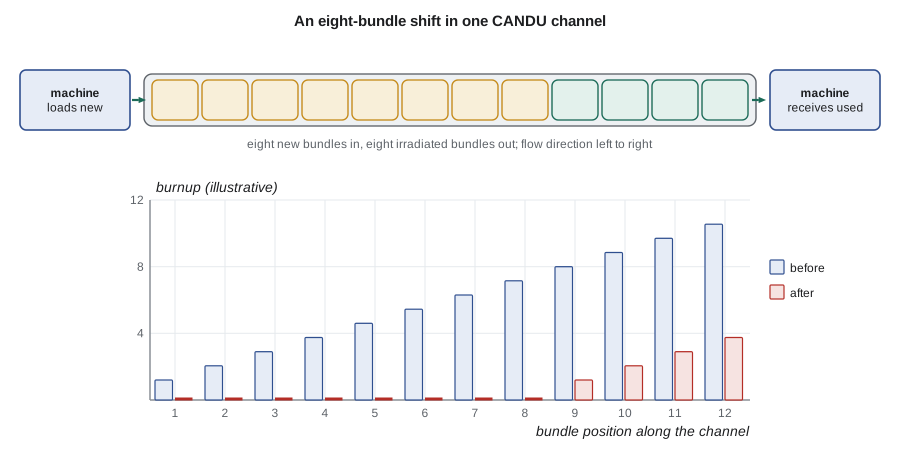
A fuelling scheme specifies how many bundles are pushed in at each visit. In an eight-bundle shift, the eight most burned bundles, those that have travelled down the channel toward the exit, are discharged and eight fresh bundles are inserted. The bundles that were near the entrance move to the exit end and stay for another cycle. Other schemes use four, two or ten bundles per visit. Fewer bundles per visit means more frequent visits and smaller reactivity changes; more bundles per visit means fewer visits and larger local power changes. Each station chooses a scheme that suits its fuelling machine capacity, its power limits and its lattice. The examples here use twelve bundles per channel and an eight-bundle shift as illustrative values.
Because the fresh bundles sit at one end of a channel and the most burned bundles at the other, the axial power in a single channel is not symmetric. Refuelling adjacent channels in opposite directions, as lesson 7 described, restores symmetry in the core average.
How often, and how much reactivity?
The rate of refuelling follows directly from an energy balance. The core must discharge, on average, enough bundles each day to make up for the energy produced:
where P_th is the thermal power, B_d the average discharge burnup and m_U the mass of uranium per bundle. The program below works through the numbers for a large CANDU unit and estimates the reactivity that each visit must add and the daily swing that the zone controllers must absorb.
# On-power refuelling in a CANDU-like core (illustrative numbers).
# How many channels must be refuelled each day, and how big is the reactivity
# ripple from refuelling one channel at a time?
channels = 480
bundles_per_channel = 12
bundles_per_visit = 8            # an 8-bundle shift (some stations use other schemes)
thermal_power_MW = 2776           # roughly a large CANDU unit (illustrative)
discharge_burnup = 7.5           # MWd per kg U, average
kg_U_per_bundle = 19.2
# Fuel needed per day: energy per day / energy per bundle
energy_per_bundle_MWd = discharge_burnup * kg_U_per_bundle
bundles_per_day = thermal_power_MW / energy_per_bundle_MWd
visits_per_day = bundles_per_day / bundles_per_visit
print(f"bundles discharged per full-power day: {bundles_per_day:.1f}")
print(f"channel visits per day with an {bundles_per_visit}-bundle shift: {visits_per_day:.1f}")
print(f"average time between visits to a given channel: {channels / visits_per_day:.0f} full-power days")
# Reactivity balance: the core loses reactivity at a steady rate; each visit adds some back.
loss_mk_per_day = 0.4            # illustrative reactivity loss from burnup, mk per day
gain_per_visit = loss_mk_per_day / visits_per_day
print(f"reactivity added per visit to stay critical: {gain_per_visit:.2f} mk")
# Liquid zone controllers absorb the ripple. Simulate one day with visits spread evenly.
rho, levels = 0.0, []
for hour in range(24):
    rho -= loss_mk_per_day / 24
    if hour % round(24 / visits_per_day) == 0: rho += gain_per_visit
    levels.append(rho)
swing = max(levels) - min(levels)
print(f"reactivity swing over one day without zone control: {swing:.2f} mk, which the zone controllers absorb")bundles discharged per full-power day: 19.3 channel visits per day with an 8-bundle shift: 2.4 average time between visits to a given channel: 199 full-power days reactivity added per visit to stay critical: 0.17 mk reactivity swing over one day without zone control: 0.15 mk, which the zone controllers absorb
With an eight-bundle shift, the unit needs roughly two to three channel visits per full-power day. Each channel is therefore visited about every 200 full-power days, and each visit adds a fraction of a milli-k of reactivity. The core loses reactivity at about 0.4 mk per full-power day from burnup, so a station that stopped refuelling would have only a few weeks before it could no longer stay critical at full power, even after withdrawing its adjusters. This is why refuelling availability is watched closely, and why fuelling machine maintenance is planned carefully.
Worked problem
Running without refuelling
A CANDU unit can recover about 15 mk by withdrawing its adjusters and draining its zone controllers to their low limit. If refuelling stops and the core loses 0.4 mk per full-power day, how long can it run at full power?
Show solution
- Time = available reactivity/loss rate.
- 15 mk/(0.4 mk per day) ≈ 38 full-power days.
Answer: The unit can ride through a short fuelling machine outage, but after about five weeks it must reduce power. In practice stations do not use all of the adjuster worth for this purpose, because adjusters are also needed to flatten power and for xenon override after a trip.
Channel power ripple
Refuelling a channel raises its power immediately, because high-burnup bundles are replaced by fresh ones. The jump can be about ten percent of the channel power, and neighbouring channels rise too. Over the following weeks, the channel's power falls as the fresh fuel picks up plutonium briefly, then burns. This pattern is called refuelling ripple. Channel and bundle power limits must be met at the peak of the ripple, not just on average. Fuel engineers therefore choose channels to refuel partly by their current power: a channel already near its limit is a poor choice, because refuelling would push it over.
The ripple also adds to the time-averaged power distribution that the design assumes. Safety analyses use a reference power distribution called the time-average model, with an allowance for ripple, to set conservative initial conditions for accident analyses. Hana's group compares measured channel powers from the in-core flux detectors with the core simulator's predictions every day, and investigates any channel that drifts outside the expected band.
Reactivity devices and the fuelling engineer
The fuelling engineer works hand in hand with the reactivity control system. Liquid zone controllers, fourteen compartments of light water distributed through the core, provide fine control and spatial balance. When a channel is refuelled, the zones near it fill slightly to absorb the extra reactivity. Over a day, the zone levels drift down as fuel burns and up as channels are refuelled. Average zone level is therefore a direct measure of whether refuelling is keeping pace with burnup. A low average level means the core is short of reactivity, and refuelling should speed up; a high average level means the core has more reactivity than it needs. Zone levels in individual zones show regional imbalances that the choice of channels should correct.
Adjuster rods, normally fully inserted, flatten the power distribution and provide reactivity for xenon override and for short periods without refuelling. Shutoff rods and liquid poison injection make up the two independent shutdown systems and are not used for control. Lesson 9 compares these devices with those of light-water reactors.
Equilibrium, start-up and transitions
An equilibrium core is reached only after many months of on-power refuelling following start-up or a long outage. The first core of a new or refurbished unit starts with all fresh fuel, which has far more reactivity than the equilibrium core. This excess is held down with soluble poison in the moderator, sometimes with depleted fuel bundles in selected channels, and refuelling begins only after the core average burnup has risen enough. The transition from first core to equilibrium requires its own fuel management plan, with careful choice of which channels to refuel first and in which direction.
The Darlington units, freshly refurbished with new fuel channels and feeders, each went through such a transition on their return to service. New pressure tubes start with slightly different dimensions and creep behaviour from aged ones, so the lattice constants and the channel power limits used in fuel management were updated, as the Nuclear Materials course discussed for the materials side.
Fuel economics of on-power refuelling
The fuel cost of a CANDU unit is low per unit of energy, because natural uranium needs no enrichment and the bundles are simple. The main economic measure in fuel management is the average discharge burnup: every increase in burnup reduces the number of bundles needed per year. Burnup can be raised a little by careful refuelling, such as choosing channels whose exit bundles have the highest burnup and avoiding premature discharge of bundles that still have useful reactivity. It is limited by the core's reactivity balance and by channel and bundle power limits. A station that refuels channels too early, or too often in a region with spare reactivity, loses burnup and raises fuel consumption.
| Quantity | Illustrative value | Effect of a 5 % increase in discharge burnup |
|---|---|---|
| Average discharge burnup | 7.5 MWd/kgU | rises to about 7.9 MWd/kgU |
| Bundles per full-power day | about 19 | falls to about 18 |
| Bundles per year at 90 % capacity factor | about 6 200 | falls by about 300 |
| Spent fuel generated | proportional to bundles discharged | falls by about 5 % |
Spent CANDU bundles go to a water-filled bay at the station for cooling and then to dry storage. Because CANDU spent fuel has a low burnup, its decay heat per bundle is relatively low, but the number of bundles is large. The fuel management records of every bundle, including its channel, position, power history and burnup, follow it into storage and are used for safeguards accounting and for long-term waste management planning.
Fuel management also interacts with maintenance. Each fuelling machine must be maintained regularly, and while one is out of service the refuelling rate may fall. Physics planners therefore keep a small reserve of excess reactivity, in the form of zone controller margin and fuel ahead of schedule, so that a few days without refuelling do not force a power reduction. When the machines return, the backlog of channels is worked off over several days, following the same selection rules.
The refuelling record also supports the long-term care of the fuel. Each discharged bundle's identity, channel, position history and burnup are logged, and the bundles are tracked through the irradiated fuel bay to dry storage. Periodic inspections of selected bundles in the bay, compared with their recorded histories, confirm that the fuel behaves as expected and help to set future limits on bundle power and burnup.
Hana ends her first week on the fuel management desk with a short summary for Teodora: channels visited, bundles discharged, the average exit burnup and the zone level trend. The numbers are routine, which is exactly what everyone wants.
Common mistakes
MistakeA CANDU reactor refuels a whole channel at each visit.
InsteadIt usually replaces only part of the channel, for example eight of the bundles, at each visit.
MistakeOn-power refuelling is just a way to avoid outages.
InsteadIt also roughly doubles the discharge burnup of natural uranium fuel compared with batch loading.
MistakeRefuelling a channel lowers its power because fresh fuel is cool.
InsteadIt raises the channel's power, because fresh bundles are more reactive than those removed.
Summary and key terms
- CANDU reactors refuel on power because natural uranium has little excess reactivity.
- Fuelling machines push fresh bundles in at one end of a channel and receive irradiated bundles at the other.
- The refuelling rate follows from thermal power, discharge burnup and bundle mass.
- Refuelling ripple raises channel power after a visit and must stay within channel and bundle limits.
- Average zone controller level shows whether refuelling keeps pace with burnup.
- On-power refuelling
- Replacing fuel while the reactor operates at power.
- Fuelling scheme
- The number of bundles inserted at each channel visit, for example an eight-bundle shift.
- Channel visit
- One refuelling operation on one fuel channel.
- Refuelling ripple
- The rise and slow fall of channel power after a channel is refuelled.
- Time-average model
- A reference CANDU power distribution averaged over the refuelling cycle.
- Liquid zone controller
- A compartment of light water whose level is varied for fine reactivity and spatial control.
Practice problems
Work each problem on paper first, then reveal the answer to check.
Why can natural uranium not be used efficiently in a batch-loaded heavy-water core?
Show answer
Its excess reactivity is so small that a single batch would reach only a low burnup.
How many bundles per day does a 2 776 MW unit need at 7.5 MWd/kgU and 19.2 kg per bundle?
Show answer
About 19 bundles per full-power day.
What does a low average zone level indicate?
Show answer
The core is short of reactivity and refuelling should be increased.
Why is a channel near its power limit a poor choice for refuelling?
Show answer
Refuelling would raise its power by roughly ten percent and could exceed the limit.
What are adjuster rods used for?
Show answer
Flattening the power distribution and providing reactivity for xenon override or a pause in refuelling.
Lesson quiz · 5 questions
Score 60% or more to complete this lesson.
Create a free account to save your progress, take quizzes and earn a certificate.