
NUC-350 · Lesson 2 of 12 · 21 min
Lattice physics
Hana's first task is to rerun the lattice calculation for the 37-element natural uranium bundle used in the refurbished Darlington units. "The core simulator never sees a fuel pin," Teodora tells her. "It sees homogenized bundles, each with a handful of cross sections. Everything about pins, sheaths, pressure tubes and the moderator between them has to be folded into those numbers by the lattice code. If the lattice step is wrong, no amount of care in the core model can fix it."
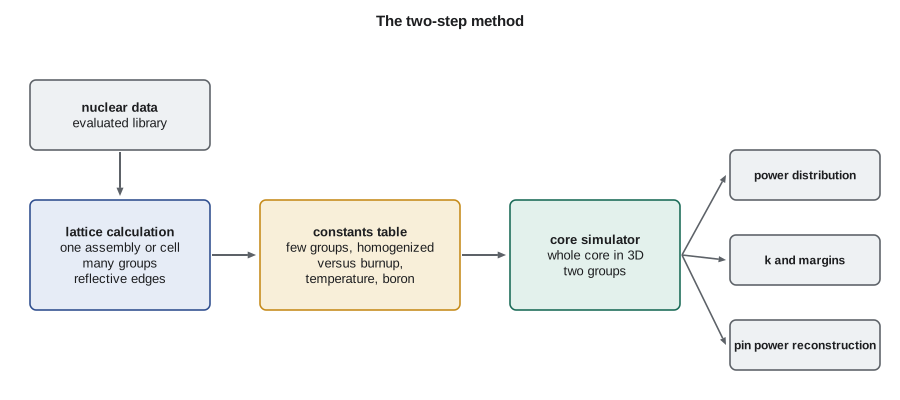
The lattice and the two-step method
A power reactor core is built from repeated units. A light-water reactor core is an array of square fuel assemblies, each holding a lattice of fuel pins, guide tubes and sometimes absorber pins, all bathed in water. A CANDU core is an array of horizontal channels on a square pitch in a tank of heavy-water moderator; each channel holds a string of fuel bundles in a pressure tube, separated from the moderator by a gas-filled calandria tube. In both cases, the core is far too detailed to model pin by pin in three dimensions over a whole cycle.
Reactor physics therefore works in two steps. In the first, the lattice step, a transport calculation is made for one assembly or bundle cell, usually in two dimensions with reflective boundaries, as if it were part of an infinite array of identical units. This calculation uses dozens or hundreds of energy groups and represents every pin, sheath and coolant region explicitly. Its output is a set of few-group, homogenized cross sections for the whole unit, together with factors that let the detailed pin powers be reconstructed later. In the second step, the core step, a diffusion or simplified transport code solves for the whole core using those homogenized constants node by node.
The pin cell and the Wigner-Seitz approximation
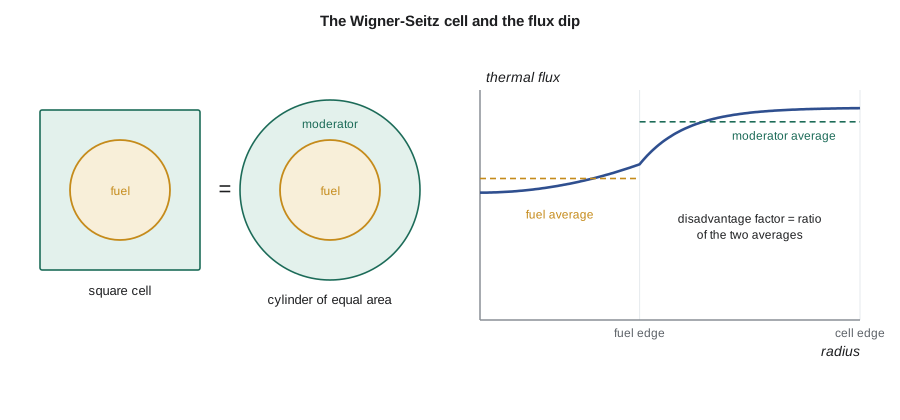
The simplest lattice unit is a single fuel pin and its share of moderator. In a square lattice, each pin sits at the centre of a square cell whose side is the pitch. The traditional simplification, due to Wigner and Seitz, replaces the square cell by a cylinder of the same area, with a reflective or white boundary condition on its outer surface. The fuel occupies the inner region, followed by a gap, the cladding and the moderator. Because the cell is symmetric, the flux depends only on the radius.
Within the cell, the thermal flux is not uniform. Thermal neutrons are created by slowing down in the moderator, diffuse toward the fuel and are absorbed there. The flux is therefore highest in the moderator and lowest at the centre of the fuel. Two quantities describe this flux shape:
| Quantity | Definition | Typical size |
|---|---|---|
| Thermal disadvantage factor | average thermal flux in the moderator divided by that in the fuel | about 1.05 to 1.2 in light-water pin cells; larger for CANDU clusters |
| Thermal utilization f | thermal absorptions in fuel divided by all thermal absorptions in the cell | about 0.85 to 0.95 in light-water lattices; about 0.9 to 0.98 in CANDU |
| Self-shielding factor | average flux inside an absorber divided by the flux at its surface | well below 1 for strong absorbers and resonances |
The thermal utilization enters the four-factor formula from Reactor Physics I directly. Written with flux-weighted averages, it is:
where ζ = φ̄_M/φ̄_F is the disadvantage factor. A larger disadvantage factor means that the moderator sees relatively more flux and therefore absorbs a larger share of neutrons. Lattice design always balances two effects: adding moderator improves slowing down and reduces resonance absorption, but also increases parasitic absorption in the moderator. The best ratio of moderator to fuel depends strongly on the moderator. Light water absorbs enough that light-water lattices are tight, with a pitch only about 1.3 times the pin diameter. Heavy water absorbs so little that CANDU lattices can be widely spaced, with a pitch of about 28.6 cm between channels.
Homogenization: flux-volume weighting
To give the core simulator a single cross section for a cell or assembly, the lattice code averages each cross section over space, weighted by flux and volume, so that the homogenized cell absorbs and produces neutrons at the same total rates as the detailed one:
A plain volume average would give the fuel too much weight, because the fuel actually sees less flux than the moderator. The program below solves a one-speed thermal diffusion problem across a Wigner-Seitz cell with a uniform slowing-down source in the moderator, then computes the disadvantage factor, the thermal utilization and the flux-weighted absorption cross section. It runs one light-water-like pin cell and one heavy-water-like cell in which the fuel cluster has been smeared into a single cylinder.
# Lattice cell: one-speed thermal diffusion in a Wigner-Seitz cylinder.
# Neutrons are slowed down (uniform source) in the moderator and absorbed mostly
# in the fuel. Finite differences in r give the flux shape; flux-volume weighting
# gives homogenized constants. Values are illustrative.
import math
def cell(r_fuel, r_cell, D_f, sa_f, D_m, sa_m, n=200):
    h = r_cell / n; r = [(i + 0.5) * h for i in range(n)]
    D = [D_f if x < r_fuel else D_m for x in r]
    sa = [sa_f if x < r_fuel else sa_m for x in r]
    q = [0.0 if x < r_fuel else 1.0 for x in r]          # slowing-down source
    a, b, c = [0.0] * n, [0.0] * n, [0.0] * n
    for i in range(n):
        rw, re_ = i * h, (i + 1) * h
        Dw = 2 * D[i] * D[i - 1] / (D[i] + D[i - 1]) if i else 0.0
        De = 2 * D[i] * D[i + 1] / (D[i] + D[i + 1]) if i < n - 1 else 0.0   # reflective outer edge
        vol = r[i] * h
        a[i] = -Dw * rw / h; c[i] = -De * re_ / h
        b[i] = -(a[i] + c[i]) + sa[i] * vol; q[i] *= vol
    cp, dp = [0.0] * n, [0.0] * n
    for i in range(n):
        m = b[i] - (a[i] * cp[i - 1] if i else 0.0)
        cp[i] = c[i] / m; dp[i] = (q[i] - (a[i] * dp[i - 1] if i else 0.0)) / m
    phi = [0.0] * n
    for i in reversed(range(n)):
        phi[i] = dp[i] - (cp[i] * phi[i + 1] if i < n - 1 else 0.0)
    V = [r[i] * h for i in range(n)]
    fF = sum(phi[i] * V[i] for i in range(n) if r[i] < r_fuel) / sum(V[i] for i in range(n) if r[i] < r_fuel)
    fM = sum(phi[i] * V[i] for i in range(n) if r[i] >= r_fuel) / sum(V[i] for i in range(n) if r[i] >= r_fuel)
    vf = r_fuel**2 / r_cell**2
    f = sa_f * fF * vf / (sa_f * fF * vf + sa_m * fM * (1 - vf))
    sa_hom = (sa_f * fF * vf + sa_m * fM * (1 - vf)) / (fF * vf + fM * (1 - vf))
    return fM / fF, f, sa_hom
# light-water-like pin cell (cm): small pitch, strong moderator absorption
dis, f, sah = cell(0.41, 0.71, 0.36, 0.30, 0.16, 0.020)
print(f"light-water pin cell: disadvantage factor {dis:.3f}, thermal utilization f = {f:.3f}, homogenized sigma_a = {sah:.4f} /cm")
# heavy-water-like cell: fuel cluster smeared into a 5 cm radius, large lattice
dis2, f2, sah2 = cell(5.0, 16.0, 0.70, 0.060, 0.85, 0.00008)
print(f"heavy-water cluster cell: disadvantage factor {dis2:.3f}, thermal utilization f = {f2:.3f}, homogenized sigma_a = {sah2:.5f} /cm")
# what a simple volume-weighted average (no flux weighting) would give
vf = 0.41**2 / 0.71**2
print(f"volume-only average for the pin cell = {0.30*vf + 0.020*(1-vf):.4f} /cm (overestimates fuel absorption)")light-water pin cell: disadvantage factor 1.054, thermal utilization f = 0.877, homogenized sigma_a = 0.1101 /cm heavy-water cluster cell: disadvantage factor 1.790, thermal utilization f = 0.978, homogenized sigma_a = 0.00350 /cm volume-only average for the pin cell = 0.1134 /cm (overestimates fuel absorption)
The light-water cell has a small disadvantage factor because its moderator region is thin. The heavy-water cell has a much larger one, because neutrons slow down far from the fuel and the flux builds up in the large moderator region. Even so, the heavy-water cell has the higher thermal utilization, because heavy water absorbs so little. The volume-only average for the light-water cell overestimates the absorption cross section by about 3 percent, which would bias k by several hundred pcm in a core calculation.
Worked problem
Thermal utilization from a disadvantage factor
A pin cell has a fuel-to-moderator volume ratio V_F/V_M = 0.50, Σ_{a,F} = 0.30 per cm and Σ_{a,M} = 0.020 per cm. The disadvantage factor is 1.10. Find f.
Show solution
- Ratio term: (Σ_{a,M}V_M)/(Σ_{a,F}V_F) = (0.020 × 2.0)/(0.30 × 1.0) = 0.1333.
- Multiply by ζ: 0.1333 × 1.10 = 0.1467.
- f = 1/(1 + 0.1467) = 0.872.
Answer: About 87 percent of thermal absorptions occur in the fuel. Without the flux dip, ζ = 1 would give 0.882, an error of about one percent in f.
From pin cell to assembly
Real lattice codes go well beyond the Wigner-Seitz pin cell. A modern light-water lattice calculation models the full assembly in two dimensions: each fuel pin with its own composition, the guide tubes and instrument tube filled with water, any burnable absorber pins, the grid spacers smeared into the coolant and the water gap between assemblies. The transport equation is solved by the method of characteristics, collision probabilities or discrete ordinates in many groups. The resulting flux gives homogenized constants for the whole assembly, and also the pin-by-pin power within it.
For a CANDU bundle, the lattice cell contains the 37 fuel elements of the bundle, the heavy-water coolant inside the pressure tube, the pressure tube, the gas gap, the calandria tube and the surrounding square of heavy-water moderator. Because the coolant and moderator are separate, a lattice code can study what happens if the coolant density changes while the moderator does not, which is the origin of the coolant void reactivity effect studied in Reactor Physics I. The Canadian industry standard lattice code for CANDU has been WIMS-AECL, with DRAGON also widely used, and supercell calculations are added to model devices such as adjusters and shutoff rods between channels.
Branches, histories and the cross-section table
A lattice calculation is not done once. The fuel burns, and its composition changes; the operating state changes, and the spectrum changes with it. A lattice code therefore performs a depletion calculation through the life of the fuel at nominal conditions, called the history, and at selected burnup points it branches off to calculate constants at other conditions: higher or lower fuel temperature, moderator temperature or density, boron, void or control insertion. The results fill a multidimensional table, and the core simulator interpolates in that table for each node at each step.
Effects that depend on history rather than the current state are especially important. Fuel burned with the moderator at high void fraction in a boiling water reactor, for example, builds up more plutonium than fuel burned at low void, because the harder spectrum favours capture in uranium-238. Two nodes with the same burnup but different void histories therefore have different reactivities. Codes handle this by tabulating constants against both the instantaneous and the historical conditions, or by tracking important nuclides directly in the core calculation.
Pin power reconstruction and discontinuity factors
Homogenization throws away detail that matters for safety: the power of the hottest pin. Core simulators recover it by pin power reconstruction. The lattice code stores, for each assembly type, the ratio of each pin's power to the assembly average in an infinite lattice. The core simulator computes a smooth intra-assembly flux shape from its own nodal solution and multiplies it by these form factors to estimate each pin's power in the actual core environment.
A second correction keeps the homogenized model consistent. When a detailed heterogeneous assembly is replaced by a homogeneous block, the flux at the block surface no longer matches the true surface flux. Assembly discontinuity factors, the ratio of the heterogeneous surface flux to the homogeneous one, are stored by the lattice code and used by the core simulator to allow a controlled discontinuity in the homogeneous flux at assembly faces. With these factors, a coarse nodal model can reproduce the reaction rates of the detailed calculation much more closely.
Common mistakes
MistakeA simple volume average of the cross sections is good enough for homogenization.
InsteadCross sections must be weighted by flux as well as volume, because the fuel sees less flux than the moderator.
MistakeLattice constants are calculated once for fresh fuel.
InsteadThey are tabulated through the whole burnup history and at branch conditions for temperature, density, boron, void and control.
MistakeHomogenization removes the need to know individual pin powers.
InsteadPin powers are reconstructed from stored form factors, because the hottest pin sets safety limits.
Summary and key terms
- The two-step method uses a detailed lattice transport calculation to make homogenized constants for a core simulator.
- In a lattice cell, thermal flux dips in the fuel; the disadvantage factor measures that dip.
- Homogenized constants are flux-volume weighted so that reaction rates are preserved.
- Lattice constants are tabulated against burnup, history and branch conditions.
- Pin power reconstruction and discontinuity factors recover detail lost by homogenization.
- Lattice code
- A transport code that calculates neutron behaviour in one fuel assembly or cell in many energy groups.
- Wigner-Seitz cell
- A cylinder of the same area as a square lattice cell, used to simplify the cell geometry.
- Disadvantage factor
- The ratio of average thermal flux in the moderator to that in the fuel.
- Homogenization
- Replacing a detailed region by a uniform one with equivalent cross sections.
- Branch calculation
- A lattice calculation at off-nominal conditions taken from a point in the depletion history.
- Discontinuity factor
- The ratio of heterogeneous to homogeneous surface flux used to correct nodal models.
Practice problems
Work each problem on paper first, then reveal the answer to check.
Why does the thermal flux dip in the fuel of a pin cell?
Show answer
Thermal neutrons are produced in the moderator and absorbed strongly in the fuel, so the flux falls toward the fuel centre.
Why can CANDU lattices be more widely spaced than light-water lattices?
Show answer
Heavy water absorbs very few neutrons, so adding moderator costs little parasitic absorption.
What is a branch calculation?
Show answer
A lattice calculation at changed conditions, such as higher fuel temperature or boron, made at a burnup point of the nominal history.
In the example, what would f be if the disadvantage factor were 1.0?
Show answer
About 0.882.
What are pin form factors used for?
Show answer
To reconstruct individual pin powers from the core simulator's smooth nodal flux.
Lesson quiz · 5 questions
Score 60% or more to complete this lesson.
Create a free account to save your progress, take quizzes and earn a certificate.