
NUC-350 · Lesson 4 of 12 · 20 min
Fuel depletion
Teodora pulls up the history of one bundle from a Darlington channel: its power in each week since it was loaded, ending about eight months later when it was pushed out of the channel. "Every week," she says, "that bundle lost some uranium-235, gained some plutonium and filled up with fission products. Its reactivity fell, and the core had to make up for it with fresh fuel. Depletion is the clock that runs the whole fuel management problem."
Burnup and what changes
Burnup measures the energy a fuel has produced per unit mass of heavy metal, usually in megawatt-days per kilogram of initial uranium (MWd/kgU, equivalent to GWd per tonne). Because about 200 MeV is released per fission, one megawatt-day corresponds to about 2.7 × 10²¹ fissions, or roughly 1.05 grams of fissioned heavy metal. Typical discharge burnups differ widely between reactor types:
| Reactor and fuel | Typical average discharge burnup | Time in core |
|---|---|---|
| CANDU, natural uranium | about 7 to 8 MWd/kgU | roughly 6 to 12 months, set by refuelling |
| PWR, low-enriched uranium (up to 5 % U-235) | about 45 to 55 MWd/kgU | three or four cycles of 18 to 24 months |
| BWR, low-enriched uranium | about 40 to 50 MWd/kgU | several cycles of 12 to 24 months |
Three groups of changes happen as fuel burns. The fissile nuclide that started the chain, uranium-235, is consumed. New heavy nuclides are formed by neutron capture, most importantly plutonium-239 from uranium-238. And fission products accumulate. Each change affects reactivity: losing uranium-235 lowers it, forming plutonium-239 raises it, and the fission products, which absorb neutrons, lower it further. In a light-water reactor, the net reactivity of an assembly falls roughly linearly with burnup over most of its life, a fact that lesson 8 uses to design reload batches.
The depletion equations
The number density N_i of each nuclide changes because of neutron absorption, radioactive decay and production from other nuclides. For a nuclide in a constant one-group flux φ, the balance is:
The first term is production by fission of nuclide j with yield γ, or by capture in nuclide j with branching b; the second is production by decay of nuclide k; the third is loss by absorption and decay. Written for every nuclide, these equations form a large linear system, the Bateman equations, which can be solved by matrix exponential methods. Production depletion codes track hundreds of actinides and fission products. For many purposes, a handful of nuclides tells most of the story.
A simplified actinide chain
The main heavy-nuclide path in low-enriched or natural uranium fuel is short. Uranium-235 either fissions or captures a neutron to become uranium-236. Uranium-238 occasionally fissions with fast neutrons but mostly captures neutrons, especially in its resonances, becoming uranium-239. That decays with a half-life of about 23 minutes to neptunium-239, which decays with a half-life of about 2.4 days to plutonium-239. Because these half-lives are short compared with the time fuel spends in the core, the chain is often simplified to direct production of plutonium-239 from capture in uranium-238.
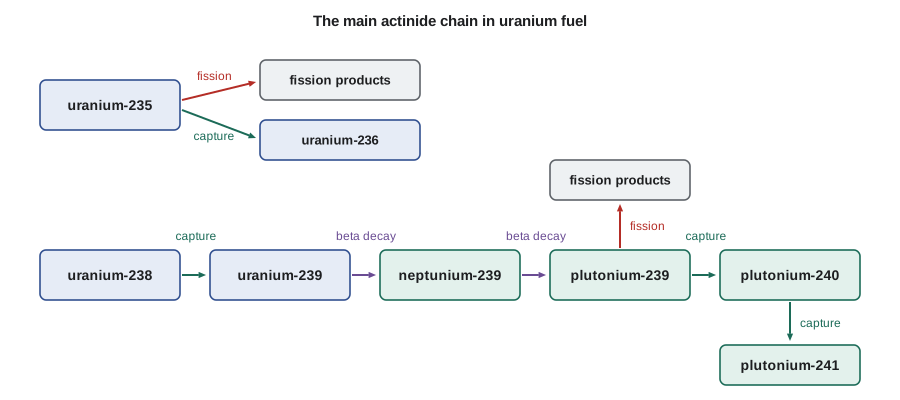
Plutonium-239 itself fissions readily with thermal neutrons and captures neutrons to form plutonium-240, which has a strong absorption resonance near 1 eV. Further capture gives plutonium-241, which is fissile. In commercial fuel, the plutonium formed during irradiation is burned in place: by the end of life, a substantial share of the fissions in a light-water fuel assembly, roughly a third or more, are in plutonium nuclides rather than uranium-235. The plutonium inventory approaches a balance between production and consumption, which is why its concentration levels off at high burnup in the calculation below.
Constant power, rising flux
A power reactor runs at nearly constant power, not constant flux. As fissile nuclides are consumed, the flux in a given piece of fuel must rise to keep its fission rate, and therefore its power, the same. This matters in depletion calculations because the rate at which every nuclide changes is proportional to the flux. Codes therefore calculate depletion in steps: at each step they solve for the flux and power distribution, deplete each region at its own power for a time step, then recompute the flux. A common refinement is the predictor-corrector method, which averages the reaction rates at the beginning and end of each step.
The program below depletes a simplified chain at constant specific power for two fuels: light-water reactor fuel with 4.5 percent uranium-235 and CANDU natural uranium. It uses one-group effective cross sections and adjusts the flux each time step to keep the fission power constant.
# Fuel depletion with a simplified chain at constant specific power:
#   U-235 -> fission or capture;  U-238 + n -> Pu-239;  Pu-239 -> fission or Pu-240
# Effective one-group cross sections (barns) are illustrative thermal-reactor values.
# The flux is adjusted every step so the fission power stays constant.
b = 1e-24
sf5, sc5, sf9, sc9 = 480 * b, 100 * b, 1000 * b, 550 * b
# Effective U-238 capture is larger in the harder light-water spectrum.
SC8 = {'LWR': 8.0 * b, 'CANDU': 4.0 * b}
J_PER_FISSION = 200e6 * 1.602e-19
def deplete(enrich, kw_per_kg, days, every, sc8, dt_days=2):
    N = 6.022e23 / 238.0 * 1000          # uranium atoms per kg
    N5, N8, N9 = enrich * N, (1 - enrich) * N, 0.0
    rate = kw_per_kg * 1000 / J_PER_FISSION   # fissions per second per kg
    rows, dt = [], dt_days * 86400.0
    for step in range(int(days / dt_days) + 1):
        d = step * dt_days
        flux = rate / (sf5 * N5 + sf9 * N9)
        if d % every == 0:
            bu = kw_per_kg * d / 1000          # MWd per kgU
            rows.append((d, bu, N5 / N * 100, N9 / N * 100, flux))
        dN5 = -(sf5 + sc5) * N5 * flux
        dN8 = -sc8 * N8 * flux
        dN9 = sc8 * N8 * flux - (sf9 + sc9) * N9 * flux
        N5 += dN5 * dt; N8 += dN8 * dt; N9 += dN9 * dt
    return rows
for name, e, p, days, ev, c8 in (("LWR fuel, 4.5 % U-235 at 38 kW/kgU", 0.045, 38, 1200, 200, SC8["LWR"]),
                             ("CANDU natural uranium at 27 kW/kgU", 0.0071, 27, 300, 50, SC8["CANDU"])):
    print(name)
    print("  days | burnup MWd/kgU | U-235 wt% | Pu-239 wt% | flux n/cm2.s")
    for d, bu, u5, p9, fl in deplete(e, p, days, ev, c8):
print(f" {d:4d} | {bu:14.1f} | {u5:9.3f} | {p9:10.3f} | {fl:.2e}")LWR fuel, 4.5 % U-235 at 38 kW/kgU
days | burnup MWd/kgU | U-235 wt% | Pu-239 wt% | flux n/cm2.s
0 | 0.0 | 4.500 | 0.000 | 2.17e+13
200 | 7.6 | 3.580 | 0.225 | 2.41e+13
400 | 15.2 | 2.762 | 0.358 | 2.78e+13
600 | 22.8 | 2.037 | 0.431 | 3.33e+13
800 | 30.4 | 1.406 | 0.466 | 4.11e+13
1000 | 38.0 | 0.884 | 0.478 | 5.19e+13
1200 | 45.6 | 0.491 | 0.479 | 6.56e+13
CANDU natural uranium at 27 kW/kgU
days | burnup MWd/kgU | U-235 wt% | Pu-239 wt% | flux n/cm2.s
0 | 0.0 | 0.710 | 0.000 | 9.77e+13
50 | 1.4 | 0.566 | 0.117 | 8.57e+13
100 | 2.7 | 0.457 | 0.178 | 8.39e+13
150 | 4.0 | 0.370 | 0.211 | 8.56e+13
200 | 5.4 | 0.297 | 0.231 | 8.92e+13
250 | 6.8 | 0.236 | 0.242 | 9.38e+13
300 | 8.1 | 0.185 | 0.248 | 9.90e+13The light-water fuel loses most of its uranium-235 over about three years, while the plutonium-239 content rises and levels off near half a percent. The flux needed to hold power constant roughly triples, because the fissile content falls. The CANDU fuel starts with only 0.71 percent uranium-235 but reaches a discharge burnup of about 8 MWd/kgU in less than a year, with roughly as much plutonium-239 as uranium-235 at discharge. In both cases the model shows the general trend; real codes add fission product absorption, the effect of the changing spectrum and many more nuclides.
Worked problem
Energy from one kilogram of uranium
A PWR assembly reaches 50 MWd/kgU. How many grams of heavy metal have fissioned per kilogram of initial uranium, and what fraction is that?
Show solution
- About 1.05 g of heavy metal fissions per megawatt-day.
- 50 MWd × 1.05 g/MWd = 52.5 g per kg of uranium.
- Fraction fissioned: 52.5/1000 = 5.25 percent of the initial heavy metal.
Answer: At 50 MWd/kgU about 5 percent of the heavy metal has fissioned, more than the 4.5 percent of uranium-235 loaded, because plutonium formed from uranium-238 supplies part of the fissions.
Fission products
Each fission produces two fission products, which then decay through chains toward stability. Most have small absorption cross sections, but together they act as a slowly growing poison. A few nuclides stand out. Xenon-135 and samarium-149 have such large thermal absorption cross sections that they are treated separately in every core calculation; lesson 5 is about them. Others, such as rhodium-103, neodymium-143, technetium-99 and the gadolinium and europium isotopes, contribute a steady reactivity loss that grows with burnup. Lumped fission product models in older codes have largely been replaced by explicit tracking of the most important nuclides.
Fission products also matter for decay heat. After a reactor shuts down, the decay of fission products keeps producing heat, a few percent of full power just after shutdown and falling over hours and days. Decay heat depends on the power history and burnup, so the same depletion calculation that predicts reactivity also supplies the source terms for decay heat removal analyses and spent fuel storage design.
Depletion in CANDU fuel management
In a CANDU core, depletion is tracked bundle by bundle. The core simulator follows the burnup of each of the thousands of bundles in the core, using lattice constants tabulated against burnup. Because fuel is added a few channels at a time every day, the core reaches an equilibrium in which the average burnup, the average reactivity and the power distribution stay nearly constant. The physics team monitors that equilibrium continuously and chooses channels to refuel based on their burnup and power, as lessons 8 and 12 describe.
Limits on burnup
Discharge burnup is limited by fuel performance as well as by reactivity. As burnup increases, fission gas is released into the rod plenum, raising internal pressure; the pellet swells; the cladding corrodes and picks up hydrogen; and at very high burnup a porous rim structure forms at the pellet edge. Regulators approve fuel designs up to stated burnup limits based on test data. In light-water reactors in the United States, many fuel designs have been licensed to rod-average burnups of about 62 MWd/kgU, and industry programs are pursuing higher burnups together with fuel enriched somewhat above 5 percent, while remaining within the low-enriched range. CANDU fuel burnup is set mainly by the reactivity of natural uranium, so its limit is reached long before fuel performance limits apply.
Reactivity against burnup
Plotting assembly k_inf against burnup gives one of the most useful curves in fuel management. For light-water fuel without burnable absorbers, the curve falls almost linearly after the first few MWd/kgU, during which xenon and samarium build up to equilibrium. With gadolinia, the curve is flatter at first and then rises slightly as the absorber burns out, before resuming its linear fall. For CANDU natural uranium fuel, the curve has a characteristic plutonium peak: k_inf actually rises over the first one or two MWd/kgU as plutonium-239 builds up faster than uranium-235 is consumed, then falls steadily. Because of this peak, a freshly refuelled CANDU channel gains a little reactivity during its first weeks before losing it, which contributes to the refuelling ripple described in lesson 8.
Depletion calculations also give the change in the delayed neutron fraction with burnup. Plutonium-239 has a smaller delayed neutron fraction than uranium-235, so as plutonium contributes more of the fissions, the effective delayed neutron fraction of the core falls. This makes the core respond faster to a reactivity change late in a cycle than early, which safety analyses take into account by using burnup-dependent kinetics parameters.
Common mistakes
MistakeBurnup measures how long fuel has been in the core.
InsteadIt measures energy produced per unit mass of heavy metal; time in the core depends on the power.
MistakeAll of the energy from LWR fuel comes from the uranium-235 loaded.
InsteadPlutonium formed from uranium-238 provides a large share of the fissions late in life.
MistakeA depletion calculation can use the initial flux throughout the fuel's life.
InsteadAt constant power the flux rises as fissile material is consumed, so the flux must be recalculated each step.
Summary and key terms
- Burnup is the energy produced per unit mass of heavy metal, usually in MWd/kgU.
- Depletion consumes uranium-235, builds plutonium from uranium-238 and accumulates fission products.
- The Bateman equations describe how each nuclide's density changes with flux and decay.
- At constant power, the flux in a fuel region rises as fissile content falls.
- Fission products act as a growing poison; xenon and samarium are treated separately.
- Burnup
- Energy produced per unit initial mass of heavy metal, often in MWd per kilogram of uranium.
- Bateman equations
- The coupled equations for the number densities of nuclides undergoing transmutation and decay.
- Specific power
- Power produced per unit mass of heavy metal, for example kW per kg of uranium.
- Fissile nuclide
- A nuclide that can fission with thermal neutrons, such as uranium-235 or plutonium-239.
- Fertile nuclide
- A nuclide, such as uranium-238, that becomes fissile after neutron capture.
- Predictor-corrector method
- A depletion method that averages reaction rates from the start and end of each step.
Practice problems
Work each problem on paper first, then reveal the answer to check.
How many grams of heavy metal fission per megawatt-day?
Show answer
About 1.05 grams.
Why does the flux rise during depletion at constant power?
Show answer
Fissile material is consumed, so more flux is needed to keep the same fission rate.
What is the main path from uranium-238 to plutonium-239?
Show answer
Capture to uranium-239, then beta decay to neptunium-239 and plutonium-239.
Why does plutonium-239 level off at high burnup?
Show answer
Its production from uranium-238 becomes balanced by its own fission and capture.
Give two fuel performance effects that limit burnup.
Show answer
Fission gas release raising rod pressure and cladding corrosion with hydrogen pickup; pellet swelling also matters.
Lesson quiz · 5 questions
Score 60% or more to complete this lesson.
Create a free account to save your progress, take quizzes and earn a certificate.