
NUC-350 · Lesson 9 of 12 · 20 min
Reactivity control
Teodora gives Hana a sheet with three columns: what changes reactivity, how fast and by how much, and what the control systems use to counter it. "Every reactor has the same problem," she says. "Fuel burns, xenon comes and goes, temperatures change with power, and every so often we need to shut down fast. A CANDU and a PWR solve it with completely different hardware, and you need to understand both, because our safety analysis people will ask you about both."
What has to be controlled
Reactivity control serves four purposes. It must compensate for slow changes such as burnup and fission product buildup over weeks and months. It must follow intermediate changes such as xenon transients over hours and power manoeuvres over minutes. It must shape the power distribution so that local limits are met. And it must shut the reactor down quickly and keep it shut down under all conditions. Different devices are suited to different purposes, and a well-designed reactor uses each for what it does best.
| Effect | Time scale | Typical size | Usual compensation |
|---|---|---|---|
| Burnup and fission products | weeks to months | several thousand pcm over a PWR cycle; about 0.4 mk per day in CANDU | soluble boron and burnable absorbers (PWR); refuelling (CANDU) |
| Xenon and samarium | hours to days | about 2 000 to 3 000 pcm at equilibrium, more after a trip | boron or rods (PWR); adjusters and zones (CANDU) |
| Power defect (fuel and moderator temperature) | seconds to minutes | roughly 1 000 to 2 000 pcm from zero to full power in a PWR | rods and boron |
| Shutdown | seconds | must exceed all positive reactivity plus margin | control and shutdown rods; second shutdown system |
Control rods and their worth
A control rod or blade contains a strong absorber, such as silver-indium-cadmium alloy, boron carbide or hafnium. Its worth, the reactivity change when it is fully inserted, depends on the flux where it sits. To first order, perturbation theory says that the worth of a small absorber is proportional to the square of the flux at its location, weighted by the importance of neutrons there. Rods near the centre of the core, where flux is highest, are worth much more than rods near the edge. Rods also shadow each other: inserting one rod depresses the flux near its neighbours and lowers their worth.
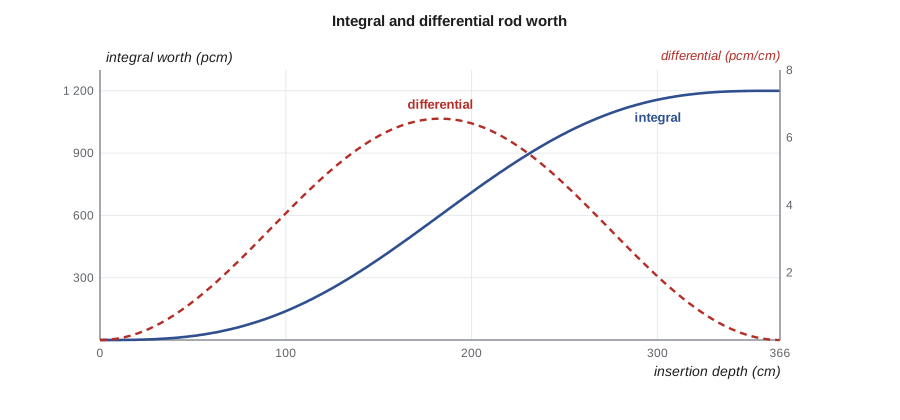
The worth of a rod partly inserted from the top follows an S-shaped curve. When the tip is near the top of the core, where the axial flux is low, moving it further adds little worth. When the tip is near the core midplane, where the flux peaks, each centimetre adds the most worth. Near the bottom, the differential worth falls again. For a cosine axial flux shape, the differential worth varies as sin² of the relative position, and the integral worth as:
where W is the total worth, x the insertion and H the core height. Measured curves differ from this ideal shape, because the axial flux is not a pure cosine and the inserted rod itself distorts it, but the S shape is always present.
Soluble boron in PWRs
In a pressurized water reactor, boric acid dissolved in the primary coolant provides the main compensation for burnup. Its great advantage is that it is uniform: it absorbs neutrons everywhere in the core without distorting the power distribution. The chemical and volume control system adds borated water or pure water to change the concentration slowly, at rates of a few ppm per minute. At the start of a cycle, the critical boron concentration might be over a thousand ppm; as the fuel burns, the operators dilute the coolant, and the boron falls toward a few tens of ppm at the end of the cycle. The curve of critical boron against burnup is called the boron letdown curve, and predicting it accurately is one of the core designer's main tasks.
The program below calculates an integral rod worth curve, a simplified boron letdown curve and a shutdown margin check.
# Reactivity control: rod worth curves, soluble boron letdown and shutdown margin.
# All values are illustrative teaching numbers.
import math
H = 366.0                         # active core height, cm
W = 1200.0                        # total worth of a control bank, pcm
def integral_worth(x):
    """Worth inserted when the bank tip is x cm into the core (sine-squared differential worth)."""
    return W * (x / H - math.sin(2 * math.pi * x / H) / (2 * math.pi))
print("insertion (cm) | integral worth (pcm) | differential worth (pcm/cm)")
for x in (0, 60, 120, 183, 240, 300, 366):
    dw = W / H * (1 - math.cos(2 * math.pi * x / H))
    print(f"{x:14.0f} | {integral_worth(x):20.0f} | {dw:12.2f}")
# Soluble boron letdown: excess reactivity falls with burnup; boron holds it down.
boron_worth = -9.0                # pcm per ppm (illustrative; becomes less negative with burnup)
excess0, loss_per_efpd, xe_sm = 16500.0, 26.0, 2800.0
print("\n   EFPD | excess (pcm) | critical boron (ppm)")
for d in range(0, 541, 90):
    excess = excess0 - (xe_sm if d > 0 else 0.0) - loss_per_efpd * d
    print(f"{d:7d} | {excess:12.0f} | {max(0.0, excess / -boron_worth):10.0f}")
# Shutdown margin with the most reactive rod stuck out
total_rods, stuck_rod_worth = 6800.0, 1150.0
required_power_defect, margin_required = 1600.0, 1300.0
sdm = total_rods - stuck_rod_worth - required_power_defect
print(f"\nshutdown margin with the strongest rod stuck out: {sdm:.0f} pcm (target at least {margin_required:.0f} pcm)")insertion (cm) | integral worth (pcm) | differential worth (pcm/cm)
0 | 0 | 0.00
60 | 33 | 1.59
120 | 225 | 4.82
183 | 600 | 6.56
240 | 945 | 5.11
300 | 1157 | 1.89
366 | 1200 | 0.00
EFPD | excess (pcm) | critical boron (ppm)
0 | 16500 | 1833
90 | 11360 | 1262
180 | 9020 | 1002
270 | 6680 | 742
360 | 4340 | 482
450 | 2000 | 222
540 | -340 | 0
shutdown margin with the strongest rod stuck out: 4050 pcm (target at least 1300 pcm)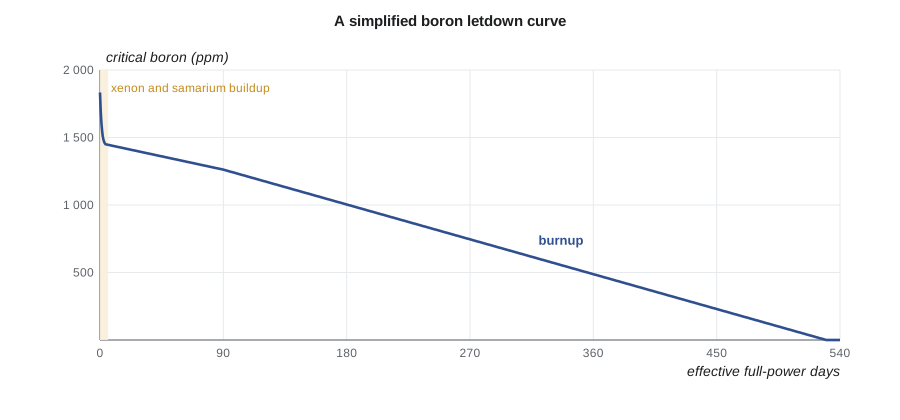
The letdown curve shows the early step from xenon and samarium buildup, then a steady fall as the fuel burns. The real curve is usually curved early in the cycle, rising or flattening as the gadolinia burns out and releases reactivity, which is one reason burnable absorber design and boron letdown are designed together. The cycle ends when the critical boron reaches a small value; after that, the unit can coast down as lesson 8 described.
Worked problem
Boron needed for a xenon transient
A PWR at mid-cycle has a boron worth of −8.5 pcm/ppm. After a power reduction, xenon worth increases by 600 pcm over six hours. How much must the boron change to stay critical without moving rods?
Show solution
- The extra negative reactivity from xenon must be offset by removing boron.
- Δppm = 600/8.5 ≈ 71 ppm of dilution.
Answer: About 70 ppm of dilution over six hours, which the chemical and volume control system can handle. Later, as xenon burns out, the operators must add boron again.
Shutdown margin
Shutdown margin is the amount by which the reactor would be subcritical if all control rods were inserted, except the single rod of highest worth, which is assumed to stick out. It is calculated at the most reactive condition, usually at hot zero power, with no xenon and with conservative allowances. Technical specifications require a minimum margin, often about 1 300 pcm or more for a PWR, at all times. Because rods are worth less in a core with a harder spectrum and because the most reactive state shifts through the cycle, shutdown margin must be checked at several points in every cycle. The calculation in the program above shows a margin well above a typical requirement; in reload design, a pattern that meets every other goal but fails shutdown margin must be changed.
Reactivity devices in a CANDU reactor
A CANDU reactor has no soluble boron in the coolant during operation and uses a different set of devices, all inserted vertically into the low-pressure moderator between fuel channels rather than into the high-pressure coolant:
| Device | Typical worth | Purpose |
|---|---|---|
| Liquid zone controllers | several mk in total | fine control of power and spatial distribution; respond to refuelling and small changes |
| Adjuster rods | about 15 mk in total | flatten power; supply reactivity for xenon override and refuelling outages |
| Mechanical control absorbers | several mk | fast power reductions |
| Moderator poison (boron or gadolinium) | adjustable | excess reactivity for first core, long shutdowns and guaranteed shutdown states |
| Shutdown system 1: shutoff rods | more than 50 mk | fast shutdown by gravity-driven, spring-assisted absorber rods |
| Shutdown system 2: liquid poison injection | more than 300 mk | independent fast shutdown by gadolinium nitrate injected into the moderator |
The two shutdown systems in a CANDU reactor are fully independent, diverse in design and each able to shut the reactor down on its own for any design-basis event. This design reflects the CANDU's positive coolant void reactivity: in a large loss-of-coolant accident, voiding the coolant adds reactivity, and the shutdown systems must act within a second or two to terminate the power pulse. In a light-water reactor, voiding the coolant removes moderator and reduces reactivity, which is one of the inherent safety features of that design. Both designs meet the same regulatory principle, that the reactor be safely shut down in all events, by different means.
Boiling water reactors use cruciform control blades inserted from below between groups of four assemblies, and no soluble boron during normal operation. Burnup is compensated by burnable gadolinia and by moving blades in a planned sequence through the cycle. Power changes can also be made by changing core flow, because more flow sweeps out steam voids, adding moderator and reactivity. The BWRX-300, as a natural-circulation design without recirculation pumps, cannot use flow control in the same way and relies on control blades and gadolinia for reactivity control.
Power coefficients and the power defect
Raising the power of a reactor heats its fuel and moderator. In a light-water reactor, both the Doppler coefficient and the moderator temperature coefficient are normally negative, so raising power removes reactivity. The total reactivity change from zero to full power is the power defect, which in a PWR is roughly 1 000 to 2 000 pcm. Rods or boron must supply that reactivity to raise power, and when power falls, the same reactivity is released. The power defect is a large share of the reactivity that a PWR must hold in reserve at hot zero power, and it is included in the shutdown margin calculation.
In a CANDU reactor, the power coefficient is small and can be slightly negative or slightly positive depending on burnup and conditions, because the negative fuel temperature coefficient is partly offset by a positive coolant temperature effect. CANDU control systems are designed for this: the zone controllers respond to power changes quickly and the shutdown systems are designed to act for any event in which reactivity rises. Core designers in both countries calculate these coefficients throughout every cycle and show that they remain within the limits assumed in the safety analysis.
Measuring rod worth and reactivity
Calculated rod worths and coefficients are checked by measurement. At the start of each PWR cycle, the operators measure the worth of control banks during the start-up physics tests, often by the boron dilution method, in which boron is diluted at a steady rate while a bank is inserted to hold the core critical, or by the rod swap method, in which a reference bank's measured worth is used to infer the others. A reactivity computer, which solves the inverse point kinetics equations from the measured flux, converts flux changes into reactivity. The measured worths must agree with the predictions within the acceptance criteria of the methodology, typically about ten percent for individual banks; larger differences are investigated before the reactor goes to power.
In a CANDU station, the worths of adjusters, zone controllers and shutoff rods are confirmed by measurements during commissioning and after major outages, and the zone controller response is checked continuously in operation. The reactivity balance, comparing zone levels and device positions with the core simulator's predictions, serves as a daily check on the calculated reactivity of the core.
Common mistakes
MistakeAll control rods have the same worth.
InsteadWorth depends on the flux at the rod's location, so rods near the core centre are worth more, and rods shadow each other.
MistakeSoluble boron is used for fast shutdown in a PWR.
InsteadBoron changes slowly; fast shutdown uses control and shutdown rods.
MistakeShutdown margin is calculated with all rods inserted.
InsteadIt assumes the most reactive rod is stuck out.
Summary and key terms
- Reactivity control compensates for burnup, xenon, temperature effects and provides shutdown.
- Rod worth depends on local flux; partial insertion follows an S-shaped integral worth curve.
- PWRs use soluble boron for burnup compensation; the letdown curve tracks its fall through the cycle.
- Shutdown margin assumes the highest-worth rod is stuck out and must exceed a minimum at all times.
- CANDU reactors use zone controllers, adjusters and two independent shutdown systems in the moderator.
- Rod worth
- The reactivity change caused by inserting a control rod or bank.
- Differential worth
- The change in rod worth per unit of insertion.
- Boron letdown curve
- Critical soluble boron concentration as a function of burnup through a cycle.
- Shutdown margin
- The subcriticality with all rods inserted except the one of highest worth.
- Power defect
- The reactivity change from zero to full power caused by temperature feedback.
- Liquid poison injection
- A CANDU shutdown system that injects gadolinium nitrate solution into the moderator.
Practice problems
Work each problem on paper first, then reveal the answer to check.
Why is a rod worth most when its tip is near the core midplane?
Show answer
The axial flux peaks there, and worth is roughly proportional to the square of the local flux.
In the example, how much boron must be diluted to offset 600 pcm of xenon?
Show answer
About 71 ppm.
Why does a PWR's boron concentration fall through the cycle?
Show answer
The fuel loses reactivity as it burns, so less boron is needed to stay critical.
Why does CANDU need two fast shutdown systems?
Show answer
Each must independently terminate any design-basis event, including the power pulse from positive coolant void reactivity.
What is the power defect?
Show answer
The reactivity removed by heating fuel and moderator when power rises from zero to full.
Lesson quiz · 5 questions
Score 60% or more to complete this lesson.
Create a free account to save your progress, take quizzes and earn a certificate.