
NUC-350 · Lesson 12 of 12 · 19 min
Fuel management project
For her final assignment in the core physics group, Teodora hands Hana a real problem in simplified form: plan the refuelling for the next two days on one Darlington unit, write the justification and present it at the morning meeting. "Everything you have learned this year goes into this," Teodora says. "Burnup, power limits, zone levels, xenon, refuelling ripple, the codes and their uncertainties. The answer must be safe first, economical second and easy for the control room to carry out."
The project brief
The unit is at full power in equilibrium. The fuelling engineer must choose about five channels to refuel over the next two days, a little more than the average rate, because the average zone controller level has drifted down over the past week, a sign that refuelling has fallen slightly behind burnup. The choice must respect several constraints:
| Constraint | Why it matters | How it is checked |
|---|---|---|
| Maximum channel power after refuelling | refuelling raises channel power by roughly ten percent; the limit protects margin to dryout | core simulator prediction with ripple and uncertainty allowance |
| Maximum bundle power | protects fuel temperature and sheath integrity | predicted bundle powers along each channel |
| Zone balance | keep each zone controller within its operating range | choose channels in zones whose controllers are high |
| Exit burnup | discharge fuel that has used most of its reactivity | channels with highest exit-bundle burnup are preferred |
| Fuelling machine availability and direction | channels must be reachable and alternate directions maintained | fuelling schedule and channel direction map |
Step 1: candidate channels
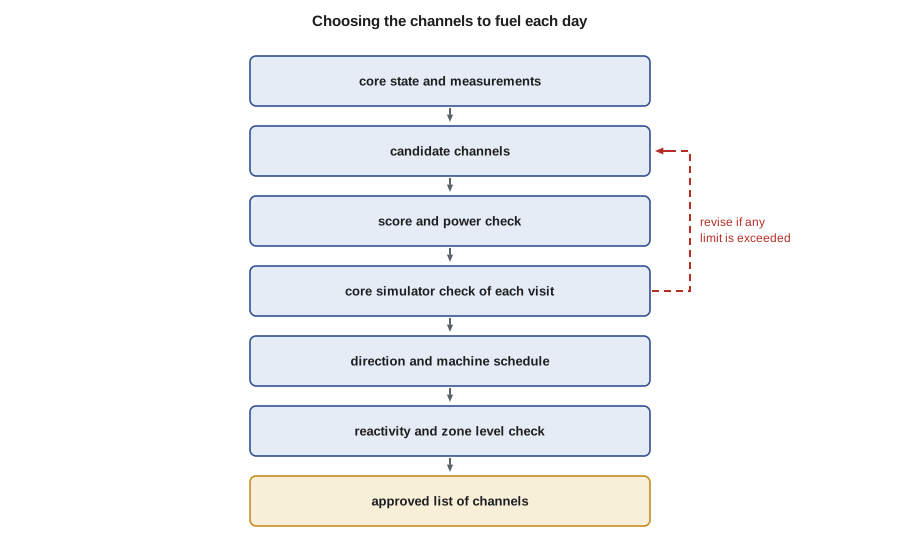
Hana starts from the core simulator's list of candidates: channels whose fuel has been in the core long enough that their exit bundles have reached a high burnup. For each candidate, the simulator gives the current channel power and the predicted power just after refuelling. The station's monitoring system supplies the current zone controller levels. Hana combines these into a simple score that favours high burnup, low current power and zones whose controllers are high, then checks each candidate against the channel power limit after refuelling.
# Fuel management project (CANDU-like): choose the next channels to refuel.
# Each candidate channel has an exit burnup, a current power and a local zone-level
# reading. Score = favour high burnup and low power, and keep zones balanced.
# Limits and data are illustrative teaching values.
channels = [  # name, exit-bundle burnup MWd/kgU, channel power kW, zone level %
    ("K-10", 8.9, 6150, 52), ("L-14", 9.4, 5880, 61), ("M-08", 7.2, 6720, 47),
    ("N-17", 9.1, 6010, 58), ("P-05", 8.4, 6300, 44), ("Q-12", 9.8, 5650, 63),
    ("R-19", 6.9, 6900, 50), ("S-07", 9.0, 5990, 39)]
CH_LIMIT = 7300.0                 # licensed-style maximum channel power, kW (illustrative)
POWER_RISE = 0.11                 # fractional rise in channel power just after refuelling
def score(bu, kw, zone):
    s = 2.0 * bu - kw / 1000.0
    s += 0.05 * (zone - 50)       # refuel where zone controllers are high (they have room to drain)
    return s
ranked = sorted(channels, key=lambda c: -score(*c[1:]))
print(" channel | burnup | power kW | after refuel kW | zone % | ok?")
picked = []
for name, bu, kw, z in ranked:
    after = kw * (1 + POWER_RISE)
    ok = after <= CH_LIMIT
    print(f"{name:>8} | {bu:6.1f} | {kw:8.0f} | {after:15.0f} | {z:6.0f} | {'yes' if ok else 'no'}")
    if ok and len(picked) < 5: picked.append(name)
print("refuelling list for the next two days:", ", ".join(picked))
avg_bu = sum(c[1] for c in channels if c[0] in picked) / len(picked)
print(f"average exit burnup of selected channels: {avg_bu:.1f} MWd/kgU") channel | burnup | power kW | after refuel kW | zone % | ok?
Q-12 | 9.8 | 5650 | 6272 | 63 | yes
L-14 | 9.4 | 5880 | 6527 | 61 | yes
N-17 | 9.1 | 6010 | 6671 | 58 | yes
K-10 | 8.9 | 6150 | 6827 | 52 | yes
S-07 | 9.0 | 5990 | 6649 | 39 | yes
P-05 | 8.4 | 6300 | 6993 | 44 | yes
M-08 | 7.2 | 6720 | 7459 | 47 | no
R-19 | 6.9 | 6900 | 7659 | 50 | no
refuelling list for the next two days: Q-12, L-14, N-17, K-10, S-07
average exit burnup of selected channels: 9.2 MWd/kgUSix candidates pass the power check and two fail: M-08 and R-19 are already running at high power, and refuelling them would push them over the limit. Hana picks the five highest-ranked channels that pass. Their average exit burnup is above the core-average discharge burnup, which is what a good selection should achieve.
Step 2: checking the selection with the core simulator
The simple score is only a first cut. Hana runs the core simulator for the proposed sequence, refuelling one channel at a time, and checks the full three-dimensional power distribution after each visit. Refuelling a channel raises the power of its neighbours as well as its own; two refuelled channels close together could combine to push a third over its limit. The simulation also shows how the zone controller levels will respond. Hana confirms that the sequence keeps every channel and bundle power below its limit with the uncertainty allowance included, and that the average zone level will recover toward its target.
Worked problem
Channel power margin
Channel K-10 runs at 6 150 kW and is predicted to rise by 11 percent after refuelling. The channel power limit is 7 300 kW and the method's uncertainty allowance is 3 percent. Is there margin?
Show solution
- Predicted power after refuelling: 6 150 × 1.11 = 6 827 kW.
- With the allowance: 6 827 × 1.03 = 7 032 kW.
- Margin to the limit: (7 300 − 7 032)/7 300 = 3.7 percent.
Answer: The channel can be refuelled with about 4 percent margin. Channels with less than about 2 percent margin would normally be deferred until their power falls.
Step 3: direction, sequence and the fuelling machines
Each selected channel has an assigned refuelling direction, set by the bidirectional fuelling pattern described in lesson 7. Hana checks that the fuelling machines can reach the five channels in a sensible order, minimizing machine travel and time between channels, and that no two channels in the same small region are refuelled within hours of each other. She also checks that none of the channels is scheduled for inspection or has a fuel bundle flagged for special handling.
Step 4: reactivity and xenon
Refuelling five channels adds roughly the reactivity the core loses in a little more than two days, plus a small surplus to restore the zone levels. Hana confirms that the unit has no planned power changes in the next two days; a power reduction would change xenon and could change the best choice of channels. She notes that if the unit trips, the refuelling plan would be suspended, and the xenon override strategy of lesson 5 would apply.
Step 5: the morning meeting
At the morning meeting, Hana presents the five channels, their order, the predicted power after each visit with margins, and the expected recovery of zone levels. The control room supervisor asks what happens if the fuelling machine is delayed by a day. Hana has the answer ready: the core loses about 0.4 mk per day, the zones have enough range for a day's delay, and the selection would still be valid, although she would rerun the simulator before resuming.
Longer-term fuel management
Daily refuelling is only one part of CANDU fuel management. The physics group also tracks the long-term equilibrium: the average discharge burnup, the fuel consumption per unit energy, the time-average power distribution and its comparison with the reference used in safety analysis. It plans for events such as long outages, after which the core must be brought back to equilibrium, and for changes such as aging of the heat transport system that may require derating of channel powers. After the refurbishment of the Darlington units, with new pressure tubes and feeders, fuel management plans were updated to reflect the new channel conditions. The same tools apply: lattice constants, the core simulator, comparisons with measurements and careful attention to limits.
Reflection
Hana's two-day plan uses every topic of the course. Multigroup diffusion and lattice physics supply the constants. Resonance absorption and depletion explain why exit bundles lose reactivity. Xenon sets the context for restarts and power changes. The loading pattern, here the differential and bidirectional fuelling of regions, shapes the power. Reactivity devices absorb the daily ripple. The codes, validated against the plant, give predictions with known uncertainty. Fuel management is where reactor physics meets daily operation, and its decisions are checked, documented and repeated every working day of a station's life.
Documentation and handover
Every refuelling plan is documented. Hana's record lists the channels selected, the reasons for each choice, the predicted powers with margins, the rejected candidates and why, and the expected zone level response. After the refuelling, the actual channel powers and zone levels are compared with the predictions, and the record is closed. This record forms part of the station's fuel management history, which is reviewed periodically by the physics group and by the regulator's inspectors. It also allows any later question, for example about a bundle found damaged in the fuel bay, to be traced back to the conditions in which the bundle operated.
| Record item | Purpose |
|---|---|
| Selected channels and sequence | instructions to the control room and fuelling machine operators |
| Predicted channel and bundle powers with margins | evidence that limits are met |
| Rejected candidates and reasons | shows that limits guided the choice |
| Expected and actual zone level response | checks the reactivity balance |
| Bundle histories | support fuel inspection and long-term storage records |
Teodora reviews and signs Hana's first plan, adding one comment: next time, check the predicted bundle powers in the two channels nearest each selected channel, not just the selected channel itself. It is a small change, and it is how every fuel engineer learns the job.
Looking further ahead
Beyond the daily plan, the fuel management group keeps a longer view. Every few months, it runs a projection of the core over the coming year, using expected refuelling rates and the planned outage schedule. The projection checks that the burnup distribution will stay close to the time-average design and that planned outages and returns to power can be supported. It also feeds the station's fuel procurement plan, which sets how many bundles will be manufactured and delivered.
Refurbishment adds another layer. After a unit is refurbished, with new pressure tubes and calandria tubes, the core starts again with fresh fuel and needs an approach-to-equilibrium period, during which the refuelling sequence and the use of adjuster rods are planned specially. Experienced fuel engineers who have managed such restarts pass their knowledge on to the next generation, often through exactly the kind of supervised projects that Hana is now doing.
Hana's next assignment is to prepare the refuelling plan for the week before the next planned outage, when the core must be left in a state that supports a smooth return to power. She starts by reviewing the projection and the list of channels that will be inspected during the outage.
A final check closes the project. Hana compares her plan with the one prepared independently by a second engineer from the same starting state. The two selected lists share four of five channels, and the fifth choice differs only in order of preference. Such independent checks are part of the station's routine, and small differences like this one are discussed rather than resolved by rule, because experience with the core often decides between two acceptable options.
The project shows how the course's methods combine in practice: lattice constants and depletion give bundle properties, the core model gives channel powers, the poisons and control devices set the reactivity balance, and the uncertainty allowances turn calculated values into limits that can be trusted.
Common mistakes
MistakeThe best channel to refuel is always the one with the highest burnup.
InsteadIt must also pass the channel and bundle power limits after refuelling and help balance the zones.
MistakeA simple ranking score is enough to approve the plan.
InsteadEach visit must be checked with the core simulator, including effects on neighbouring channels.
MistakeFuel management is a one-time design decision.
InsteadIn a CANDU it is a daily process, with long-term tracking of equilibrium and limits.
Summary and key terms
- Daily CANDU fuel management chooses channels by burnup, power margin and zone balance.
- Each visit is checked with the core simulator, including neighbour effects and uncertainty allowances.
- Directions and fuelling machine schedules must be respected.
- Zone controller levels show whether refuelling keeps pace with burnup.
- Long-term fuel management tracks equilibrium burnup and the time-average power distribution.
- Channel power limit
- The maximum allowed power in a fuel channel, set to protect margin to dryout.
- Exit-bundle burnup
- The burnup of the bundle about to be discharged from a channel.
- Fuelling engineer
- The engineer who selects channels to refuel and checks the plan.
- Zone balance
- Keeping all liquid zone controllers within their operating ranges.
- Derating
- Reducing allowed power to preserve margin as components age.
- Refuelling sequence
- The order in which selected channels are refuelled.
Practice problems
Work each problem on paper first, then reveal the answer to check.
Why were M-08 and R-19 rejected?
Show answer
Their predicted power after refuelling would exceed the channel power limit.
In the example, what is K-10's margin with the allowance?
Show answer
About 3.7 percent.
Why check neighbouring channels after each visit?
Show answer
Refuelling raises the power of nearby channels too, and their combined effect could exceed a limit.
What does a drifting-down average zone level suggest?
Show answer
Refuelling is behind burnup and should increase slightly.
What would Hana do if the fuelling machine were delayed by a day?
Show answer
Rely on zone range for the day and rerun the core simulator before resuming.
Lesson quiz · 5 questions
Score 60% or more to complete this lesson.
Create a free account to save your progress, take quizzes and earn a certificate.