
NUC-350 · Lesson 6 of 12 · 22 min
Burnable absorbers
Hana asks why the CANDU lattice calculations never mention gadolinia pins, while the light-water reload reports she has read are full of them. "Because a CANDU core never holds much excess reactivity," Teodora says. "We add a little fresh fuel every day. A light-water reactor loads a third of its core at once and has to hold down all that new reactivity for a year and a half. Burnable absorbers are how they do it without huge amounts of boron. We do use them in one place, though: the first core, and some special fuel studies. Let us look at both."
Why burnable absorbers are needed
A batch-loaded reactor starts each cycle with enough reactivity to last until the end of the cycle. At the start, the fresh fuel has its highest reactivity, so the core carries a large excess that must be held down. Three tools are available: control rods, soluble boron in the coolant and burnable absorbers in the fuel. Control rods are needed for control and shutdown and should not be deeply inserted during normal operation, because they distort the power distribution. Soluble boron is uniform and flexible, but too much of it causes a problem: boron is removed from the core when the moderator heats and expands, so a high boron concentration makes the moderator temperature coefficient less negative and could make it positive at the start of a cycle.
A burnable absorber is a neutron absorber placed in or near the fuel that is gradually consumed by neutron absorption. Ideally, it holds down excess reactivity early in the cycle and burns away as the fuel itself loses reactivity, so that the net reactivity stays nearly flat. It can also be placed selectively to flatten the power distribution by suppressing the hottest fresh assemblies.
| Absorber | Form | Key nuclides | Behaviour |
|---|---|---|---|
| Gadolinia | Gd₂O₃ mixed into some UO₂ pellets, a few to about 10 wt% | gadolinium-155 and -157 | very strong; burns out from the outside of the pellet inward over the first part of the cycle |
| Integral fuel burnable absorber (IFBA) | thin zirconium diboride coating on fuel pellets | boron-10 | weakly self-shielded; burns out nearly exponentially |
| Discrete absorber rods | borosilicate glass or alumina-boron carbide in guide tubes | boron-10 | removable; used in older designs and some first cores |
| Erbia | Er₂O₃ in fuel pellets | erbium-167 | slower burnout, used in some long-cycle designs |
Self-shielding and the burnout curve
The way a burnable absorber loses its worth depends on how strongly it shields itself. Gadolinium-155 and -157 have thermal absorption cross sections of tens to hundreds of thousands of barns. A gadolinia pellet is so black to thermal neutrons that the interior is almost completely shielded at first. Absorption happens in a thin outer layer, and the absorber burns away from the outside inward, like the layers of an onion. The worth of the pin therefore falls slowly at first and then quickly as the last of the gadolinium is consumed. After burnout, the pin behaves like ordinary fuel with slightly lower uranium content.
A boron coating, by contrast, is thin and only weakly self-shielded. Every boron-10 atom sees nearly the same flux, so the coating burns out almost exponentially, losing a constant fraction of its remaining atoms per unit burnup. The two absorbers therefore have different shapes of reactivity curve, and designers often combine them to shape the core reactivity through the cycle.
The program below models both behaviours with an escape factor that depends on the optical thickness of the absorber, and applies their worths to an assembly whose reactivity falls linearly with burnup.
# Burnable absorbers: how a gadolinia pin and an IFBA-coated pin lose their worth.
# Self-shielding is modelled by an escape factor g(x) = (1 - e^-x)/x, where x is the
# optical thickness of the absorber, which shrinks as it burns. Values are illustrative.
import math
def g(x): return 1.0 if x < 1e-9 else (1 - math.exp(-x)) / x
def burn(x0, sigma_phi_per_mwd, steps, dbu):
    """Return remaining absorber fraction at each burnup step (MWd/kgU)."""
    n, out = 1.0, []
    for i in range(steps + 1):
        out.append((i * dbu, n))
        rate = sigma_phi_per_mwd * g(x0 * n)
        n = max(0.0, n * math.exp(-rate * dbu))
    return out
# gadolinia: very black (x0 large), so it burns slowly at first, then quickly
gad = burn(x0=25.0, sigma_phi_per_mwd=2.2, steps=20, dbu=1.0)
# IFBA: thin boride coating, nearly unshielded, burns roughly exponentially
ifba = burn(x0=0.8, sigma_phi_per_mwd=0.17, steps=20, dbu=1.0)
worth_gad0, worth_ifba0 = 0.060, 0.045         # initial assembly hold-down (delta k)
k_fresh = 1.30
print(" burnup | Gd left | IFBA left | k_inf no BA | with Gd | with IFBA")
for (bu, ng), (_, ni) in zip(gad, ifba):
    if bu % 2: continue
    k0 = k_fresh - 0.0105 * bu                  # linear reactivity loss with burnup
print(f"{bu:7.0f} | {ng:7.2f} | {ni:9.2f} | {k0:11.3f} | {k0 - worth_gad0*ng:7.3f} | {k0 - worth_ifba0*ni:9.3f}") burnup | Gd left | IFBA left | k_inf no BA | with Gd | with IFBA
0 | 1.00 | 1.00 | 1.300 | 1.240 | 1.255
2 | 0.83 | 0.79 | 1.279 | 1.229 | 1.244
4 | 0.67 | 0.61 | 1.258 | 1.218 | 1.231
6 | 0.50 | 0.46 | 1.237 | 1.207 | 1.216
8 | 0.34 | 0.35 | 1.216 | 1.196 | 1.200
10 | 0.19 | 0.26 | 1.195 | 1.184 | 1.183
12 | 0.06 | 0.19 | 1.174 | 1.170 | 1.165
14 | 0.00 | 0.14 | 1.153 | 1.153 | 1.147
16 | 0.00 | 0.10 | 1.132 | 1.132 | 1.128
18 | 0.00 | 0.07 | 1.111 | 1.111 | 1.108
20 | 0.00 | 0.05 | 1.090 | 1.090 | 1.088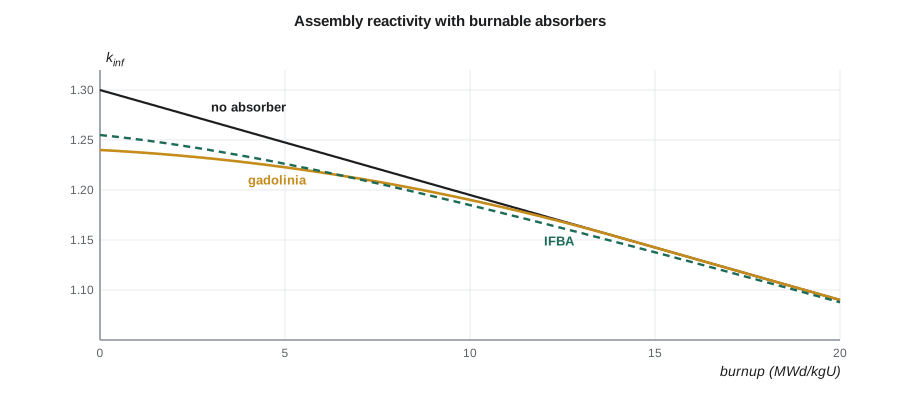
The gadolinia case shows the characteristic plateau: k_inf falls slowly over the first 10 MWd/kgU because the absorber is burning away as fast as the fuel loses reactivity, then the two curves join once the gadolinium is gone. The IFBA case starts with less hold-down but burns out gradually, leaving a small residual. A real design avoids a large residual at the end of the cycle, because any absorber left over is lost reactivity that shortens the cycle.
Worked problem
Boron saved by burnable absorbers
A reload holds down 4 500 pcm with burnable absorbers at the start of the cycle. The boron worth is about −9 pcm per ppm. How much extra soluble boron would be needed without the absorbers, starting from a critical boron of 1 400 ppm?
Show solution
- Extra boron = 4 500/9 = 500 ppm.
- Total initial boron without absorbers: 1 400 + 500 = 1 900 ppm.
Answer: The burnable absorbers lower the beginning-of-cycle boron by about 500 ppm. This keeps the moderator temperature coefficient comfortably negative at hot full power and reduces the effluent and chemistry burden of boron control.
Using burnable absorbers to shape power
Burnable absorbers also control where power is produced. Fresh assemblies have the highest reactivity in the core and tend to run at the highest power. Placing absorber pins in them lowers their power during the early part of the cycle, when the risk of exceeding a peaking limit is greatest. Designers choose the number of absorber pins per assembly, the gadolinia content and the axial extent of the absorber to tailor the power distribution. Axial blankets of natural or lightly enriched uranium at the ends of each rod, and cutbacks of absorber near the top and bottom, help shape the axial power profile.
Gadolinia pins have drawbacks that must be managed. Gadolinia lowers the thermal conductivity of the pellet and the melting point, and the pins usually have lower uranium-235 enrichment to compensate. Because their power is low early and high later, their peak conditions may come late in life. Lattice codes model gadolinia pins with many radial rings to follow the onion-skin burnout correctly, and the depletion steps must be small while the gadolinium is burning.
Burnable absorbers and CANDU cores
A CANDU reactor in its equilibrium state does not need burnable absorbers: on-power refuelling keeps the excess reactivity small, and the liquid zone controllers and adjusters handle the remaining variations. The exception is the first core. When a CANDU reactor first starts, every bundle is fresh, and the core has far more reactivity than in equilibrium. One approach is to add a soluble poison, such as boron or gadolinium dissolved in the heavy-water moderator, and remove it with ion exchange as the fuel burns. Another, used in some first cores, is to load some depleted uranium bundles to hold down the excess. Burnable absorber bundles have also been studied for CANDU designs that seek to reduce the coolant void reactivity, by adding a small neutron absorber to the central element of the bundle.
Designing the burnout to match the cycle
The ideal burnable absorber disappears exactly when it is no longer needed. If it burns out too early, the core has excess reactivity left late in the cycle that must be held down by boron. If it burns out too late, the residual absorber steals reactivity at the end of the cycle and shortens the cycle. For an 18-month cycle, gadolinia contents are chosen so that most of the gadolinium has burned out by roughly the middle of the cycle, while IFBA coatings decline steadily. For 24-month cycles, which require higher-enrichment fuel and more hold-down, designers use more absorber pins and higher gadolinia concentrations, or slower-burning absorbers such as erbia.
Burnable absorber modelling in lattice and core codes
Burnable absorbers are among the hardest features to model accurately, because they combine strong self-shielding with fast depletion. A lattice code divides each gadolinia pellet into many thin radial rings, often ten or more, so that the onion-skin burnout is followed ring by ring. It also uses shorter depletion steps while the gadolinium is burning, because the absorption rate in the rings changes quickly. The core simulator receives the result as part of the cross section tables: the assembly's few-group constants are tabulated against burnup, and the burnout appears as a change in those constants. Errors in burnable absorber modelling show up in the plant as differences between predicted and measured critical boron early and in the middle of the cycle, which is one of the first things core designers check after start-up.
| Modelling step | What it captures | Typical approach |
|---|---|---|
| Radial subdivision of absorber pins | onion-skin burnout | many thin rings in the lattice code |
| Short depletion steps | fast change in absorber density | smaller steps while absorber burns |
| History effects | absorber burnout rate depends on local power history | tabulation against history variables in the core simulator |
| Measurement comparison | checks the whole chain | critical boron and flux maps early and mid-cycle |
Worked problem
Choosing gadolinia pins for a cycle
An assembly design with eight gadolinia pins holds down 6 000 pcm at the start of life and burns out by about 13 MWd/kgU. The assembly will reach 21 MWd/kgU by the end of its first cycle. Is any absorber likely to be left at the end of that cycle?
Show solution
- The absorber burns out at about 13 MWd/kgU, well before the 21 MWd/kgU reached by the end of the cycle.
- So essentially no gadolinium remains at the end of the first cycle, and there is no residual penalty.
Answer: The design is consistent with an 18-month cycle. For a 24-month cycle with a first-cycle burnup near 28 MWd/kgU, the same design would also burn out in time, but the hold-down might be too small early on, and more pins or higher gadolinia content would be considered.
Burnable absorber design is closely tied to fuel fabrication and inspection. Gadolinia pellets have a lower thermal conductivity and a lower melting point than ordinary uranium dioxide pellets, so the gadolinia-bearing rods usually contain uranium of lower enrichment to keep their power and temperature lower. Coated pellets must have a uniform coating thickness, checked during manufacture, so that the boron loading matches the design. Each design choice, from the number of absorber pins to their positions and concentrations, is evaluated by the lattice code and confirmed by the core simulator before the fuel is ordered, often more than a year before it enters the core.
Common mistakes
MistakeBurnable absorbers permanently reduce the energy a core can produce.
InsteadWell-designed absorbers burn out almost completely; only a small residual penalty remains.
MistakeMore soluble boron is always a better way to hold down reactivity.
InsteadHigh boron makes the moderator temperature coefficient less negative, so burnable absorbers are used to limit it.
MistakeGadolinia and boron coatings burn out in the same way.
InsteadGadolinia is strongly self-shielded and burns from the outside inward; thin boron coatings burn out nearly exponentially.
Summary and key terms
- Burnable absorbers hold down the excess reactivity of fresh fuel and burn away as the fuel depletes.
- They limit the soluble boron needed at the start of a cycle and help keep the moderator temperature coefficient negative.
- Gadolinia is strongly self-shielded and burns out from the outside of the pellet inward.
- Thin boron coatings burn out nearly exponentially with little self-shielding.
- Burnable absorbers also flatten the power distribution by suppressing fresh assemblies.
- Burnable absorber
- A neutron absorber placed in the core that is gradually consumed by neutron absorption.
- Gadolinia
- Gadolinium oxide mixed into fuel pellets as a burnable absorber.
- IFBA
- Integral fuel burnable absorber: a thin boride coating on fuel pellets.
- Residual absorber
- Absorber that remains at the end of the cycle and reduces available reactivity.
- Hold-down
- The negative reactivity provided to offset excess reactivity of fresh fuel.
- Moderator temperature coefficient
- The change in reactivity per unit change in moderator temperature.
Practice problems
Work each problem on paper first, then reveal the answer to check.
Why does a batch-loaded core need more hold-down than a CANDU core?
Show answer
It loads a large batch of fresh fuel at once and must carry reactivity for the whole cycle, while CANDU adds fuel continuously.
How does too much soluble boron affect the moderator temperature coefficient?
Show answer
It makes the coefficient less negative and possibly positive, because heating the moderator expels boron.
Describe the burnout of a gadolinia pin.
Show answer
It burns from the outside inward; worth falls slowly at first and then quickly once the last gadolinium is consumed.
In the example, how many ppm of boron do the burnable absorbers replace?
Show answer
About 500 ppm.
Why is a large residual absorber at end of cycle undesirable?
Show answer
It absorbs neutrons that could otherwise extend the cycle.
Lesson quiz · 5 questions
Score 60% or more to complete this lesson.
Create a free account to save your progress, take quizzes and earn a certificate.