
NUC-350 · Lesson 3 of 12 · 20 min
Resonance absorption
The bundle lattice calculation runs, but Hana notices that the largest single correction in the output is not in the thermal range at all. "Look at the resonance escape probability," Teodora says. "In natural uranium fuel, more than a tenth of the neutrons are lost to uranium-238 resonances while they slow down. Get that wrong by one percent and the whole core is off by about ten milli-k. It also gives us our fastest reactivity feedback, the fuel temperature coefficient."
Resonances and why they matter
Between about 1 eV and a few keV, the cross sections of heavy nuclides such as uranium-238 and plutonium-240 show sharp peaks called resonances. Each peak corresponds to the formation of a compound nucleus in an excited state with an energy that matches the neutron energy plus the binding energy. At the peak of the lowest uranium-238 resonance, near 6.67 eV, the total cross section exceeds twenty thousand barns, compared with about ten barns between resonances. A neutron slowing down through that energy band in a lump of uranium has almost no chance of passing through the centre of the lump without being captured.
Capture in uranium-238 matters for two reasons. It removes neutrons that would otherwise reach thermal energies and cause fission, so it reduces k. It also produces uranium-239, which decays to neptunium-239 and then to plutonium-239, a fissile nuclide that contributes a growing share of the power as commercial fuel burns. Lesson 4 follows that buildup. Here the concern is the neutron loss and its dependence on temperature.
The single-level Breit-Wigner shape
An isolated resonance at energy E₀ has, to a good approximation, the single-level Breit-Wigner form. For the capture cross section, ignoring the small energy dependence of the widths:
Here σ₀ is the peak total cross section, Γ is the total width of the resonance and Γ_γ is its capture width. For the 6.67 eV resonance of uranium-238, the total width is only about 0.026 eV and most of it is capture. The resonance is therefore very tall and very narrow: its full width at half maximum is about one part in 250 of its energy.
Self-shielding and dilution
Because the resonance is so strong, neutrons at the resonance energy are absorbed in the outer layer of a fuel pellet before they can reach its centre. The flux at the resonance energy dips sharply inside the fuel. This is resonance self-shielding: the fuel shields itself, and the effective absorption is much smaller than the infinitely dilute cross section would suggest.
A standard way to describe self-shielding uses the narrow resonance approximation. If a resonance is narrow compared with the energy a neutron loses in a collision with the moderator, the flux near the resonance falls in proportion to 1/(σ_t + σ_d), where σ_t is the total cross section of the absorber and σ_d is the background or dilution cross section per absorber atom. The dilution cross section includes scattering by the other nuclides mixed with the absorber and, through an equivalence theory, an escape cross section that accounts for neutrons leaving the fuel lump. The effective resonance integral is then:
When σ_d is very large, the factor approaches one and I_eff approaches the infinitely dilute resonance integral. When σ_d is small, as in a dense lump of uranium dioxide, the factor is small near the peak and I_eff is reduced. The resonance escape probability, which enters the four-factor formula, follows from the effective resonance integral:
where N_F is the absorber number density, V_F and V_M are the fuel and moderator volumes and ξΣ_s is the slowing-down power of the moderator. Lumping fuel into pins, rather than mixing it uniformly with moderator, lowers the dilution cross section and so lowers I_eff. This is one of the main reasons natural uranium can sustain a chain reaction in a heterogeneous heavy-water lattice.
Doppler broadening
The nuclei in fuel are not at rest. They vibrate in the crystal lattice with thermal energies that grow with temperature. A neutron sees a resonance in the frame of the moving nucleus, so the resonance as seen in the laboratory is smeared out by the distribution of nuclear velocities. The Doppler width of the resonance is approximately:
For the 6.67 eV resonance in uranium-238 at 900 K, Γ_D is about 0.09 eV, several times the natural width. As temperature rises, the resonance becomes lower and wider. The area under the infinitely dilute cross section stays almost the same, but in a self-shielded lump the wider wings capture neutrons that would have passed through before. The effective resonance integral therefore increases with temperature, the resonance escape probability falls and k drops. This is the Doppler effect, and it is prompt: the fuel temperature responds within a fraction of a second to a power change.
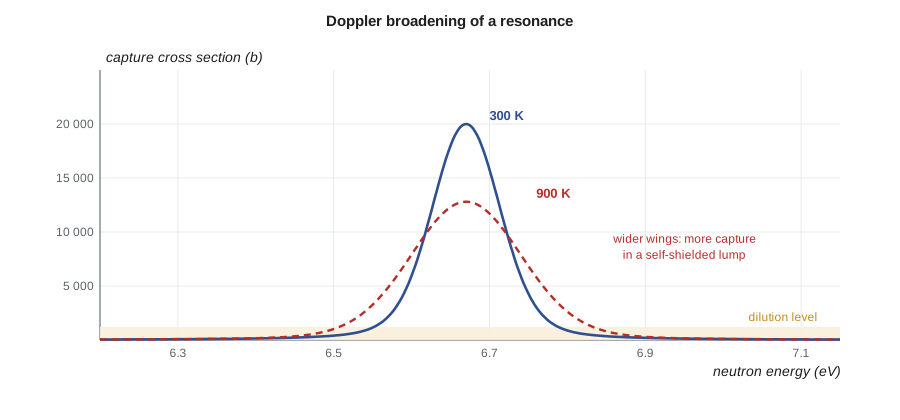
The program below evaluates the effective resonance integral of a single uranium-238-like resonance at two temperatures and four dilutions, with Doppler broadening applied as a Gaussian smear of the line shape.
# Resonance absorption: one U-238-like resonance near 6.67 eV in the narrow
# resonance approximation. Flux ~ 1/(E (sigma_t + sigma_d)), where sigma_d is the
# background (dilution) cross section per absorber atom. Doppler broadening is a
# Gaussian smear of the line shape. Resonance parameters are textbook-style values.
import math
E0, G, Gg, s0 = 6.67, 0.0255, 0.0230, 2.16e4     # eV, eV, eV, barns (peak total)
A = 238.0; kB = 8.617e-5                           # eV/K
def shape(E, T):
    # Doppler width and Gaussian-broadened Breit-Wigner line (numerical)
    if T == 0: return 1 / (1 + (2 * (E - E0) / G) ** 2)
    Dw = math.sqrt(4 * E0 * kB * T / A); n = 61; s = w = 0.0
    for j in range(n):
        u = -3 + 6 * j / (n - 1); wt = math.exp(-u * u)
        Ep = E + u * Dw; s += wt / (1 + (2 * (Ep - E0) / G) ** 2); w += wt
    return s / w
def res_integral(sig_d, T):
    tot, N = 0.0, 3000
    for i in range(N):
        E = E0 - 1.2 + 2.4 * (i + 0.5) / N; dE = 2.4 / N
        st = s0 * shape(E, T); sg = st * Gg / G
        tot += sg * sig_d / (st + sig_d) / E * dE
    return tot
print("dilution sigma_d (b) | RI at 300 K | RI at 900 K | Doppler increase")
for sd in (50, 200, 1000, 1e5):
    r1, r2 = res_integral(sd, 300), res_integral(sd, 900)
print(f"{sd:>19.0f} | {r1:11.2f} | {r2:11.2f} | {100*(r2/r1-1):6.1f} %")dilution sigma_d (b) | RI at 300 K | RI at 900 K | Doppler increase
50 | 5.01 | 5.31 | 6.0 %
200 | 11.41 | 12.99 | 13.8 %
1000 | 29.45 | 35.63 | 21.0 %
100000 | 111.19 | 112.84 | 1.5 %The results show the two essential features. At low dilution, typical of a fuel pellet, the effective integral is only a few percent of the infinitely dilute value: self-shielding is strong. The Doppler increase is largest at intermediate dilution and smallest at very high dilution, where the absorber is so thinly spread that broadening the resonance hardly changes the total capture. Real fuel sits in the range where the Doppler effect is significant, which is why the fuel temperature coefficient of every water-cooled power reactor is negative.
Worked problem
Estimating the Doppler coefficient
A lattice calculation gives k_inf = 1.1825 at a fuel temperature of 900 K and 1.1795 at 1000 K. Estimate the fuel temperature coefficient in pcm per kelvin.
Show solution
- Reactivity at each temperature: ρ = (k − 1)/k.
- ρ(900 K) = 0.1825/1.1825 = 0.15433; ρ(1000 K) = 0.1795/1.1795 = 0.15218.
- Change: −0.00215 over 100 K, or −2.15 × 10⁻⁵ per kelvin.
- In pcm: −2.15 pcm per kelvin.
Answer: A coefficient of about −2 pcm/K is typical of uranium dioxide fuel. A power increase that raises the average fuel temperature by 300 K would add about −650 pcm of reactivity, a strong and prompt brake on any power excursion.
Treating resonances in lattice codes
Production lattice codes cannot integrate over every resonance with a simple narrow-resonance formula. Instead they use one of several self-shielding methods. In the equivalence approach, the heterogeneous cell is mapped to an equivalent homogeneous mixture with an escape cross section, and pre-tabulated resonance integrals or shielded cross sections are interpolated as functions of dilution and temperature. In the subgroup approach, each group's cross section is represented by a few discrete levels with probabilities, and transport calculations are made for each level. Some modern codes solve the slowing-down equation on a very fine energy mesh, thousands of points, in the resonance region, which avoids most approximations at higher cost.
Several effects complicate the picture. Resonances of different nuclides overlap and shield each other; uranium-238 and plutonium-240 resonances interact, for example. The temperature is not uniform across a pellet, being much hotter at the centre than at the rim, and an effective temperature must be chosen. Burnup creates a rim region of high plutonium content in light-water fuel, because the outer layer of the pellet captures most resonance neutrons. Lattice codes treat each of these with sub-pin rings and careful temperature models.
In a CANDU bundle, the 37 elements are arranged in rings, and the outer ring sees the moderator directly while the inner elements are shielded by the outer ones. The resonance capture is therefore uneven across the bundle, and so is the plutonium production. Lattice codes model each ring separately, and the power within the bundle peaks in the outer ring. The Doppler coefficient of CANDU fuel is negative and similar in size per kelvin to that of light-water fuel, although the total power coefficient of a CANDU core also includes coolant and moderator effects.
Why the Doppler coefficient matters for safety
Every water-cooled power reactor relies on a negative fuel temperature coefficient as its first line of inherent protection against reactivity increases. If an accident inserted reactivity faster than control systems could respond, the fission power would rise, the fuel would heat within milliseconds to seconds and the Doppler effect would remove reactivity before the coolant or moderator had time to change. Safety analyses therefore require that the Doppler coefficient be negative throughout the cycle and model its value carefully, often with a conservative bias toward a weaker coefficient. Regulators in both countries review these calculations as part of licensing each core design.
Resonance absorption and lattice design
Resonance absorption is one of the main reasons lattice dimensions are what they are. Making fuel pins thicker lowers the surface-to-volume ratio of the fuel, so a larger share of the uranium-238 sits in the shielded interior, and the effective resonance integral per atom falls. Spacing pins further apart gives neutrons more moderator in which to slow down past the resonance energies before they reach the next pin. Both changes raise the resonance escape probability, but both also have costs: thicker pins run hotter for the same linear power, and wider spacing adds moderator absorption and makes the core larger. Lattice designers trade these effects using the same physics described above, and the optimum depends on the moderator, the enrichment and the operating conditions.
The Dancoff effect adds another interaction between pins. A neutron that escapes from one fuel pin without colliding in the moderator can enter a neighbouring pin while still at a resonance energy. Close-packed lattices therefore shield each pin partly through its neighbours, which reduces the escape cross section in equivalence theory. Lattice codes compute Dancoff factors for each pin from the geometry, and pins at the edge of an assembly or next to a water gap or guide tube have smaller Dancoff shadowing and therefore slightly higher resonance absorption than pins in the interior.
| Change to the lattice | Effect on self-shielding | Effect on resonance escape p |
|---|---|---|
| Thicker fuel pins at the same fuel volume fraction | more shielding of the pin interior | rises |
| Wider pitch (more moderator) | more slowing down between pins, less Dancoff shadowing | rises |
| Higher fuel temperature | broader resonances, less effective shielding | falls |
| More plutonium-240 at high burnup | additional resonance near 1 eV | falls |
Common mistakes
MistakeDoppler broadening increases the area under the resonance, so the fuel absorbs more.
InsteadThe infinitely dilute area stays almost constant; the effective absorption grows because the broader wings capture neutrons in self-shielded fuel.
MistakeSelf-shielding is negligible in modern fuel.
InsteadSelf-shielding reduces effective resonance absorption by a large factor in dense fuel pellets and must be modelled carefully.
MistakeThe Doppler effect acts slowly, after the coolant heats.
InsteadIt responds to fuel temperature, which changes within a fraction of a second of a power change.
Summary and key terms
- Uranium-238 resonances between about 1 eV and a few keV capture many slowing-down neutrons.
- Self-shielding lowers the effective resonance integral in dense fuel lumps.
- Dilution cross sections describe how strongly a resonance is shielded.
- Doppler broadening widens resonances as fuel heats, increasing capture and lowering k.
- The prompt, negative fuel temperature coefficient is a key inherent safety feature.
- Resonance
- A sharp peak in a cross section where the neutron energy matches an excited state of the compound nucleus.
- Self-shielding
- The reduction of flux inside an absorber at energies where it absorbs strongly.
- Dilution cross section
- The background cross section per absorber atom that sets how much a resonance is shielded.
- Resonance integral
- The integral of the capture cross section over energy, weighted by 1/E.
- Doppler broadening
- The widening of resonances caused by thermal motion of the target nuclei.
- Fuel temperature coefficient
- The change in reactivity per unit change in fuel temperature.
Practice problems
Work each problem on paper first, then reveal the answer to check.
Why does lumping fuel into pins reduce resonance absorption?
Show answer
It lowers the dilution cross section, so the fuel shields itself more strongly at resonance energies.
What happens to the peak and width of a resonance as temperature rises?
Show answer
The peak falls and the width increases.
Estimate the Doppler width of the 6.67 eV resonance at 300 K.
Show answer
Γ_D = √(4 × 6.67 × 8.6 × 10⁻⁵ × 300/238) ≈ 0.054 eV.
Why is the Doppler increase small at infinite dilution?
Show answer
With no self-shielding, broadening redistributes absorption without increasing its total much.
Why must the Doppler coefficient be negative?
Show answer
So that a power increase heats the fuel and automatically removes reactivity, limiting any excursion.
Lesson quiz · 5 questions
Score 60% or more to complete this lesson.
Create a free account to save your progress, take quizzes and earn a certificate.