
MELC-213 · Lesson 9 of 12 · 21 min
Contracts and mechanics' liens in Nunavut
▶ Video coming soon A video version of this lesson is on the way.
Getting paid is part of the job. In most of Canada, the law gives contractors and suppliers a lien, a security interest in the land they improved, if they are not paid. Nunavut's version is the Mechanics Lien Act, which the territory inherited from the Northwest Territories in 1999. It is an old statute with short deadlines, and it differs from the modern lien and prompt payment laws that several provinces, and in 2025 the Northwest Territories, have adopted. This lesson explains how it works, along with the contract habits that keep most payment disputes from reaching it.
Lien rights depend on exact dates and documents, so the habit to build is simple: know the deadlines from the first day of a job, keep the records that prove them, and bring in a lawyer as soon as a lien looks likely.
Start with the contract
Most payment problems trace back to an unclear contract. Before work starts, the contract should say what work is included, the price or how it is calculated, when payments are due and against what, how changes are priced and approved, what holdback applies, and who owns materials delivered to site. For public housing and government work, the client's standard contract usually sets these terms; read them before bidding.
Change orders deserve special attention. On the Apex retrofit, the housing organization's site representative asks for extra range circuits during a visit. Jeela writes a one-page change order with the price and gets it signed before her crew starts. Without that page, the extra work is a debt she must prove later.
| Contract term | Why it matters in Nunavut |
|---|---|
| Payment schedule | Long gaps between sealift purchases and payment strain cash flow |
| Materials payment | Lets the contractor be paid for material shipped and stored before installation |
| Change orders | Written approval before extra work avoids disputes |
| Holdback | Sets how much is retained and when it is released |
| Delay terms | Says who bears the cost if the sealift is late or the site is not ready |
Who can claim a lien
Under the Mechanics Lien Act, a person who does work on or supplies materials for an improvement to land, at the request of the owner or someone acting for the owner, can have a lien on the owner's interest in the land for the price of that work or material. That includes a general contractor, a subcontractor such as an electrical contractor, a supplier, and workers owed wages. The lien secures the debt against the land, which gives the claimant a powerful tool: the owner cannot easily sell or refinance the property with a registered lien on title.
Some land cannot be liened. Liens generally do not attach to Crown land, and in Nunavut a great deal of land is held by the Government of Canada, by the Commissioner of Nunavut, or as Inuit Owned Lands under the Nunavut Agreement, where special rules apply. Many buildings sit on leased land. Whether a lien can attach to a particular interest is a legal question for each job, so check early, before the job starts, what security you actually have.
The holdback
The Act lets an owner retain a holdback: up to 10 percent of the value of the work, kept back for 45 days after the work is completed. Paying properly and keeping the holdback for that period protects the owner, because the owner's liability to lien claimants is limited to the holdback amount if the owner has paid in good faith. Unlike some provinces' modern laws, Nunavut's holdback is framed as permissive, not mandatory, so contracts often set out their own holdback terms.
Worked problem
Calculating the holdback
Jeela's subcontract on the community hall is worth 186,000 dollars. The general contractor retains a 10 percent holdback. How much is held back, and when should it be released if the work is completed on May 20?
Show solution
- Ten percent of 186,000 dollars is 18,600 dollars.
- The holdback is retained for 45 days after completion.
- Counting 45 days from May 20 gives July 4.
- If no liens are registered in that period, the holdback should be released under the contract's terms.
Answer: 18,600 dollars, held until about July 4, then released if no liens are claimed.
from datetime import date, timedelta

value = 186000
completed = date(2026, 5, 20)
holdback = round(value * 0.10)
release = completed + timedelta(days=45)
print("holdback:", holdback, "dollars")
print("held until:", release)holdback: 18600 dollars held until: 2026-07-04
Registering a lien
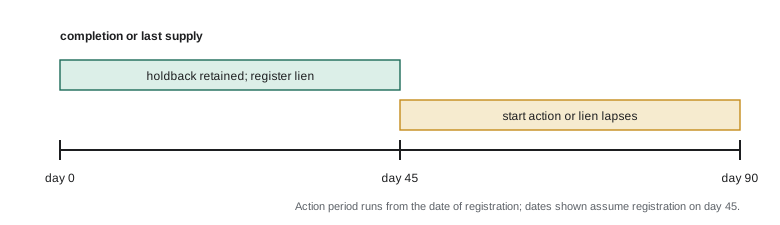
A lien that is not registered in time is lost. The Act requires a claim of lien to be registered in the land titles office within 45 days after the work is completed or the last materials supplied. That is a short period, and in the North, it can run out while a contractor is waiting for a promised payment.
A registered lien does not last forever either. It ceases to exist unless the claimant starts an action to enforce it within a set time after registration, which the Act also sets at 45 days, or unless another claimant's action covers it. Liens are enforced in the Nunavut Court of Justice.
Worked problem
The deadlines for a supplier's lien
A supplier delivered the last panels for a job on March 2. The contractor has not paid. If the supplier registers a claim of lien on April 10, when must it start an action to keep the lien alive?
Show solution
- Check registration: March 2 plus 45 days is April 16, so registration on April 10 is in time.
- The action period runs 45 days from registration.
- April 10 plus 45 days is May 25.
- The supplier should start the action by May 25, and sooner is safer.
Answer: By May 25. A lawyer should check the dates and the exact wording of the Act.
Prompt payment
Several provinces now have prompt payment laws that set firm deadlines for paying invoices and a fast adjudication process for disputes. We found no prompt payment legislation in force in Nunavut. Payment timing on a Nunavut job depends on the contract, the client's own policies, and general law. Some public owners, including the federal government on its own projects, have prompt payment rules of their own that may apply on federal work in the territory.
The Northwest Territories replaced its old Mechanics Lien Act with a modern Builders' Lien Act in force September 1, 2025. That law does not apply in Nunavut. Contractors who work in both territories should not assume the newer rules carry across.
Steps when payment is late
Jeela's escalation ladder for a late payment is simple, and the first steps solve almost every case.
- Check that the invoice was complete and went to the right person, with the change orders and any WSCC clearance the client requires.
- Call the client's project manager and finance contact, and follow up in writing.
- Diarize the lien registration deadline from the date of completion or last supply, the moment a payment looks at risk.
- If payment is still not coming, talk to a lawyer before the deadline, not after.
A lien is a serious step in a small market, where the owner may be the contractor's main client. It is also sometimes the only way to get paid. Having the dates ready keeps the choice open.
Proving the completion date
Because every lien deadline runs from completion or the last supply, the completion date is often the most important fact in a lien dispute. An owner may say the work finished earlier than the contractor claims, so that the 45 days ran out. A contractor may point to later work. Courts look at the facts, and small follow-up items such as fixing a deficiency or warranty work may not count as continuing the work.
Good records settle the question. The date of final inspection in the permit file, the last delivery slip, the crew's time sheets and a dated completion notice sent to the client all help. Jeela sends a short written notice of completion on every job, with the date and a list of any minor items still open. That notice also starts the conversation about releasing the holdback.
Materials stored for a season
Sealift creates a lien question the South rarely sees. Material may arrive in a community in September for a job that does not start until spring. If it sits in the contractor's sea can, it has not yet improved the owner's land, and a lien for it may be uncertain. If it is delivered to the site and stored there for the owner, the position may be different. The contract should say who owns stored material, who insures it, and whether the contractor can be paid for it before it is installed.
On the community hall, Jeela's contract includes a materials payment clause. When the sealift container arrives, she invoices for the material with the shipping documents and photographs of the stored items, and the hamlet pays 90 percent of their value. The material is insured under the builder's risk policy from that day.
Other ways to secure payment
A lien is one tool. Others can be set up before the job starts.
- Deposits or advance payments for material, common for private clients.
- Payment bonds on larger public projects, where a surety guarantees that subcontractors and suppliers will be paid.
- Joint cheques, where the owner pays the general contractor and the subcontractor together.
- Progress billing at short intervals, so the amount at risk stays small.
For private homeowners, a deposit is often the most practical security. For housing organizations and government clients, the risk is usually slow payment rather than non-payment, and a well-prepared invoice with every required document attached is the best remedy.
Going to court
Nunavut has a single-level trial court, the Nunavut Court of Justice, which hears civil claims of every size, including lien actions. Judges travel on circuit to communities, but civil matters are commonly heard in Iqaluit. Court is slow and costly compared with the amount at stake on most electrical subcontracts, so most disputes are settled by negotiation, sometimes with the help of a mediator.
Many construction contracts include a dispute resolution clause requiring negotiation, then mediation, then arbitration or court. Read that clause before signing, because it can affect how and where a claim is decided. A lien action may still need to be started within the Act's deadline to keep the lien alive, even while other steps are under way. That is one more reason to speak with a lawyer early.
Suppliers and the contractor
Kilabuk Electric is a customer as well as a contractor. Its suppliers in Ottawa, Montreal and Iqaluit extend credit, and they have lien rights too if the company does not pay them for material that goes into a job. Peter pays suppliers on time, even when a client is late, because a supplier's lien on a client's building would damage Jeela's relationship with that client far more than a short-term loan would cost.
Suppliers usually ask a new northern customer to fill in a credit application with references, and some ask for a personal guarantee from the owner of a small company. Jeela reads those guarantees carefully. A personal guarantee can undo the protection that incorporation gives, because it makes her personally liable for the company's account with that supplier.
The relationship runs both ways. A supplier who knows the company pays on time will hold stock for the sealift, chase a late shipment, or send a missing part on the next flight. In a place where a single missing breaker can stop a job for weeks, that goodwill is worth protecting.
Common mistakes
MistakeWaiting until the money is badly overdue before counting lien deadlines.
InsteadThe registration period is 45 days from completion or last supply; diarize it at once.
MistakeAssuming the Northwest Territories' new Builders' Lien Act applies in Nunavut.
InsteadIt does not; Nunavut still uses the Mechanics Lien Act.
MistakeDoing extra work on a verbal request.
InsteadGet a written, priced change order signed before starting.
MistakeAssuming every building can be liened.
InsteadCrown land, Commissioner's land, leases and Inuit Owned Lands raise special questions.
Summary and key terms
- Nunavut's lien law is the Mechanics Lien Act inherited from the Northwest Territories.
- An owner may retain a holdback of up to 10 percent for 45 days after completion.
- A claim of lien must be registered within 45 days after completion or last supply.
- A registered lien lapses unless an enforcement action starts within the set period, also 45 days.
- We found no prompt payment law in force in Nunavut; contracts govern payment timing.
- Mechanics' lien
- A claim against an owner's interest in land for unpaid work or materials that improved it.
- Holdback
- The part of a payment, up to 10 percent, retained for 45 days after completion.
- Claim of lien
- The document registered in the land titles office to preserve a lien.
- Change order
- A written, priced agreement to change the contract's work.
- Prompt payment
- Legislation in some provinces setting payment deadlines and fast adjudication.
Practice problems
Work each problem on paper first, then reveal the answer to check.
What is the holdback on a 50,000-dollar contract at 10 percent?
Show answer
5,000 dollars.
Within how many days after completion must a lien be registered?
Show answer
45 days.
Does the NWT Builders' Lien Act apply to a job in Iqaluit?
Show answer
No; Nunavut uses its own Mechanics Lien Act.
Which court enforces liens in Nunavut?
Show answer
The Nunavut Court of Justice.
Lesson quiz · 5 questions
Score 60% or more to complete this lesson.
Create a free account to save your progress, take quizzes and earn a certificate.