
MELC-213 · Lesson 5 of 12 · 19 min
The Canadian Electrical Code as adopted in Nunavut
▶ Video coming soon A video version of this lesson is on the way.
Electrical work in Nunavut is built to the Canadian Electrical Code, Part I, the national installation standard published by CSA Group. The Code has no force on its own. It becomes law in Nunavut because a regulation under the Electrical Protection Act adopts it, usually with a schedule of territorial amendments. This lesson explains how that adoption works, which edition applies, how to read Nunavut's amendments, and how to keep up when a new edition arrives.
Kyle, the newcomer from Nova Scotia, asks the obvious question in his first week: is it the same Code? Mostly yes. The technical rules are the national ones. What differs is the edition in force on a given date, the territory's amendments, and the way the territory's own Act and regulations sit alongside the Code. This course does not reproduce the Code's text or tables. Learners should work from their own licensed copy.
How adoption works
The Act lets the Commissioner in Executive Council make regulations, including regulations adopting codes and standards. Nunavut has used that power to adopt successive editions of the Canadian Electrical Code. Each adoption regulation names the edition, sets the date it comes into force, and lists any amendments in a schedule.
The record shows a steady pattern. A 2002 regulation adopted the 19th edition. A 2007 regulation adopted the 20th edition. A 2015 regulation adopted the 23rd edition, the 2015 Code, in force October 1, 2015, with a schedule of Nunavut amendments. Electro-Federation Canada's national tracking table, a secondary source, reports that Nunavut adopted the 2018 Code in August 2019. We could not confirm that adoption, or any later one, in the territory's consolidated legislation, so check which edition Safety Services is enforcing before you design a job.
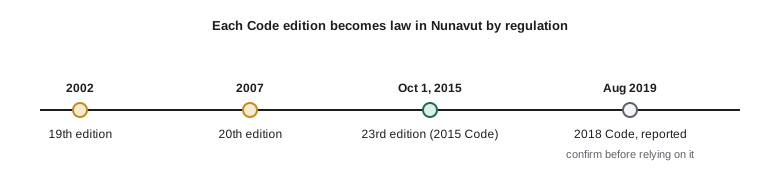
Why the lag? The national Code is revised every three years. Each province and territory reviews the new edition, decides on amendments and makes a regulation. Small jurisdictions with few staff often adopt later than larger ones, and sometimes skip an edition. In Nunavut, a design that met the national Code's newest edition might still need checking against the edition actually adopted.
Which edition applies to a job
The rule of thumb is that the edition in force when the permit is issued applies to the work under that permit. Adoption regulations sometimes include transition rules, for example allowing work designed or permitted before the in-force date to proceed under the older edition. Read the adoption regulation's transition section, and if it is unclear, ask the inspector in writing.
Worked problem
Which Code for the community hall?
A hamlet asks Kilabuk Electric to price a new community hall. The engineer's drawings cite a recent national edition of the Code. Jeela's permit will be issued next spring. What should she check?
Show solution
- Confirm with Safety Services which edition is in force in Nunavut and whether a newer one is expected before the permit date.
- Ask the engineer to confirm the design meets the edition in force, with Nunavut's amendments.
- Where a newer edition's requirement is stricter, building to it is usually acceptable, but where it is more lenient, the adopted edition governs.
- Record the inspector's answer in the permit file.
Answer: Build to the edition in force with Nunavut's amendments, confirmed in writing before the permit is issued.
Reading Nunavut's amendments
An adoption regulation's schedule lists each amended rule by its number, and says whether the territory adds to it, replaces it, or deletes it. The amendments reflect local conditions, the territory's own administrative system, and points where Nunavut's other laws already cover the subject. Because the Code's rule numbers change between editions, an amendment written for one edition may not line up with the next.
When reading an amendment, ask three questions. Which rule does it change, in which edition? What does it change, in your own words? And does the change still make sense in the edition you are working under? Keep a copy of the schedule next to your Code, with each amended rule flagged in the Code itself.
We have not set out the specific amendments in this course, because the current schedule should be read directly from the consolidated regulation and because amendments change with each adoption. Safety Services can supply the current version.
How the Code fits with the Act and regulations
The Code is a technical standard. It tells you how to size conductors, protect circuits, ground and bond, and install equipment in particular locations. The Act and regulations are the administrative law. They decide who may do the work, what permits are needed, when inspections happen and what penalties apply. Where the Code's own administrative rules, such as those in its first section about permits and inspection, conflict with the territory's law, the territory's law prevails.
| Question | Where the answer comes from |
|---|---|
| How large must the service conductors be? | The Code, as adopted |
| Who may take out the permit? | The Act and regulations |
| When must I give notice for inspection? | The Act |
| When is an engineer's seal required? | The regulations |
| How deep must cable be buried in frozen ground? | The Code and its amendments, with engineering advice for permafrost |
| What is the permit fee? | The regulations |
Approval of equipment
The Code requires electrical equipment to be approved, which in Canada usually means certified by an accredited certification body and marked accordingly. In the North, that rule meets a practical problem. Some equipment arrives through unusual supply chains, including online orders and items carried on personal flights. A heater, light fixture or charger without a recognized Canadian certification mark is not approved, however good it looks.
If equipment without a recognized mark is already installed, the inspector may require it to be replaced or field-evaluated. Field evaluation by an accredited body is possible but expensive when the evaluator has to fly in. The cheaper answer is to check marks before ordering, especially for equipment bought outside Canada.
Northern topics the Code touches
Several Code subjects come up more often in Nunavut than in the South. They include:
- heating equipment, because most buildings run on oil-fired heat with electric controls, and electric heat is costly on diesel-generated power;
- block heaters and parking receptacles, which are everywhere in a cold climate;
- generators and transfer equipment for standby power, because outages can be long and the cold makes them dangerous;
- grounding, because frozen and rocky ground makes low-resistance earth electrodes hard to achieve;
- cable and raceway in buildings on piles, where conductors must cross from the ground or a utilidor to a building raised above permafrost.
Lesson 11 returns to these conditions. The Code sets the rules; the northern conditions make them harder to meet, and engineering advice is often needed where the ground or the building structure is unusual.
Keeping up with new editions
Doug's advice to Jeela is to treat each new Code edition as a project. When CSA Group publishes a new edition, buy it, and read the summary of changes that industry groups publish. Then watch for Nunavut's adoption regulation, which may come a year or more later. When it arrives, read the amendments schedule and the transition rules, update the company's standard details, and brief the crew.
Training helps. Code update courses are offered in the South and online, and some are offered in Iqaluit through the college or industry associations. Jeela budgets for one update course per edition for each permit holder. Lesson 12 discusses keeping skills current.
Using the Code well
A few habits make Code work faster and safer. Work from a current, licensed copy, not photocopied pages. Use the index and the appendix notes, which explain the intent of many rules. Mark Nunavut's amendments in the margin. And when a rule is unclear, ask the inspector before the work is covered, not after.
Jeela keeps a short log of questions she has asked inspectors and the answers she received, by rule number. Over the years it has become the company's own guide to how Nunavut's inspectors read the Code. She shares it with new hires like Kyle, who find it more useful than any summary.
The Code beside other building rules
Electrical work rarely stands alone. A new building in Nunavut also has to meet building and fire safety rules, which are administered separately from the electrical system. The Fire Marshal's office handles fire safety and building plan review for many buildings, and municipalities such as the City of Iqaluit issue building and development permits under their own bylaws. Those permits do not replace the electrical permit, and the electrical permit does not replace them.
On the community hall, Jeela will deal with at least three offices: Safety Services for the electrical permit and inspections, the fire safety office for fire alarm and emergency lighting questions that cross into the building rules, and the hamlet for development approval. The general contractor usually coordinates the building and development side, but Jeela needs to know where electrical requirements come from in each case, because a fire alarm system, for instance, must satisfy both the electrical Code and fire safety requirements.
Practising with an amendment
Here is a made-up amendment, written only to practise the reading method. It is not a real Nunavut rule. Suppose a schedule said that, in a particular rule about outdoor receptacles, the territory adds a requirement that receptacles for vehicle block heaters be controlled so they can be switched off from inside the building.
Applying the three questions: the amendment changes one rule about outdoor receptacles in a named edition; it adds an indoor control requirement for block heater receptacles; and when the next edition renumbers its rules, the reader must find where the outdoor receptacle rule moved and check whether the amendment was carried forward in the new adoption regulation. That last step is the one people skip.
The practice is the same for any real amendment. Translate it into plain words, find where it lands in the edition you are using, and mark it in your copy of the Code.
Budgeting for Code updates
A new Code edition costs money: the book, the update course, travel for training, and time to revise standard details. The short calculator below estimates the per-edition cost for a small company. The figures are invented for illustration.
permit_holders = 3
book = 220            # dollars per licensed copy
course = 450          # dollars per person for an update course
travel = 1800         # dollars per person if the course is in the South
online_share = 2 / 3  # share of holders taking the course online, no travel
revision_hours = 16   # office hours to update standard details
hourly = 60

travellers = round(permit_holders * (1 - online_share))
cost = permit_holders * (book + course) + travellers * travel + revision_hours * hourly
print("people travelling:", travellers)
print("estimated cost per edition:", cost, "dollars")
print("per year over a three-year cycle:", round(cost / 3), "dollars")people travelling: 1 estimated cost per edition: 4770 dollars per year over a three-year cycle: 1590 dollars
Spread over a three-year cycle, the cost is modest compared with a single failed inspection on a fly-in job. Online update courses have made the North's training costs much lower than they were a decade ago.
When the inspector reads a rule differently
Sometimes a contractor and an inspector disagree about what a Code rule requires. The first step is a conversation, with the rule open in front of both people. Many disagreements end there, because one person has missed an appendix note or a Nunavut amendment. If the disagreement continues, ask for the inspector's direction in writing and the reason for it. The Act gives a route to appeal an inspector's decision to the chief inspector within a short time, which Lesson 7 explains.
Jeela's experience is that inspectors in Nunavut are generally willing to talk through a rule, and that a good working relationship with them matters more than winning any single argument. Inspectors cover huge distances, and a contractor who makes their visits efficient gets fewer surprises.
Common mistakes
MistakeAssuming the newest national edition is in force in Nunavut.
InsteadNunavut adopts editions by regulation, often later; confirm the edition in force.
MistakeIgnoring the territory's amendments schedule.
InsteadAmendments add to, replace or delete Code rules in Nunavut.
MistakeTreating the Code's administrative section as the last word on permits.
InsteadThe Act and regulations govern administration; where they conflict, they prevail.
MistakeInstalling equipment without a recognized Canadian certification mark.
InsteadEquipment must be approved; field evaluation in the North is costly.
Summary and key terms
- The Canadian Electrical Code becomes law in Nunavut only by an adoption regulation, usually with amendments.
- Regulations adopted the 19th, 20th and 23rd (2015) editions; a 2018 adoption is reported and should be confirmed.
- The edition in force at the permit date, with any transition rules, governs the work.
- The Code answers technical questions; the Act and regulations answer administrative ones.
- Equipment must be approved, which usually means a recognized Canadian certification mark.
- Adoption regulation
- A regulation that makes a Code edition law in the territory, often with a schedule of amendments.
- Amendment schedule
- The list of territorial changes to specific Code rules.
- Edition in force
- The Code edition that applies on a given date.
- Transition rule
- A rule saying how work already designed or permitted is treated when a new edition takes effect.
- Approved equipment
- Equipment certified by an accredited body and marked for use in Canada.
Practice problems
Work each problem on paper first, then reveal the answer to check.
Which regulation brought the 2015 Code into force in Nunavut?
Show answer
A 2015 regulation, in force October 1, 2015, with a schedule of amendments.
What should you do if engineer's drawings cite a newer edition than the one in force?
Show answer
Confirm the edition in force and have the engineer check the design against it and Nunavut's amendments.
If the Code's administrative rules conflict with the Act, which governs?
Show answer
The Act and regulations.
What makes grounding hard in Nunavut?
Show answer
Frozen and rocky ground makes low-resistance earth electrodes difficult.
Lesson quiz · 5 questions
Score 60% or more to complete this lesson.
Create a free account to save your progress, take quizzes and earn a certificate.