
MELC-213 · Lesson 4 of 12 · 21 min
Electrical permits: installation, annual and owner's permits
▶ Video coming soon A video version of this lesson is on the way.
Every piece of electrical work in Nunavut that the Act covers needs a permit. The Electrical Protection Act prohibits installing, altering or repairing electrical equipment without one, and the regulations set out the kinds of permit, who may hold each, what they cost and how long they last. This lesson covers the three permits a contractor meets most often: the installation permit, the annual permit and the owner's permit, plus the rules that apply to all of them.
Jeela has three jobs on her desk in March. The first is the Apex four-plex retrofit. The second is a new duplex in Iqaluit's Plateau subdivision, for which she will be the electrical contractor. The third is a call from Annie Pitsiulak, a homeowner in Pangnirtung, who wants to know whether she can wire her own new shed. Each of them involves a different permit question.
The installation permit
The installation permit is the ordinary permit for electrical work. It is issued to a registered qualified electrical worker for a particular installation at a particular place. The permit holder is responsible for the work under it, for giving notice for inspection, and for correcting any deficiencies the inspector finds.
The application describes the work, the location and its estimated value, and it comes with the fee. The fee depends on the value of the electrical work, using brackets set in the regulations. Lesson 1 introduced the brackets; here they are again, with the rule for larger jobs.
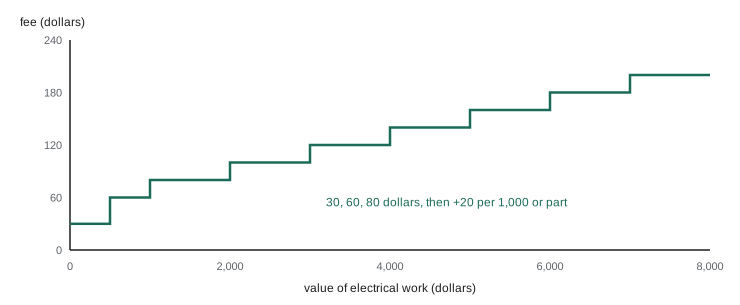
The value of the work means the value of the electrical installation, including labour and materials, not the value of the whole building. For a large job, ask Safety Services how they want the value calculated, and keep the estimate on file in case the inspector asks.
The regulations require the fee to be paid when the permit is applied for. A permit is not issued on credit.
Calculating the fee
The calculator below applies the brackets. Peter uses a version of it when preparing permit applications. Run it with the duplex value to check the worked example that follows.
import math

def permit_fee(value):
    if value <= 500:
        return 30
    if value <= 1000:
        return 60
    if value <= 2000:
        return 80
    extra_thousands = math.ceil((value - 2000) / 1000)
    return 80 + 20 * extra_thousands

for value in (450, 900, 1800, 2001, 18500, 42000):
print(f"{value:>7} dollars of work: fee {permit_fee(value)} dollars") 450 dollars of work: fee 30 dollars
900 dollars of work: fee 60 dollars
1800 dollars of work: fee 80 dollars
2001 dollars of work: fee 100 dollars
18500 dollars of work: fee 420 dollars
42000 dollars of work: fee 880 dollarsWorked problem
The permit fee for the Plateau duplex
The electrical work on the new duplex is estimated at 42,000 dollars. What is the permit fee?
Show solution
- The value is above 2,000 dollars, so start with 80 dollars.
- The amount above 2,000 is 40,000 dollars.
- That is 40 thousands, so add 40 times 20 dollars, which is 800 dollars.
- The total is 80 plus 800, which is 880 dollars.
Answer: 880 dollars, paid with the application.
Small permits matter too. When Jeela changes a damaged receptacle and its box in a public housing unit, the work may be worth only a few hundred dollars, and the fee is 30 dollars. Some contractors are tempted to skip a permit for work that small. The law makes no exception for small jobs, and an annual permit, described below, is the usual answer for a steady flow of small repairs in the same facility.
How long a permit lasts
Under the regulations, an installation permit is valid for one year. A permit may be cancelled if the work it covers does not start within 90 days of issue, or if the work stops for 90 days. A permit cannot be transferred to another person or another place.
These rules matter in the North because schedules slip. If materials for the duplex miss the sealift, the job may wait a year for the next one. If the permit was taken out in June and no work starts until the following August, the permit may already be cancelled or expired, and Jeela will need a new one and a new fee. The practical habit is to take out the permit when the work is ready to start, not when the contract is signed.
| Rule | What it means on site |
|---|---|
| Valid one year | Plan to finish and have final inspection within the year, or talk to the inspector early. |
| May be cancelled if work does not start in 90 days | Do not take out the permit until materials and crew are in place. |
| May be cancelled if work stops for 90 days | A long winter pause on an unheated building can end the permit. |
| Cannot be transferred | A new permit holder takes out a new permit for remaining work. |
| Fee paid on application | Budget the fee in the bid and pay it with the application. |
Temporary service
Construction sites often need temporary power before the permanent service is ready. The regulations set a separate fee for a temporary service, 55 dollars. In Nunavut, temporary power on a new site may come from a portable generator or from a temporary connection to Qulliq Energy's distribution system. A connection to the utility needs the same inspection approval as a permanent service, which Lesson 6 explains.
The annual permit
The regulations also provide for an annual permit. An annual permit covers routine maintenance and repair work in a facility for a year, instead of a separate installation permit for each small job. It suits buildings with steady electrical maintenance: a hospital, a school, a mine site camp, a municipal building, or a housing organization's units in one community.
The details of eligibility and fees for annual permits are set in the regulations and administered by Safety Services, and they are not covered in depth here. Before relying on an annual permit, confirm with Safety Services what work it covers, whether new installations or service changes are excluded, and how records of work done under it must be kept. As a rule of thumb, new circuits, service upgrades and anything that changes the design of the system still need an installation permit.
Kilabuk Electric's maintenance contract with a local housing organization is a good fit. Under that contract, Jeela's crew replaces failed fixtures, receptacles and breakers in dozens of units every year. One annual permit, with a log of each repair, is simpler for everyone than dozens of small installation permits.
The owner's permit
Some homeowners want to do their own electrical work. The Act allows the chief inspector to issue a permit to an owner of a building for work on that building, within limits. The regulations say the chief inspector shall refuse an owner's permit for a service larger than 125 amperes, or for any service that is not single phase.
That limit keeps owner's permits to modest residential work. A homeowner with a 100-ampere single-phase service may be eligible to wire a shed or add circuits, subject to the chief inspector's decision and inspection. A homeowner wanting to install a 200-ampere service, or anyone working on a three-phase commercial building, needs a registered qualified electrical worker.
Annie's shed in Pangnirtung, fed from her house's 100-ampere single-phase service, may be the kind of job an owner's permit covers. Jeela tells her to call Safety Services to ask, and to expect the same inspection a contractor's work would get. She also warns her that an owner's permit puts the responsibility for the work, and for fixing deficiencies, on her.
Owner's permits are a common source of trouble. If a homeowner takes out an owner's permit and then hires an unregistered friend to do the work, the permit does not cover the friend. The permit is for the owner's own work.
Plans and engineering
Larger installations need more than a permit application. The regulations require plans and specifications sealed by a professional engineer for single-phase services over 400 amperes, three-phase services over 200 amperes, and any installation over 750 volts. Lesson 6 covers plan approval and inspection. For now, note that the permit for such a job will not be issued until the plans requirement has been dealt with.
The Plateau duplex, with two 200-ampere single-phase services, is below the threshold. A new community hall with a 400-ampere three-phase service is not, and Jeela's bid for that job includes the engineer's fees.
What happens without a permit
Doing electrical work without a permit is an offence under the Act, and the Act also lets an inspector order work stopped, exposed for inspection, or disconnected. Lesson 7 covers enforcement and penalties. For a contractor, the more immediate consequence is practical: Qulliq Energy will not connect a new or altered service without inspection approval, and an inspector who finds unpermitted work may require it to be opened up.
There is also an insurance angle. An insurer investigating a fire may ask whether the electrical work was permitted and inspected. Unpermitted work can complicate a claim.
The three March jobs, resolved
Worked problem
Matching the jobs to permits
Jeela has the Apex retrofit under a housing maintenance contract, the new Plateau duplex, and Annie's question about her shed. Which permits apply?
Show solution
- Apex retrofit: if the work is routine replacement under the housing organization's maintenance program, an annual permit may cover it; new circuits or service work need installation permits.
- Plateau duplex: an installation permit in Jeela's name, fee 880 dollars on 42,000 dollars of work, plus a temporary service if needed.
- Annie's shed: possibly an owner's permit, since her service is 100 amperes single phase, subject to the chief inspector's decision.
- In every case, give notice for inspection before work is covered, as Lesson 6 explains.
Answer: Annual permit for routine maintenance, installation permit for the duplex, and possibly an owner's permit for the shed.
Permits and the community calendar
In the South, a contractor can usually order missing material and have it on site in a day or two. In most Nunavut communities, heavy and bulky material arrives once a year on the sealift, and anything urgent comes by air cargo at a much higher cost. That rhythm shapes when permits should be taken out.
Jeela's habit is to apply for the permit when two things are true: the materials are physically in the community, and the crew has a confirmed start date. For the Plateau duplex, the sealift container with the panels, cable and boxes arrives in August, so she applies for the permit in late August and starts rough-in the first week of September. That timing gives her the whole year of permit validity to finish, with time to spare for the final inspection before the following August.
Winter adds its own risk. If the building envelope is not closed before freeze-up, work may have to stop until the space can be heated, and a long pause can approach the 90-day limit. Jeela tells the general contractor early when a pause is likely, and she calls the inspector to explain the situation rather than letting the permit lapse quietly.
Keeping a permit file
Every permit gets a folder, paper or digital, with the same contents: the application and receipt, the permit itself, any plans, a copy of the inspection notices, the inspector's reports, the record of deficiencies and how they were corrected, and the final approval. Peter numbers the folders to match the permit numbers so that anyone in the office can find them.
The permit file protects the contractor. If a dispute arises about the work years later, the file shows what was permitted, what was inspected and when the inspector approved it. It also helps with liens and payment disputes, which Lesson 9 covers, because it shows when the work was done and finished.
On a big job, the file also helps the next person. If Moses takes over a later phase under his own permit, he can see exactly what was inspected under Jeela's permit and where his work begins.
Common mistakes
MistakeTaking out a permit when the contract is signed months before work begins.
InsteadA permit may be cancelled if work does not start within 90 days. Apply when materials and crew are ready.
MistakeSkipping a permit for small jobs.
InsteadThe law has no small-job exception. Use an annual permit for routine maintenance where it fits.
MistakeLetting a friend do the work under a homeowner's owner's permit.
InsteadAn owner's permit covers the owner's own work only.
MistakeCalculating the fee on the value of the building.
InsteadThe fee is based on the value of the electrical work.
Summary and key terms
- Electrical work needs a permit; the installation permit is issued to a registered qualified electrical worker.
- Fees step up with the value of the work: 30, 60, 80 dollars, then 20 dollars for each further 1,000 or part.
- Permits last one year, may be cancelled after 90 days without work, and cannot be transferred.
- An annual permit can cover routine maintenance in a facility; confirm the scope with Safety Services.
- An owner's permit is refused for services over 125 amperes or not single phase.
- Installation permit
- The ordinary permit for a particular electrical installation, issued to a registered qualified electrical worker.
- Annual permit
- A permit covering routine maintenance and repair in a facility for a year.
- Owner's permit
- A permit for an owner to do their own work on their building, within the regulations' limits.
- Temporary service
- A short-term supply for construction, with its own fee.
- Value of the work
- The cost of the electrical installation, labour and materials, used to set the fee.
Practice problems
Work each problem on paper first, then reveal the answer to check.
What is the fee for 1,800 dollars of electrical work?
Show answer
80 dollars, since the value is above 1,000 and not above 2,000.
Can an owner's permit be issued for a 200-ampere service?
Show answer
No. The regulations require refusal above 125 amperes.
Above what three-phase service size are engineer-sealed plans required?
Show answer
Above 200 amperes.
What happens if work stops for 90 days?
Show answer
The permit may be cancelled; talk to the inspector and expect to need a new permit.
Lesson quiz · 5 questions
Score 60% or more to complete this lesson.
Create a free account to save your progress, take quizzes and earn a certificate.