
MELC-213 · Lesson 1 of 12 · 20 min
How electrical safety regulation works in Nunavut
▶ Video coming soon A video version of this lesson is on the way.
Jeela Kilabuk has been a construction electrician for nine years. She grew up in Pangnirtung, apprenticed in Iqaluit through the territorial apprenticeship program, wrote the interprovincial exam and earned her certificate of qualification with a Red Seal endorsement. For the last six years she has worked for a southern contractor that flies crews north each summer for public housing retrofits, school upgrades and the occasional new warehouse. This winter she is setting up her own company in Iqaluit, Kilabuk Electric Ltd., with her cousin Peter Ootoova keeping the books. Before she quotes a single job, she wants to know exactly what Nunavut requires of the people who do electrical work and of the companies that sell it.
This course follows Jeela through that process. It is a companion to the Canadian core courses (MELC-101 to MELC-106), which teach the Code, calculations, wiring methods, grounding, special installations and the business side. This course adds what is particular to Nunavut: the law, who may do electrical work, worker registration, permits, plans and inspections, the territory's Code amendments, connection to the community power plant, liens, workplace safety and the realities of building in the Arctic.
One thing to settle at the start: Nunavut does not have a master electrician licence, and its electrical law does not create an electrical contractor licence either. We could find no published master or contractor exam. What Nunavut has is a system built around the individual: a qualified electrical worker, who must be registered, takes out a permit for each job, gives notice so an inspector can see the work, and may not energize anything until the inspector says so. This course is built around that real system. Where we could not confirm a detail from an official source, the lesson says so and tells you who to ask.
The law: one Act and one set of regulations
Two pieces of law do most of the work.
- The Electrical Protection Act (C.S.Nu., c. E-20) is the statute. Nunavut inherited it from the Northwest Territories when the territory was created on April 1, 1999, and has amended it several times since, most recently in 2025. It defines a qualified electrical worker, forbids electrical work without a permit, requires plans for larger installations, sets out inspections and notice, controls when the utility may connect power, and lets the Minister make regulations.
- The Electrical Protection Regulations (R.R.N.W.T. 1990, c. E-21, as they apply in Nunavut) fill in the detail: registration of qualified electrical workers, the permit types, permit and inspection fees, plan approval, engineer's seals for large services, and the edition of the Canadian Electrical Code that applies, with Nunavut's own amendments.
The regulations adopt the Canadian Electrical Code, Part I, as the technical standard, and the Minister decides which edition. Lesson 5 explains what we could confirm about the edition in force and the Nunavut amendments that deal with permafrost, pilings and oil-heated homes.
Section numbers in this course refer to the Act as consolidated to June 3, 2025, and to the regulations as consolidated in the territory's legislation database. Laws change, and Nunavut's database warns that some consolidations are out of date. Before you rely on a section number or a fee for anything that matters, check the current version on nunavutlegislation.ca or ask Safety Services.
A change on the horizon
Nunavut has passed a newer statute, the Technical Standards and Safety Act, which is designed to replace the Electrical Protection Act, the Gas Protection Act and the Boilers and Pressure Vessels Act. In November 2024 the Legislative Assembly amended it so that each of the older Acts can be repealed separately, and the electrical repeal takes the old regulations with it. We could not confirm whether the electrical part is in force yet. Until Safety Services announces otherwise, the Electrical Protection Act and its regulations are the rules this course teaches. When the change comes, expect new terms and possibly new licensing categories, and plan to read the new regulations as soon as they are published.
Who runs the system
Electrical safety sits in the Department of Community and Government Services, in Safety Services, which also handles boilers, gas, elevators and fire safety. Safety Services has staff and offices in Iqaluit, Kinngait, Rankin Inlet and Cambridge Bay, and the government lists an Office of the Chief Electrical Inspector. The chief inspector is the official the Act names for discretionary approvals, appeals and the annual report to the Minister. Electrical inspectors carry out inspections across all three regions: Qikiqtaaluk, Kivalliq and Kitikmeot.
The Act also lets a municipality appoint a qualified electrical worker as its own electrical inspector by by-law and set its own permit and inspection fees, as long as those fees are not lower than the territorial ones. If a hamlet or the City of Iqaluit has done that, the local office is part of the picture. Ask when you start work in a new community.
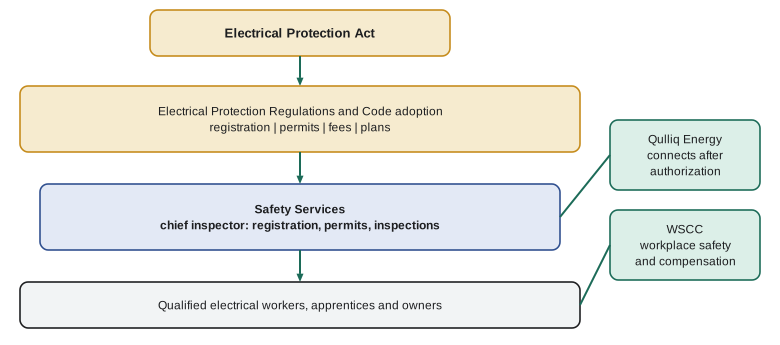
The other players
Several other organizations touch an electrical contractor's work in Nunavut. None of them issues electrical permits, but each can stop a job.
| Organization | What it does for an electrical contractor |
|---|---|
| Safety Services (Community and Government Services) | Worker registration, electrical permits, plan approval, inspections, appeals to the chief inspector |
| Qulliq Energy Corporation | Service applications, new and upgraded connections, metering, connection after inspection |
| Apprenticeship and trade certification office | Apprenticeship, certificates of qualification, Red Seal |
| Workers' Safety and Compensation Commission (WSCC) | Compensation coverage, incident reporting, occupational health and safety enforcement |
| City of Iqaluit and hamlet councils | Building permits, business licences and any local electrical inspection by-law |
| Nunavut Court of Justice | Enforcement of mechanics' liens and other contract claims |
Qulliq Energy matters more than newcomers expect. It runs the power plant in every one of Nunavut's 25 communities, and none of those plants is connected to another. A new or upgraded service starts with an application to Qulliq Energy, and the utility energizes only after an inspector tells it the work has passed. Lesson 6 walks through that sequence.
What the permit system actually controls
In practice, the Act and regulations control four things.
- Who may do the work. Electrical work needs a permit, and an installation permit is issued only to a qualified electrical worker who is registered. A company cannot take out a permit in its own name; a registered person on its staff does.
- What may be built. The work must follow the prescribed edition of the Code with Nunavut's amendments, and larger installations need plans approved in writing before work begins.
- When work may be covered. The worker must give notice before work becomes inaccessible, and no one may cover electrical work without the inspector's permission.
- When power may flow. The utility may supply power to an installation only after an inspector permits it.
Notice what is missing from that list: there is no separate business licence for electrical contracting under the electrical law. A company still needs the ordinary business registrations and any municipal business licence, and Lesson 8 covers those. But the electrical law hangs every job on a registered individual. When Jeela signs a permit application, it is her registration and her name on the line, not just her company's.
A worked example: three people, three routes
Worked problem
Who can take out a permit?
Three people want to do electrical work in Iqaluit. Jeela wants to wire a new duplex for a customer under Kilabuk Electric. Her uncle Simeonie, a retired heavy equipment operator, wants to add two circuits in the single-family house he owns and lives in. A certified electrician visiting from Ontario for the summer offers to wire a small office for a friend's business.
Show solution
- Jeela: as a certified electrician she is a qualified electrical worker. Once she is registered, she can apply for an installation permit for the duplex.
- Simeonie: the Act provides a residential property owner's permit for the owner of a single family dwelling to do work in that dwelling, and the regulations refuse it where the service is larger than 125 amperes or is not single phase.
- The visiting electrician: a certificate from a province makes him a qualified electrical worker under the Act's definition, but he still has to register in Nunavut before he can be issued an installation permit.
- The office: as a commercial building it may also need plans submitted and approved before work begins, depending on its size and equipment.
Answer: Jeela can take out the duplex permit once registered. Simeonie may qualify for an owner's permit for his own house. The visitor must register before he can get a permit, and the office may need plan approval first.
Doug MacLeod, a retired Rankin Inlet contractor who came north in the 1990s and has agreed to mentor Jeela, tells her the visiting-electrician case happens every summer. Good electricians arrive with southern licences and assume they can start work the day they land. The permit office sees it differently, and an unpermitted job can leave the owner without a connection from Qulliq Energy.
How this course is organized
| Lessons | Topic |
|---|---|
| 1 to 3 | The system, qualified electrical workers, and registration |
| 4 to 6 | Permits, the Code as adopted in Nunavut, plans, inspections and connection |
| 7 and 8 | The permit holder's duties, and running the business |
| 9 and 10 | Contracts and mechanics' liens, and workplace safety and compensation |
| 11 and 12 | Building in the North, and a readiness review |
Each lesson ends with a short quiz. The final exam is a mixed review. There is no official Nunavut exam for this course to imitate, so the questions test the knowledge a working electrician and a new contractor need on the job and when dealing with Safety Services.
A first look at fees
Permit fees in Nunavut are calculated from the cost of the work, labour and materials together, under Schedule A of the regulations. Lesson 4 covers the full schedule. Here is a first taste: a short calculator using the brackets printed in the consolidated regulations. Fees are revised from time to time, and the consolidation we read may not show the latest figures, so always check the current schedule with Safety Services before you quote.
def permit_fee(cost):
    # Installation permit fee by cost of work, from the brackets in the
    # consolidated Electrical Protection Regulations (Schedule A, item 2).
    # Illustrative only: confirm the current schedule with Safety Services.
    if cost <= 500:
        return 30.00
    if cost <= 1000:
        return 60.00
    if cost <= 2000:
        return 80.00
    extra = cost - 2000
    thousands = -(-extra // 1000)   # each 1,000 dollars or part
    return 80.00 + 20.00 * thousands

for job, cost in [("Two added circuits", 450), ("Panel replacement", 1800),
                  ("Duplex rough-in and finish", 38500)]:
print(f"{job}: cost {cost} -> permit fee {permit_fee(cost):.2f}")Two added circuits: cost 450 -> permit fee 30.00 Panel replacement: cost 1800 -> permit fee 80.00 Duplex rough-in and finish: cost 38500 -> permit fee 820.00
The calculator rounds each partial thousand up to a full thousand, because the schedule charges for each thousand dollars or part of a thousand. If the office's own calculation differs, the office's number wins.
Why the territory runs its own system
Nunavut covers about a fifth of Canada's land area, and its roughly 40,000 people live in 25 communities, none connected to another by road. Every community has its own diesel power plant. Most building materials, equipment and fuel arrive by sealift during a short summer shipping season, and everything else comes by air. That geography shapes the electrical system in ways a southern contractor may not expect. A small territorial office handles registration, permits and inspections for the whole territory. Inspectors travel by air, so notice and scheduling matter, and the regulations charge reinspections by the half hour plus travel and living expenses. And because each community grid stands alone, the inspector's control over when power may be connected protects the whole community's supply, not just one building.
The same geography explains why Nunavut relies on trade certification, registration and inspection rather than on a separate master exam. A small office cannot run a large exam program, but it can confirm that every person taking a permit holds a trade certificate, require plans for the larger jobs, and inspect the work before power flows.
Common mistakes
MistakeCalling Nunavut's system a master electrician licence.
InsteadNunavut registers qualified electrical workers and issues permits; we found no master electrician licence, contractor licence or exam.
MistakeAssuming a southern certificate means you can start work on arrival.
InsteadA provincial certificate makes you a qualified electrical worker, but you must register in Nunavut before you can be issued an installation permit.
MistakeTaking out a permit in the company's name.
InsteadInstallation permits are issued to a registered qualified electrical worker, so a registered person on staff applies.
MistakeQuoting a remote job without inspection travel.
InsteadReinspections and requested inspections are charged by the half hour plus travel and living expenses, so price them in.
Summary and key terms
- Electrical safety in Nunavut rests on the Electrical Protection Act and the Electrical Protection Regulations, inherited from the Northwest Territories in 1999.
- Safety Services in Community and Government Services, with the chief electrical inspector, handles registration, permits, plans and inspections.
- The system hangs every job on a registered qualified electrical worker who holds a permit.
- Qulliq Energy may connect power only after an inspector permits it.
- The Technical Standards and Safety Act is set to replace the electrical law; check whether it is in force before relying on old rules.
- Electrical Protection Act
- The Nunavut statute that governs electrical work, permits, plans, inspections and connection.
- Electrical Protection Regulations
- The regulations that set registration, permit types, fees and the Code edition, with Nunavut amendments.
- Qualified electrical worker
- A person holding an electrician's certificate from Nunavut, a province or another territory, or approved by the chief inspector.
- Safety Services
- The branch of Community and Government Services that runs electrical safety.
- Technical Standards and Safety Act
- A newer Nunavut statute designed to replace the electrical, gas and boiler Acts when it comes into force.
Practice problems
Work each problem on paper first, then reveal the answer to check.
Which department runs electrical safety in Nunavut?
Show answer
Community and Government Services, through Safety Services and the chief electrical inspector.
Can a company take out an installation permit in its own name?
Show answer
No. Installation permits are issued to registered qualified electrical workers.
Who may connect power to a new installation, and when?
Show answer
Qulliq Energy, the supply authority, and only after an inspector permits it.
Which newer statute is designed to replace the Electrical Protection Act?
Show answer
The Technical Standards and Safety Act, once its electrical repeal comes into force.
Lesson quiz · 5 questions
Score 60% or more to complete this lesson.
Create a free account to save your progress, take quizzes and earn a certificate.