
MELC-213 · Lesson 8 of 12 · 19 min
Running an electrical contracting business in Nunavut
▶ Video coming soon A video version of this lesson is on the way.
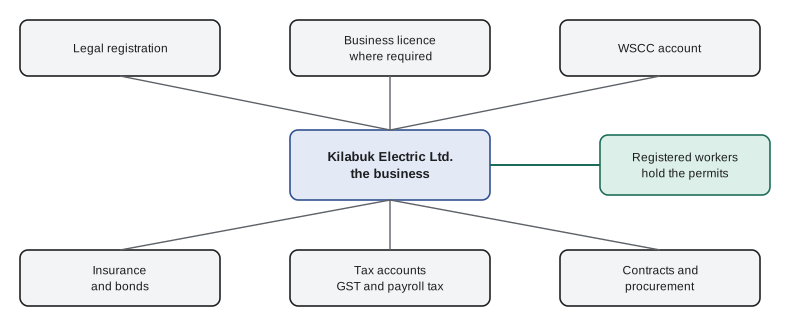
Nunavut's electrical law has no contractor licence. A company does not need an electrical contractor's licence, a bond under the electrical law, or a master electrician to take on work. What it does need is a registered qualified electrical worker to hold each permit, and everything else that any business in the territory needs: legal registration, any required business licence, WSCC coverage for its workers, insurance, tax accounts and contracts. This lesson walks through those pieces as Jeela sets up Kilabuk Electric Ltd.
The business side is where many good electricians struggle. Doug spent his first two years in business in Rankin Inlet doing excellent work and losing money, because he priced jobs as if materials came by truck. Jeela wants to avoid that.
Choosing a business structure
Jeela could work as a sole proprietor under her own name, form a partnership with Moses, or incorporate. She chooses to incorporate Kilabuk Electric Ltd. under Nunavut's Business Corporations Act, which separates the company's debts from her personal assets in most cases and makes it easier to bring in partners later. Corporations and business names in Nunavut are registered with the Legal Registries Division of the Department of Justice.
Incorporation is not a shield for professional responsibility. Jeela is still personally the permit holder, and her duties under the Electrical Protection Act are personal. What the company protects is her house and savings from ordinary business debts, not her from her own duties as permit holder.
Business licensing can also apply. Depending on the community and the kind of business, a territorial or municipal business licence may be required. The City of Iqaluit, for instance, licenses businesses operating within the city. Check with the community's municipal office and the territorial government before starting work.
WSCC registration
The Workers' Safety and Compensation Commission covers both the Northwest Territories and Nunavut. Employers with workers in Nunavut must register with the WSCC and pay assessments based on their payroll and industry classification. Coverage protects workers who are injured on the job and protects the employer from being sued by a covered worker for a workplace injury.
Clients, especially the territorial government and housing organizations, usually require a contractor to show that its WSCC account is in good standing before they pay, and often before they sign a contract. Lesson 10 covers WSCC's injury reporting and the safety law in more detail.
Insurance
No law requires a Nunavut electrical contractor to carry liability insurance as a condition of doing electrical work, but almost every client will. Commercial general liability insurance covers claims that the company's work caused injury or property damage. Clients commonly ask for a minimum of two million dollars or more per occurrence, and for the client to be named as an additional insured. Larger jobs may require builder's risk insurance, often arranged by the general contractor or owner, and vehicle and equipment insurance.
Some contracts, especially larger public projects, require performance and labour and material payment bonds. These are contract requirements, not electrical law. A bond is a guarantee from a surety company that the work will be finished and that subcontractors and suppliers will be paid. Bonding capacity depends on the company's financial strength, so it grows as the business grows.
Insurance and bonding are worded generally here because coverage, limits and costs change. Talk to a broker who knows northern construction.
Pricing a job north of sixty
Pricing in Nunavut has two big differences from the South. Freight and travel are a large part of the cost, and materials must usually be bought and shipped months before the job, which ties up cash. A bid that forgets either will lose money.
Sealift is the cheapest way to ship heavy and bulky material, but it runs only in the open-water season, roughly July to October depending on the region and the ice. Air cargo runs year round at a much higher cost per kilogram. Jeela's rule is to ship everything she can by sealift, and to price a contingency for air freight of items that are forgotten, damaged or late.
materials = 18000           # dollars, supplier price in the South
sealift_rate = 0.22         # freight as a share of material cost (illustrative)
air_contingency = 0.05      # share of materials expected to need air freight
air_multiplier = 1.10       # air freight as a share of the value it carries (illustrative)
labour_hours = 320
labour_rate = 95            # charge-out rate, dollars per hour
travel = 2 * 1650           # return flights for two workers to a community
lodging = 2 * 18 * 260      # two workers, 18 nights
permit = 80 + 20 * 16       # permit fee on 18,000 dollars of work

freight = materials * sealift_rate + materials * air_contingency * air_multiplier
subtotal = materials + freight + labour_hours * labour_rate + travel + lodging + permit
overhead_profit = 0.15
price = subtotal * (1 + overhead_profit)
print("freight:", round(freight))
print("subtotal:", round(subtotal))
print("bid before GST:", round(price))freight: 4950 subtotal: 66410 bid before GST: 76372
Every rate in the script is an assumption for illustration. Freight rates vary by carrier, community and season. Real bids use quotes. But the structure is the point: freight, travel and lodging can add a third or more to a southern price, and the permit fee is small by comparison.
Cash flow
Buying materials in spring for a sealift shipment that arrives in August, for a job that will not be paid until the following year, means carrying costs for many months. Jeela negotiates a deposit or a materials payment on larger jobs, and she keeps a line of credit with her bank for the sealift season. Peter tracks money out and money in month by month, and flags any job where the gap is growing.
Holdbacks also affect cash. Some contracts hold back part of each payment until the work is finished. Lesson 9 explains holdbacks and the Mechanics Lien Act.
Public procurement and Inuit businesses
Much of the construction work in Nunavut is paid for by the territorial government, housing organizations, hamlets and Inuit organizations. Government of Nunavut procurement follows its own rules, including the Nunavummi Nangminiqaqtunik Ikajuuti (NNI) Policy, which gives bid adjustments to qualifying Nunavut businesses and Inuit firms and sets Inuit employment and training expectations on contracts. Nunavut Tunngavik Incorporated maintains an Inuit Firm Registry that is used in procurement.
Kilabuk Electric is majority owned by Jeela, who is Inuk and a beneficiary under the Nunavut Agreement, so the company may qualify for registration as an Inuit firm. Procurement rules and eligibility details change and are described generally here. Read the current policy and the tender documents for each job, because the adjustments and conditions are set in each call for bids.
Inuit employment and training commitments are also a way of building the trade. On the Apex retrofit, Elisapee's apprenticeship hours count toward the contract's training commitment, and the housing organization reports them.
Taxes and accounts
A Nunavut business deals with federal taxes: income tax, GST registration once revenue passes the small-supplier threshold, and payroll deductions for employees. Nunavut has no territorial sales tax, so invoices carry GST only. Nunavut also levies a payroll tax on employment income, collected by employers. Peter keeps separate accounts for GST, payroll deductions and the territorial payroll tax so that the money is ready when it must be remitted.
Northern residents may claim the federal northern residents deductions on their personal tax returns, which affects how Jeela structures travel benefits for staff, but that is a question for an accountant.
People: hiring, housing and training
The hardest resource for a Nunavut contractor to find is often not material but housing. Staff housing is scarce in every community, and a southern hire without a place to live cannot start. Jeela hires locally where she can, and when she brings someone north, like Kyle, she secures accommodation before the job offer is final. Housing costs belong in the business plan, not as a surprise.
Training is the other long-term investment. Apprentices like Elisapee attend technical training blocks, which may be offered in Nunavut or require travel to a southern college. The company plans the job schedule around those blocks and keeps the apprentice's position open while they are away. Over four years, an apprentice who becomes a certified electrician is worth more to a northern company than almost any piece of equipment, because they live in the community and stay.
Jeela also pays attention to how work fits with community life. Many of her workers hunt, fish and travel on the land, and spring and fall harvesting seasons matter to families. A schedule that allows for that keeps good people. A schedule that ignores it loses them.
Equipment and vehicles
A truck, a trailer, a lift or a trencher shipped to a community usually comes by sealift and stays there. Moving equipment between communities is expensive and slow, so contractors working in several communities often keep a basic kit in each place where they have steady work. Kilabuk Electric keeps a truck and a tool crib in Iqaluit and a smaller kit stored with a partner company in Pangnirtung.
Cold is hard on equipment. Batteries fail, cords stiffen and crack, and hydraulic tools need cold-weather fluids. Peter's equipment budget includes winter replacement of cords and batteries every year, and a heated storage space for testing instruments, which lose accuracy in the cold.
Labour productivity in winter
Cold slows work. Gloved hands are slower, outdoor tasks need warm-up breaks, and short daylight in December limits outdoor work in the Qikiqtaaluk region to a few hours. Jeela estimates outdoor labour in mid-winter at a substantially higher number of hours than the same task in summer, and she tells clients why. Indoor work in a heated building is closer to normal, which is one more reason to close in buildings before freeze-up.
Worked problem
Adjusting an estimate for winter
An outdoor service and meter base installation takes 12 hours in summer. Jeela adds 40 percent for work in January. How many hours should she estimate?
Show solution
- Forty percent of 12 hours is 4.8 hours.
- 12 plus 4.8 is 16.8 hours.
- Round up to 17 hours for planning.
- The 40 percent factor is Jeela's own estimate from experience, not a published standard.
Answer: About 17 hours.
Doug reviews the bid
Before Jeela sends her first big bid, the community hall, she asks Doug to review it. He asks four questions. Did she price freight for everything, including the small items that always get forgotten? Did she allow for at least one inspector reinspection on a fly-in basis? Did she include the cost of her own time managing the job from Iqaluit? And does the schedule assume the sealift arrives on time, with no allowance if it is late?
Two of the four were missing. Jeela adds a reinspection allowance and a late-sealift contingency, and raises the bid by about six percent. She wins the job anyway, because the hamlet's evaluation looks at schedule risk as well as price, and her schedule is the only one that explains what happens if the ship is late.
Warranty and callbacks
Most contracts require the contractor to fix defects for a period after completion, often one year. In a fly-in community, a warranty callback can cost more than the original task. Jeela reduces callbacks with careful testing before handover, and she groups warranty visits with other work in the same community where possible. Her bids include a small warranty allowance for each remote job, based on the company's own callback history.
Callbacks are also a reputation matter. In a community of a few hundred or a few thousand people, word travels fast. A contractor who comes back promptly to fix a problem, explains what went wrong and leaves the site clean will be asked back. One who leaves a family waiting through a cold week for a furnace circuit to be repaired will not, and the housing organization will remember at the next tender. Jeela treats every warranty call as the start of the next job in that community.
Common mistakes
MistakeThinking incorporation removes the permit holder's personal duties.
InsteadDuties under the Electrical Protection Act stay with the permit holder personally.
MistakePricing materials at southern cost.
InsteadFreight, travel and lodging can add a third or more; use real quotes.
MistakeStarting work before the WSCC account is in place.
InsteadEmployers must register with the WSCC, and clients usually check before paying.
MistakeAssuming procurement preferences apply automatically.
InsteadEligibility and adjustments are set by the current policy and each tender.
Summary and key terms
- Nunavut has no electrical contractor licence; permits are held by registered qualified electrical workers.
- A business still needs legal registration, any required business licence, a WSCC account, insurance and tax accounts.
- Clients usually require liability insurance, WSCC clearance and sometimes bonds.
- Freight, sealift timing and travel drive northern pricing and cash flow.
- Government procurement uses the NNI Policy and the Inuit Firm Registry; check the current rules for each tender.
- Legal Registries
- The Department of Justice division that registers corporations and business names in Nunavut.
- WSCC
- The Workers' Safety and Compensation Commission serving the Northwest Territories and Nunavut.
- Commercial general liability
- Insurance covering claims of injury or damage caused by the business.
- Sealift
- The annual open-water shipping season that brings most heavy goods to Nunavut communities.
- NNI Policy
- The Government of Nunavut procurement policy supporting Nunavut and Inuit businesses.
Practice problems
Work each problem on paper first, then reveal the answer to check.
Does a Nunavut electrical company need an electrical contractor's licence?
Show answer
No. The Electrical Protection Act has no contractor licence; permit holders must be registered qualified electrical workers.
Which body handles workers' compensation for Nunavut employers?
Show answer
The WSCC, which serves both the Northwest Territories and Nunavut.
Is liability insurance required by the electrical law?
Show answer
No, but almost every client requires it by contract.
Why is sealift timing a cash-flow issue?
Show answer
Materials are bought and shipped months before the job is paid for.
Lesson quiz · 5 questions
Score 60% or more to complete this lesson.
Create a free account to save your progress, take quizzes and earn a certificate.