
MELC-213 · Lesson 7 of 12 · 19 min
Duties and responsibilities of the permit holder
▶ Video coming soon A video version of this lesson is on the way.
Nunavut's electrical law is built around one person on each job: the permit holder. The Act does not license a company or a master electrician. Instead, it places the duties on the registered qualified electrical worker named on the permit. This lesson gathers those duties in one place, explains what the inspector can do when they are not met, and covers appeals, offences and penalties.
Jeela understands the weight of this when she signs her first permit for Kilabuk Electric. Whatever Moses, Kyle or Elisapee do on the Apex retrofit, it is her name on the permit and her responsibility to the inspector. Doug's advice is blunt: never sign for work you are not prepared to supervise.
The core duties
Reading the Act and regulations together, a permit holder's duties fall into five groups.
- Do the work, or have it done under supervision, in accordance with the Code as adopted and the regulations.
- Hold the right permit for the work before it starts, with the fee paid, and keep within its scope.
- Give notice for inspection before work is covered and when it is complete, and give the inspector access.
- Correct any deficiencies the inspector identifies, within the time the inspector sets.
- Comply with any order an inspector makes, unless it is stayed or changed on appeal.
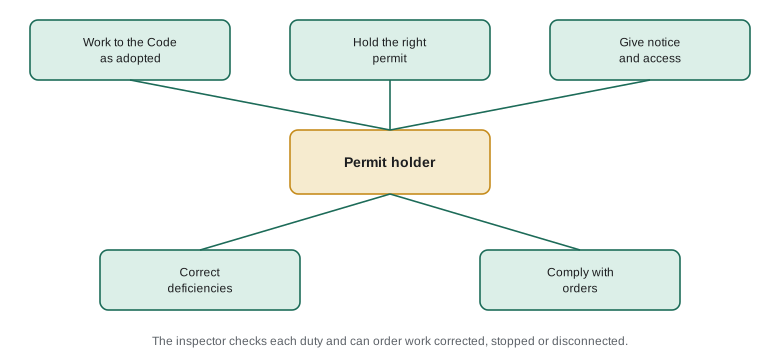
Behind these duties is a simple idea. The permit is the territory's way of knowing who is responsible. If the work is unsafe, the inspector knows whom to call.
Supervision
A permit holder who uses employees, apprentices or helpers must supervise their work closely enough to answer for it. What counts as enough depends on the person: an experienced journeyman like Moses needs far less oversight than a second-year apprentice. The apprenticeship rules set minimum supervision for apprentices. For everyone else, it is the permit holder's judgment, backed by their legal responsibility.
Jeela's rule on the four-plex is that she walks every unit before giving notice for inspection, and checks every termination in the panels herself. It takes a few hours. It is the only way she can sign the permit with confidence.
What the inspector can do
The Act gives inspectors powers to enter places where electrical work is done or equipment is installed, to inspect the work, and to require that work be made safe. Where an installation is dangerous or does not comply, an inspector can order the work corrected, stopped, or disconnected from the supply. These powers are serious because electrical hazards are serious, and in a small community a fire can leave a family without a home in a place with almost no spare housing.
| Situation | Typical inspector response |
|---|---|
| Minor deficiency found at inspection | Deficiency list; correct and give notice for reinspection |
| Work covered before inspection | Order to uncover the work at the permit holder's cost |
| Work being done without a permit | Order to stop; permit required; possible prosecution |
| Immediate danger to people or property | Order to disconnect supply until corrected |
Appeals
Section 19 of the Act provides an appeal from an inspector's decision or order. The appeal must be made within 10 days, which is a short period in the North, where a permit holder may be out on the land or working in another community when the order is issued. Read every order the day it arrives, and if you disagree, act quickly.
An appeal is not the first step. Most disagreements are settled by talking to the inspector, with the Code open and the facts in front of both people. If talking fails, write down the order, the rule in question and your reasons, and make the appeal within the time limit. Keep complying with a safety order while the appeal is pending unless it is stayed.
Worked problem
Counting an appeal deadline
An inspector issues an order to Moses on Thursday, November 6, 2025, while he is working in Kimmirut. Moses reads it on Monday, November 10, when he is back in Iqaluit. If the 10 days run from the date of the order, what is the last day to appeal?
Show solution
- Day 1 is Friday, November 7, the day after the order.
- Count 10 days: November 7 through November 16.
- November 16 is a Sunday. Whether a deadline that falls on a weekend moves to the next business day depends on the Interpretation Act and the wording of the order, so do not rely on it.
- Moses should file by Friday, November 14, the last business day inside the period.
Answer: File by Friday, November 14 to be safe; the deadline does not wait for him to read the order.
Offences and penalties
The Act makes it an offence to contravene the Act or the regulations, including doing work without a permit and failing to comply with an order. The consolidated Act sets maximum fines of 2,000 dollars and 500 dollars in different circumstances, which are low by modern standards. Section 21.1 limits prosecutions to one year after the offence.
Low fines do not make the risk low. The bigger consequences for a contractor are practical and commercial: a stop-work order that delays a job, the cost of uncovering work, lost reputation in a small market, and civil liability if unsafe work causes injury or a fire. The Technical Standards and Safety Act amendments passed in 2024 are expected to bring a more modern enforcement scheme when they take effect, so check whether they are in force.
Civil liability
Separate from the Act, a contractor can be sued in negligence if faulty electrical work causes harm. A permit and a passed inspection are evidence that the work met the standard at the time, but they are not a complete defence. The inspector checks a sample of work and cannot see everything. Liability insurance, covered in Lesson 8, exists for this risk.
Contracts also set duties. A public housing contract might require the contractor to warrant the work for a year, to fix defects at no cost, and to indemnify the owner against claims. Those duties come from the contract, not the Act, but they sit on top of the permit holder's legal responsibilities.
When things go wrong
If a permit holder discovers that work under their permit is unsafe after the inspection, the right course is to tell the owner, make it safe, and tell the inspector. Doug's story from Rankin Inlet is about a feeder that overheated a year after inspection because a lug had been under-torqued. The contractor found it during a maintenance call, replaced the lug, told the inspector, and reviewed the company's torque practice. Nothing burned. Owning the mistake protected everyone, including the contractor.
Duties at a glance
Peter turned the duties into a short checklist for each job. A script version follows, which Jeela runs at the end of each week on open permits.
checks = [
    ("Permit in hand before work started", True),
    ("Work within the permit's scope", True),
    ("Notice given before covering", True),
    ("Deficiencies from last visit corrected", False),
    ("Any orders complied with or appealed in time", True),
]
open_items = [name for name, done in checks if not done]
print("Permit holder checklist:", len(checks) - len(open_items), "of", len(checks), "done")
for item in open_items:
print(" ACTION:", item)Permit holder checklist: 4 of 5 done ACTION: Deficiencies from last visit corrected
Scope changes
A permit covers the work described in the application. Jobs change. On the Apex four-plex, the housing organization asks halfway through for new range circuits in two units, and later for an exterior light at each entrance. Each addition is electrical work, and the permit holder must make sure it is covered.
For a small addition, Safety Services may let the permit holder amend the permit, with any extra fee based on the added value. For a large change, such as a new service or a major addition, a new permit may be needed. Either way, the conversation with Safety Services should happen before the extra work starts. Jeela keeps a page in the permit file headed scope changes, listing each change, its value and how it was added to the permit.
Scope changes also matter for the contract. Each added item should be confirmed in writing with the client as a change order, with a price, before the work is done. Lesson 9 shows why that written record matters if payment becomes a dispute.
Working in occupied homes
Much of Kilabuk Electric's work is in occupied public housing. Nunavut has a serious housing shortage, and many homes are crowded, with several generations under one roof. When the crew works in a unit, children, elders and pets may be present, and a family may have nowhere else to go during the day.
That changes how the permit holder runs the job. Power outages are kept short and scheduled with the family, never in the coldest part of the day if the furnace controls are on the circuit. Open boxes and panels are never left unattended. Tools and offcuts are cleared before the crew leaves. Elisapee, who speaks Inuktitut with the elders in most of the units, explains each day's work at the door, which avoids most surprises.
None of this is written in the Electrical Protection Act. It flows from the permit holder's broader responsibility to do the work safely, from occupational health and safety law, which Lesson 10 covers, and from respect for the people whose home it is.
Subcontracting electrical work
Sometimes Kilabuk Electric is itself a subcontractor to a general contractor, and sometimes Jeela brings in a specialist, such as a fire alarm technician or a controls company. Each arrangement raises the same question: whose permit covers the work? If the specialist's work falls under Jeela's permit, she is responsible for it and must supervise it. If the specialist takes out their own permit, their scope must be clear, so that every part of the installation is covered by exactly one permit.
A one-line rule helps: before any other trade touches the electrical system, agree in writing whose permit covers what. On the community hall, Jeela and the fire alarm company agree that the alarm system will be under the alarm company's own permit, and that Kilabuk Electric's permit covers the power supply to the alarm panel.
How long to keep records
The Act does not say how long a permit holder must keep job records. Practical reasons point to keeping them for many years: civil claims can arise long after work is finished, insurers may ask for records, and owners call back years later. Kilabuk Electric keeps permit files for at least ten years, scanned and stored in two places, because paper does not always survive in a cold storage shed or a flooded basement.
Records also protect against a common northern problem: staff turnover. People move between communities and to the South, and a file outlasts any one person.
Handing over at the end of a job
A permit holder's duties do not end the moment the inspector signs off. A good handover leaves the owner able to use and maintain the installation safely. For the Plateau duplex, Jeela's handover package contains the final inspection report, a typed panel directory for each unit, manuals for the range hoods, heat recovery ventilators and smoke alarms, warranty information, and the company's phone number for service.
She also walks the owner through the panels, shows where the main disconnects are, and explains the block heater receptacles and their timers. In a community where the nearest electrician may be a flight away, an owner who understands the basics can reset a tripped breaker, recognize when a fault is serious, and describe a problem clearly on the phone.
Handover is the last chance to catch problems while the crew is still in the community. Jeela asks the owner to switch on every circuit with her present, and notes anything odd. It is cheaper to fix a loose device on handover day than to fly someone back for it.
A short note in the file closes the job: date of handover, who received the package, and any open items.
Records also matter for the next job. If the permit holder for a job has left the company, the file is the company's memory of what was done, and it tells the next electrician what is behind the walls.
Common mistakes
MistakeSigning a permit for work you cannot supervise.
InsteadThe permit holder answers for all the work under the permit.
MistakeWaiting to read an order until back from the community.
InsteadAppeals must be made within 10 days; read orders promptly.
MistakeTreating low fines as low risk.
InsteadStop-work orders, uncovering costs, reputation and civil liability are the bigger consequences.
MistakeKeeping quiet about a defect found after inspection.
InsteadMake it safe, tell the owner and tell the inspector.
Summary and key terms
- The permit holder carries the legal duties for the installation.
- Duties include working to Code, holding the right permit, giving notice, correcting deficiencies and obeying orders.
- Inspectors can order work corrected, stopped, uncovered or disconnected.
- Appeals from an inspector's decision must be made within 10 days.
- Fines under the Act are modest, but commercial and civil consequences are significant.
- Permit holder
- The registered qualified electrical worker named on a permit.
- Deficiency
- A part of the installation that does not comply and must be corrected.
- Order
- An inspector's direction to correct, stop, uncover or disconnect work.
- Appeal
- A challenge to an inspector's decision, made within 10 days.
- Limitation period
- The one-year limit on starting a prosecution under the Act.
Practice problems
Work each problem on paper first, then reveal the answer to check.
Who answers to the inspector for an apprentice's mistake?
Show answer
The permit holder.
What should you do while appealing a safety order?
Show answer
Keep complying unless the order is stayed.
How long after an offence can a prosecution start?
Show answer
Within one year.
Is a passed inspection a full defence to a negligence claim?
Show answer
No. It is evidence the work met the standard but not a complete defence.
Lesson quiz · 5 questions
Score 60% or more to complete this lesson.
Create a free account to save your progress, take quizzes and earn a certificate.