
MELC-213 · Lesson 11 of 12 · 19 min
Building in the North: sealift, permafrost and community power
▶ Video coming soon A video version of this lesson is on the way.
Earlier lessons covered the law. This one covers the conditions that make electrical work in Nunavut different from anywhere in the South: the sealift that brings most material once a year, the permafrost that most buildings stand on, the cold and dark, and the community diesel power systems that every installation connects to. None of this changes the Code or the Act. It changes how work is planned, designed and built to meet them.
Doug has a line he uses with every southern electrician he trains: in the North, the job starts a year before you arrive. This lesson explains why.
Sealift: the annual supply chain
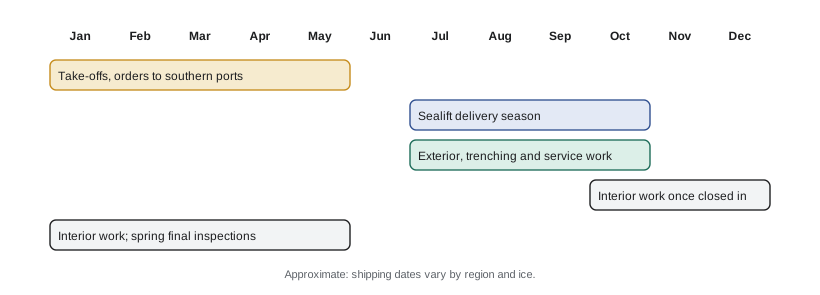
Nunavut has no road or rail connection to the rest of Canada, and only a few short roads link places within the territory. Most heavy and bulky goods, including building materials, vehicles, fuel and electrical equipment, arrive by sealift during the open-water season. Ships leave southern ports in early summer, and each community receives one or a few calls, typically between July and October depending on the region and the ice.
For an electrical contractor, sealift means ordering almost everything for next year's jobs in the spring. Panels, transformers, cable reels, conduit, fixtures and boxes must be on the dock in the South before the shipping deadlines. Anything missed comes by air cargo, at a much higher cost, and some large items cannot fly at all on the aircraft that serve small communities.
Worked problem
Planning a sealift order
The community hall will be built next year. The sealift deadline for orders at the southern port is in late May. What should Jeela do between January and May?
Show solution
- January: get the issued-for-construction drawings and do a full take-off of materials.
- February: confirm long-lead items, such as the service equipment and transformer coordination with Qulliq Energy.
- March: place orders with suppliers, specifying packing for sealift and the shipping deadline.
- April and May: confirm items are on the dock, and add a spares allowance for small items most likely to be short.
Answer: Take off, order and confirm by the port deadline, with spares for what cannot be flown in cheaply.
Spares are a northern discipline. A box of extra connectors, breakers in each common size, a spare reel of the most-used cable, and extra fasteners cost little on the sealift and can save a week's delay. Jeela's rule is to carry about five to ten percent extra on small items, based on the company's own history.
Permafrost and foundations
Most of Nunavut lies in the zone of continuous permafrost, ground that stays frozen for two or more years in a row. Only the top layer, the active layer, thaws each summer. Building on permafrost without keeping it frozen can cause the ground to settle unevenly, damaging the building. That is why many northern buildings sit on piles or adjustable steel foundations with an air gap underneath, which keeps the building's heat away from the ground.
Climate change is warming permafrost across the North, deepening the active layer and making some ground less stable. Foundations designed for past conditions may move more than expected. For an electrical contractor, that movement matters wherever conductors cross from the ground to the building or between parts of a structure that may shift.
- Service entrances and underground feeders must allow for movement between the ground and a building on piles, using flexible connections, expansion fittings or loops as the design requires.
- Buried cable in the active layer is subject to frost heave, which can push it up or damage it; follow the design for depth, protection and bedding.
- Excavation in permafrost can damage the ground's thermal balance; follow the engineer's direction, especially near foundations.
Where the ground or structure is unusual, the electrical design should come from an engineer who knows permafrost, and the inspector may ask to see that design.
Grounding in frozen and rocky ground
A grounding electrode works by making good contact with soil that conducts. Frozen ground and bare rock conduct poorly, so a single ground rod can have a very high resistance in much of Nunavut, especially in winter. The Code sets requirements for grounding electrodes; meeting them in the North can require different electrode types, multiple electrodes, or engineered systems. Check the Code as adopted and any Nunavut amendments, and ask the inspector early what approach is accepted in a given community.
Testing helps. Ground resistance can be measured, though readings change between summer and winter. A reading taken in August may look good and be much worse in February, so a design that relies on soil contact should allow for the frozen season.
Community diesel power
Every Nunavut community runs on its own power system. Qulliq Energy Corporation operates 25 diesel power plants, and none of the community systems are connected to each other or to a southern grid. Fuel for the plants arrives by sealift and is stored in tank farms for the year. Generation is expensive, and the territorial government subsidizes residential rates for part of each household's use.
Isolated diesel systems shape electrical work in three ways.
- Capacity: a small community plant may have limited spare capacity, so a large new load, such as a big building or electric heating, needs early discussion with Qulliq Energy.
- Reliability: outages happen, and in the cold they are dangerous; standby generators and heating that keeps working during outages are common in critical buildings.
- Cost: electric space heating is costly on diesel power, so most buildings heat with oil and use electricity for controls, fans and pumps.
Changes are under way. Qulliq Energy offers net metering for small customer-owned renewable systems, and communities and Inuit organizations are developing solar and other projects to cut diesel use. A proposed Kivalliq Hydro-Fibre Link would bring hydroelectric power and fibre optic communications from Manitoba to Kivalliq communities, and has been under study for years. Check its current status before relying on it for planning.
# Comparing the annual energy cost of a 1.5 kW block heater, illustrative rates only
hours_per_day = 4
days = 150
kw = 1.5
rate = 0.90        # dollars per kWh, unsubsidized illustration
timer_hours = 2    # with a thermostat or timer controlling the heater

full = kw * hours_per_day * days * rate
timed = kw * timer_hours * days * rate
print("without control:", round(full), "dollars per season")
print("with timer:", round(timed), "dollars per season")
print("saving:", round(full - timed), "dollars")without control: 810 dollars per season with timer: 405 dollars per season saving: 405 dollars
The rate in the example is an illustration, not a published tariff. The point holds at any realistic northern rate: small loads that run for long hours, such as block heaters and heat tracing, add up quickly, and controls pay for themselves.
Water, sewer and heat tracing
In most Nunavut communities, water is delivered by truck to tanks inside buildings, and sewage is pumped out by truck. Iqaluit and Rankin Inlet have piped systems in parts of town, some in insulated utilidors, the boxed corridors that carry pipes above or just below ground. Electrical work around these systems includes heat tracing to keep lines from freezing, tank heaters, pumps and alarms. A frozen water or sewer line in January is an emergency for a household, so these circuits must be reliable, well labelled and protected.
Cold, dark and the work schedule
In Iqaluit, the shortest days of December have only a few hours of daylight. Farther north, communities like Grise Fiord and Resolute have weeks with no sun at all. Temperatures of minus 30 to minus 40 with wind are common. Outdoor work is slower and riskier, and materials behave differently: cable jackets stiffen and can crack if bent when cold, so cable may need to be warmed before pulling. Manufacturers state minimum installation temperatures for cable and equipment; check them for winter work.
The northern schedule puts exterior work, trenching and service work in the short summer and fall, and interior work in the winter once buildings are closed in and heated.
When the sealift is missed
Two years ago, a supplier shipped the panels for a Pangnirtung job to the wrong port. The ship sailed without them. Jeela had three choices: fly the panels in by air cargo at several times the freight cost, find equivalent panels already in the community, or delay the job a year. She chose a mix. Two panels small enough to fly came on a scheduled flight, the hamlet's maintenance stock supplied a third, and one large distribution panel waited for the next season, with temporary arrangements approved by the inspector in the meantime.
The lessons she took were practical. Confirm with the supplier, in writing, the port and the vessel for every order. Check the port's receiving list before the deadline. And for any item that cannot fly, have a fallback before it is needed.
Fuel, generators and critical buildings
Health centres, schools, RCMP detachments, airports, water plants and community halls that serve as emergency shelters all need power when the community plant goes down. Many have standby generators with automatic transfer switches, fuel tanks and controls. Electrical work on these systems must keep the standby supply working, which may mean scheduling shutdowns with the building's operator, testing transfer equipment after any change, and confirming that the generator's fuel and heating are not affected by the work.
These buildings are also often the ones where the community gathers in an emergency. A failed transfer switch in a storm can leave a health centre dark when it is needed most. Jeela's crews treat work on critical buildings with the same care as live work: planned, documented and tested before they leave.
Fire and housing
House fires are a serious risk in Nunavut, where homes are often crowded, fire department resources in small communities are limited, and losing a house can leave a family without anywhere to live. Overloaded extension cords, damaged cords run under rugs, space heaters and unsafe block heater connections are common electrical causes. Electricians working in homes are well placed to notice these hazards and explain them to families, in Inuktut where possible.
On the Apex retrofit, the housing organization asks Jeela's crew to note any unsafe cord use or overloaded circuits they see in each unit. Elisapee keeps the list, and the housing organization follows up with the tenants. It is a small task that may prevent a fire.
Planning with the community
Every community has its own rhythm, its own knowledge and its own priorities. Before starting a large job, Jeela meets the hamlet's senior administrative officer and, where it fits, elders or community members who know the site. They know where the snow drifts in winter, where the ground has moved, which roads close in spring, and which weeks matter for hunting and community events. That knowledge, part of what is called Inuit Qaujimajatuqangit, makes a job plan better and safer.
Respect also means hiring and buying locally where possible, telling residents when work will disturb them, and leaving the site clean. A contractor who works that way will be welcome back. One who ignores the community will find doors closing.
Designing for maintenance
An installation in a small community will be maintained, for decades, by whoever is available there. That argues for simple, robust designs: standard breaker types that the hamlet or housing organization already stocks, clear labelling, panel directories that match the circuits, and equipment that can be repaired with parts that fit on a small aircraft. A clever design that needs a specialist from the South to service it can leave a building without heat or light for weeks.
Jeela asks every engineer she works with one question at design review: who will fix this in February? If the answer is not someone in the community or a short flight away, the design gets another look.
Communications
Internet and phone service in Nunavut has historically relied on satellite links, with limited bandwidth and higher costs than in the South, though service has been improving with newer satellite systems. For an electrical contractor, that can affect everything from emailing drawings to running cloud-based software on site. Jeela keeps offline copies of drawings, the Code and the job file on a tablet, and does not assume a video call with an engineer will work from every site.
Common mistakes
MistakeOrdering materials after the sealift deadline.
InsteadOrder in spring for next year's jobs; air freight is costly and some items cannot fly.
MistakeRigid connections between the ground and a building on piles.
InsteadAllow for movement with the connections the design requires.
MistakeAssuming a summer ground resistance reading holds in winter.
InsteadFrozen ground conducts poorly; design for the frozen season.
MistakeAdding a large load without talking to Qulliq Energy.
InsteadCommunity diesel plants may have limited spare capacity.
Summary and key terms
- Sealift brings most materials once a year; plan and order in spring, with spares.
- Most buildings stand on permafrost, often on piles, and climate change is making the ground less stable.
- Frozen and rocky ground makes grounding difficult; plan for winter conditions.
- Qulliq Energy runs 25 separate diesel systems; capacity, reliability and cost shape designs.
- Cold and darkness affect materials, productivity and safety.
- Sealift
- The annual open-water shipping season that supplies Nunavut communities.
- Permafrost
- Ground that stays frozen for two or more consecutive years.
- Active layer
- The surface layer above permafrost that thaws each summer.
- Utilidor
- An insulated corridor carrying water and sewer pipes in some northern towns.
- Net metering
- A utility arrangement crediting customers for small renewable generation.
Practice problems
Work each problem on paper first, then reveal the answer to check.
Why do many northern buildings sit on piles?
Show answer
To keep building heat from thawing the permafrost beneath.
Why might a ground rod perform poorly in Nunavut?
Show answer
Frozen ground and rock conduct poorly.
Are Nunavut communities connected to a common grid?
Show answer
No. Each has its own diesel system.
Why warm cable before pulling it in severe cold?
Show answer
Cold jackets stiffen and can crack when bent.
Lesson quiz · 5 questions
Score 60% or more to complete this lesson.
Create a free account to save your progress, take quizzes and earn a certificate.