
MELC-213 · Lesson 6 of 12 · 21 min
Plans, inspections and connection to Qulliq Energy
▶ Video coming soon A video version of this lesson is on the way.
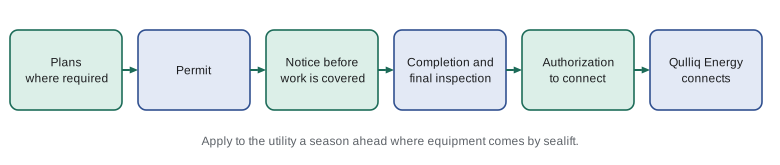
A permit starts the legal life of an installation. Inspection ends it, and in Nunavut the end point that matters most to a client is the moment Qulliq Energy Corporation connects the power. This lesson follows the Plateau duplex and the hamlet community hall from plans to final inspection to connection, using the Act's sections on plans, notice and inspection, and supply.
The sequence is simple to state and easy to get wrong in the North, where inspectors travel, materials arrive once a year, and the utility's crews in a community may be few. Planning each step in advance is what keeps a job on schedule.
Plans and when they are required
Section 9 of the Act lets the chief inspector require plans and specifications for an installation before a permit is issued or work begins. The regulations go further for large installations. Plans sealed by a professional engineer are required for single-phase services over 400 amperes, three-phase services over 200 amperes, and installations over 750 volts.
Plan review costs money. The regulations set a fee for plan approval of 50 dollars for each half hour of the inspector's time, and where an inspector must travel, the cost of travel and living expenses can also be charged. On a remote job, that travel can cost more than the review itself, which is one reason to submit complete, well-organized plans the first time.
Worked problem
Plan review cost for the community hall
The hall has a 400-ampere three-phase service, so its plans must be engineer sealed. The inspector spends three and a half hours reviewing them in Iqaluit. What is the plan approval fee under the regulation rate?
Show solution
- Three and a half hours is seven half hours.
- Seven times 50 dollars is 350 dollars.
- No travel is needed because the review is done in the office.
- Budget extra if questions require a second review.
Answer: 350 dollars.
Notice for inspection
Section 14 of the Act puts a duty on the permit holder to give the inspector notice at the stages the Act and the inspector require. The two that matter on almost every job are notice before any work is covered or concealed, and notice when the installation is complete. Covering wiring before it has been inspected or released can lead to an order to uncover it at the permit holder's cost.
In a community without a resident inspector, notice needs more lead time. Jeela agrees an inspection plan with Safety Services at the start of each out-of-town job: which stages the inspector wants to see, whether photographs will be accepted for any stage, and when the inspector expects to be in the community. Photographs are not a legal substitute for inspection unless the inspector agrees to them, so get that agreement in writing.
| Stage | What the inspector usually looks for | Notice tip |
|---|---|---|
| Underground or under-slab | Depth, protection, bedding, bonding of buried systems | Plan around frozen ground and pile caps |
| Rough-in | Boxes, cable support, fire separations, conductor sizes | Give notice before insulation and vapour barrier |
| Service | Service equipment, grounding, clearances, meter base | Coordinate with the utility early |
| Final | Devices, labelling, protection, panel directory, tests | Have test results and the permit file on site |
Reinspection
If an inspector finds deficiencies and has to return, the regulations allow a reinspection fee at the same rate of 50 dollars per half hour, plus travel and living expenses where the inspector travels. In Iqaluit, that may be a modest cost. In Grise Fiord or Kugaaruk, an inspector's return flight and accommodation can run into thousands of dollars.
def reinspection_cost(hours, travel=0.0, nights=0, per_night=0.0):
    half_hours = round(hours * 2)
    return 50 * half_hours + travel + nights * per_night

local = reinspection_cost(1.0)
remote = reinspection_cost(1.5, travel=2400, nights=2, per_night=320)
print("Iqaluit reinspection:", local, "dollars")
print("Fly-in reinspection:", remote, "dollars")Iqaluit reinspection: 100.0 dollars Fly-in reinspection: 3190 dollars
The travel and accommodation figures in the example are invented, but the lesson is real: on a fly-in job, getting the work right the first time is worth more than almost any other cost saving.
When an inspection fails
The inspector gives the permit holder a list of deficiencies. The permit holder corrects them and gives notice that the work is ready for reinspection. The inspector may accept evidence of correction for minor items, or may require a return visit. Lesson 7 covers orders and appeals; for now, note that a deficiency notice is directed at the permit holder, who must fix the work even if a subcontractor or apprentice did it.
Municipal inspection
Section 18 of the Act allows the appointment of inspectors for a municipality. In practice, electrical inspection across Nunavut is carried out by the territory's Safety Services, but a contractor should check whether any municipal arrangement applies before a job begins. The City of Iqaluit, for instance, issues building and development permits under its own bylaws, which are separate from the electrical permit.
Connection to Qulliq Energy
Qulliq Energy Corporation, the territory's power utility, generates electricity at 25 diesel power plants, one or more in each community. None of the community systems are interconnected, and there is no transmission line to the southern grid. The utility serves more than 15,000 customers.
Sections 16 and 17 of the Act govern supply. A supply authority must not connect an installation that requires a permit until the inspector has authorized the connection. That rule is why final inspection matters so much to clients. Until the inspector approves, Qulliq Energy will not energize the service, and the building cannot be occupied with permanent power.
Connecting a new service has its own utility process. The owner or contractor applies for service with Qulliq Energy, which may issue a work order for the line work, meter and any transformer. Qulliq Energy charges a connection fee and may require a security deposit from the customer. Its published connection fees at the time of writing were 20 dollars or 40 dollars plus GST, depending on the type of connection, but check the utility's current rates.
In smaller communities, utility materials such as transformers and poles also arrive by sealift. Qulliq Energy asks for service applications well ahead of the shipping season so it can order what it needs. A new duplex in a hamlet that needs a new transformer may wait a year if the application is late.
Worked problem
Planning the duplex connection
The Plateau duplex will be ready for final inspection in late March. What should Jeela arrange, and when?
Show solution
- The previous spring: the owner submits a service application to Qulliq Energy so any new equipment can come on the sealift.
- At rough-in: confirm the service location and meter base requirements with the utility.
- In March: give notice of completion to Safety Services and book the final inspection.
- After approval: the inspector authorizes the connection, and Qulliq Energy connects the service once its own requirements, including any fees and deposit, are met.
Answer: Apply to the utility a season ahead, coordinate at rough-in, and book final inspection so the authorization reaches the utility promptly.
Temporary power and generators
Many northern sites start on a portable generator before utility power is available. A generator feeding temporary site wiring is still part of an electrical installation, and the permit should cover it. If the generator will connect to a building that will later be served by the utility, transfer equipment must prevent backfeed into Qulliq Energy's lines. Backfeed can kill a line worker who believes a line is dead.
After connection
When the service is energized, keep the final inspection report, any test results and the utility's confirmation in the permit file. Give the owner a copy of the panel directory and any manuals for equipment such as generators or transfer switches. In a small community, the owner may call the contractor years later when something fails, and a good record saves time on both sides.
Inspection day in Kimmirut
In January, Moses holds the permit for a small addition to the health centre in Kimmirut, a community of about 400 people on the south coast of Baffin Island, reached from Iqaluit by a short flight. The inspector is flying in on Tuesday's scheduled flight and leaving on Thursday's. Moses has two days of the inspector's time to share with two other permits in the community, so he has to be ready on the first morning.
His preparation starts a week before. He confirms by phone that the rough-in is complete, sends photographs of the panel location and the fire separation penetrations so the inspector knows what to expect, and checks that the health centre staff know an inspector will need access to the mechanical room. On Monday evening, he walks the job with Elisapee and fixes two missing cable straps and a box without a cover.
On Tuesday the inspector spends ninety minutes on site. There is one deficiency: a cable passes through a fire separation without an approved firestop. Moses corrects it that afternoon with the firestop system the drawings specified, and the inspector checks it on Wednesday morning before leaving. Without the preparation, a deficiency found on Thursday would have meant a reinspection on the inspector's next trip, weeks later, and a delay to the wall closing.
Test records the inspector may ask for
Inspectors increasingly expect to see evidence of testing at final inspection, such as checks of polarity, continuity of bonding, the operation of ground fault and arc fault devices, and insulation resistance on feeders and motors. The Code and good practice describe these tests; the inspector decides what to ask for. Kilabuk Electric uses a one-page test sheet for every panel, filled in by the person who did the test and signed by the permit holder.
A test sheet does two jobs. It shows the inspector that the work was checked before they arrived, which builds trust and shortens visits. And it gives the company a record if a problem appears after the building is occupied.
Solar panels, wind and net metering
Some Nunavut households, businesses and community organizations are adding solar panels to cut diesel use. The Canada Energy Regulator's provincial and territorial energy profile notes that Qulliq Energy offers net metering for customer-owned renewable generation up to 10 kilowatts. A net-metered system connects to the utility, so it needs an electrical permit and inspection like any other installation, and the utility has its own application and interconnection requirements.
Larger community renewable projects follow the utility's separate programs. A contractor working on any grid-connected generator should start with two calls: Safety Services about the permit and inspection, and Qulliq Energy about the interconnection rules and metering. The inverter and other equipment must be approved for use in Canada, and the system must be designed so that it stops exporting power when the utility's supply is lost.
Solar in the Arctic has its own pattern. Production is high in spring and summer, with long daylight and snow reflection, and close to zero in the dark months. That is a design matter for the owner and designer, but it also affects when installers can work safely on roofs, and when the system can be tested under real sun.
What to have on site
For any inspection, Jeela's crews have the same items ready: the permit and the approved plans, the test sheets, the Code and Nunavut's amendments, the list of deficiencies from any earlier visit and how each was fixed, and a ladder, flashlight and keys to every room the inspector needs. In winter, the building should be heated enough that covers can be removed and devices tested without risk of frost damage.
Doug adds one more habit from his years in the Kivalliq: offer the inspector help with the logistics. A ride from the airstrip, the phone number of the hotel or co-op, and a clear schedule of which permits are ready on which day all make an inspector's trip productive. Inspectors are covering thousands of kilometres, and contractors who make the trip easy tend to get their inspections done on the first visit.
Common mistakes
MistakeCovering wiring before the inspector has seen or released it.
InsteadGive notice before work is covered; the inspector may order it uncovered.
MistakeAssuming photographs replace an inspection.
InsteadPhotographs count only if the inspector agrees to accept them, preferably in writing.
MistakeApplying to Qulliq Energy only after final inspection.
InsteadApply a season ahead, because utility equipment may need the sealift.
MistakeRunning a generator into a building without transfer equipment.
InsteadBackfeed endangers line workers; the installation needs proper transfer equipment.
Summary and key terms
- The chief inspector may require plans; engineer-sealed plans are required above set service sizes and over 750 volts.
- Plan approval and reinspection are charged at 50 dollars per half hour, plus travel and living expenses where the inspector travels.
- The permit holder must give notice before work is covered and when it is complete.
- A supply authority may not connect an installation that needs a permit until the inspector authorizes it.
- Qulliq Energy runs 25 separate diesel systems; apply for service early, especially where equipment comes by sealift.
- Plans and specifications
- Drawings and documents describing an installation, sealed by an engineer when the regulations require.
- Notice for inspection
- The permit holder's notice that work is ready to be inspected.
- Reinspection
- A return inspection after deficiencies, charged by the half hour.
- Authorization to connect
- The inspector's approval that lets the supply authority energize a service.
- Qulliq Energy Corporation
- Nunavut's territorial power utility, operating community diesel plants.
Practice problems
Work each problem on paper first, then reveal the answer to check.
What is the plan approval fee for two hours of review?
Show answer
200 dollars: four half hours at 50 dollars.
Can Qulliq Energy connect a new service before inspection approval?
Show answer
No. The Act prohibits connection until the inspector authorizes it.
Why is backfeed dangerous?
Show answer
It can energize utility lines that workers believe are dead.
Why apply to the utility a season early?
Show answer
Transformers and other equipment may have to come on the sealift.
Lesson quiz · 5 questions
Score 60% or more to complete this lesson.
Create a free account to save your progress, take quizzes and earn a certificate.