
MELC-213 · Lesson 10 of 12 · 19 min
Occupational health and safety law for electrical contractors
▶ Video coming soon A video version of this lesson is on the way.
The Electrical Protection Act protects the public from unsafe installations. Workplace safety, the protection of the people doing the work, falls under Nunavut's Safety Act and its occupational health and safety regulations, administered by the Workers' Safety and Compensation Commission. This lesson covers the employer's duties under that law, the rights of workers, the electrical hazards that matter most, the northern hazards that come with them, and how to report an injury to the WSCC.
The details of the regulations are long and specific, and they change. This lesson describes them in general terms. An employer should read the current Safety Act and regulations, and the WSCC's codes of practice and guidance, for the rules that apply to each task.
Who is responsible
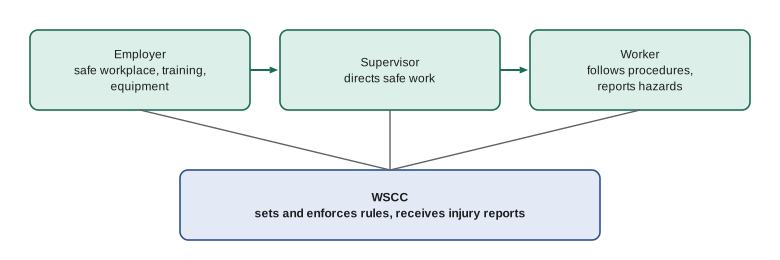
Under the Safety Act, every employer must maintain the workplace and carry on work in a way that protects the health and safety of workers, so far as is reasonably practicable. Supervisors must make sure workers follow safe procedures. Workers must take reasonable care for their own safety and others', use the protective equipment provided, and report hazards. A principal contractor or owner who controls a multi-employer site also has duties to coordinate safety.
For Kilabuk Electric, that means Jeela, as owner and employer, is responsible for the company's safety program, its training and its equipment. On a job site, she or the person she names as supervisor is responsible for day-to-day safe work. On the community hall, the general contractor coordinates the whole site, and Jeela's crew follows the site's rules as well as its own.
Workers' rights
Nunavut's workplace safety law, like that of other Canadian jurisdictions, gives workers three basic rights: the right to know about hazards, the right to participate in health and safety, and the right to refuse dangerous work. A worker who believes a task is unusually dangerous may refuse it, and must report the refusal to the supervisor, who must investigate. An employer may not punish a worker for a refusal made in good faith.
Elisapee uses this right in her second month. Asked to work in a crawlspace where she smells fuel oil, she stops and tells Moses. Moses agrees, ventilates the space, has the furnace contractor check for a leak, and tests the air before anyone goes back in. The job loses two hours. Nobody is hurt.
Electrical hazards
Shock, arc flash and arc blast are the hazards that set electrical work apart. The basic control is to work de-energized: isolate the supply, lock it out, tag it, and test that it is dead before touching it. Workplace safety rules require effective lockout of hazardous energy, and electrical safety standards such as CSA Z462, Workplace electrical safety, describe how to assess and control energized work when it cannot be avoided.
In Nunavut, isolation has a local twist. Many buildings have standby generators because outages in the cold are dangerous, and some have solar or other customer-owned generation. A circuit can be dead from the utility and live from a generator. Testing before touching, every time, catches what the drawings miss.
| Step | What it means on a typical job |
|---|---|
| Plan | Identify every source of supply, including generators and solar |
| Isolate | Open the disconnect or breaker for each source |
| Lock and tag | Each worker applies a personal lock and tag |
| Test | Verify absence of voltage with a tested meter |
| Work | Proceed only after the test, and re-test if the work is interrupted |
| Restore | Remove locks only when everyone is clear, then re-energize |
Northern hazards
Some of the most serious hazards on a Nunavut job are not electrical.
- Cold: frostbite and hypothermia, especially on outdoor service work and in unheated buildings. Plan warm-up breaks and heated shelter.
- Short daylight: reduced visibility outdoors in winter. Light the work area and the routes to it.
- Wildlife: polar bears are a real hazard in many coastal communities, especially in fall. Follow community advice and bear safety practices when working outside town.
- Working alone: travel between buildings or to remote sites in winter weather. Use a check-in system and make sure someone knows where each worker is.
- Fuel: oil furnaces, tanks and generators are in almost every building, with fire and fume hazards in tight spaces.
Inuit knowledge of weather, ice and land is a safety resource. Elisapee's uncle Simeonie, a hunter, warns the crew about a blizzard a day before the forecast catches up. Jeela pulls the crew from an outdoor service job that morning.
Training and records
Employers must train workers for the hazards of their work and keep records of that training. For an electrical contractor, typical training includes lockout, the company's electrical safety program, fall protection for work at height, first aid, WHMIS for hazardous products, and any equipment-specific training for lifts or trenching equipment. Larger workplaces must also have a joint health and safety committee or a representative; check the thresholds in the current regulations.
Peter keeps a training matrix: workers down one side, required training across the top, and the date each was completed. When the community hall tender asks for proof of training, the matrix is ready.
from datetime import date

training = {
    "Elisapee Nuqingaq": {"lockout": date(2025, 9, 3), "first aid": date(2024, 5, 12), "fall protection": None},
    "Kyle Brennan": {"lockout": date(2026, 6, 22), "first aid": date(2023, 3, 1), "fall protection": date(2026, 6, 23)},
}
VALID_YEARS = {"lockout": 3, "first aid": 3, "fall protection": 3}   # company policy for this example
today = date(2026, 9, 1)

for person, courses in training.items():
    for course, done in courses.items():
        if done is None:
            print(f"{person}: {course} MISSING")
        elif (today - done).days > VALID_YEARS[course] * 365:
print(f"{person}: {course} out of date")Elisapee Nuqingaq: fall protection MISSING Kyle Brennan: first aid out of date
Reporting injuries to the WSCC
When a worker is injured on the job, the employer must report it to the WSCC. The WSCC's guidance for employers says to submit the employer's report of injury within three business days of learning of an injury that needs medical care or causes lost time. Serious incidents, such as a death, a serious injury or a dangerous occurrence, must also be reported to the WSCC's safety staff as soon as reasonably possible, and the scene left undisturbed except to help the injured or prevent further harm. The WSCC has a toll-free line for Nunavut.
Worked problem
Reporting an electrical burn
On a Wednesday morning, Kyle receives a minor burn to his hand from a flash while testing a panel. He goes to the health centre, which treats it, and he misses Thursday's shift. What must the company do?
Show solution
- Make the area safe and find out what happened.
- The injury needed medical care and caused lost time, so an employer's report goes to the WSCC within three business days of learning of it.
- Because an arc flash is a dangerous occurrence that could have caused serious injury, call the WSCC's safety staff promptly and ask whether it must be reported as a serious incident.
- Investigate the cause, fix the procedure that failed, and record the lessons.
Answer: Report to the WSCC within three business days, call about the flash promptly, and investigate.
An incident like Kyle's is a signal. The company reviews why the panel was being tested live, whether the right protective equipment was worn, and whether the procedure should change. Jeela decides that all panel testing will be done de-energized unless a written energized work plan is approved.
A hazard assessment for the Apex retrofit
Before the four-plex job starts, Jeela and Moses walk the building and write a hazard assessment. It takes an hour and fills two pages. The main entries are these.
- Electrical: panels are old, and labels may not match the circuits. Control: trace and test every circuit before work, and relabel.
- Occupied units: children and elders at home. Control: barriers around open work, no tools left unattended, outages scheduled with each family.
- Asbestos and old materials: the building dates from the 1980s. Control: ask the housing organization for its hazardous materials survey before drilling or cutting.
- Access: icy entrance stairs. Control: clear and sand them each morning; use crampons on outdoor steps.
- Cold: some units are cool during outages. Control: keep outages short and away from the coldest hours.
The assessment goes in the job file and is reviewed with the crew on the first morning. When conditions change, such as the discovery of a second, unlabelled subpanel in unit three, the assessment is updated and the crew briefed again.
Energized work
Sometimes work cannot be done de-energized, for example, testing and troubleshooting, or work on equipment that supports life safety and cannot be shut down. Energized work needs a written justification and plan, a risk assessment for shock and arc flash, trained and qualified workers, the right protective equipment and tools, and boundaries that keep others away. Safety standards such as CSA Z462 describe how to do that assessment, and the employer's electrical safety program should say when energized work is allowed and who may approve it.
In a remote community, an energized work plan must also consider emergency response. If an arc flash burns a worker in a hamlet, the nearest hospital may be a medical evacuation flight away, and weather can ground that flight. That is one more reason the default must be de-energized work.
Protective equipment for the cold
Protective equipment has to work at minus 40. Arc-rated clothing must be worn as the outer layer to protect, so a parka that is not arc rated over arc-rated coveralls defeats the purpose. Rubber insulating gloves stiffen and can crack in severe cold, and they must be stored, inspected and tested as the manufacturer and the standards require. Hard hats need winter liners that do not compromise their rating, and safety glasses fog when a worker comes inside. Jeela buys arc-rated winter outerwear for every electrician, which is expensive but the only way to make the protection real outdoors.
Equipment also needs warm storage. Meters and testers can give false readings when cold, so crews warm them before testing. A tester that reads zero because its battery is frozen is a deadly failure.
Getting to and from work
In many communities, crews move between jobs by truck, all-terrain vehicle or snowmobile, and sometimes by boat in summer. Vehicle incidents are a leading cause of serious workplace injury across Canada, and northern conditions add ice, whiteouts and long distances between help. Employers should treat travel as part of the work: vehicles maintained for the cold, survival gear carried, trip plans left with someone, and no travel in conditions local people consider unsafe.
Rotation, isolation and wellbeing
Workers flown in from the South for a few weeks at a time, like Kyle, can feel isolated, especially in the dark months. Long shifts, crowded accommodation and distance from family affect safety as well as wellbeing, because tired and stressed workers make mistakes. Jeela keeps shifts to reasonable lengths, makes sure rotational workers have a way to stay in touch with home, and points new arrivals to community resources. Local workers face their own pressures, including crowded housing. A supervisor who notices that someone is struggling and checks in is doing safety work.
After an injury: claims and return to work
The WSCC handles the injured worker's claim, which can cover medical costs and lost wages. The employer's role is to report promptly, cooperate with the claim, and help the worker return to suitable work when they are ready, which might mean lighter duties for a while. Assessments, the premiums employers pay to the WSCC, are based on industry classification and payroll, and an employer's injury record can affect its costs over time.
For Kilabuk Electric, Kyle's burn healed in a week. He returned to work doing drawings and material counts for two days before going back to the tools, and the company's report and follow-up were done on time. The investigation led to the new rule on de-energized panel testing, which every worker signed.
Common mistakes
MistakeTreating electrical safety as covered by the Electrical Protection Act alone.
InsteadWorker safety is governed by the Safety Act and its regulations, administered by the WSCC.
MistakeIsolating the utility supply and forgetting the generator.
InsteadIdentify and lock out every source, and test before touching.
MistakeReporting a lost-time injury at the end of the month.
InsteadThe employer's report is due within three business days.
MistakeIgnoring wildlife and weather in a job hazard assessment.
InsteadCold, darkness, polar bears and travel are serious northern hazards.
Summary and key terms
- Worker safety in Nunavut falls under the Safety Act and its regulations, administered by the WSCC.
- Employers, supervisors and workers each have duties; workers have the right to know, participate and refuse.
- Lockout, tagging and testing every source, including generators and solar, are the core electrical controls.
- Northern hazards include cold, darkness, wildlife, working alone and fuel.
- Report injuries to the WSCC within three business days, and serious incidents as soon as reasonably possible.
- Safety Act
- Nunavut's workplace health and safety statute.
- Lockout
- Isolating and securing energy sources with personal locks so equipment cannot be energized.
- Arc flash
- A release of energy from an electrical arc that can burn and injure.
- Right to refuse
- A worker's right to refuse unusually dangerous work without reprisal.
- Employer's report of injury
- The report an employer sends the WSCC after a workplace injury.
Practice problems
Work each problem on paper first, then reveal the answer to check.
Who administers workplace safety law in Nunavut?
Show answer
The Workers' Safety and Compensation Commission.
What are the three basic worker rights?
Show answer
To know, to participate and to refuse dangerous work.
Why test for voltage after lockout in a building with a generator?
Show answer
The circuit may be fed from a source that was missed.
Within how many business days is an employer's report of injury due?
Show answer
Three.
Lesson quiz · 5 questions
Score 60% or more to complete this lesson.
Create a free account to save your progress, take quizzes and earn a certificate.