
MELC-213 · Lesson 2 of 12 · 20 min
Qualified electrical workers: certificates and approval
▶ Video coming soon A video version of this lesson is on the way.
Jeela's first job for her new company is not a wiring job. It is a staffing question. Kilabuk Electric has a contract to upgrade lighting and receptacles in a four-plex in Apex, and she wants three people on it: herself, Moses Akavak, a journeyman from Arviat who has worked with her for years, and Elisapee Nuqingaq, a second-year apprentice. A friend of a friend, Kyle Brennan, a certified electrician from Nova Scotia, has also asked whether he can join for the summer. Who among them may do electrical work in Nunavut, and on what basis?
The answer turns on one definition in the Electrical Protection Act. Almost every rule in the Act and regulations refers back to the qualified electrical worker, so this lesson is about that term: what it means, how a person becomes one, what the chief inspector's approval adds, and where apprentices fit.
The definition
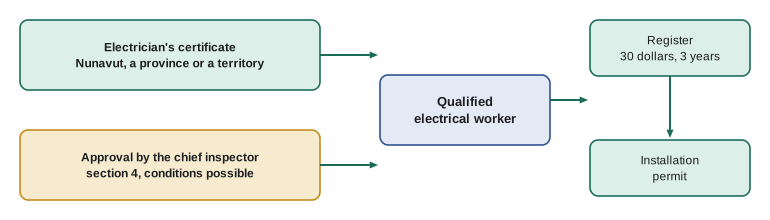
Section 1 of the Act defines a qualified electrical worker as a person who either holds an electrician's certificate issued in Nunavut, a province or another territory, or has been approved by the chief inspector under section 4. That is the whole test. There is no separate territorial exam, no experience threshold written into the Act, and no class system like the ones some provinces use. A certificate from any Canadian jurisdiction counts.
The consolidated Act carries a note that the first branch of the definition will change when an amendment comes into force: instead of an electrician's certificate, it will refer to a journeyperson in the trade of electrician under Nunavut's Apprenticeship and Certification Act. In practice that describes the same people, certified tradespeople, but it ties the definition to Nunavut's own trade certification law. Check the current consolidation to see which wording is in force when you read this.
Certificates: what counts
In Canada, electricians earn certificates of qualification from the province or territory where they apprenticed or challenged the trade exam. Most also hold the Red Seal endorsement, which shows they passed the interprovincial exam and makes their certificate easier to recognize across the country. For Nunavut's definition, the important point is the certificate itself, issued by a Canadian jurisdiction for the electrician trade.
| Person | Certificate | Qualified electrical worker? |
|---|---|---|
| Jeela Kilabuk | Nunavut certificate of qualification, Red Seal | Yes, by certificate |
| Moses Akavak | Nunavut certificate of qualification | Yes, by certificate |
| Kyle Brennan | Nova Scotia certificate of qualification, Red Seal | Yes, by certificate from a province |
| Elisapee Nuqingaq | Registered apprentice, no certificate yet | No, unless approved by the chief inspector |
Kyle's certificate qualifies him under the definition. But he still cannot take out a permit until he registers in Nunavut, which Lesson 3 covers. Being a qualified electrical worker is the condition for registering; registration is the condition for an installation permit.
What about electricians trained outside Canada? The definition refers to certificates issued in Nunavut, a province or another territory. A foreign certificate on its own does not fit that wording, so a foreign-trained electrician would normally need to have their experience assessed and earn a Canadian certificate, or seek the chief inspector's approval. Ask the apprenticeship and certification office about the trade route, and Safety Services about approval.
Approval by the chief inspector
Section 4 gives the chief inspector discretion to approve a person who does not hold an electrician's certificate as a qualified electrical worker. The Act says the chief inspector may attach conditions to that person's permit. The Act does not list criteria, and we found no published policy setting them, so treat approval as a case-by-case decision.
Why would such a power exist? Think about the territory's history. For decades, small communities had few certified electricians, and experienced people did essential work keeping schools, nursing stations and municipal buildings running. Approval gives the chief inspector a way to recognize real competence where certification has not caught up, while limiting what the person may do through conditions on the permit. Typical conditions might restrict the type or size of installation, or require a certified electrician to review the work. Those are examples of what conditions could look like, not published rules.
Approval is discretionary, which means the chief inspector may say no. If you are refused, the Act gives a route to appeal decisions by inspectors to the chief inspector, but approval is the chief inspector's own decision, so the practical step is to ask what evidence would change the answer. Lesson 7 covers appeals in more detail.
Apprentices
Elisapee is a registered apprentice. Apprentices are learning the trade on the job under supervision, and they are not certified yet, so they do not meet the first branch of the definition. That does not stop them working. It means the permit for the job must be held by a qualified electrical worker who is registered, and the apprentice works under that person's supervision according to the apprenticeship rules.
Nunavut's apprenticeship program, like those in the provinces, sets out how apprentices are supervised and how their hours are recorded. Those rules sit in the trade certification law and the apprenticeship office's policies, not in the Electrical Protection Act. We could not confirm the current supervision ratio for electrical apprentices in Nunavut, so ask the apprenticeship office before you plan a crew. On Jeela's job, Elisapee works alongside Jeela or Moses at all times, and Jeela signs her logbook hours each week.
The arrangement matters for responsibility. The registered worker who holds the permit answers to the inspector for the work done under it, including the apprentice's work. If Elisapee wires a receptacle wrong and the inspector finds it, the deficiency is on Jeela's permit.
Labourers and helpers
The Act's prohibition is on performing electrical work without a permit. It does not create a category for helpers who carry material, dig trenches, pull cable under direction or set up lifts. In practice, crews include such workers, and the permit holder supervises them. Where the line falls between helping and doing electrical work is a question of fact. A sensible rule: anyone making terminations, connections or decisions about the installation should be a qualified electrical worker or an apprentice under direct supervision.
Comparing Nunavut with its neighbours
Contractors who work across the North should know that the territories handle this differently.
| Territory | How individuals qualify | Business licence for electrical contracting? |
|---|---|---|
| Nunavut | Qualified electrical worker by certificate or chief inspector approval; must register | None under the electrical law (we found none) |
| Northwest Territories | Inherited the same Act in 1999; check its current rules, which have changed separately since | Check current NWT rules |
| Yukon | Trade certificate; contractor licensed by class under a different Electrical Protection Act | Yes, a contractor licence with a bond |
The Northwest Territories and Nunavut started with the same Act in 1999, but each has amended its own copy since, and the Northwest Territories has adopted newer Code editions and a new lien law. A contractor who learned the rules in Yellowknife should reread them for Nunavut.
A worked example: building the crew
Worked problem
Who can do what on the Apex four-plex?
Jeela plans the four-plex job with Moses, Elisapee and possibly Kyle. Which of them may hold the permit, which may work under it, and what must happen first?
Show solution
- Jeela holds a Nunavut certificate, so she is a qualified electrical worker. Once registered, she can apply for the installation permit.
- Moses is also a qualified electrical worker by certificate and could hold the permit if registered, but one permit holder for the job keeps responsibility clear.
- Elisapee is an apprentice. She may work under supervision, following the apprenticeship rules, but cannot hold the permit.
- Kyle is qualified by his Nova Scotia certificate, but must register in Nunavut before he could hold a permit himself. Working under Jeela's permit as an employee, he still needs to be a qualified electrical worker, which he is.
Answer: Jeela holds the permit. Moses and Kyle work as qualified electrical workers, and Elisapee works as a supervised apprentice.
Doug's advice is to put the registration numbers of everyone who may hold a permit on the company's job file. If Jeela is sick or on another job, Moses can take over as permit holder for a new permit without delay, because his registration is already done.
Tracking qualifications
A small company can keep its crew records in a spreadsheet. The calculator below checks each person against the definition and flags who still needs to register before they can take out a permit. The dates are invented for the example.
crew = [
    {"name": "Jeela Kilabuk", "certificate": "NU", "registered": True},
    {"name": "Moses Akavak", "certificate": "NU", "registered": True},
    {"name": "Kyle Brennan", "certificate": "NS", "registered": False},
    {"name": "Elisapee Nuqingaq", "certificate": None, "registered": False},
]
CANADIAN = {"NU", "NT", "YT", "BC", "AB", "SK", "MB", "ON", "QC", "NB", "NS", "PE", "NL"}

for person in crew:
    qualified = person["certificate"] in CANADIAN
    if qualified and person["registered"]:
        status = "may hold a permit"
    elif qualified:
        status = "qualified, must register before holding a permit"
    else:
        status = "not qualified: apprentice or helper under supervision"
print(f"{person['name']}: {status}")Jeela Kilabuk: may hold a permit Moses Akavak: may hold a permit Kyle Brennan: qualified, must register before holding a permit Elisapee Nuqingaq: not qualified: apprentice or helper under supervision
The check is simple on purpose. Real records also hold certificate numbers, registration expiry dates and apprenticeship levels, which Lesson 3 adds.
Language, community and the trade
Most Nunavummiut speak Inuktut, which includes Inuktitut and Inuinnaqtun, and many tradespeople work in Inuktut on site and in English on paperwork. Jeela grew up speaking Inuktitut in Pangnirtung and learned the trade's English vocabulary in technical training. When she explains a lockout to an elder at home, or a panel change to a family in public housing, she switches to Inuktitut. That is not a legal requirement, but it is good practice, and it is one reason the territory has worked to train more Inuit tradespeople at home.
The Nunavut Agreement commits governments to increasing Inuit employment, and apprenticeship is one of the main routes into the skilled trades. For a contractor, hiring and training local apprentices is often both the right thing to do and a practical advantage. People who live in a community do not need flights and accommodation, and they know the buildings. Elisapee, for instance, already knows which houses in Apex had their entrance stairs rebuilt after frost heave.
None of this changes the legal definition. A qualified electrical worker is still a person with a certificate or the chief inspector's approval. But planning a crew in Nunavut means thinking about who is certified, who is training, and how the next generation of certified electricians will come from the communities themselves.
Kyle's first week
Kyle arrives in Iqaluit in June. He has never worked north of sixty. Jeela gives him three jobs before he touches a tool: send his registration application to Safety Services with a copy of his Nova Scotia certificate, read the company's cold-weather and wildlife safety notes, and spend a day with Moses learning how Kilabuk Electric tracks materials, because every spool of cable on the job came up on last year's sealift and cannot be replaced quickly.
Kyle is surprised that nobody asks him to write an exam. Jeela explains that the Act cares about his certificate, which already proves his trade knowledge, and about registration, which puts his name on the territory's list. The Code is the same Canadian Code he used in Halifax, with Nunavut's own amendments, which Lesson 5 covers. What he does need to learn quickly are the northern practices: planning around one shipment of materials a year, working near frozen ground, and dealing with a community diesel plant run by Qulliq Energy instead of a southern grid.
By the end of the week, Kyle's registration has been received. Jeela keeps the permit for the four-plex in her own name, and Kyle works under it as an employee, which is allowed because he is a qualified electrical worker.
Common mistakes
MistakeTreating a southern licence as permission to start work in Nunavut.
InsteadA Canadian certificate makes a person a qualified electrical worker, but registration in Nunavut must come before an installation permit.
MistakeLetting an apprentice hold a permit.
InsteadApprentices are not certified; the permit is held by a registered qualified electrical worker who supervises them.
MistakeAssuming the chief inspector must approve anyone with experience.
InsteadApproval under section 4 is discretionary, and conditions may be attached to the person's permit.
MistakeAssuming Northwest Territories rules match Nunavut's.
InsteadThe two territories started with the same Act in 1999 but have amended their own laws separately since.
Summary and key terms
- A qualified electrical worker holds an electrician's certificate from Nunavut, a province or another territory, or is approved by the chief inspector.
- A pending amendment will tie the definition to journeypersons under Nunavut's Apprenticeship and Certification Act.
- Chief inspector approval is discretionary and may come with conditions on the person's permit.
- Apprentices work under the supervision of a registered qualified electrical worker who holds the permit.
- Qualification is the condition for registering; registration is the condition for an installation permit.
- Certificate of qualification
- The provincial or territorial certificate that shows a person has qualified in a trade.
- Red Seal
- The interprovincial endorsement on a certificate, earned by passing the interprovincial exam.
- Chief inspector approval
- The discretionary power in section 4 to approve an uncertified person as a qualified electrical worker.
- Apprentice
- A person learning the trade under supervision, registered with the apprenticeship program.
- Permit holder
- The registered qualified electrical worker named on a permit, who answers for the work under it.
Practice problems
Work each problem on paper first, then reveal the answer to check.
Does a certificate from Alberta make a person a qualified electrical worker in Nunavut?
Show answer
Yes. The definition accepts certificates issued in a province or another territory. The person must still register before getting a permit.
Can the chief inspector attach conditions to an approved person's permit?
Show answer
Yes. Section 4 lets the chief inspector attach conditions.
Who holds the permit when an apprentice works on a job?
Show answer
A registered qualified electrical worker, who supervises the apprentice.
Where are apprentice supervision ratios set?
Show answer
In the apprenticeship and trade certification rules, not in the Electrical Protection Act; ask the apprenticeship office.
Lesson quiz · 5 questions
Score 60% or more to complete this lesson.
Create a free account to save your progress, take quizzes and earn a certificate.