
MELC-207 · Lesson 9 of 12 · 24 min
Contracts and construction liens in New Brunswick
▶ Video coming soon A video version of this lesson is on the way.
Getting paid is as important to an electrical contractor as passing inspection. In New Brunswick, the main tool that protects contractors, subcontractors and suppliers when payment goes wrong is the Construction Remedies Act, which replaced the province's older lien legislation for contracts entered into on or after November 1, 2021. The province has also passed prompt payment and adjudication legislation that is not yet in force. Many people still use the general words builders' lien or mechanics' lien; under the current Act the right is simply a lien, and lesson titles in other provinces use other names. This lesson covers written contracts, holdback, liens and the coming prompt payment rules, using Tantramar's subcontract on the Mountain Road clinic as the example. It is a general overview, not legal advice; deadlines in this area are strict, and a contractor facing a dispute should get advice early.
Start with a written contract
Most payment disputes begin with an unclear agreement. A written contract should identify the parties, describe the scope of work and what is excluded, state the price or how it is calculated, set out how and when invoices are submitted and paid, deal with holdback, explain how changes are priced and approved, and say what happens if either side does not perform. Standard forms help. Many projects use the Canadian Construction Documents Committee forms: a stipulated price contract between owner and general contractor, and a matching subcontract form between the general contractor and trades such as Tantramar.
For small jobs, a short written quote accepted in writing by the customer may be enough, provided it covers the same essentials. Gilles insists on written acceptance for every job, even a service call that turns into a larger repair. When the Dieppe duplex owner asked for extra exterior lighting halfway through the job, Émilie wrote a one-page change order with the price, had the owner sign it and filed it with the contract.
Change orders
Changes are where contractors most often lose money. A change order should describe the added or deleted work, the price adjustment, any change to the schedule, and be signed by someone with authority before the work is done. On a subcontract, the authority usually lies with the general contractor, not the owner's representative who happens to be on site. Doing extra work on a verbal instruction, without a signed change, invites a dispute about whether the work was ordered and what it is worth.
Worked problem
Pricing a change
On the clinic fit-out, the general contractor asks Tantramar to add six data drops and two receptacles in a room that has been added to the plans.
Show solution
- Émilie lists the materials and estimates the labour: 14 hours at the company's labour rate.
- She adds the materials, labour, overhead and profit according to the subcontract's terms for changes.
- She notes that the added work will extend the rough-in by one day.
- She sends a written change order to the general contractor's project manager and waits for a signature before ordering materials.
Answer: The change is signed before the work begins, and the price and schedule change become part of the subcontract.
Holdback under the Construction Remedies Act
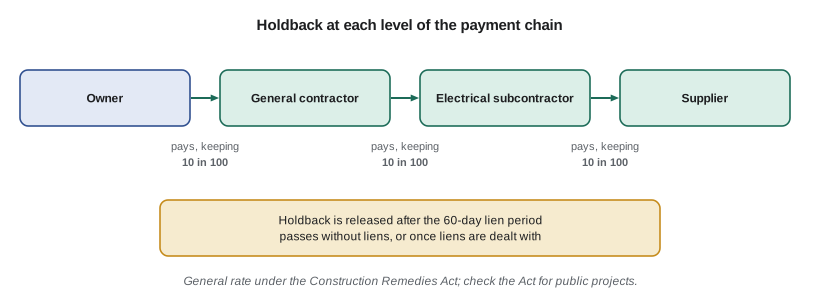
Holdback is money that the owner, and each contractor further down the chain, keeps back from each payment as security for the people below them who could claim liens. Under the Construction Remedies Act, the general rule for contracts entered into on or after November 1, 2021 is a holdback of 10 in every 100 dollars of the value of the work, a reduction from the older rule. A different, lower rate is reported for some public projects, so check the Act for the type of project you are working on. Holdback is released once the period for registering liens has passed without liens being registered, or once registered liens are dealt with.
The Act as first passed required owners to keep holdback in a separate trust account, and gave people with lien rights the right to ask about that account. Amendments to the trust account rules were proposed in 2023. Before relying on the trust account rules, check the current version of the Act.
| Progress billing | Value of work | Holdback (10 in 100) | Paid now |
|---|---|---|---|
| Month 1 | 40,000 | 4,000 | 36,000 |
| Month 2 | 55,000 | 5,500 | 49,500 |
| Month 3 | 35,000 | 3,500 | 31,500 |
| Total | 130,000 | 13,000 | 117,000 |
Liens
A lien gives a contractor, subcontractor, worker or supplier who has done work or supplied materials for an improvement a security interest in the property improved, up to the amount owed, limited by the holdback in many situations. To keep the right, the lien must be registered within the time the Act allows. Under the Construction Remedies Act, the basic period is 60 days. For a subcontractor or supplier, the 60 days run from the earliest of several events that the Act lists, which can include a certificate or declaration of substantial performance. Because the trigger can come earlier than the last day of work, a cautious contractor counts 60 days from the earliest possible trigger rather than from its own last day on site.
Registering a lien is only the first step. If the claim is not resolved, the lien holder must take further steps within further deadlines set by the Act, or the lien expires. A lien that is registered for more than is owed, or without basis, can expose the person who registered it to liability. These are reasons to involve a lawyer early when a lien looks likely.
from datetime import date, timedelta

# Count the 60-day lien period from the earliest possible trigger (illustrative dates)
triggers = {
    "substantial performance declared": date(2026, 9, 8),
    "Tantramar's last day supplying work": date(2026, 9, 25),
}
earliest_name, earliest = min(triggers.items(), key=lambda kv: kv[1])
deadline = earliest + timedelta(days=60)
print("earliest trigger:", earliest_name, earliest)
print("register no later than:", deadline)
print("days after last work:", (deadline - triggers["Tantramar's last day supplying work"]).days)earliest trigger: substantial performance declared 2026-09-08 register no later than: 2026-11-07 days after last work: 43
Counting from Tantramar's last day would have given a later date. Counting from the earliest trigger keeps the claim safe.
Prompt payment and adjudication
The Construction Prompt Payment and Adjudication Act received royal assent on June 16, 2023, but it has not been proclaimed in force. A 2026 industry report described implementation as delayed until 2027, with regulations still to come. When it is in force, the scheme set out when the bill was introduced would require an owner to pay a proper invoice within 28 days of receiving it, unless it gives a notice of non-payment within 14 days disputing all or part of the invoice. Payment would then cascade down the chain, with seven days at each level. Disputes over payment could be referred to adjudication, a fast process with a decision that binds the parties on an interim basis.
Until the Act is proclaimed, payment timing depends on the contract. Contractors should watch for the proclamation and the regulations, because the details, including which contracts are covered and when, will be set there. Lesson 11 suggests ways to keep track of changes like this one.
Worked problem
What the prompt payment cascade would mean
Assume the prompt payment scheme is in force as introduced. The owner of the clinic receives the general contractor's proper invoice on day 0 and pays on day 28.
Show solution
- The general contractor would have 7 days after being paid to pay Tantramar: day 35.
- Tantramar would have 7 days after being paid to pay its own supplier: day 42.
- If the owner disputes part of the invoice, it would have to give notice of non-payment within 14 days and still pay the undisputed part on time.
- Until proclamation, the subcontract's payment terms govern.
Answer: Under the scheme as introduced, Tantramar would expect payment by day 35 and its supplier by day 42; today, the contract decides.
Protecting yourself in practice
Good habits prevent most payment problems. Check the customer's ability to pay before taking on a large job. Use written contracts and signed change orders. Invoice promptly and accurately, and keep records of what was done and when. Track holdback owed to you and the date it should be released. Diary the earliest possible lien deadline on every job where money is outstanding. And respond quickly to disputes rather than letting them build up. Nicole keeps a payment tracker for every open job with the contract value, invoices, holdback and the lien deadline, and Gilles reviews it every Friday.
Invoices that get paid
An invoice that is unclear or incomplete gives the payer an easy reason to delay. A good progress invoice identifies the contract, the period covered, the value of work completed to date, the amount previously invoiced, the holdback retained, approved change orders listed separately, the tax and the amount now due. It should match the format the contract requires, which on larger projects may be a schedule of values agreed at the start. Under the prompt payment scheme, once it is in force, the idea of a proper invoice will matter even more, because the payment clock will run from when a proper invoice is received.
Records support invoices. Daily reports showing who worked, what was done and what materials were used, signed delivery slips and signed change orders all help if a payer questions an invoice. Tantramar's crew leaders fill in a daily report on their tablets before leaving each site, and Nicole uses the reports to prepare each month's progress invoice.
Worked problem
Building a progress invoice
For month 2 of the clinic subcontract, Tantramar has completed 95,000 dollars of work to date, including 4,000 dollars of approved change orders. It invoiced 40,000 dollars of work in month 1.
Show solution
- Work completed this period: 95,000 minus 40,000 gives 55,000 dollars.
- Holdback at 10 in 100 on this period: 5,500 dollars.
- Amount due before tax: 55,000 minus 5,500 gives 49,500 dollars.
- Harmonized sales tax is calculated and shown as the contract and tax rules require, and the change orders are listed separately with their numbers.
Answer: The invoice shows 55,000 dollars of work this period, 5,500 dollars of holdback retained and 49,500 dollars due before tax, with the change orders itemized.
When a payment is late, follow up promptly and in writing. A short, polite reminder a few days after the due date, followed by a call, often solves the problem. If it does not, check the lien deadline before doing anything else, because the deadline does not wait while the parties talk.
When to involve a lawyer
Most payment problems are solved by a phone call, a meeting or a reminder letter. But when money owed is significant and the payer stops responding, or when a lien deadline is approaching, it is time to involve a lawyer who practises construction law. Lien rules are technical, and a lien that is registered late, against the wrong property or for the wrong amount can fail or create liability. The cost of an hour of advice early is small compared with the cost of losing a lien right.
Gilles keeps the name of a construction lawyer in the company's contacts and has used her twice in twenty years. Both times, the lien was registered on time and the matter settled without a trial.
Common mistakes
MistakeCounting the 60-day lien period from the last day you worked.
InsteadCount from the earliest trigger the Act lists, which may be earlier, such as substantial performance.
MistakeAssuming the prompt payment deadlines already apply.
InsteadThe prompt payment Act received royal assent in 2023 but has not been proclaimed; the contract governs payment timing for now.
MistakeDoing extra work on a verbal request.
InsteadGet a signed change order from someone with authority before doing the work.
MistakeUsing the old holdback rules on a new contract.
InsteadContracts entered into on or after November 1, 2021 fall under the Construction Remedies Act.
Summary and key terms
- The Construction Remedies Act applies to contracts entered into on or after November 1, 2021.
- The general holdback rate is 10 in 100; check the Act for public projects.
- Liens must be registered within 60 days, counted from the earliest trigger for subcontractors and suppliers.
- The Construction Prompt Payment and Adjudication Act received royal assent on June 16, 2023 but is not yet in force.
- Written contracts, signed change orders and careful records prevent most disputes.
- Holdback
- Money kept back from each payment as security for people lower in the chain who could claim liens.
- Lien
- A security interest in an improved property for unpaid work or materials, registered within the time the Act allows.
- Substantial performance
- The point at which the work is substantially complete, which can start lien periods.
- Change order
- A signed written agreement to change the scope, price or schedule of a contract.
- Adjudication
- A fast interim process for resolving payment disputes under prompt payment legislation.
Practice problems
Work each problem on paper first, then reveal the answer to check.
Which Act governs liens on New Brunswick contracts entered into after November 1, 2021?
Show answer
The Construction Remedies Act.
What is the general holdback rate?
Show answer
10 in every 100 dollars of the value of the work.
How long does a contractor have to register a lien?
Show answer
60 days, counted from the earliest trigger the Act lists.
Is the prompt payment Act in force?
Show answer
No; it received royal assent on June 16, 2023 but has not been proclaimed.
Who should sign a change order on a subcontract?
Show answer
Someone with authority, usually the general contractor.
Lesson quiz · 5 questions
Score 60% or more to complete this lesson.
Create a free account to save your progress, take quizzes and earn a certificate.