
MELC-207 · Lesson 10 of 12 · 21 min
Occupational health and safety law for electrical contractors
▶ Video coming soon A video version of this lesson is on the way.
Electrical contractors work with a hazard that gives no warning. Shock, arc flash, falls from ladders and lifts, and work in trenches and confined spaces are all part of the trade. In New Brunswick, the Occupational Health and Safety Act and its regulations set the legal duties of employers, supervisors and workers, and WorkSafeNB administers both the safety law and the workers compensation system. This lesson covers the duties that matter most to an electrical contractor, the reporting rules, and the specific provisions on electrical work and qualified persons, using Tantramar's jobs as examples.
Who is responsible for what
The Occupational Health and Safety Act places duties on everyone in the workplace. Employers must take every reasonable precaution to protect the health and safety of their employees. WorkSafeNB's summary of the employer's duties includes inspecting the workplace at least once a month to identify risks, giving every new employee a health and safety orientation before they start work, providing training, supervision and personal protective equipment, keeping tools and equipment in good working order, working with the joint health and safety committee, and reporting serious injuries and incidents. Supervisors must make sure the people they direct work safely, and workers must follow the rules, use the protective equipment provided and report hazards.
On a construction site several employers often work side by side. The owner, the general contractor and each trade contractor all have duties, and the general contractor usually coordinates safety across the site. Tantramar's crews follow the general contractor's site rules on the clinic project while remaining responsible for their own work, their own equipment and their own workers.
Joint committees and orientation
WorkSafeNB states that workplaces with 20 or more employees must have a joint health and safety committee, made up of employer and worker representatives, to deal with health and safety concerns. With eleven people, Tantramar is below that threshold today, but it holds a short safety meeting every Monday and keeps minutes. Smaller workplaces may have other obligations, such as a health and safety representative, so check WorkSafeNB's guidance as the company grows.
Orientation is required before a new employee starts work. When Owen joined Tantramar, Gilles walked him through the company's safety program, its lockout procedure, the emergency procedures for each active site and the reporting rules, and Owen signed the orientation record. Logan received the same orientation when he started as an apprentice, with extra time on the tasks he would not be allowed to do alone.
Reporting injuries and incidents
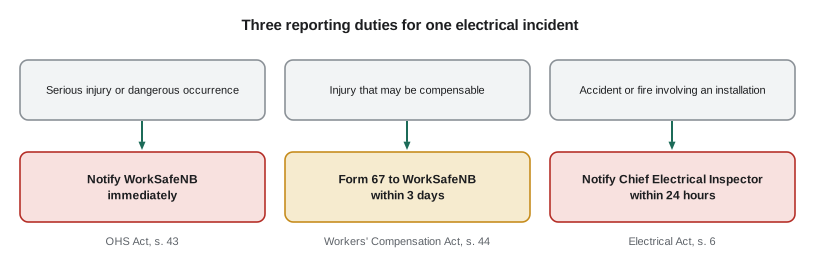
Two reporting duties run side by side, under two different Acts. Under section 43 of the Occupational Health and Safety Act, the employer must notify WorkSafeNB immediately, once first aid has been given and nobody is in immediate danger, of injuries such as loss of consciousness, amputation, most fractures, burns needing medical attention, loss of vision, deep cuts, admission to hospital or death, and of accidental explosions, accidental exposures to harmful agents and catastrophic events or equipment failures, whether or not anyone is hurt. The joint committee or health and safety representative must be notified too.
Separately, under section 44 of the Workers' Compensation Act, an employer must send WorkSafeNB an Employer Report of Injury or Illness, known as Form 67, within three days after a worker is injured in an accident that may entitle them to compensation, beyond first aid given by the employer. WorkSafeNB stresses that filing Form 67 does not satisfy the immediate notification duty. And if the incident involves an electrical installation, lesson 7's rule applies as well: the owner or user must notify the Chief Electrical Inspector within 24 hours.
Worked problem
One incident, three reports
On the Riverview charger job, Owen receives a shock while working in a panel that was thought to be de-energized. He loses consciousness briefly and is taken to hospital, where he is kept overnight.
Show solution
- Loss of consciousness and admission to hospital are on the list of injuries the employer must report to WorkSafeNB immediately.
- Owen's injury may entitle him to compensation, so Tantramar must also send Form 67 within three days.
- The accident involved an electrical installation and caused injury, so the Chief Electrical Inspector must be notified within 24 hours.
- The scene is left undisturbed, except to make it safe, until an inspector allows otherwise, and Tantramar investigates why the panel was energized.
Answer: Émilie makes the immediate WorkSafeNB call and the call to TIS the same afternoon, Nicole files Form 67 the next day, and the company reviews its lockout procedure.
Electrical work and qualified persons
New Brunswick's General Regulation 91-191 under the Occupational Health and Safety Act contains specific provisions on electrical work. WorkSafeNB's interpretation explains three of them. Section 286 defines a qualified person for work on electrical equipment by reference to the electrical licensing regulation: a person who meets the requirements of section 11 or section 24 of Regulation 84-165. Section 287 requires the employer to ensure that an employee does not work on energized electrical equipment unless the employee is a qualified person. Section 287.1 requires the employer to ensure that no one enters a room or enclosure with electrical hazards unless they are a qualified person, or an employee entering for a non-electrical duty who has been instructed and trained in the electrical hazards.
The link between the two regulations matters. A licensed electrician meets section 11 of the electrical regulation and is a qualified person for safety purposes. A maintenance worker who is familiar with the equipment and its hazards may meet section 24 for minor repairs that do not change the circuits. A worker who is neither, such as a painter or a cleaner, must not work on energized equipment and may enter an electrical room only for non-electrical duties and only after training in the hazards.
| Worker | Work on energized equipment? | Enter an electrical room? |
|---|---|---|
| Licensed electrician | Yes, as a qualified person, with safe procedures | Yes |
| Maintenance worker familiar with the equipment | Only within section 24 minor repairs | Yes, if qualified for the task |
| Painter or cleaner | No | Only for non-electrical duties, after training in the hazards |
Lockout and de-energized work
Being allowed to work on energized equipment does not mean it is wise. Good practice, reflected in the regulation and in the national standard on workplace electrical safety, CSA Z462, is to de-energize equipment, lock it out and verify the absence of voltage before working on it, and to work energized only when de-energizing is not feasible or would create a greater hazard. The regulation contains requirements for isolating energy sources and locking them out before work begins; read them in the current regulation, and build your company procedure around them.
A lockout procedure should say who may apply locks, how each energy source is identified and isolated, how stored energy is released, how the absence of voltage is tested and with what instrument, and how the equipment is returned to service. Each worker applies their own lock and keeps the key. After Owen's shock, Tantramar found that a second supply to the panel had not been identified on the drawings, and it added a step to its procedure: trace and label every supply before the first lock goes on.
# A simple lockout checklist runner
steps = [
    ("Identify every energy source, including second supplies", True),
    ("Notify affected people", True),
    ("Isolate and apply personal locks and tags", True),
    ("Release or block stored energy", True),
    ("Test for absence of voltage with a proven tester", False),
]
for i, (step, done) in enumerate(steps, 1):
    print(f"{i}. [{'x' if done else ' '}] {step}")
if all(done for _, done in steps):
    print("Safe to begin work")
else:
print("STOP: complete every step before work begins")1. [x] Identify every energy source, including second supplies 2. [x] Notify affected people 3. [x] Isolate and apply personal locks and tags 4. [x] Release or block stored energy 5. [ ] Test for absence of voltage with a proven tester STOP: complete every step before work begins
Other site hazards
Electrical contractors face hazards beyond electricity. Falls from ladders, scaffolds and lifts are a leading cause of serious injury in construction, and the regulation sets requirements for fall protection and for the equipment used. Excavations for underground services must be shored or sloped. Overhead power lines near a site require planning, because the regulation sets limits on how close workers and equipment may come. Confined spaces, such as some vaults and pits, need special procedures. A contractor should assess the hazards on each site before work starts, plan the controls and make sure workers are trained in them.
At the Sussex farm, the grain building is close to an overhead line. Before the boom lift arrived, Émilie contacted the utility to discuss the line, marked the approach limit on the ground and briefed the crew on it. The job sheet records the briefing, signed by each worker.
A safety program sized for a small contractor
A small electrical contractor does not need an elaborate system to meet its safety duties, but it does need a written, working one. The core pieces are a short statement of the company's commitment to safety, hazard assessments for its common tasks, safe work procedures for the most dangerous of them, such as lockout and work near overhead lines, an orientation and training record for each worker, a schedule of workplace inspections, an incident reporting and investigation procedure, and a process for correcting hazards that workers report.
WorkSafeNB publishes guidance for employers, and industry associations offer templates and training. Tantramar built its program from these sources and tailored it to electrical work. The monthly inspection checklist includes the condition of ladders and lifts, the calibration and condition of voltage testers, the state of extension cords and portable tools, and whether every crew has its lockout kit complete.
Worked problem
A monthly inspection
On the first Friday of the month, Émilie inspects the company's shop and its two active sites.
Show solution
- At the shop she checks ladders, the lift, the first aid kit and the condition of portable tools, and tags one damaged extension cord out of service.
- At the Dieppe duplex she checks housekeeping, the temporary service, ladder use and that each worker has the right protective equipment.
- At the Riverview site she checks that lockout kits are complete and that the voltage tester has been proven on a known source that week.
- She records the findings, assigns each correction to a person with a date, and reviews the open items at the Monday meeting.
Answer: The inspection finds two minor problems, both corrected within the week, and the record shows the monthly duty was met.
Workers should be encouraged to report hazards and near misses without fear of blame. A near miss, such as a voltage tester that fails to show a live circuit, is a warning that costs nothing if it is acted on and may cost a life if it is not.
Common mistakes
MistakeFiling Form 67 and assuming the serious injury has been reported.
InsteadForm 67 is separate; serious injuries must also be reported to WorkSafeNB immediately under the OHS Act.
MistakeLetting a trained painter work on an energized panel.
InsteadOnly qualified persons may work on energized equipment under section 287.
MistakeRelying on drawings to identify every supply before lockout.
InsteadTrace and verify every supply and test for absence of voltage.
MistakeAssuming the general contractor is responsible for all safety on site.
InsteadEach employer remains responsible for its own workers, work and equipment.
Summary and key terms
- The Occupational Health and Safety Act sets duties for employers, supervisors and workers; WorkSafeNB administers it.
- Workplaces with 20 or more employees need a joint health and safety committee; employers inspect monthly and orient new employees.
- Serious injuries and dangerous occurrences must be reported to WorkSafeNB immediately; Form 67 is due within three days for compensable injuries.
- Regulation 91-191 limits work on energized equipment and entry to electrical rooms to qualified persons, defined by reference to Regulation 84-165.
- De-energize, lock out and verify before working; plan for falls, excavations, overhead lines and confined spaces.
- Joint health and safety committee
- A committee of employer and worker representatives required in workplaces with 20 or more employees.
- Form 67
- The Employer Report of Injury or Illness sent to WorkSafeNB within three days of a compensable injury.
- Qualified person (safety)
- Under section 286 of Regulation 91-191, a person meeting section 11 or 24 of Regulation 84-165.
- Lockout
- Isolating energy sources and applying personal locks so equipment cannot be energized during work.
- Absence of voltage test
- Testing with a proven instrument to confirm that equipment is de-energized before work begins.
Practice problems
Work each problem on paper first, then reveal the answer to check.
At what size must a workplace have a joint health and safety committee?
Show answer
20 or more employees.
Within how many days must Form 67 be sent?
Show answer
Within three days.
Which section of Regulation 91-191 limits work on energized equipment to qualified persons?
Show answer
Section 287.
Who may enter a room with exposed energized parts for a non-electrical duty?
Show answer
An employee who has been instructed and trained in the electrical hazards.
What should be done before work begins on de-energized equipment?
Show answer
Isolate, lock out, release stored energy and test for absence of voltage.
Lesson quiz · 5 questions
Score 60% or more to complete this lesson.
Create a free account to save your progress, take quizzes and earn a certificate.