
MELC-207 · Lesson 1 of 12 · 20 min
How electrical licensing works in New Brunswick
▶ Video coming soon A video version of this lesson is on the way.
New Brunswick regulates electrical work in a way that surprises candidates who have read about Ontario or Alberta. There is no master electrician exam and no separate written exam for the electrical contractor licence. Instead, the province links three things together: a certificate of qualification that proves a person is a construction electrician, a provincial electrician's licence that lets that person do electrical work, and an electrical contractor licence that lets a business take out wiring permits. Each step builds on the one before it. This course explains each step, the rules that come with it and the knowledge an electrical contractor in New Brunswick is expected to have, so that you can apply with confidence and run the business legally once you are licensed.
The course follows Émilie Cormier, a construction electrician in Moncton who earned her New Brunswick certificate of qualification with the Red Seal endorsement in 2021 and has held a Class 3 electrician's licence ever since. She works for Tantramar Electric Ltd., a company of eleven people run by Gilles LeBlanc, who has held the company's contractor licence for more than twenty years and is the electrician the licence relies on. Gilles plans to retire within eighteen months. He has asked Émilie to become the licensed electrician named on the company's contractor licence, and she is also weighing whether to start her own company instead. Nicole Gauvin runs the office and keeps the licence, permit and insurance records. Owen MacDonald is a journeyperson who recently moved from Nova Scotia, and Logan Arsenault is a second-year apprentice. This season the company is wiring a duplex in Dieppe, fitting out a medical clinic on Mountain Road, upgrading a grain storage building on a farm near Sussex and installing electric vehicle chargers at a condominium in Riverview.
Everything in this course comes from public sources: the Electrical Installation and Inspection Act, its General Regulation, the electrical pages of the Government of New Brunswick, NB Power's wiring permit pages, the Construction Remedies Act and WorkSafeNB's guidance. No text from the Canadian Electrical Code is reproduced. Fees, rules and forms change, so treat every detail here as a starting point and confirm it with Technical Inspection Services, NB Power or WorkSafeNB before you rely on it.
The statute and the regulation
The governing statute is the Electrical Installation and Inspection Act, chapter 144 of the Revised Statutes of New Brunswick, 2011. It is a short Act. Section 3 requires electrical installations to meet the standards set by regulation and forbids anyone to do electrical work except as the Act and the regulations allow. Section 4 provides for a Chief Electrical Inspector and inspectors, section 5 gives inspectors the power to inspect and make orders, section 6 requires accidents and fires involving electrical installations to be reported, section 7 creates the offences, and section 9 sets out appeals. Most of the detail lives in the General Regulation, New Brunswick Regulation 84-165, which deals with licences, permits, inspections, fees and the adoption of the electrical code.
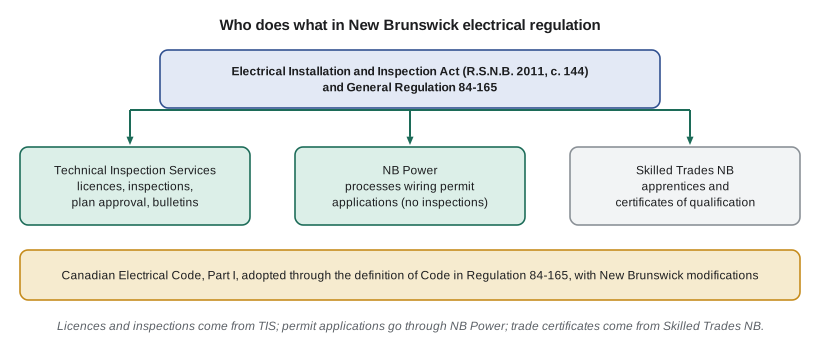
Read together, the Act and the regulation answer four questions that come up again and again. Who may do electrical work? Who may take out a wiring permit? What standard must the installation meet? And who checks it? The answers are, in order: holders of the right electrician's licence and the people the regulation exempts; licensed electrical contractors; the Canadian Electrical Code as adopted and modified by the regulation; and the inspectors of Technical Inspection Services.
Technical Inspection Services
The provincial body that runs the system is Technical Inspection Services, a branch of the Department of Public Safety. People often shorten the name to TIS. It is the office of the Chief Electrical Inspector. TIS issues and renews electrician and contractor licences, inspects electrical installations, approves electrical plans for larger installations, receives construction point call-ins from contractors and publishes bulletins that explain how it interprets the regulation. Applications for new electrician and contractor licences are made through an online portal called TIS Connect, and renewals can be done online through Service New Brunswick.
Two other organizations play supporting roles. Skilled Trades NB, the provincial apprenticeship and occupational certification office, registers apprentices and issues certificates of qualification in the designated trades, including construction electrician. NB Power processes applications for electrical wiring permits from licensed contractors, under an agreement that the Act allows, but it does not inspect installations; inspections are done by TIS. Keeping these roles straight saves confusion. If a question is about a trade certificate, think Skilled Trades NB; about a permit application, think NB Power's online form; about a licence, an inspection or the meaning of a rule, think TIS.
The licences at a glance
The province describes eight types of licence connected to electrical work. For a construction electrician and a contractor, three matter most. The electrician's licence, issued in Class 3 today, is for a person who holds a New Brunswick certificate of qualification as a construction electrician; it lets that person do electrical work on any type of installation and act as the electrician in charge of a job. The industrial electrician's licence is for holders of a certificate in the industrial electrician trade who work in establishments that employ electricians permanently. The electrical contractor licence, issued in Group 3 today, lets a business take out wiring permits and carry on the business of electrical contracting.
The other licences cover narrower fields: a sign installer contractor licence and a sign installer licence, an identification card for sign installer helpers, and two licences for lightning protection systems, one for agents and one for suppliers. Older Class 2 electrician licences and Group 2 contractor licences, issued before 1968, can still be renewed but are no longer issued. Holders of a construction electrician certificate from another province can receive a construction electrician identification card, which lets them work for a limited time while they sort out their New Brunswick status. Lesson 2 looks at eligibility for each licence in detail.
| Licence or card | Who it is for | What it allows |
|---|---|---|
| Electrician licence, Class 3 | Holder of a New Brunswick certificate of qualification, construction electrician | Electrical work on any installation; electrician in charge |
| Industrial electrician licence | Holder of an industrial electrician certificate | Work in establishments with permanently employed electricians |
| Electrical contractor licence, Group 3 | A Class 3 electrician with two years of experience, or a business that employs one | Taking out wiring permits; carrying on electrical contracting |
| Construction electrician identification card | Holder of a certificate from another province | Electrical work for a limited period |
Three separate permissions
It helps to keep three permissions apart. The first is the right to do electrical work with your own hands, which comes from a valid electrician's licence, an identification card or, for an apprentice, registration and supervision. The second is the right to take out wiring permits, which comes only from holding an electrical contractor licence. The third is the right to run a business, which depends on business registration, tax accounts, WorkSafeNB coverage and insurance rather than on any electrical licence. A person can have the first without the second: Owen, for example, can work on Tantramar's jobs once his status is in order, but he cannot take out a permit in his own name. A company can have the second only if it relies on someone who has the first.
The regulation adds a fourth idea that ties the first two together: the electrician in charge. Every electrical construction job must be directed by a licensed electrician who is on site or readily available. The contractor licence and the permit say who is responsible to the province for the job; the electrician in charge is the qualified person who directs the work on the ground. On a small job these may be the same person. On a larger one, a company with one contractor licence may have several electricians in charge, one for each job.
Worked problem
Who may do this work?
A renovation company in Dieppe is redoing a kitchen. Its carpenter, who holds no electrician's licence, offers to move two receptacles and add lighting under the cabinets. The homeowner asks whether that is allowed.
Show solution
- Moving receptacles and adding lighting is an electrical installation, not a minor repair or replacement that leaves the circuits unchanged.
- The regulation allows electrical installations to be made only by authorized people: licensed electricians, supervised apprentices and the narrow categories of qualified persons doing minor repairs.
- The carpenter is not authorized, and the regulation also forbids an employer to have unauthorized people do the work.
- A wiring permit is needed before the work starts, and only a licensed electrical contractor can obtain one.
Answer: The renovation company should hire a licensed electrical contractor such as Tantramar Electric, which obtains the wiring permit and has a licensed electrician do the work.
Where the code comes from
The technical rules for installations come from the Canadian Electrical Code, Part I, published by CSA Group. New Brunswick gives the code legal force through the definition of Code in Regulation 84-165, which names a specific edition and lists a small number of New Brunswick modifications. An amending regulation filed in March 2026 moved the definition to the 2024 edition, the 26th, with effect from March 15, 2026, and replaced the New Brunswick rule on receptacles in dwelling units. The regulation also says that where it conflicts with the code, the regulation prevails. Lesson 5 covers the adoption and the modifications in detail.
What a contractor is expected to know
Because there is no separate contractor exam, nobody sits you down and tests your knowledge of the regulation before the licence is issued. That does not make the knowledge optional. A contractor who takes out permits without understanding the rules soon meets an inspector's order, a failed inspection, a stop on supply, an unpaid account or a suspended licence. The regulation lets the Chief Electrical Inspector suspend or revoke a licence for repeated infractions, negligence, misrepresentation, employing unauthorized people and other grounds. The knowledge in this course is what keeps a licence in good standing.
The core courses in this program cover the code skills: navigating the code, calculations, wiring methods, grounding and bonding, and special installations. This course covers the New Brunswick layer: who may do what, how licences and permits work, the provincial modifications, the contractor's duties, contracts and liens, workplace safety, renewal and keeping up to date. Gilles suggests that Émilie start by drawing a one-page map of the system, with the Act and regulation at the top and the organizations and documents below, so that every rule she learns has a place to go.
# Emilie's question sorter: which body answers which kind of question?
sources = {
    "Can an unlicensed carpenter move a receptacle?": "Regulation 84-165 (licensing rules)",
    "Where do I apply for a contractor licence?": "Technical Inspection Services (TIS Connect)",
    "How do I apply for a wiring permit?": "NB Power online form (licensed contractors only)",
    "Who inspects the Dieppe duplex?": "Technical Inspection Services",
    "Who issues a certificate of qualification?": "Skilled Trades NB",
    "Which code edition applies to a new job?": "Regulation 84-165, definition of Code",
}
for question, source in sources.items():
    print(f"{question:<50} -> {source}")
print(len(sources), "questions sorted")Can an unlicensed carpenter move a receptacle? -> Regulation 84-165 (licensing rules) Where do I apply for a contractor licence? -> Technical Inspection Services (TIS Connect) How do I apply for a wiring permit? -> NB Power online form (licensed contractors only) Who inspects the Dieppe duplex? -> Technical Inspection Services Who issues a certificate of qualification? -> Skilled Trades NB Which code edition applies to a new job? -> Regulation 84-165, definition of Code 6 questions sorted
Some questions draw on more than one source. A question about a failed inspection on a job with an unpaid invoice may involve the regulation, the code, the contract and the Construction Remedies Act at once. Starting in the right place still saves time.
Common mistakes
MistakeAssuming New Brunswick has a master electrician exam like Ontario's.
InsteadNew Brunswick has no master exam; the contractor licence depends on a Class 3 electrician with two years of experience.
MistakeThinking NB Power inspects installations because it processes permit applications.
InsteadNB Power processes wiring permit applications; Technical Inspection Services inspects.
MistakeBelieving any licensed electrician may take out a wiring permit.
InsteadOnly licensed electrical contractors may obtain wiring permits.
MistakeTreating any small job as exempt.
InsteadOnly minor repairs and replacements that leave the circuits unchanged, done by a qualified person, fall outside the licensing rule.
Summary and key terms
- The Electrical Installation and Inspection Act, R.S.N.B. 2011, c. 144, and Regulation 84-165 govern electrical work in New Brunswick.
- Technical Inspection Services issues licences, inspects installations and is the office of the Chief Electrical Inspector.
- Skilled Trades NB issues certificates of qualification; NB Power processes wiring permit applications but does not inspect.
- The Class 3 electrician licence rests on a certificate of qualification; the Group 3 contractor licence rests on a Class 3 electrician with two years of experience.
- Regulation 84-165 adopts the CE Code Part I with New Brunswick modifications; the 2024 edition took effect on March 15, 2026.
- TIS
- Technical Inspection Services, the branch of the Department of Public Safety that licenses electricians and contractors and inspects installations.
- Chief Electrical Inspector
- The official appointed under the Act who heads electrical inspection and licensing.
- Certificate of qualification
- The provincial trade certificate issued by Skilled Trades NB; for construction electricians it is the basis of the Class 3 licence.
- Electrician in charge
- The licensed electrician who directs electrical construction on a job and is on site or readily available.
- Group 3 contractor licence
- The electrical contractor licence issued today, which allows a business to obtain wiring permits.
Practice problems
Work each problem on paper first, then reveal the answer to check.
What is the chapter citation of the Electrical Installation and Inspection Act?
Show answer
R.S.N.B. 2011, c. 144.
Which regulation holds the licensing, permit and code adoption rules?
Show answer
New Brunswick Regulation 84-165, the General Regulation.
Who issues certificates of qualification for construction electricians?
Show answer
Skilled Trades NB.
Does NB Power inspect electrical installations?
Show answer
No. It processes wiring permit applications; Technical Inspection Services inspects.
Can a licensed electrician who is not a contractor obtain a wiring permit?
Show answer
No. Only licensed electrical contractors may obtain wiring permits.
Lesson quiz · 5 questions
Score 60% or more to complete this lesson.
Create a free account to save your progress, take quizzes and earn a certificate.