
MELC-207 · Lesson 12 of 12 · 21 min
Practice review and licensing scenarios
▶ Video coming soon A video version of this lesson is on the way.
This last lesson brings the course together. Because New Brunswick has no separate contractor exam, the practice here takes two forms. The first is a set of licensing scenarios, the kind of situations a contractor meets in the first year of holding a licence, each worked through using the Act, Regulation 84-165, the Construction Remedies Act and the workplace safety rules. The second is a review routine for the code knowledge that the Red Seal exam tests and inspectors check, for apprentices and trade qualifiers preparing for the certificate and for licensed electricians refreshing their knowledge after a new edition. Work through the scenarios before reading the answers, and use the routine to plan your own review.
Scenario 1: the new hire from Nova Scotia
A contractor hires an electrician certified in Nova Scotia with the Red Seal endorsement. The electrician wants to start on Monday. What must happen first? Under the regulation, a construction electrician identification card lets a holder of another province's certificate work for up to six months. The contractor should make sure the card is issued before the electrician works, note its expiry date, and encourage the electrician to pursue recognition of the certificate in New Brunswick so that a Class 3 licence can be issued before the card runs out. Until then the electrician can work but cannot support the company's contractor licence.
Scenario 2: the qualified person resigns
A corporation's contractor licence rests on one electrician, who resigns with two weeks' notice. What should the company do? It no longer meets the condition it certified, and continuing as if nothing had happened risks a finding of misrepresentation, a ground for suspension. It should identify another employee with a Class 3 licence and at least two years of experience since qualifying, or hire one, prepare a new written certification and contact TIS promptly about the change. Meanwhile, it should not apply for new permits on the strength of the departing electrician.
Scenario 3: the customer's maintenance staff
A property manager asks Tantramar to quote a lighting retrofit but says the building's maintenance staff will install the new circuits to save money, with Tantramar only obtaining the permit. What is the answer? Adding circuits is an electrical installation, not a minor repair that leaves circuits unchanged, so section 24 does not cover it. The work must be done by authorized people, and a contractor who obtains a permit for work done by unauthorized people risks its licence. Tantramar declines to permit work it does not do, and offers instead to do the circuit work while the maintenance staff do like-for-like replacements within section 24.
Scenario 4: an incident on site
An apprentice receives a burn needing medical attention while terminating in a panel that was thought to be locked out. Which reports are needed? A burn needing medical attention is on the list of injuries the employer must report to WorkSafeNB immediately under the Occupational Health and Safety Act. If the injury may entitle the apprentice to compensation, Form 67 must be sent within three days under the Workers' Compensation Act. Because the accident involved an electrical installation and caused injury, the owner or user must notify the Chief Electrical Inspector within 24 hours, and the scene should be left undisturbed except as needed for safety. The company must also investigate the lockout failure and the supervision of the apprentice.
Scenario 5: the unpaid invoice
On a subcontract entered into in 2026, the general contractor stops paying Tantramar after a dispute with the owner. Substantial performance was declared on October 1, and Tantramar's last work was October 20. What should Tantramar do? Under the Construction Remedies Act, the lien period is 60 days, and for a subcontractor it can run from the earliest of the listed triggers, which may include substantial performance. Counting from October 1 gives a deadline of November 30. Tantramar should check its records, consider getting legal advice, and if the matter is not resolved, register its lien before November 30 rather than counting from its own last day. The prompt payment Act is not yet in force, so payment timing depends on the subcontract.
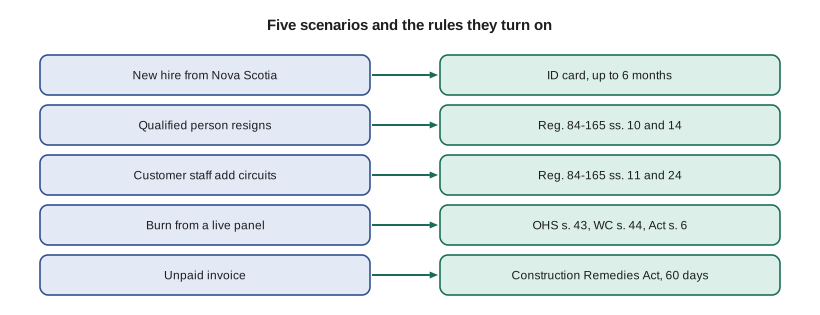
| Scenario | Key rule | Action |
|---|---|---|
| Out-of-province electrician | Identification card, up to six months | Card before work; pursue recognition and a Class 3 licence |
| Qualified person resigns | Section 10; misrepresentation is a ground in section 14 | Name a qualified replacement and inform TIS |
| Customer staff add circuits | Sections 11 and 24 | Decline to permit work done by unauthorized people |
| Burn from a live panel | OHS Act s. 43; WC Act s. 44; Act s. 6 | Immediate WorkSafeNB call, Form 67 within 3 days, Chief Electrical Inspector within 24 hours |
| Unpaid invoice | Construction Remedies Act, 60 days | Register the lien within 60 days of the earliest trigger |
A review routine for code knowledge
The code knowledge that inspectors check, and that the Red Seal exam tests, rewards regular practice more than last-minute cramming. A simple routine works for both apprentices and experienced electricians. Each week, pick one major work activity from the Red Seal breakdown and spend an hour on the code sections behind it. Each evening, do ten timed look-ups: a question that names a situation and asks for the rule that governs it, answered by finding the rule number. Once a month, do a longer timed set of calculation questions, writing out the method for each. Keep a log of the rules you found slow to locate and tab them.
For candidates writing the Red Seal exam, the weighting tells you where to focus: wiring systems and distribution and service systems together make up more than half of the questions. For licensed electricians refreshing after a new edition, focus on the changes between editions and on the New Brunswick modifications, which no national study guide covers.
Worked problem
Building a four-week refresher
Émilie has four weeks before she becomes Tantramar's qualified person and wants a structured refresher on the 2024 edition.
Show solution
- Week 1: services, overcurrent protection and conductors, the areas behind distribution and service systems.
- Week 2: wiring methods and the New Brunswick dwelling unit receptacle rule.
- Week 3: grounding and bonding, then motors and controls.
- Week 4: special installations, signalling and communication, and a timed mixed set of 40 look-ups.
Answer: Each week ends with a 20-question self-test, and the slow look-ups are tabbed before the next week begins.
# Track timed look-up practice and flag slow topics
log = [
    ("services", 95), ("services", 70), ("grounding", 150), ("grounding", 140),
    ("wiring methods", 80), ("receptacles NB rule", 160), ("motors", 110),
]
target = 120  # seconds per look-up
totals = {}
for topic, secs in log:
    totals.setdefault(topic, []).append(secs)
for topic, times in totals.items():
    avg = sum(times) / len(times)
print(f"{topic:<22} average {avg:5.0f} s {'TAB AND REVIEW' if avg > target else 'ok'}")services average 82 s ok grounding average 145 s TAB AND REVIEW wiring methods average 80 s ok receptacles NB rule average 160 s TAB AND REVIEW motors average 110 s ok
The log shows grounding and the New Brunswick receptacle rule above the two-minute target. Émilie tabs both and puts them at the top of next week's plan.
Test-day habits for the Red Seal exam
For apprentices and trade qualifiers, a few habits make a difference on exam day. Confirm the date, time, location or testing method and identification requirements with Skilled Trades NB beforehand. Arrive early. Read each question fully before answering, answer the ones you know first and mark the rest. Keep an eye on the time at set checkpoints. For calculations, write the formula and units. Before submitting, make sure every question has an answer. Logan has copied these habits onto the inside cover of his study notebook, two years ahead of his exam.
Your first year as a licence holder
Whether Émilie takes over at Tantramar or starts her own company, her first year as the electrician the licence rests on will test everything in this course. A short checklist helps her start well: confirm the licence and her own Class 3 licence are current; check every worker's status; name an electrician in charge for each job; obtain and post permits before work starts; call in every construction point; correct orders promptly; report incidents correctly; keep written contracts and change orders; track holdback and lien deadlines; keep WorkSafeNB coverage and insurance current; renew every licence on time; and keep learning. Gilles's last piece of advice is that a licence is easier to keep than to win back.
Scenario 6: a sign job
A customer asks Tantramar to install a new illuminated sign on a store front and connect it. Tantramar holds an electrical contractor licence but has no licensed sign installer. What should it do? Sign installation is licensed separately: a sign installer contractor must employ someone with a sign installer licence, and that licence requires a course, documented hours and a competency test. Tantramar can provide the electrical supply to the sign location under its own licence and permit, and the customer should hire a licensed sign installer contractor to install the sign itself, unless Tantramar arranges that licensing for its own staff.
The scenario shows a general point: an electrical contractor licence is broad, but it is not the only licence in the electrical field. Lightning protection systems are another example. Before quoting unfamiliar work, check whether it falls under a separate licence.
Scenario 7: a job that straddles the code change
A customer asks why the receptacle layout on a house designed in January 2026 had to change before rough-in in April. The answer comes from lesson 5: the 2024 edition took effect on March 15, 2026, and Regulation 2026-5 also replaced the New Brunswick dwelling unit receptacle rule. Work installed after the change must comply with the rules in force unless TIS transition guidance says otherwise, and the safest course is to confirm with the inspector and record the answer. Explaining this to the customer early, with the regulation in hand, avoids the impression that the contractor made a mistake.
Worked problem
Talking a customer through a rule change
The homeowner is frustrated that two receptacles have moved since the original drawing.
Show solution
- Émilie explains that the province adopted a new code edition on March 15, 2026, with a replaced rule for receptacles in homes.
- She shows the homeowner the date in the regulation and the inspector's confirmation recorded in the job file.
- She explains that following the new rule avoids a failed inspection and the cost of moving receptacles after the walls are finished.
- She confirms that the change does not affect the agreed price, because Tantramar caught it at the drawing stage.
Answer: The homeowner understands the reason for the change, and the job proceeds without a dispute.
Common mistakes
MistakeLetting an out-of-province electrician start before the identification card is issued.
InsteadGet the card first and track its six-month limit.
MistakeKeeping a business licence in place after the qualified person leaves.
InsteadName a qualified replacement and inform TIS promptly.
MistakeCounting the lien deadline from your own last day of work.
InsteadCount 60 days from the earliest trigger listed in the Construction Remedies Act.
MistakeReporting a worker injury only on Form 67.
InsteadSerious injuries also need immediate notification to WorkSafeNB, and electrical accidents a call to the Chief Electrical Inspector.
Summary and key terms
- Licensing scenarios turn on sections 10, 11, 14 and 24 of Regulation 84-165.
- Incidents can require three reports: immediate WorkSafeNB notice, Form 67 within three days and the Chief Electrical Inspector within 24 hours.
- Lien deadlines run 60 days from the earliest trigger under the Construction Remedies Act.
- Regular timed look-ups and focused weekly review build the code knowledge that inspectors and the Red Seal exam check.
- A first-year checklist keeps a new licence holder on track.
- Licensing scenario
- A practical situation that tests how the licensing, permit and safety rules apply.
- Timed look-up
- A practice question answered by finding the governing code rule under time pressure.
- Checkpoint
- A set time during an exam by which a set number of questions should be done.
- Recognition
- The process by which a certificate from another province is accepted in New Brunswick.
- First-year checklist
- A list of the duties a new licence holder must keep on top of.
Practice problems
Work each problem on paper first, then reveal the answer to check.
What lets a Nova Scotia certificate holder work in New Brunswick while recognition is pending?
Show answer
A construction electrician identification card, valid for up to six months.
Can a contractor obtain a permit for circuit work done by a customer's unlicensed staff?
Show answer
No; adding circuits is not a minor repair under section 24 and must be done by authorized people.
Substantial performance is declared October 1. What is the lien deadline counting 60 days?
Show answer
November 30.
Which two Red Seal major work activities carry the most questions?
Show answer
Wiring systems and generating, distribution and service systems.
Name three reports that may follow a shock injury on site.
Show answer
Immediate WorkSafeNB notification, Form 67 within three days and notice to the Chief Electrical Inspector within 24 hours.
Lesson quiz · 5 questions
Score 60% or more to complete this lesson.
Create a free account to save your progress, take quizzes and earn a certificate.