
MELC-207 · Lesson 8 of 12 · 21 min
Contractor licensing, insurance and bonding
▶ Video coming soon A video version of this lesson is on the way.
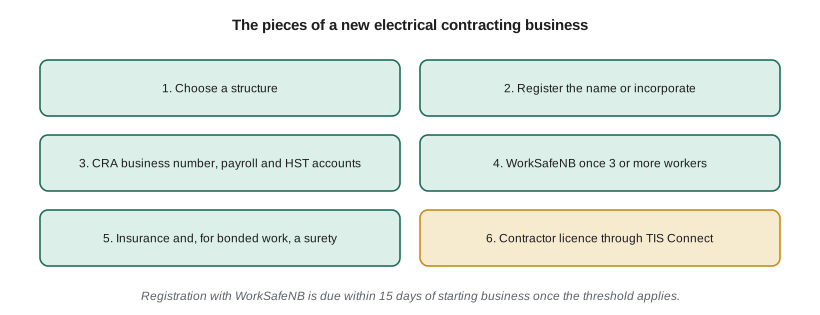
The electrical contractor licence lets a business obtain permits, but it does not make the business a business. Registration, tax accounts, workers compensation coverage, insurance and, on many projects, surety bonds all sit alongside the licence. Regulation 84-165 says nothing about insurance or bonds; those requirements come from other laws, from contracts and from the expectations of owners and general contractors. This lesson covers the business framework a New Brunswick electrical contractor works within, using Émilie's choice between taking over at Tantramar and starting her own company as the example.
Choosing a business structure
There are three common structures. A sole proprietorship is the simplest: the owner and the business are the same person, the owner takes all the profit and carries all the risk, and creditors of the business can pursue the owner's personal assets. A partnership is similar but shared between two or more people, each of whom can generally be responsible for the debts of the partnership. A corporation is a separate legal person, incorporated under the Business Corporations Act or the federal equivalent; its shareholders are generally not personally responsible for its debts, but it costs more to set up and run and must keep corporate records.
The licensing rules work with each structure. A sole proprietor who is a qualified electrician can hold the contractor licence on their own qualifications. A partnership or corporation holds it by employing a qualified electrician and certifying that in writing, as lesson 2 explained. If Émilie starts her own business, she must decide which structure suits her: a sole proprietorship to start small, or a corporation for the liability protection, with herself as the qualified employee.
| Structure | Liability for business debts | How it holds the contractor licence |
|---|---|---|
| Sole proprietorship | Owner personally | On the owner's own qualifications |
| Partnership | Partners, generally personally | By employing a qualified electrician |
| Corporation | The corporation; shareholders generally protected | By employing a qualified electrician |
Registration and tax accounts
A business that operates under a name other than the owner's own name generally registers that name with the Corporate Registry, which in New Brunswick is part of Service New Brunswick. Corporations are registered when they are incorporated. Federally, a business needs a business number from the Canada Revenue Agency and the accounts that go with it: a payroll account once it has employees, an income tax account for a corporation and, once its taxable sales pass the small supplier threshold, a harmonized sales tax account. New Brunswick is a harmonized sales tax province, so contractors charge the combined federal and provincial tax on most of their work. Small businesses below the threshold may register voluntarily, which lets them claim input tax credits on what they buy.
Nicole reminds Émilie that a new company should open separate bank accounts, keep its records from the first day and set money aside for sales tax and payroll remittances. More small contractors fail because of cash flow and tax arrears than because of poor workmanship.
WorkSafeNB coverage
Workers compensation in New Brunswick is administered by WorkSafeNB. WorkSafeNB's employer pages state that all employers with three or more workers at any time during the year must register for mandatory coverage, and that they must register within 15 days of starting business. Coverage protects workers by providing benefits for work-related injuries and protects employers from being sued by injured workers. Assessment rates depend on the industry classification and the employer's own claims history.
Workers compensation matters for contracts as well as for workers. General contractors and owners often ask subcontractors to show that they are registered and in good standing before work starts, because a principal can become responsible for unpaid assessments of a contractor it hires. An electrical contractor that is not in good standing may find doors closed. Lesson 10 covers WorkSafeNB's role in health and safety; here the point is that coverage is part of setting up the business.
Insurance
Regulation 84-165 does not require electrical contractors to carry any particular insurance, but almost every contractor does, and most customers and general contractors require it. The central policy is commercial general liability insurance, which covers claims for injury and property damage caused by the business's work or operations, including claims made after a job is finished. Contractors also commonly carry insurance on their tools and equipment, commercial vehicle insurance, and sometimes errors and omissions coverage if they do design work. Larger projects may require the owner or general contractor to be named as an additional insured.
The amount of coverage is usually set by the contract. Tender documents and subcontracts often specify a minimum limit for each occurrence and in total, and the subcontractor must provide a certificate of insurance before starting. Nicole keeps the current certificate on file and sends it to each general contractor at the start of a subcontract. When the clinic's general contractor asked for a higher limit than Tantramar carried, she arranged an increase with the broker before the subcontract was signed.
Surety bonds
A surety bond is a three-party arrangement: the surety company guarantees to the owner (the obligee) that the contractor (the principal) will meet a particular obligation. Bonds are common on public projects and larger private ones. Three kinds come up most often. A bid bond guarantees that the contractor will sign the contract and provide the required performance and payment bonds if its bid is accepted. A performance bond guarantees that the contractor will complete the work according to the contract. A labour and material payment bond guarantees that the contractor will pay its subcontractors and suppliers.
Bonds are not insurance for the contractor. If a surety pays out on a bond, it will look to the contractor to repay it, often under an indemnity agreement signed by the contractor's owners. Sureties therefore examine a contractor's finances, experience and work in progress before agreeing to bond it, and they set a limit on the total value of bonded work they will support. A new company like the one Émilie might start may find bonding hard to obtain until it has a track record.
| Bond | Guarantees that the contractor will | Typically required |
|---|---|---|
| Bid bond | Sign the contract and provide the other bonds if its bid is accepted | With the bid on bonded tenders |
| Performance bond | Complete the work according to the contract | On award of the contract |
| Labour and material payment bond | Pay its subcontractors and suppliers | On award of the contract |
Worked problem
Estimating the cost of a performance bond
Tantramar bids on a school electrical upgrade worth 480,000 dollars. The tender requires a performance bond and a labour and material payment bond, each for half the contract price. Tantramar's surety quotes an illustrative premium of 9 dollars for every 1,000 dollars of contract price, covering both bonds.
Show solution
- The premium is based on the contract price: 480,000 divided by 1,000 gives 480 thousands.
- Multiply by the illustrative rate: 480 times 9 gives 4,320 dollars.
- Add the premium to the bid as a cost of the job.
- If the contract value changes, the premium is adjusted.
Answer: The bonds cost about 4,320 dollars at the illustrative rate. Actual rates depend on the surety and the contractor's finances.
def bond_premium(contract_price, rate_per_thousand):
    # Illustrative only: sureties set their own rates
    return contract_price / 1000 * rate_per_thousand

for price in [120_000, 480_000, 1_250_000]:
print(f"{price:>10,} dollars -> premium {bond_premium(price, 9):>8,.0f} dollars")120,000 dollars -> premium 1,080 dollars 480,000 dollars -> premium 4,320 dollars 1,250,000 dollars -> premium 11,250 dollars
Putting it together
The licence, the business registration, the tax accounts, workers compensation and insurance all have renewal dates and conditions. A contractor who lets one lapse can find that a general contractor stops payment, that a tender is rejected or that a job cannot start. Tantramar keeps all these dates on a single calendar that Nicole reviews monthly. When Émilie compares staying with starting her own company, the calendar reminds her how much administration comes with a business, and how much of it Tantramar already has in place.
Cash flow and pricing
Many small contractors that do good work still fail because money comes in more slowly than it goes out. Wages are paid every week or two, suppliers expect payment within a month, and sales tax and payroll deductions must be remitted on time, but customers and general contractors often pay 30 to 60 days after invoicing, and holdback is released only after the lien period. A contractor should plan for this gap with a line of credit, careful scheduling of large purchases and prompt, accurate invoicing.
Pricing affects cash flow too. A price must cover direct costs, such as labour and materials, and the overhead of running the business: the office, vehicles, insurance, licences, WorkSafeNB assessments and the owner's own time spent estimating and managing. Markup and margin are often confused. Markup is the amount added to cost, expressed against cost; margin is profit expressed against the selling price. A markup of 25 dollars on 100 dollars of cost gives a price of 125 dollars and a margin of 20 dollars in 100 of price.
Worked problem
Markup and margin
A small service job has direct costs of 800 dollars. Tantramar applies a markup of 30 dollars on every 100 dollars of cost to cover overhead and profit.
Show solution
- Markup amount: 800 times 30 divided by 100 gives 240 dollars.
- Selling price before tax: 800 plus 240 gives 1,040 dollars.
- Margin: 240 divided by 1,040 gives about 23 dollars in every 100 dollars of price.
- Harmonized sales tax is added to the selling price on the invoice and remitted to the government; it is not part of the margin.
Answer: The job is priced at 1,040 dollars before tax, a margin of about 23 in 100, which is lower than the 30 in 100 markup.
Émilie notices that if she starts her own company, she will have to price every job herself, keep the books, chase payments and still do the electrical work. At Tantramar, Nicole and Gilles carry most of that load. It is one of the factors she weighs in her decision.
Choosing an insurance broker and a surety
Insurance and bonding are specialized markets, and most contractors use a broker who works with construction businesses. A good broker explains what each policy covers and excludes, helps the contractor meet the insurance requirements in contracts, and arranges introductions to sureties when the contractor starts bidding on bonded work. Contractors should read their policies, especially the exclusions, and tell the broker when their work changes, for example when they start design work or take on larger projects.
Sureties look closely at a contractor's financial statements, the experience of its key people, its work in progress and its history of completing jobs. A contractor that wants bonding should keep accurate books, prepare year-end financial statements with an accountant, and build a record of finished projects. Tantramar has been bonded for many years, and its surety asks each spring for its financial statements and a list of work in progress. If Émilie starts her own company, she will start without that history and may need to begin with smaller, unbonded work.
Common mistakes
MistakeAssuming the electrical regulation requires a set amount of liability insurance.
InsteadRegulation 84-165 does not; insurance requirements come from contracts and good practice.
MistakeWaiting until the first claim to register with WorkSafeNB.
InsteadRegister within 15 days of starting business once there will be three or more workers at any time in the year.
MistakeTreating a performance bond as insurance that protects the contractor.
InsteadThe surety will seek repayment from the contractor if it pays out.
MistakeForgetting to charge or remit harmonized sales tax.
InsteadRegister when required and set tax money aside from every invoice.
Summary and key terms
- Business structure affects personal liability and how the contractor licence is held.
- Businesses register names or incorporate, and obtain CRA, payroll and HST accounts as required.
- WorkSafeNB coverage is mandatory for employers with three or more workers at any time in the year, with registration within 15 days.
- Insurance and bonds are required by contracts rather than by Regulation 84-165.
- Bid, performance and labour and material payment bonds guarantee different obligations, and the surety can recover from the contractor.
- Commercial general liability insurance
- Insurance covering claims for injury or property damage caused by a business's work or operations.
- Certificate of insurance
- A document from the insurer or broker showing a business's current coverage.
- Surety
- The company that guarantees a contractor's obligation under a bond.
- Obligee
- The party, usually the owner, that a bond protects.
- Indemnity agreement
- An agreement under which the contractor and often its owners must repay the surety for losses on bonds.
Practice problems
Work each problem on paper first, then reveal the answer to check.
Which structure gives the owner personal liability for all business debts?
Show answer
A sole proprietorship.
When must an employer register with WorkSafeNB?
Show answer
When it has three or more workers at any time in the year, within 15 days of starting business.
Does Regulation 84-165 require liability insurance?
Show answer
No; insurance requirements come from contracts and good practice.
What does a labour and material payment bond guarantee?
Show answer
That the contractor will pay its subcontractors and suppliers.
What is the illustrative bond premium on a 120,000-dollar contract at 9 dollars per thousand?
Show answer
1,080 dollars.
Lesson quiz · 5 questions
Score 60% or more to complete this lesson.
Create a free account to save your progress, take quizzes and earn a certificate.