
MELC-207 · Lesson 5 of 12 · 22 min
The Canadian Electrical Code as adopted in New Brunswick
▶ Video coming soon A video version of this lesson is on the way.
The Canadian Electrical Code, Part I, is a national model code. It has no legal force anywhere until a province or territory adopts it. New Brunswick adopts it through Regulation 84-165, which names the edition, lists a short set of New Brunswick modifications and says what happens when the regulation and the code disagree. This lesson explains how that adoption works, what the current modifications deal with, how to handle jobs that straddle a change of edition and where to find the province's interpretations. No code text is reproduced here; bring your own copy of the 2024 code and the regulation when you study.
Adoption by definition
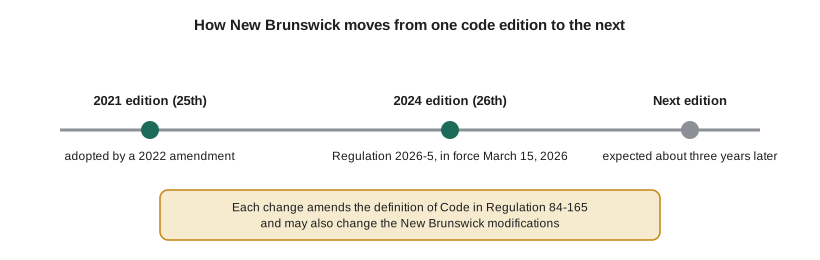
The adoption is done in an unusual but effective way: through the definition of the word Code in section 2 of the regulation. The definition names a particular CSA standard by number and edition, including its errata. The regulation then requires installations to comply with the Code, so whatever edition the definition names is the standard that applies. Changing editions is therefore done by amending one definition rather than by rewriting the regulation.
The most recent change was made by Regulation 2026-5, filed on March 11, 2026, and in force on March 15, 2026. It replaced the reference to the 2021 edition, the 25th, with the 2024 edition, the 26th, and replaced the New Brunswick rule on receptacles in dwelling units. Before that, a 2022 amendment had moved New Brunswick from the 2018 edition to the 2021 edition. This pattern, a short amending regulation each time CSA publishes a new edition, is likely to continue.
The New Brunswick modifications
Regulation 84-165 changes a handful of code rules for New Brunswick. In the current version, the modifications deal with the following subjects. Rule 6-104 is modified on the limits that apply to a consumer's service. Rule 6-206 is modified in its paragraph on where the service disconnecting means is located. Rule 26-722 is replaced with a New Brunswick rule on receptacles in dwelling units, covering duplex receptacle spacing in finished rooms, receptacle placement in kitchens and receptacles in hallways. Rule 34-106 is modified on ground fault protection for portable outdoor signs. Rule 76-004 is modified on grounding for temporary services.
These modifications are short, but they matter, because they change answers that a candidate who learned the national code would give by habit. The dwelling unit receptacle rule in particular affects nearly every house and apartment job. When Émilie reviews the drawings for the Dieppe duplex, she reads the New Brunswick version of the receptacle rule from the regulation, not the national rule from her code book, and she marks her code book with a note at the national rule pointing to the regulation.
| Code rule | Subject of the New Brunswick modification |
|---|---|
| 6-104 | Limits on a consumer's service |
| 6-206(1)(c) | Location of the service disconnecting means |
| 26-722 | Receptacles in dwelling units (replaced by a New Brunswick rule) |
| 34-106(3) | Ground fault protection for portable outdoor signs |
| 76-004 | Grounding of temporary services |
Section 25 of the regulation adds a rule of priority: where the regulation conflicts with the Code, the regulation prevails. That covers the modifications, but it also covers anything else in the regulation, such as the permit and licensing rules. If a code rule seems to point one way and the regulation another, follow the regulation.
Marking up your code book
Because the modifications live in the regulation rather than in the code book, contractors need a way to remember them on the job. A simple method works well. At each modified rule in your copy of the code, add a tab or a margin note that says NB modified and gives the regulation reference. Keep a printed copy of the current definition and modifications section of the regulation inside the front cover. Check the regulation online once a year, or whenever TIS announces a change, and update both the notes and the printed copy.
Gilles adds one more habit. On the company's standard drawings and specification notes, he lists the code edition and the regulation in force, so that anyone reading the drawings years later knows which rules the installation was designed to. When the Riverview chargers were designed in early 2026, the drawing notes said 2021 edition; when the job was redesigned after March 15, they were updated to the 2024 edition.
Jobs that straddle a change of edition
Code changes create a practical question: which edition applies to a job that was designed, permitted or started under the old one? The regulation's definition names one edition at any given time, so the safe default is that work must comply with the edition in force. In practice, regulators usually provide some transition guidance, and TIS has published bulletins on earlier adoptions. Before relying on an old edition for a job that is still under way, check whether TIS has issued transition guidance for the 2024 adoption, and if in doubt, ask the inspector assigned to the job and record the answer.
Worked problem
Which edition applies?
Tantramar designed the electrical work for the Mountain Road clinic fit-out in January 2026 and applied for the wiring permit in February. Rough-in starts in April, after the 2024 edition took effect on March 15.
Show solution
- The definition of Code in the regulation named the 2021 edition until March 14 and names the 2024 edition from March 15.
- The work being installed from April onward is installed after the new edition took effect.
- Check whether TIS has published transition guidance for permits obtained before March 15.
- If there is no clear guidance, ask the assigned inspector which edition will be applied, record the answer and review the design against any rule changes that affect it.
Answer: Émilie confirms with the inspector, records the answer in the job file and reviews the clinic design against the 2024 changes before rough-in begins.
Bulletins and interpretations
Technical Inspection Services publishes electrical inspection bulletins. Each bulletin is numbered after the section of the regulation it relates to, which is why bulletin titles often begin with 84-165 followed by a section number. Bulletins explain how the province applies a rule, announce adoptions and transition arrangements, and address recurring questions such as permit requirements and the meaning of qualified person. They are not a substitute for the regulation or the code, but they tell you how the inspector who will look at your work reads them.
A contractor should know where the bulletins are kept, check them when a question comes up and look for new ones regularly. Nicole prints new bulletins and files them in a binder by regulation section, and the crew leaders read new ones at the Monday morning meeting. When a bulletin replaces an earlier one, she moves the old one to an archive file rather than throwing it away, because a job designed under the old guidance may need to be explained later.
# Which code edition named in Regulation 84-165 applies on a given date?
from datetime import date

editions = [
    (date(2026, 3, 15), "2024 edition (26th), Regulation 2026-5"),
    (date(2022, 1, 1), "2021 edition (25th), illustrative start date"),
]

def edition_on(d):
    for start, name in editions:   # newest first
        if d >= start:
            return name
    return "earlier edition"

for d in [date(2026, 2, 20), date(2026, 3, 14), date(2026, 3, 15), date(2026, 11, 10)]:
print(d, "->", edition_on(d))2026-02-20 -> 2021 edition (25th), illustrative start date 2026-03-14 -> 2021 edition (25th), illustrative start date 2026-03-15 -> 2024 edition (26th), Regulation 2026-5 2026-11-10 -> 2024 edition (26th), Regulation 2026-5
The start date for the 2021 edition in the code is illustrative; only the 2024 date comes from the regulation. The point of the exercise is the boundary: a date of March 14, 2026 falls under the old edition and March 15 under the new one.
Other standards the regulation brings in
The code itself refers to many other standards, such as product standards and installation standards for particular systems, and the regulation has its own references. Lightning protection systems, for example, are tied to an installation code for lightning protection systems through the supplier licence. Electrical equipment must generally be approved, meaning certified or specially inspected, before it is installed or sold, and the regulation gives the Chief Electrical Inspector powers to prohibit equipment that does not meet recognized standards. For a contractor the practical rule is simple: buy certified equipment from reputable suppliers, keep the certification marks visible, and ask TIS about special inspection before installing anything that lacks a recognized mark.
Modifications in practice
The modifications look short on paper, but each one can change a design. A modification on service limits can change whether a building needs a larger service or a second one. A modification on the location of the service disconnecting means can change where the panel goes on a new house, and therefore the routing of the service conductors. The replaced dwelling unit receptacle rule affects receptacle layouts on every house and apartment. The rule on portable outdoor signs affects sign contractors and the businesses that use them, and the rule on temporary service grounding affects every construction site with a temporary service.
For each modification, the habit is the same: read the New Brunswick text in the regulation, compare it with the national rule in your code book, note the difference in your own words and add the note to your company standards. When the Riverview chargers needed a temporary service for the construction period, Émilie checked the modified temporary grounding rule before the service was built rather than after the inspector arrived.
Worked problem
Checking a design against the modifications
Tantramar is laying out receptacles for the Dieppe duplex using drawings prepared by a designer from another province.
Show solution
- Émilie identifies which modifications could affect the job: the dwelling unit receptacle rule and, for the service, the service limit and disconnecting means location rules.
- She reads the New Brunswick text for each in Regulation 84-165.
- She marks up the drawings where the layout follows the national rule but not the New Brunswick replacement, especially in the kitchens and hallways.
- She sends the marked-up drawings to the designer and keeps a copy in the job file.
Answer: The layout is corrected before rough-in begins, avoiding an inspector's order at the final inspection.
Designers and engineers from outside the province often work from the national code alone, so contractors in New Brunswick are frequently the people who catch the provincial differences. Doing it early, at the drawing stage, costs a few minutes; doing it after an inspector's order costs a return trip, new materials and sometimes repairs to finished walls.
Explaining the code to customers
Customers sometimes ask why a contractor's price includes work they did not expect, such as extra receptacles or a different panel location. The honest answer is often that the code, as modified for New Brunswick, requires it. A short explanation with a reference to the rule, offered at the quoting stage, avoids the impression that the contractor is padding the job. Tantramar's quotes for houses include a line noting that the layout follows the Canadian Electrical Code as adopted and modified by Regulation 84-165.
When customers want something the code does not allow, the contractor's answer must be no, however politely it is given. The permit and the inspection exist precisely so that the installation is safe for the people who will live with it long after the contractor has left. Émilie finds that customers accept a refusal more easily when she explains the hazard the rule guards against, rather than simply quoting the rule number.
Common mistakes
MistakeApplying the national dwelling unit receptacle rule on a New Brunswick house.
InsteadUse the New Brunswick replacement rule for 26-722 in Regulation 84-165.
MistakeAssuming the code book alone tells you New Brunswick's requirements.
InsteadRead the code together with the regulation's definition and modifications, and check TIS bulletins.
MistakeKeeping an old edition for a job without checking transition guidance.
InsteadCheck for TIS transition guidance and confirm with the inspector; record the answer.
MistakeThinking the code overrides the regulation when they conflict.
InsteadSection 25 says the regulation prevails.
Summary and key terms
- Regulation 84-165 adopts the CE Code Part I through its definition of Code, which names the edition.
- Regulation 2026-5 adopted the 2024 edition, the 26th, in force March 15, 2026, and replaced the dwelling unit receptacle rule.
- New Brunswick modifies rules 6-104, 6-206(1)(c), 26-722, 34-106(3) and 76-004.
- Where the regulation conflicts with the code, the regulation prevails.
- TIS bulletins, numbered by regulation section, explain how the province applies the rules.
- Adoption by reference
- Giving a published standard legal force by naming it in a regulation.
- Errata
- Corrections issued by the publisher of a standard after publication.
- Modification
- A provincial change to a rule of the national code.
- Transition guidance
- A regulator's statement on how a new code edition applies to work already designed or permitted.
- Electrical inspection bulletin
- A TIS publication explaining how a section of the regulation or a code rule is applied.
Practice problems
Work each problem on paper first, then reveal the answer to check.
How does Regulation 84-165 adopt the code?
Show answer
Through its definition of Code, which names the edition.
When did the 2024 edition take effect in New Brunswick?
Show answer
March 15, 2026, under Regulation 2026-5.
Which code rule does New Brunswick replace entirely?
Show answer
Rule 26-722, receptacles in dwelling units.
If the regulation and the code conflict, which prevails?
Show answer
The regulation, under section 25.
How are TIS bulletins numbered?
Show answer
After the section of Regulation 84-165 they relate to.
Lesson quiz · 5 questions
Score 60% or more to complete this lesson.
Create a free account to save your progress, take quizzes and earn a certificate.