
MELC-207 · Lesson 4 of 12 · 21 min
The certificate of qualification exam and code knowledge
▶ Video coming soon A video version of this lesson is on the way.
The only written exam on the path to a New Brunswick electrical contractor licence is the one that leads to the certificate of qualification. For construction electricians, that is the interprovincial Red Seal exam. Once a person has the certificate, the electrician's licence and, two years later, the contractor licence follow by application. This lesson covers what the Red Seal exam looks like, how its content is organized and how a contractor's code knowledge is checked after the licence is issued, when the test is no longer an exam paper but a series of inspections.
The Red Seal exam for construction electricians
Red Seal exams are developed nationally for each Red Seal trade from the Red Seal Occupational Standard, a document that describes what a fully qualified tradesperson does and is expected to know. Provincial apprenticeship offices administer the exams, so in New Brunswick a candidate books and writes the exam through Skilled Trades NB. Because the exam is the same across the country, the information published by other provinces for candidates describes it accurately. Saskatchewan's 2025 information sheet for construction electricians, for example, describes an exam of 100 multiple-choice questions with a pass mark of 70 out of 100.
The same information sheet explains that candidates are given a copy of the Canadian Electrical Code to use during the exam, together with a booklet of reference material containing acronyms, formulas and diagrams. The edition of the code supplied may lag behind the newest edition while the national exam bank is updated, so candidates should check which edition their exam uses and practise with that edition. Details such as the time allowed, the testing method and the booking process are set by the province, so confirm them with Skilled Trades NB.
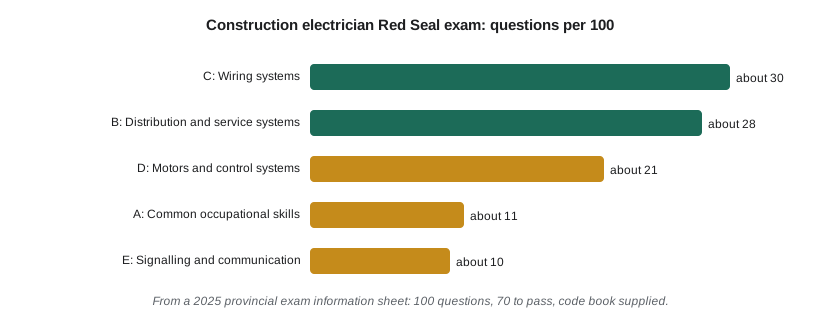
| Major work activity | Share of questions |
|---|---|
| A: Common occupational skills | about 11 in 100 |
| B: Generating, distribution and service systems | about 28 in 100 |
| C: Wiring systems | about 30 in 100 |
| D: Motors and control systems | about 21 in 100 |
| E: Signalling and communication systems | about 10 in 100 |
The weights show where to spend study time. More than half the questions come from distribution and service systems and wiring systems, which is where the code is used most heavily: service sizing, overcurrent protection, conductor selection, grounding and bonding, and wiring methods. Motors and controls account for about one question in five. Common occupational skills, such as safety, tools and documentation, and signalling and communication systems make up the rest.
Who writes this exam on the contractor path
Most people who apply for a contractor licence wrote this exam years earlier, at the end of their apprenticeship. Émilie wrote hers in 2021. For her, the exam is history; what matters now is keeping her code knowledge current as editions change. The exam matters most to three groups: apprentices finishing their training, like Logan; trade qualifiers who have worked in the trade without a New Brunswick apprenticeship; and electricians certified in a non-Red Seal jurisdiction who need the Red Seal endorsement. The provincial statistics for the year ending March 31, 2025 show why preparation matters: about 77 in 100 New Brunswick apprentices passed, compared with about 47 in 100 trade qualifiers.
Logan has two years to go, but he is already preparing. He keeps a log of the code rules he uses on each job, grouped by major work activity, so that by the time he writes the exam he has looked up most of the rules the exam draws on. He also asks Émilie to set him ten timed look-up questions each Friday, the same drill the core course in this program recommends.
Technique for a code-based multiple-choice exam
The Red Seal exam is a multiple-choice exam with the code available, so the skills are the same ones the core courses build: finding the right section quickly, reading a rule precisely and doing calculations accurately. A few habits help. Read the whole question before opening the code, and underline the facts that decide which rule applies: the voltage, the occupancy, the location, the conductor type. Answer the questions you can answer from memory first, and mark the look-up questions to return to. Never leave a question blank, because a guess has a chance of being right and a blank has none.
Calculation questions deserve a written method. Write the formula, substitute the values with their units, calculate and check that the answer is reasonable before choosing an option. Many wrong options in calculation questions are the results of common mistakes, such as forgetting the square root of three in a three-phase calculation or using the wrong demand factor, so landing on an option is not proof of a correct answer. Lesson 12 returns to time management and practice routines.
Worked problem
Planning time for a 100-question exam
Logan's practice exam has 100 questions and he allows himself 240 minutes, matching a common exam length. He wants to keep the last 20 minutes for review.
Show solution
- Time available for answering: 240 minus 20 gives 220 minutes.
- Average per question: 220 divided by 100 gives 2.2 minutes.
- He plans a first pass of about 60 minutes for the questions he can answer without the code.
- That leaves about 160 minutes for the look-up and calculation questions he marked.
Answer: About 2.2 minutes per question on average, with a fast first pass and most of the time kept for look-ups. He checks the actual time allowed when he books the real exam.
# Logan's practice exam pacing check
total_minutes = 240
review = 20
questions = 100
per_q = (total_minutes - review) / questions
print(f"average per question: {per_q:.1f} min")
checkpoints = [25, 50, 75, 100]
for q in checkpoints:
print(f"question {q:>3} by minute {q * per_q:5.0f}")average per question: 2.2 min question 25 by minute 55 question 50 by minute 110 question 75 by minute 165 question 100 by minute 220
How a contractor's knowledge is checked after licensing
Once the contractor licence is issued, nobody hands the contractor another exam paper. The checking happens on the job. Inspectors of Technical Inspection Services inspect installations, and where an installation does not comply, the regulation lets the inspector issue an order describing what must be corrected. For larger installations, plans sealed by a professional engineer must be approved by the Chief Electrical Inspector before work starts. Repeated infractions and negligence are grounds for suspending or revoking a licence. In practice, then, a contractor's code knowledge is tested every time an inspector arrives.
Inspection results also shape a contractor's reputation. General contractors notice which electrical subcontractors pass inspections the first time and which cause delays. Customers notice whether the electrician has to come back. Gilles tells Émilie that the best measure of a contractor's knowledge is the rate of first-time inspection passes, and he tracks it for every crew.
| Check | Who carries it out | What it tests |
|---|---|---|
| Red Seal exam | Skilled Trades NB (national exam) | Trade and code knowledge at certification |
| Plan approval for larger installations | Chief Electrical Inspector | Design and code compliance before work starts |
| Inspections and construction point call-ins | TIS inspectors | Code compliance on the job |
| Orders and re-inspections | TIS inspectors | Correction of deficiencies |
| Suspension or revocation | Chief Electrical Inspector | Repeated infractions, negligence and other grounds |
Keeping code knowledge current
Code editions change about every three years. The 2024 edition took effect in New Brunswick on March 15, 2026, and a candidate who learned the 2018 or 2021 edition has new and renumbered rules to learn. The core courses in this program cover the 2024 edition. Contractors should also watch for TIS bulletins, which explain how the province interprets particular rules, and for amendments to the New Brunswick modifications in Regulation 84-165. Lesson 5 covers the adoption and modifications, and lesson 11 covers ways to keep up to date.
Émilie plans to work through the core courses again as a refresher before she becomes Tantramar's qualified person, concentrating on the changes in the 2024 edition. She also signs up for the electrical bulletins TIS publishes and asks the company's suppliers to tell her when new product standards affect common installations.
Reading questions carefully
Many wrong answers on code-based exams come from misreading the question rather than from not knowing the rule. Watch for words that change the answer: minimum or maximum, shall or may, dwelling unit or other occupancy, indoor or outdoor, copper or aluminum, single-phase or three-phase. Watch also for negative questions that ask which statement is not true. A simple habit is to underline or note these words before looking at the options, then to check the chosen answer against them before moving on.
Calculation questions have their own traps. The question may give a value in one unit and expect an answer in another, or give more information than is needed, so that a candidate who uses every number goes wrong. Before calculating, list which values the rule actually needs. After calculating, ask whether the answer makes sense: a conductor size that would fit a whole building's service on a single lighting circuit, or a voltage drop larger than the supply voltage, means a mistake somewhere.
Worked problem
Spotting the deciding words
A practice question asks for the minimum size of a conductor for a circuit in a particular location, and gives the load, the length of the run, the voltage and the ambient temperature.
Show solution
- Note the deciding words first: minimum, the location, and the conductor material if stated.
- Decide which values the rule needs: the load for ampacity, the ambient temperature for correction, the length and voltage only if the question also asks about voltage drop.
- Look up the rule and table in the code supplied, apply the correction factor and choose the smallest size that meets the requirement.
- Check the answer against the deciding words: it must be the minimum that complies, not merely a size that works.
Answer: Noting the deciding words before opening the code keeps the calculation focused and avoids choosing a size that works but is not the minimum.
Logan practises this on every question in his weekly drill. He reads the question, writes the deciding words in the margin, then answers. At first it slows him down; after a month he is faster than before, because he spends less time going back to questions he misread.
After the certificate
Passing the Red Seal exam is a beginning, not an end. The certificate proves knowledge at one point in time, against one edition of the code. Within a few years the code changes, new equipment arrives and installation practices move on. Electricians who keep learning after certification find later code changes easy to absorb; those who stop find each new edition harder. For contractors, the difference shows up in inspection results, in the quality of estimates and in how confidently they answer customers' questions.
Émilie keeps the study habits she built for the exam. Once a month she picks a section of the code she has not used recently and reads it with a current job in mind. When a rule surprises her, she writes it on a card for the next Monday meeting, so that the whole crew learns from it.
Common mistakes
MistakeExpecting a separate written exam for the New Brunswick contractor licence.
InsteadThe written exam on the path is the Red Seal exam for the certificate of qualification; the contractor licence follows by application.
MistakeAssuming the exam always supplies the newest code edition.
InsteadThe edition supplied may lag behind; check which edition your exam uses.
MistakeLeaving hard questions blank.
InsteadMark them, return later and always enter an answer.
MistakeTreating a matching option as proof of a correct calculation.
InsteadWrong options are often the results of common mistakes; check the method and units.
Summary and key terms
- The construction electrician certification exam is the interprovincial Red Seal exam, administered in New Brunswick by Skilled Trades NB.
- A 2025 provincial information sheet describes 100 multiple-choice questions, a pass mark of 70 out of 100 and a supplied copy of the code.
- Wiring systems and distribution and service systems make up more than half of the questions.
- After licensing, code knowledge is checked through plan approval, inspections, orders and, in serious cases, suspension.
- Contractors must keep up with new code editions, the New Brunswick modifications and TIS bulletins.
- Red Seal Occupational Standard
- The national document describing the work and knowledge of a Red Seal trade, from which exams are built.
- Major work activity
- One of the broad areas of work into which the occupational standard and the exam are divided.
- Interprovincial exam
- A Red Seal exam that is the same across provinces and territories.
- Plan approval
- Review and approval of sealed electrical plans by the Chief Electrical Inspector for larger installations.
- First-time pass rate
- The share of inspections a contractor passes without corrections.
Practice problems
Work each problem on paper first, then reveal the answer to check.
Which exam leads to the construction electrician certificate of qualification?
Show answer
The interprovincial Red Seal exam.
What pass mark does a 2025 provincial information sheet give?
Show answer
70 out of 100.
Which two major work activities make up more than half of the questions?
Show answer
Wiring systems and generating, distribution and service systems.
When did the 2024 code edition take effect in New Brunswick?
Show answer
March 15, 2026.
Who approves sealed plans for larger installations?
Show answer
The Chief Electrical Inspector.
Lesson quiz · 5 questions
Score 60% or more to complete this lesson.
Create a free account to save your progress, take quizzes and earn a certificate.