
MELC-207 · Lesson 11 of 12 · 21 min
Renewal and continuing education
▶ Video coming soon A video version of this lesson is on the way.
A New Brunswick electrical licence is not issued once for life. Every licence under Regulation 84-165 expires one year after it is issued or renewed, so renewal is an annual task for every electrician and every contractor. The regulation itself is short on renewal requirements: an application and the prescribed fee. It does not set a continuing education requirement for renewing an electrician's or contractor's licence, although that could change and TIS can confirm the current position. Even without a formal requirement, the code changes, the regulation changes and the law around contracting changes, so a contractor who stops learning soon falls behind. This lesson covers renewal mechanics, what happens if a licence lapses, and practical ways to keep knowledge current.
The annual renewal
Section 13 of the regulation sets the term: a licence expires one year after the date it is issued or renewed, and it is renewed by submitting an application on the prescribed form with the prescribed charge. The province directs licence holders to renew technical licences online through Service New Brunswick, with separate renewal links for electricians and electrical contractors. The renewal fees are the same as the issue fees for the main licences: fifty dollars for the Class 3 electrician's licence and four hundred dollars for the Group 3 contractor licence, with lower fees for the renewal-only Group 2 licence and for sign installer renewals.
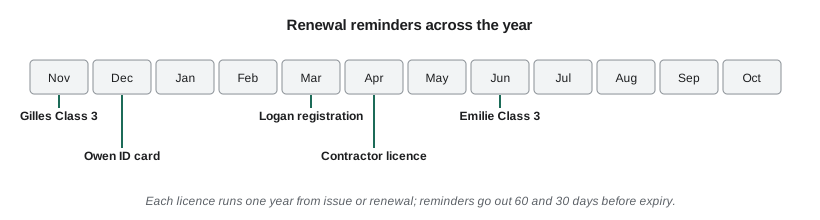
Because each licence runs from its own issue date, a company with several electricians has several renewal dates spread through the year, plus the contractor licence. Tantramar's calendar lists every licence and identification card with its expiry date, and Nicole sends each person a reminder 60 days and 30 days before expiry. The contractor licence gets the same treatment, with the added step of confirming that the qualified person's own licence is current.
| Licence | Term | Renewal fee in the regulation |
|---|---|---|
| Electrician, Class 3 | One year | 50 dollars |
| Electrician, Class 2 (renewal only) | One year | 50 dollars |
| Industrial electrician | One year | 50 dollars |
| Electrical contractor, Group 3 | One year | 400 dollars |
| Electrical contractor, Group 2 (renewal only) | One year | 250 dollars |
| Sign installer | One year | 50 dollars |
When a licence lapses
A licence that has expired is not a licence. An electrician whose licence has lapsed is no longer authorized under section 11 to make, repair or maintain installations, and an employer who lets them keep working risks breaching the rule against employing unauthorized people, one of the grounds for suspension in section 14. A contractor whose licence has lapsed cannot obtain wiring permits. And a business whose qualified person's licence has lapsed may no longer meet the condition on which its own licence rests.
The practical fix is simple: renew early and confirm that the renewal went through. If a licence has lapsed, stop the affected work, renew immediately and ask TIS whether anything else is needed. Do not let anyone work on the assumption that the renewal is in the mail.
Worked problem
Catching a lapse before it happens
In early November, the monthly check shows that Gilles's Class 3 licence expires on November 30. Gilles is the qualified person for Tantramar's contractor licence until Émilie takes over.
Show solution
- If Gilles's licence lapsed, he could not work as an electrician, and the company's contractor licence would rest on someone without a current licence.
- Nicole sends Gilles the renewal link on November 3 and asks him to renew that week.
- Gilles renews online through Service New Brunswick on November 5 and forwards the confirmation.
- Nicole updates the calendar with the new expiry date, November 30 of the next year, and files the confirmation.
Answer: The renewal is done three weeks early and recorded, and the company's licence never rests on a lapsed licence.
Keeping code knowledge current
The Canadian Electrical Code is revised about every three years, and New Brunswick adopts each new edition by amending the definition of Code in the regulation. The 2024 edition took effect on March 15, 2026. A contractor should study the changes in each new edition before it takes effect, update company standards and drawing notes, and brief the crews. Code change courses are offered by the code publisher, by industry associations and by colleges; the core courses in this program cover the 2024 edition and can be used as a refresher.
The New Brunswick modifications change too. When Regulation 2026-5 adopted the 2024 edition, it also replaced the dwelling unit receptacle rule. A contractor who reviewed only the national code changes would have missed that. The habit to build is to read the amending regulation itself whenever the province announces a change, and to check the TIS bulletins for transition guidance.
Keeping up with the rest of the law
Electrical rules are not the only ones that change. The Construction Remedies Act has been amended since it came into force, and the Construction Prompt Payment and Adjudication Act is waiting to be proclaimed. WorkSafeNB updates its policies regularly; its accident reporting policy, for example, was revised with an effective date of December 10, 2025. Tax thresholds, employment standards and insurance markets change as well. A contractor does not need to be an expert in all of these, but needs to know when something has changed and where to get advice.
Practical sources help. The province's online laws site shows the current version of each Act and regulation and lists amending regulations. WorkSafeNB publishes its policies and news. Industry associations, such as the provincial construction association and electrical contractors' associations, send members updates on legislation that affects them. Suppliers and manufacturers explain product changes. Tantramar's approach is to have one person responsible for each area: Émilie for the code and the electrical regulation, Nicole for business and tax rules, and Gilles, until he retires, for contracts and liens.
| Area | Where to check | Who watches it at Tantramar |
|---|---|---|
| Code edition and NB modifications | Regulation 84-165 on the laws site; TIS bulletins | Émilie |
| Permit and licence procedures | TIS, NB Power and Service New Brunswick pages | Nicole |
| Liens and prompt payment | Construction Remedies Act; proclamation notices | Gilles, then Émilie |
| Workplace safety and compensation | WorkSafeNB policies and news | Émilie and Nicole |
| Business, tax and insurance | CRA, Service New Brunswick, the broker | Nicole |
from datetime import date, timedelta

licences = {
    "Gilles Class 3": date(2026, 11, 30),
    "Owen ID card": date(2026, 12, 1),
    "Contractor licence": date(2027, 4, 15),
    "Emilie Class 3": date(2027, 6, 18),
}
today = date(2026, 11, 10)
for name, expires in sorted(licences.items(), key=lambda kv: kv[1]):
    for lead in (60, 30):
        remind = expires - timedelta(days=lead)
        status = "send now" if remind <= today < expires else ("past" if remind < today else "scheduled")
print(f"{name:<20} {lead}-day reminder {remind} {status}")Gilles Class 3 60-day reminder 2026-10-01 send now Gilles Class 3 30-day reminder 2026-10-31 send now Owen ID card 60-day reminder 2026-10-02 send now Owen ID card 30-day reminder 2026-11-01 send now Contractor licence 60-day reminder 2027-02-14 scheduled Contractor licence 30-day reminder 2027-03-16 scheduled Emilie Class 3 60-day reminder 2027-04-19 scheduled Emilie Class 3 30-day reminder 2027-05-19 scheduled
The reminder list shows which renewals need action today. Gilles's licence and Owen's card are both inside the 30-day window and get immediate attention.
A personal learning plan
Without a formal continuing education requirement, it helps to set a personal one. Émilie's plan for the year has four parts: a full review of the 2024 code changes before she becomes Tantramar's qualified person, a short course on workplace electrical safety, a seminar on the Construction Remedies Act offered by a law firm through the construction association, and a monthly hour reading TIS bulletins and WorkSafeNB updates. She records each activity, which keeps her on track and gives her something to show customers and insurers who ask how the company keeps its people current.
Records worth keeping
Renewal and continuing education are easier with good records. For each person, keep copies of the certificate of qualification, every licence or identification card with its dates, and a log of courses and training completed. For the company, keep the contractor licence and each renewal, the written certification naming the qualified person and any correspondence with TIS about it, insurance certificates, WorkSafeNB clearance or account records, and the business registration. Store them in one place, with digital copies backed up.
These records answer questions that come up unexpectedly: a general contractor asking for proof of licensing before a subcontract is signed, a customer asking whether the electrician who did their work was licensed at the time, an insurer asking about training after a claim, or TIS asking about the company's qualified person. Answering in minutes rather than days builds trust.
Worked problem
Answering a customer's question two years later
A homeowner in Dieppe asks Tantramar for confirmation that the electricians who wired her duplex in 2026 were licensed at the time, because she is selling the house.
Show solution
- Nicole finds the job file, which records the permit number, the electrician in charge and the crew.
- She checks the licence records for Émilie and Owen for the dates of the job: Émilie held a Class 3 licence and Owen an identification card at the time.
- She confirms that the final inspection was passed and finds the certificate of inspection.
- She sends the homeowner a letter summarizing the permit, the inspection and the licensing, with copies of the certificate.
Answer: The question is answered the same day from the company's records, and the homeowner can give the buyer clear documentation.
Good records also make the yearly renewals routine. When every expiry date is in one calendar and every document in one file, renewal becomes a ten-minute task instead of a scramble.
Planning for a change of edition
The next code edition will arrive about three years after the 2024 edition, and New Brunswick will adopt it by amending the definition of Code again. A contractor can prepare in advance: when the new edition is published, buy a copy, take a code change course, review company standards and typical designs against the changes, and watch for the amending regulation and any TIS transition guidance. Starting early avoids a rush when the new edition takes effect and jobs designed under the old one are still under way.
Building knowledge across the team
Keeping knowledge current is not only the qualified person's job. When the whole crew understands the main rules, fewer mistakes reach the inspector, and the qualified person spends less time correcting work. Short regular sessions work better than occasional long ones. Tantramar's Monday meeting includes ten minutes on one topic: a code change, a TIS bulletin, a safety lesson from an incident elsewhere or a question an inspector raised. The person who brings the topic changes each week, so apprentices take a turn too.
Logan's first topic was the replaced dwelling unit receptacle rule. Explaining it to the crew forced him to read the regulation carefully, and he caught a detail that Owen, trained in Nova Scotia, had missed. Teaching is one of the fastest ways to learn, and it helps the whole company stay current between formal courses.
Owen keeps a simple record of his own learning too: the date, the topic, how long he spent and where the material came from. Because his identification card is temporary, he also tracks his progress toward recognition of his Nova Scotia certificate, so that his Class 3 licence is in place before the card expires and the renewal cycle can begin on the same footing as everyone else's.
Common mistakes
MistakeAssuming a licence renews automatically.
InsteadLicences expire one year after issue or renewal; submit the renewal application and fee.
MistakeLetting an electrician work while their renewal is pending.
InsteadConfirm the renewal is complete; an expired licence is not authorization.
MistakeStudying only the national code changes.
InsteadAlso read the amending regulation for New Brunswick modifications, such as the replaced receptacle rule.
MistakeTreating the absence of a continuing education requirement as a reason to stop learning.
InsteadSet a personal learning plan and track it.
Summary and key terms
- Every licence under Regulation 84-165 expires one year after issue or renewal.
- Renewal is by application and fee, online through Service New Brunswick.
- A lapsed licence means the holder is not authorized, and can undermine a business's contractor licence.
- The regulation does not set a continuing education requirement for renewal; confirm the current position with TIS.
- Contractors should follow code editions, NB modifications, TIS bulletins and changes to lien, safety and business law.
- Licence term
- The one-year period after issue or renewal during which a licence is valid.
- Lapse
- Expiry of a licence that has not been renewed.
- Amending regulation
- A regulation that changes an existing one, such as Regulation 2026-5.
- Code change course
- Training on the differences between code editions.
- Learning plan
- A contractor's own schedule of courses and reading to keep knowledge current.
Practice problems
Work each problem on paper first, then reveal the answer to check.
How long is a New Brunswick electrical licence valid?
Show answer
One year after issue or renewal.
Where are technical licences renewed online?
Show answer
Through Service New Brunswick.
What is the renewal fee for a Group 3 contractor licence in the regulation?
Show answer
400 dollars.
What should a company do if an electrician's licence has lapsed?
Show answer
Stop the affected work, renew immediately and check with TIS.
Which amending regulation adopted the 2024 code edition?
Show answer
Regulation 2026-5.
Lesson quiz · 5 questions
Score 60% or more to complete this lesson.
Create a free account to save your progress, take quizzes and earn a certificate.