
MELC-207 · Lesson 6 of 12 · 22 min
Permits, inspections and the inspection authority
▶ Video coming soon A video version of this lesson is on the way.
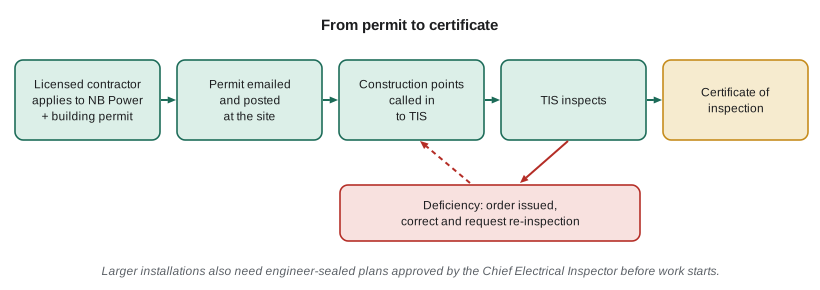
Most of a contractor's contact with the regulator happens through permits and inspections. A wiring permit tells the province that work is about to start, who is responsible for it and where it is. Inspections check that the work complies with the code and the regulation. In New Brunswick the two are handled by different organizations: NB Power processes wiring permit applications, and Technical Inspection Services carries out the inspections. This lesson follows a job through both, using the rules in sections 16 to 22 of Regulation 84-165 and the published procedures of NB Power and TIS.
Who may obtain a wiring permit
Section 16 of the regulation limits wiring permits to licensed contractors: holders of a Group 3 electrical contractor licence, holders of a renewed Group 2 licence, and sign installer contractors for sign work. NB Power's permit pages say the same thing in plain words: only licensed electrical contractors can apply for an electrical wiring permit. An electrician who holds a Class 3 licence but no contractor licence cannot obtain a permit in their own name, and neither can a homeowner or a general contractor without an electrical contractor licence.
A permit must be obtained before the electrical installation starts. Permits are not transferable from one contractor to another, so if Tantramar takes over a job started by another contractor, it needs its own permit for the work it does, and the history of the earlier permit should be sorted out with TIS. The permit must be posted at the site until all the inspections are complete, and for signs it is attached to the sign's service disconnect.
Exceptions and emergencies
The regulation recognizes a few situations where the general rule bends. Some minor work of the smallest installation type, done by an electrical contractor, is exempt from the permit requirement, and minor repairs to signs are exempt too. Emergency repairs can proceed before a permit is obtained, provided the contractor tags the work as the regulation requires and obtains the permit on the next working day. The regulation defines the installation types and the scope of each exemption; read it before relying on one, because a job that does not fit an exemption is unpermitted work.
Supply connections need attention too. The regulation requires a permit before a supply connection is made, and NB Power's permit pages explain that if a utility connection is needed and the customer is supplied by NB Power, the customer must hold a work order for the connection. Contractors often remind customers to call NB Power early, because the connection can hold up the end of a job even when the electrical work is finished.
Applying through NB Power
NB Power processes wiring permit applications through an online webform. Each application must include the electrical contractor or sign contractor section, identifying the licensed contractor. Payment can be made by pre-authorized debit, by credit card online, or by cheque or money order mailed to NB Power's Fredericton office. Approval and a copy of the permit are sent by email. The fee for each permit is set in section 23 of the regulation and scales with the size of the service, its voltage and, for larger installations, its rating in kilovolt-amperes.
NB Power's pages also point out a requirement that comes from outside the electrical rules: a building permit or a waiver from the local regional service commission, issued under the Community Planning Act. The application form lets the contractor upload the building permit or waiver, or send it by fax or mail. A contractor who forgets this step may find the electrical permit delayed.
Plan approval for larger installations
For larger installations of the largest installation type, section 17 of the regulation requires plans sealed by a professional engineer to be approved by the Chief Electrical Inspector before the work starts. The regulation sets the ratings above which plan approval applies. On a project that needs plan approval, the contractor should not start work until the approval is in hand, even if the permit application has been accepted, and should keep the approved plans on site for the inspector.
The Mountain Road clinic fit-out is small enough that it does not need plan approval, but the farm job near Sussex includes a new service for a grain dryer and fans that Émilie checks against the thresholds before ordering equipment. When she is unsure whether an installation crosses a threshold, she calls TIS and records the answer in the job file.
Construction point call-ins
Permit holders must tell TIS when a job reaches the stages at which inspection is required, often called construction points or call-ins. The province offers an online service for reporting progress on electrical projects, and NB Power's pages direct contractors to contact TIS to schedule the final inspection, quoting the permit number. The regulation provides that if a permit holder fails to notify the Chief Electrical Inspector at the required stages, an inspector may still inspect. In practice, failing to call in a rough-in before it is covered can mean opening walls later.
Tantramar's rule is that the crew leader calls in each construction point on the day it is reached and records the call in the job file with the date and permit number. For the Dieppe duplex that means a call-in when the rough wiring is complete and before insulation and drywall, and another when the job is finished.
| Stage | What the contractor does | Typical inspector action |
|---|---|---|
| Before work | Obtain the permit; obtain plan approval if required | Plan review for larger installations |
| Rough-in complete | Call in the construction point before covering | Inspects concealed wiring and boxes |
| Service ready | Call in; confirm the customer's work order for connection | Inspects the service and grounding |
| Job complete | Call in or book the final inspection with the permit number | Final inspection; certificate or order |
| Deficiency found | Correct the work and request re-inspection | Re-inspection; certificate when compliant |
What inspectors can do
Sections 5 to 8 of the regulation, together with section 5 of the Act, give inspectors broad powers. An inspector may enter and inspect installations and the business premises of licence holders at reasonable times, and owners must give reasonable access. Where an installation complies, the inspector may issue a certificate of inspection. Where it does not, the inspector may issue an order describing the deficiency and requiring correction; an order delivered by registered mail is deemed received on the fifth day after mailing. An installation found to be hazardous may be ordered disconnected, and unsafe equipment may be sealed; only an inspector may break the seal.
Two more rules affect owners as well as contractors. Any person may request an inspection in writing by paying the prescribed fee, which is useful when buying a property or settling a dispute. And a new public building may not be opened to the public until an inspector has approved the electrical installation, which puts the final inspection on the critical path for any public project.
Worked problem
Responding to an inspector's order
At the Dieppe duplex final inspection, the inspector finds that two kitchen receptacles do not meet the New Brunswick dwelling unit receptacle rule and issues an order by registered mail on June 2.
Show solution
- The order is deemed received on the fifth day after mailing: June 7.
- Émilie reads the order, checks the requirement in Regulation 84-165 and plans the correction.
- The crew corrects the receptacles, and Émilie requests re-inspection quoting the permit number.
- If Tantramar disagreed with the order, it could apply to the Chief Electrical Inspector to review it, and from there petition the Court of King's Bench.
Answer: The work is corrected, re-inspected and passed; the certificate is filed with the job records.
Fees and special permits
Section 23 sets the fees. Wiring permit fees depend on the service rating, voltage and, for large installations, the kilovolt-ampere rating. Special inspections are charged at three hundred dollars an hour with a three-hundred-dollar minimum, and four hundred dollars an hour outside regular hours. Carnivals and exhibitions need a special wiring permit, applied for at least ten days in advance, with a fee between 335 and 670 dollars. Because fees change, check the current regulation before quoting them to a customer.
import math

def special_inspection_fee(hours, overtime=False):
    # Regulation 84-165: 300 an hour, minimum 300; 400 an hour outside regular hours
    rate = 400 if overtime else 300
    return max(300, rate * hours)

for h, ot in [(0.5, False), (1.5, False), (2, True)]:
print(f"{h} h {'overtime' if ot else 'regular'}: {special_inspection_fee(h, ot):.0f} dollars")0.5 h regular: 300 dollars 1.5 h regular: 450 dollars 2 h overtime: 800 dollars
The function applies the minimum charge and the higher overtime rate. How part hours are billed in practice is a question for TIS; the function simply multiplies.
Working with the inspector
Inspectors are not adversaries. They are the people whose judgment decides whether a job passes, and a good working relationship saves time on every job. Be ready when the inspector arrives: the permit posted, the approved plans on site if there are any, the work accessible and the electrician in charge present or reachable. Answer questions directly. If you disagree with a finding, say so politely, explain your reading of the rule and listen to the inspector's. If you still disagree after the inspection, the regulation provides a route to the Chief Electrical Inspector, but most disagreements are settled on site once both sides have explained themselves.
Records help too. Photographs of concealed work before it is covered, taken with the permit number visible, can answer questions later if a wall has to stay closed. A note in the job file of each call-in, inspection and result shows the history of the job at a glance. Tantramar's crew leaders take photographs of every rough-in before calling it in, and the photographs are filed with the permit number.
Worked problem
Preparing for a final inspection
The Riverview charger installation is complete, and Émilie books the final inspection with TIS.
Show solution
- She checks that the permit is still posted at the electrical room.
- She makes sure every panel cover and junction box is accessible and that circuit directories are filled in.
- She confirms the charger load calculations and the load management settings are documented and available.
- She arranges to be on site at the booked time, with the job file and the rough-in photographs.
Answer: The inspector finds everything ready, the inspection is completed in one visit, and the certificate of inspection is issued.
When a job fails, treat it as information. Correct the deficiency, request re-inspection and ask what led to the mistake: a drawing that followed the national code rather than the New Brunswick modification, a crew member unfamiliar with a rule, or a rushed job. Fixing the cause prevents the same order on the next job.
Permits on multi-phase projects
Larger projects can raise permit questions that small jobs never do. A building finished in phases, a project where the electrical contractor changes partway through, or a renovation that grows into a major alteration may need more than one permit or a change to the original one. Because each permit is tied to its holder, contractors should sort these questions out with TIS before work starts on each phase, not after an inspector asks. A note in the job file of what was agreed avoids confusion if staff change.
On the clinic fit-out, the general contractor added a second floor of offices after Tantramar's permit was issued. Émilie called TIS to ask whether the added area needed a separate permit or a change to the existing one, followed the answer and recorded it in the job file with the date and the name of the person she spoke to.
Common mistakes
MistakeLetting a licensed electrician without a contractor licence apply for the permit.
InsteadOnly licensed electrical contractors may obtain wiring permits.
MistakeExpecting NB Power to inspect the work.
InsteadNB Power processes applications; book inspections with TIS.
MistakeCovering rough-in wiring before calling in the construction point.
InsteadCall in each required stage before it is concealed.
MistakeStarting a large installation once the permit is issued, before plan approval.
InsteadWhere section 17 applies, wait for the Chief Electrical Inspector's approval of the sealed plans.
Summary and key terms
- Only licensed electrical contractors may obtain wiring permits, which are required before work starts and are not transferable.
- NB Power processes permit applications online; a building permit or waiver from the regional service commission is also needed.
- Larger installations need engineer-sealed plans approved by the Chief Electrical Inspector.
- Contractors call in construction points to TIS and book final inspections with the permit number.
- Inspectors may issue certificates, orders, disconnection orders and seals; new public buildings need approval before opening.
- Wiring permit
- The permit a licensed contractor must obtain before starting an electrical installation.
- Construction point
- A stage of a job at which the permit holder must notify TIS so that the work can be inspected.
- Certificate of inspection
- The document an inspector issues for a compliant installation.
- Order
- An inspector's written direction to correct a deficiency.
- Demand inspection
- An inspection any person may request in writing by paying the prescribed fee.
Practice problems
Work each problem on paper first, then reveal the answer to check.
Who processes wiring permit applications in New Brunswick?
Show answer
NB Power, for licensed contractors.
Who carries out electrical inspections?
Show answer
Technical Inspection Services.
When is an order sent by registered mail deemed received?
Show answer
On the fifth day after mailing.
What other permit does NB Power ask contractors to provide with the application?
Show answer
A building permit or waiver from the local regional service commission.
How far in advance must a special permit for a carnival be applied for?
Show answer
At least ten days.
Lesson quiz · 5 questions
Score 60% or more to complete this lesson.
Create a free account to save your progress, take quizzes and earn a certificate.