
MELC-207 · Lesson 7 of 12 · 22 min
Duties and responsibilities of the Electrical Contractor Licence holder
▶ Video coming soon A video version of this lesson is on the way.
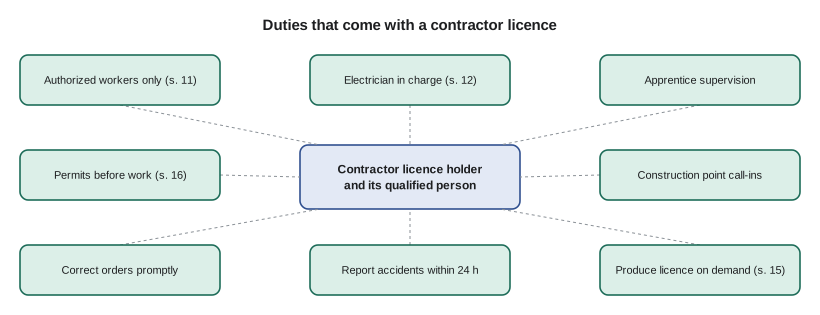
Holding an electrical contractor licence is not just a permission to obtain permits. It brings duties: to use only authorized people, to put a licensed electrician in charge of every job, to supervise apprentices properly, to obtain and post permits, to call in work for inspection, to correct deficiencies, to report accidents and to produce the licence when asked. For a business, those duties rest in practice on the qualified person whose licence the business relies on, as well as on the business itself. This lesson sets out the duties in the Act and Regulation 84-165 and shows how Tantramar organizes itself to meet them.
Using only authorized people
Section 11 of the regulation is the heart of the licensing system. It allows electrical installations to be made, repaired and maintained only by people the regulation authorizes: holders of an electrician's licence in Class 2 or Class 3, holders of an industrial electrician's licence within its scope, holders of identification cards, registered apprentices under supervision, and the narrow exceptions the regulation lists. It also forbids anyone to employ or permit an unauthorized person to do that work. Employing unauthorized people is one of the listed grounds for suspending or revoking a licence, so this duty falls squarely on the contractor.
In practice this means checking every worker's status before they start and keeping that check current. Licences expire every year and identification cards after at most six months, so a worker who was authorized in January may not be in July. Nicole keeps a list of every field worker with their licence class or apprentice registration, its number and its expiry date, and she reviews it on the first Monday of every month.
The electrician in charge
Section 12 requires all electrical construction to be directed by a licensed electrician who remains on the site or is readily available. A Class 3 licence qualifies its holder to be electrician in charge of any installation type; an older Class 2 licence qualifies its holder only for the smaller types. On each job, the contractor should name the electrician in charge, record the name in the job file and make sure that person really is directing the work, not merely lending a name.
Readily available is not defined by a distance or a response time, so contractors should apply it sensibly. An electrician in charge who is on another site across town and can return within the hour to answer questions may be readily available for simple work; one who is three hours away on a farm job probably is not, especially when apprentices are working. Tantramar names an electrician in charge for each job at the start of the week and does not change it without telling the crew.
Supervising apprentices
Registered apprentices may do electrical work only under the supervision of a licensed electrician. The apprenticeship program sets the details, including the ratio of journeypersons to apprentices and the level of supervision expected at each stage of training. The contractor's duty is to make sure the supervision is real: the supervising electrician is present or available as the program requires, the apprentice is given work appropriate to their level, and the apprentice's hours are recorded so that they progress through the program.
Logan works with Émilie on the Riverview chargers. He pulls the cables and makes up terminations under her direction, and she checks his work before it is energized. When she is called away to the clinic for an afternoon, Owen takes over the supervision and the change is noted in the job file. Logan's logbook records the tasks he did, which helps him and protects the company if there is ever a question about who did the work.
Qualified persons and minor repairs
Section 24 of the regulation recognizes that not every small electrical task needs a licensed electrician. A qualified person, defined in the regulation as someone familiar with the construction and operation of the apparatus and the hazards involved, may make minor repairs or replacements that do not change the circuits, provided the work meets the code and the regulation. WorkSafeNB's interpretation of the workplace safety rules on energized equipment refers back to the same definition. A maintenance worker who replaces a failed light fixture with an identical one may fall within this exception; one who adds a circuit does not.
Contractors meet this exception mostly when customers say their own staff can handle part of a job. Tantramar's policy is to explain the limits clearly and in writing: the customer's staff may do minor like-for-like replacements, but any new circuit, relocated device or change to the wiring is electrical installation work that Tantramar's licensed electricians must do under a permit.
| Situation | Who may do it | Permit? |
|---|---|---|
| Install new circuits in a duplex | Licensed electrician, or supervised apprentice | Yes, by a licensed contractor |
| Replace a failed fixture with an identical one, circuits unchanged | Qualified person under section 24 | Depends on the work; check the regulation |
| Emergency repair of a failed service at night | Licensed electrician | Tag the work; permit on the next working day |
| Move receptacles in a kitchen renovation | Licensed electrician, or supervised apprentice | Yes |
Reporting accidents and fires
Section 6 of the Act requires the owner or user of an electrical installation to notify the Chief Electrical Inspector within 24 hours of an accident or fire involving the installation that causes death, injury to a person or animal, or damage to property. Nobody may disturb the scene without an inspector's permission, except as needed to make it safe or prevent further harm. The Chief Electrical Inspector then investigates. Failing to report, or disturbing the scene, is among the more serious offences in the Act.
This duty is separate from the duties under workplace safety law covered in lesson 10, which require serious injuries to workers to be reported to WorkSafeNB immediately and an accident report to be filed within three days. An electrical accident on a job site can trigger both. Tantramar's incident procedure lists both calls on the same card so that the crew leader makes them together.
Worked problem
An electrical fire at a customer's building
During a service upgrade at the Sussex farm, a fault in an old panel starts a small fire that damages part of the wall before it is put out. Nobody is hurt.
Show solution
- The fire involved an electrical installation and damaged property, so the Act requires notice to the Chief Electrical Inspector within 24 hours.
- The duty falls on the owner or user, but the contractor is on site and should make sure the call is made and help the owner do it.
- The scene should be left as it is, apart from making it safe, until an inspector allows it to be disturbed.
- No worker was injured, so no WorkSafeNB injury report is needed, but the incident is recorded in the company's files.
Answer: Émilie helps the farm owner notify TIS the same day, makes the area safe without removing the damaged panel, and waits for the inspector's direction before starting repairs.
Licences on demand and other duties
Section 15 requires licence and identification card holders to produce them on demand by an inspector. Workers should carry their cards or have a digital copy available. The contractor should keep the company's licence number on vehicles, quotes and invoices, and have a copy of the licence available at the office. Section 14 lists the grounds on which the Chief Electrical Inspector may suspend or revoke a licence, including repeated infractions of the regulation, negligence, misrepresentation, employing unauthorized persons and failing to pay charges owed. A contractor who understands these grounds can see them as a list of things never to let happen.
Two further duties follow from earlier lessons. Permits must be obtained before work starts and posted until inspections are complete, and orders must be complied with. An inspector's order can be reviewed by the Chief Electrical Inspector, and the Chief Electrical Inspector's decisions can be appealed by petition to the Court of King's Bench, but until an order is changed the contractor must follow it.
from datetime import date

today = date(2026, 11, 10)
crew = [
    ("Emilie Cormier", "Class 3", date(2027, 6, 18)),
    ("Owen MacDonald", "ID card", date(2026, 12, 1)),
    ("Logan Arsenault", "Apprentice", date(2027, 3, 31)),
    ("Gilles LeBlanc", "Class 3", date(2026, 11, 30)),
]
for name, status, expires in crew:
    days = (expires - today).days
    flag = "EXPIRED" if days < 0 else ("renew soon" if days <= 30 else "ok")
print(f"{name:<16} {status:<10} expires {expires} {flag}")Emilie Cormier Class 3 expires 2027-06-18 ok Owen MacDonald ID card expires 2026-12-01 renew soon Logan Arsenault Apprentice expires 2027-03-31 ok Gilles LeBlanc Class 3 expires 2026-11-30 renew soon
The monthly check flags Gilles's licence and Owen's card as due within 30 days. Nicole sends reminders the same day, because an expired licence would make the work unauthorized.
Writing the duties into company procedures
Duties that live only in the regulation are easy to forget on a busy day. Duties written into short company procedures are much harder to miss. A small contractor does not need a thick manual; a few one-page procedures cover most of what matters: checking a new worker's authorization, naming the electrician in charge, supervising apprentices, obtaining and posting permits, calling in construction points, responding to orders, reporting incidents and renewing licences. Each procedure says who does what and where the record is kept.
Tantramar's procedures fit in a binder in the office and a folder on each crew leader's tablet. When a new worker starts, part of the orientation is reading them. When a rule changes, the procedure is updated and the change is mentioned at the Monday meeting. Gilles points out that inspectors notice when a company runs this way: the paperwork is in order, the electrician in charge is always reachable and orders are closed quickly.
Worked problem
A new worker's first day
Tantramar hires a second apprentice, who starts on a Monday.
Show solution
- Nicole confirms the apprentice's registration with Skilled Trades NB and records its number and expiry date.
- Gilles gives the safety orientation and has the apprentice read the company's procedures, and both sign the orientation record.
- The apprentice is assigned to Owen's crew, and Owen is recorded as the supervising electrician.
- The apprentice's logbook is started so that hours and tasks are recorded from the first day.
Answer: By the end of the first day the apprentice is authorized, oriented, supervised and recorded, which is exactly what the regulation and the apprenticeship program require.
Procedures also protect the company when something goes wrong. If an inspector or WorkSafeNB asks how the company ensures that only authorized people do electrical work, a written procedure and the records it produces are a clear answer.
A final point on duties: they do not stop when a job is finished. A contractor that learns of a defect in its own completed work has every reason, legal and practical, to correct it, and a contractor that notices a hazard in an installation it did not build should advise the owner in writing. Being known as the contractor who deals with problems openly is worth more than any single job.
Tantramar keeps a short log of every warranty call and every defect it corrects, with the cause. Reviewing the log once a year shows patterns, such as a supplier whose fittings keep failing or a task that crews often get wrong, and those patterns feed back into training and purchasing.
Common mistakes
MistakeAssuming a worker licensed last year is still authorized.
InsteadLicences expire yearly and identification cards within six months; check status regularly.
MistakeNaming an electrician in charge who is not actually directing the work.
InsteadThe electrician in charge must direct the work and be on site or readily available.
MistakeTreating a customer's request for its staff to add a circuit as a minor repair.
InsteadSection 24 covers only minor repairs or replacements that do not change the circuits.
MistakeReporting an electrical fire only to the insurer.
InsteadNotify the Chief Electrical Inspector within 24 hours and leave the scene undisturbed except to make it safe.
Summary and key terms
- Only authorized people may do electrical installation work, and contractors must not employ unauthorized people.
- Every job needs a licensed electrician in charge who is on site or readily available.
- Apprentices work under real supervision; qualified persons may do only minor repairs that leave circuits unchanged.
- Accidents and fires involving installations must be reported to the Chief Electrical Inspector within 24 hours.
- Licences must be produced on demand; section 14 lists the grounds for suspension or revocation.
- Authorized person
- A person the regulation allows to make, repair or maintain electrical installations.
- Electrician in charge
- The licensed electrician who directs the electrical construction on a job.
- Qualified person
- Someone familiar with the construction and operation of the apparatus and its hazards, who may make minor repairs that leave circuits unchanged.
- Suspension
- Temporary withdrawal of a licence by the Chief Electrical Inspector on grounds in section 14.
- Scene preservation
- The duty not to disturb the site of an electrical accident or fire without an inspector's permission.
Practice problems
Work each problem on paper first, then reveal the answer to check.
Which section of the regulation lists who may do electrical installation work?
Show answer
Section 11.
Where must the electrician in charge be?
Show answer
On the site or readily available.
Within what time must an electrical accident or fire be reported to the Chief Electrical Inspector?
Show answer
Within 24 hours.
What may a qualified person do under section 24?
Show answer
Minor repairs or replacements that do not change the circuits, in compliance with the code and regulation.
Name two grounds for suspending a licence.
Show answer
Any two of repeated infractions, negligence, misrepresentation, employing unauthorized persons or unpaid charges.
Lesson quiz · 5 questions
Score 60% or more to complete this lesson.
Create a free account to save your progress, take quizzes and earn a certificate.